Back Together, but Will You Be Happy? What Tends to Go Wrong the Second Time

“I’m a bit tired today. Let’s not talk right now.”
Your partner says it on the way home. It is a weekend not long after you got back together, and the two of you have been to the place you always used to go, chatting happily the whole way. You nod and say nothing. But that sentence is word for word what you heard so often in the months before the last breakup, and that night you lie awake while one question keeps coming back: Will we really be happy this time?
You are asking because this second chance means a lot to you, and because you are afraid of the same thing happening again.
Can you be happy after getting back together?
I think you can. But whether you will be happy does not depend on the fact that you are together again. It depends on whether the reason you broke up last time is still there.
That reason might have been one person always walking away in the middle of an argument. It might have been how rarely you were in touch, or wanting different things from the life ahead. It might also have been distance, work, or timing that simply did not line up. Getting back together brings back the feeling of being a couple. It does not make those reasons disappear on their own. From what I have seen, if nobody touches the reason, it tends to show up between you again one day, in a different form.
There is also something the second time has that the first time did not. When you first got together, neither of you knew where this relationship would get stuck. As I see it, this time you already hold the answer. You just have not looked at it together yet.
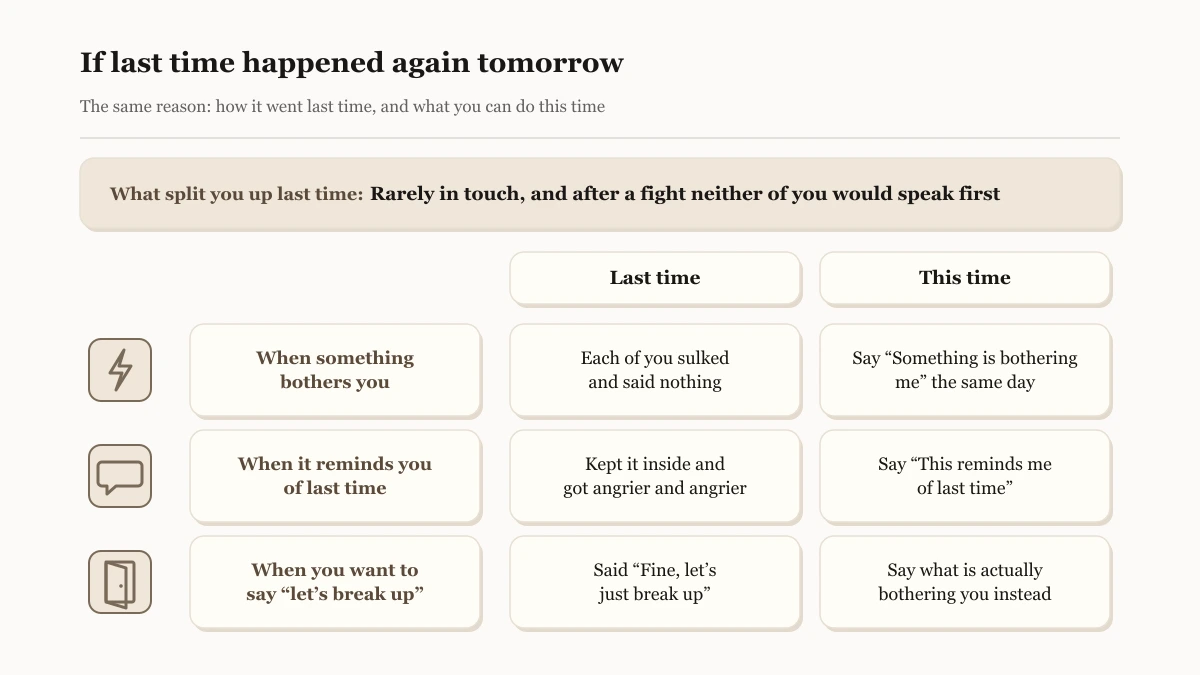
Here is a question to ask yourself: If the thing that split you up last time happened again tomorrow, what would the two of you do this time? How would it be different from last time?
If you can name something specific, such as “This time I would say something the same day it bothers me,” then you have already dealt with part of that reason. If your answer sounds a lot like last time, or if you cannot bring yourself to think it through, the reason is still there. That also means there is still something you can work on together.
The first few weeks: nobody wants to bring up last time
Right after you get back together, you are both extra careful. There are more messages than usual and more kind words, and every date is somewhere you were once happy. Whenever the conversation drifts toward why you broke up, one of you quickly steers it somewhere else.
My guess is that what you have just found again feels too precious. Neither of you wants to mention last time and risk losing the feeling that has only just come back. But leaving it unsaid does not make the reason any smaller. It only puts it somewhere neither of you can see.
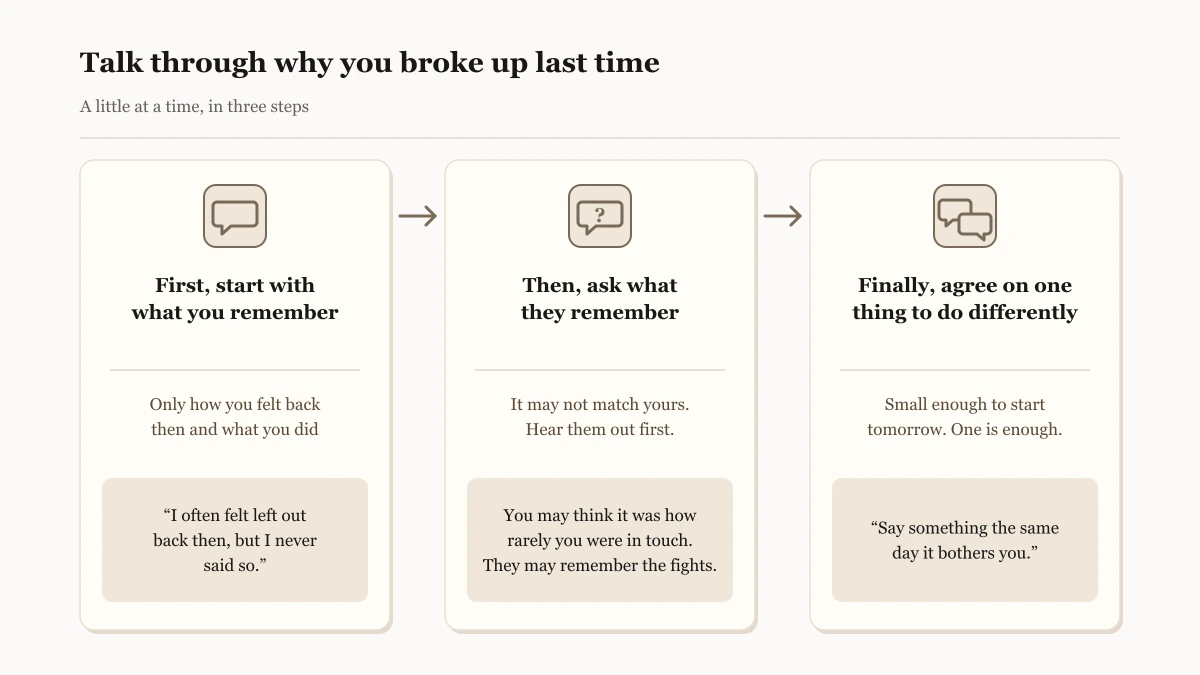
Wanting this time to go well is already a very good place to start. While you are still in these first weeks, I would suggest picking a moment when you are both relaxed and have nothing else to rush off to, and talking through why you broke up last time. You could open with: “I’d like to talk about why we broke up last time. I really value what we have now, and I don’t want us to split up over the same thing again.” If you cannot meet in person, a phone call or a video call works too. When you talk, these three steps can help.
Start with what you remember
Talk only about how you felt back then and what you yourself did. For example: “I remember I often felt left out back then, but I never said so. I just got colder and colder toward you.” Starting with your own side makes it easier for your partner to hear you, and easier for them to share theirs.
Ask what they remember
The reason they remember may not match yours. You might think it was how rarely you were in touch, while they remember that every time you were in touch, you ended up fighting. Hear them out before you explain or correct anything. Only when you put both memories together do you have the whole picture of last time.
Agree on one thing you will do differently
Choose something small enough to start tomorrow. It could be “Say something the same day it bothers you, instead of letting it pile up until it all comes out at once,” or “Keep at least one day of the weekend for each other.” One is enough. I think one thing you can actually do is more useful than a long list made all at once.
Talking it through once does not mean everything about last time is settled. What matters is that the two of you finally looked at it together.
The first fight: every argument makes you wonder if you are breaking up again
The first fight after getting back together is often about nothing big. Maybe someone forgot to return a call, or your weekend plans did not match. Halfway through, though, you are no longer thinking about the call. You are thinking: are we about to break up again?
Sometimes you skip the fight altogether and keep the hurt to yourself, because each fight feels like one less chance for this relationship.
From what I have seen, once a couple has broken up, breaking up becomes a road you both know is there. The first time around, that road felt far away. Now it seems to run right beside you, so even an ordinary argument starts to feel enormous. I believe arguments are a normal part of any relationship that lasts. What makes it hard to keep going is often the arguments that end with nothing made clear.
So what helps at this stage is taking the words “break up” out of your fights. At a time when you are not arguing and you are both in a decent mood, say it once: “From now on, when we fight, let’s not say we should break up. If something bothers us, let’s just say what it is.” Then, when you are deep in a fight and want to say “Fine, let’s just break up,” swap that sentence for whatever is actually bothering you right now. For example: “When you said that just now, I felt you didn’t respect me.” That way, what is left after the fight is something you can talk about, not a sentence you cannot take back.
When something feels like last time, you react more than the moment calls for
Your partner takes a little longer to reply. They spend the whole evening on their phone. Or they use the same tone of voice you used to hear before you broke up. At another time, none of this would bother you much. Now it makes your chest tighten right away, and what comes out of your mouth is harsher than usual.
It seems to me that in that moment, you are not only reacting to today. You are also reacting to the last time you remember. Your partner can only see what happened today, and does not know why your reaction is so strong. The two of you end up having two different arguments, where you are arguing about last time and they are arguing about today.
What helps here is saying out loud that you are thinking of last time: “This reminds me of last time, so I’m reacting more strongly than usual.” Saying it does not blame them, and it does not ask them to promise anything. It simply lets them know which part of your past you are reacting to. Once you have both calmed down a little, you can talk about how to handle this particular time.
It works the other way too. If your partner runs into something that feels like last time and reacts more than usual, you can ask, “Are you thinking about last time?” If they say yes, hold off on explaining today for now. Ask them which part of last time they are thinking of, for example: “Is it like back then, when I often replied late too?” Once they have finished, tell them what you will do this time, for example: “Something came up today and I couldn’t get away. Next time, I’ll send you a quick message first.” If they say no, go straight to talking about what happened today.
A few months in: the effort starts to slip
A few months go by and life settles back into normal. Right after you got back together, you both put real effort into a few things: letting each other know before heading out, saving weekends for each other, speaking up when something bothered you. Now, one by one, those things happen less often.
Then one day you notice that you seem to be back to the way things were before the breakup, and you start to wonder whether this time is turning out just like last time.
The way I see it, a lot of the effort right after getting back together runs on the fear of losing each other again. Once life feels steady, that fear shrinks, and the effort eases off along with it. This is common, and it does not mean you have stopped caring about each other.
At this stage, go back to the one thing you agreed to do differently when you talked through why you broke up, such as “Say something the same day it bothers you.” Check whether you are still doing it. If you are not, bring it up early, rather than waiting until it has piled up like last time and you cannot take it anymore. You could say: “We said we’d talk about it the same day if something bothered us, and lately we haven’t been doing that. I’d like us to try again.”
Once you have said it, if you are both willing to adjust, this relationship gains one more experience of the two of you fixing a problem together. If you say it and nothing changes, my judgment is that the reason really is still there. Then you have your answer, and you no longer have to keep guessing on your own. Either way, you will see more clearly what kind of relationship you are in than you would by keeping quiet and waiting for things to get better by themselves.
Wanting this time to last is a reasonable wish
In my view, the reason you keep feeling unsettled after getting back together is that the two of you have not yet looked at the reason you broke up together. As long as it is still sitting there, every fight and every moment that feels like last time will remind you of it.
Wanting this time to work, and not wanting to break up again, is a perfectly reasonable wish. Having broken up once does not mean you should ask for less.
Besides talking things through, now and then mention what the two of you are doing better than last time, like “I’ve noticed that this time, we actually talk things out after a fight.” Last time does not have to come up only when something has gone wrong. And you do not need to finish talking about why you broke up all in one day. A little at a time is enough.
You have already found your way back to each other once. You can take the days ahead one at a time, and today, start by saying one thing you have wanted to tell them, and saying it well.
Sources
Research and sources this essay draws on.
- “It’s complicated”: The continuity and correlates of cycling in cohabiting and marital relationshipsJournal of Social and Personal Relationships, 31(3), 410–430
- Charting changes in commitment: Trajectories of on-again/off-again relationshipsJournal of Social and Personal Relationships, 30(8), 1020–1044