Too Dependent on Your Partner? Healthy Love Starts With Rebuilding Your Own Life

By Saturday noon you have typed a message and deleted it again: What should I have for lunch? Your partner is away for the weekend on a work trip with colleagues, and they are busy. The first thing you did when you woke up was check whether they had texted. The second was realize that you could not think of anything to do for the next two days. You thought about asking a friend out, scrolled through your contacts, and realized it had been a long time since you had made plans with anyone. You cannot help asking yourself: Am I too dependent on them?
It is not really the two days apart that unsettle you. It is that the moment they are gone, your days seem to stop too, and there is no one to ask about lunch or about what to do with the afternoon. You have not had a fight. They have been good to you all along. Still, you have started to worry that carrying on like this is not good for either of you.
What too much dependence on a partner looks like
Start with dependence itself. Wanting to talk to your partner when you are sad, wanting to think through big decisions together, knowing at the end of a workday that someone is waiting to hear from you: all of that is dependence, and all of it is common in a good relationship. Being able to lean on someone with confidence shows that there is trust between you.
Too much dependence means that more and more of your moods, your decisions, your time and the people around you only work through your partner. When they are there, everything is fine. But when they are away, have not replied, or have not said yes yet, you do not know what to do next, and you wait for them to come back before anything moves.
In daily life it tends to show up like this:
- How quickly they reply sets your mood for the whole day. A fast answer and you relax; a late one and the unease starts.
- Whether it is what to eat, which jacket to wear, or whether to take a new job, you only dare to decide once they have said yes.
- On evenings or weekends without them, you are home with time on your hands and no idea what to do with it.
- Gradually, the people you keep in touch with and the things you do shrink down to the ones connected to them.
Two misunderstandings come up often. One says that a healthy relationship means doing everything yourself and not relying on your partner. That is not how it works. When you know there is somewhere to go back to if things go badly, you may actually find it easier to go out and try something new. The other says, “If they just spent more time with me, I would not feel so uneasy.” But it is not that simple. However much time they give you, there will be times they are not around, and what is empty then is your own days, not hours they can fill for you.
Why you have come to depend on your partner so much
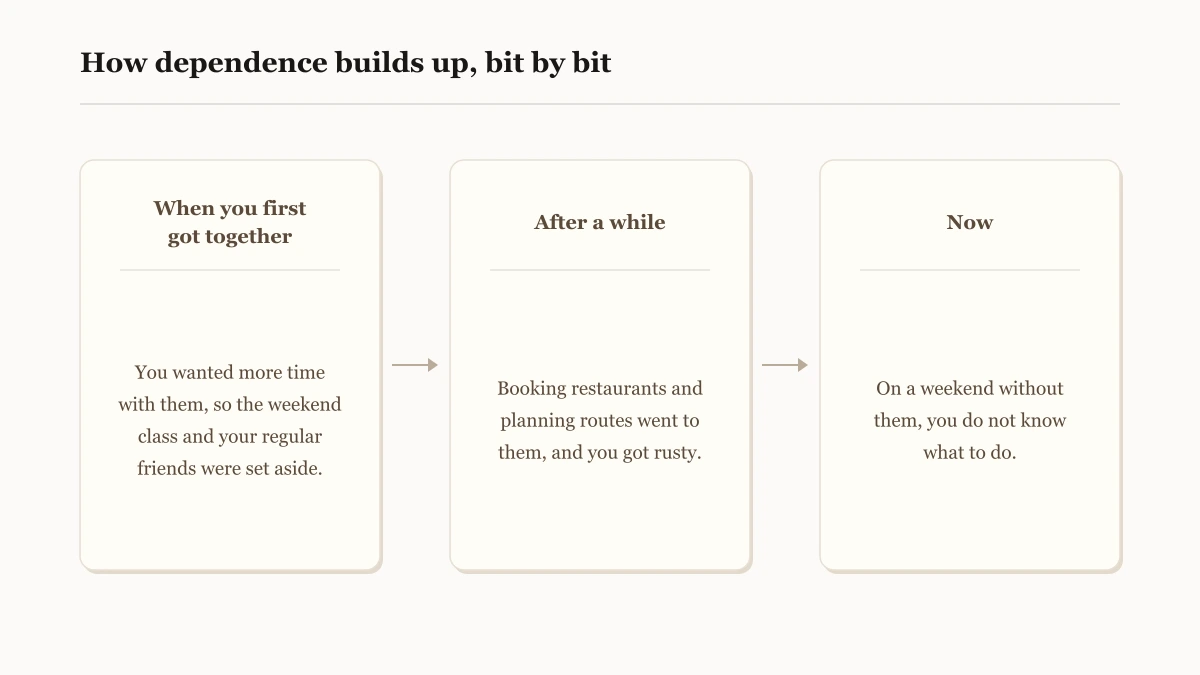
When you first got together, your time went to them and other things quietly stopped
In the early days, wanting to see them and talk a little longer is natural. The class you meant to take on weekends, the friends you used to see every month, the bookshop you liked to wander alone: each time, you set them aside because you wanted to be with your partner. There was no day when you decided to drop these things. You simply chose your partner every time. When you finally look back for them, they have been missing from your days for a long while.
The things they could do, you gradually stopped doing
Some tasks started out as things they were simply better at: booking restaurants, planning the route for a trip, phoning someone to sort out a hassle. Handing them over was quicker, and you were happy to let it go. Over time these became things only they did, and you got rusty. So the next time they are away, you are not even sure how to pick a restaurant, and you end up waiting for them to come back.
When you feel uneasy, they are the fastest way to feel safe
A bad day at work, a disagreement with your family, lying awake unable to sleep. Every time you feel uneasy, your first thought is to reach for them. A simple “it’ll be fine” from them makes you feel much better. Going to them is not a problem in itself. But if you only ever go to them, they become the one and only way you calm down. You get fewer and fewer chances to settle your feelings on your own, and eventually even a slightly late reply leaves you more anxious.
Your life got smaller, and they became all of it
Sometimes the growing dependence has little to do with either of you. Maybe you moved to a new city, changed jobs, or watched friends start families or get swamped, so the people who used to be around you had already thinned out. The person you see most and talk to most simply became your whole life.
Too much dependence rarely happens in a single day. It may build up bit by bit from places like these. So it is usually not something one person causes on their own. The way the two of you relate, along with how your life has changed over these years, are both part of it.
What can you do about being too dependent on your partner?
My suggestion: do not start by forcing yourself to reach out to them less. Start by rebuilding your own life, one piece at a time.
When you notice how much you depend on them, the first thing you may want to do is hold back: no texting, no asking their opinion, trying not to think about them. But holding back like that only means spending more energy on whether or not to contact them, and it does not make you feel any steadier. What makes dependence ease off over time is having other things in your days: a stretch of time you planned yourself, a choice you made on your own, one person besides them you can talk to. With those in place, you do not have to force yourself, and how often you reach for them may slowly settle at a level that feels right to you.
Rebuilding your own life does not mean pushing them away either. If you are sad, you can still go to them first. If a big decision comes up, you can still talk it through together. What needs to change is not reaching for them. It is reaching only for them. They are still the person closest to you; your mood for the whole day just does not have to rest entirely on one person.
Four places to start rebuilding your own life
Each step is small, and they all point the same way: making sure that, besides your partner, your days hold things you arranged for yourself.
Keep one stretch of time each week that is only yours
Choose a regular evening or half day and spend it on something that has nothing to do with them. It might be a class you have always wanted to take, an exhibition you go to alone, a swim or a run, or simply your usual café and a book you finally finish. What matters is that you planned this time yourself rather than waiting to see when they were free.
If they happen to ask to meet up that evening, you can reply: “I already have plans that night. Could we make it the next day instead?”
It may feel strange at first, maybe even a little hard to give up. After a few weeks, you might find yourself looking forward to it, and you might have a few more things to talk about when you see them.
Make small decisions yourself, then tell them
Start with the smallest things: what to have for lunch today, where to go this weekend, which jacket to wear out. Decide first and tell them after, instead of asking for their opinion first. For instance, instead of “What do you want to do this weekend?”, try:
I’m thinking of going hiking on Saturday. Want to come?
If they say yes, you go together. If they say they would rather rest at home, you go anyway. Once you have made plenty of small decisions on your own, you may find it easier, when a bigger one comes along, to work out what you want before talking it over with them.
Share one worry with someone else first
The next time something is on your mind, try telling one other person as well as your partner. It could be a family member, a friend you have not been in touch with for a long time, or a coworker you often have lunch with. It does not have to be anything deep. A small worry at work or a film that stayed on your mind for a long time will do.
If it has been a while since you reached out, you could open with: “I haven’t reached out to chat in ages. Something came up lately, and I’d like to hear what you think.” If they have time, take it slowly. If they are busy right then, find a time that suits you both. Over time, your worries will have more than one place to go, and when your partner is away or in a bad mood, there is still someone else you can talk to.
Tell them once about the change you want to make
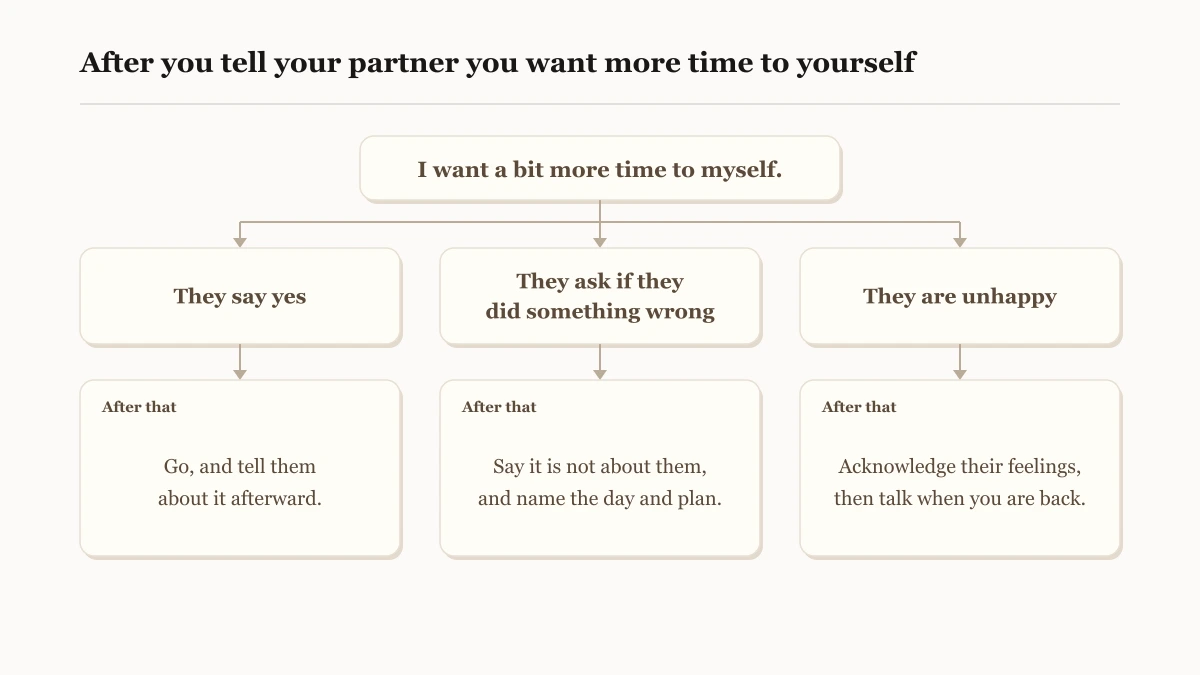
Once you start making your own plans, your partner may notice you are reaching out to them a little less. Rather than leave them guessing, tell them directly. Pick an evening when neither of you is in a hurry and say something like:
I want a bit more time to myself. It’s not that I’m unhappy with you. I just want to take better care of my own life.
There are three common ways this can go. If they say that sounds good, go ahead with your plans, and afterward tell them what you did that day so they can see your life too. If it feels unfamiliar to them and they ask whether they did something wrong, tell them again that it is not about them, and be specific about when and what, such as “I’m taking a class on Wednesday evenings, and everything else stays the same.” Knowing how big the change is may mean they do not have to guess as much.
And if they are unhappy and ask you not to go, start by acknowledging how they feel, then gently explain your plan for this time. For example: “I know you’re a bit upset. I’ve already made these plans, so let’s talk properly when I’m back. Whatever you’re worried about, tell me then.” When you get back, if they can name the worry, for example that you will see each other less, work out together how to arrange things. Your own time can be adjusted together, but it does not have to be cancelled altogether just because they are unhappy.
In healthy love, you both have your own lives and can both lean on each other
As I see it, healthy love does not mean two people who do not need each other. It means two people who can each lean on the other and who each have their own days to live. You can look at whether these three things are there between you.
The first is that when you reach for them, they show up. When you are sad or in trouble, they stop what they are doing and listen. The second is that when you go off to do the things you planned, they do not interfere. They do not keep asking where you are and who you are with, and they do not decide for you which things you should and should not do. The third is that they encourage you to go. When you say you want to learn something new or visit a place you have never been, what they say is “Go for it,” not “What about me?”
You can do these three things for them, too. When it is their turn to go off and do their own thing, be there if they need you, stay out of it, and encourage them to go ahead. When you both do this, leaning on each other no longer comes from having nobody else. It comes from both of you wanting to share your days with each other.
When love rests on one person, both people get tired
When your days have only one source, every move your partner makes starts to carry a lot of weight. A late reply can leave you unable to settle all afternoon. If they want an evening on their own, you may take it to mean they care about you less. And the other way around, your happiness and unhappiness all land on them alone, so coming home a little late or forgetting something small can turn into a reason you are hurt. In a relationship like this, it is not only the person depending who gets tired. The person being depended on may find it hard to truly relax as well.
That is why healthy love starts with rebuilding your own life. With time you arranged yourself, decisions you made yourself, and people of your own to talk to, your mood is less likely to rise and fall with them alone. When you lean on them, it is because you want to share something, not because there is nowhere else for you to go. And the person they are keeping company is someone with a life of their own, so they do not have to carry all of you by themselves.
You can keep depending on them, and you can keep missing them. The next weekend they are away, you will still check your phone for their messages, and you will also have a Saturday of your own to live.
Sources
Research and sources this essay draws on.
- The dependency paradox in close relationships: Accepting dependence promotes independenceJournal of Personality and Social Psychology, 92(2), 268–285
- Relationship influences on exploration in adulthood: The characteristics and function of a secure baseJournal of Personality and Social Psychology, 98(1), 57–76
- Navigating personal and relational concerns: The quest for equilibriumJournal of Personality and Social Psychology, 95(1), 94–110