Does an Avoidant Partner Really Not Love You? Understanding Their Behavior Through Attachment Patterns

The message said they wanted a few days to themselves.
You stared at it for a long time. Only the day before, the two of you had walked until late, and they had told you about something at work they had been carrying around for a long time. It felt like the two of you had grown a little closer again. Now their replies were short, and when you asked about seeing each other that evening, this was the answer. One question kept coming back: “Do they actually love me less than I thought?”
That question makes sense. Yesterday they were right there, and today they feel far away. Maybe you have already read about “avoidant attachment” online and recognized your partner in every line. Recognizing them did not answer the question, though.
What avoidant attachment is
Attachment theory looks at how adults deal with two things in close relationships: needing other people, and being needed by them. Someone with an avoidant attachment style tends to feel uneasy when things get too close. Leaning on others does not come naturally to them, and neither does having others lean on them. Under stress, or when a relationship suddenly gets more intimate, they tend to handle it alone. They step back a little, and they keep most of what they feel to themselves.
Where does that come from? Here is how I see it. It may be that when they needed someone as a child, the message they got was “deal with it yourself.” It may be that the adults around them did not know what to do with sadness, or that their family was simply used to not saying much of anything. A child in that situation slowly learns that putting needs away and doing everything alone leads to fewer disappointments. That habit grows up with them and follows them into love, so the moment that calls for closeness is the moment their first instinct is to take a step back.
People often read avoidant attachment as “has no feelings” or “is just cold by nature.” It is neither. The term describes how someone reacts when closeness arrives, and that is a separate matter from whether they feel anything. As I see it, it is not a fixed label either: in a steady relationship where no one is pushing, a person like this can slowly become more comfortable with closeness. However closely the online descriptions match your partner, they are only one way to understand them. What they actually do between the two of you tells you more.
The days they pull away
You probably know what it looks like. The texts get short. When you suggest meeting up, they say they have been busy. When you try to talk about how things are between you, they change the subject to what to have for dinner.
The timing is the hardest part. It tends to come right after you have been closest: a lovely weekend, a night of talking about real things, or the moment you finally worked up the courage to say “I really like where we are right now.”
Why then, of all times? My read is this: for someone with avoidant attachment, being very close is a kind of pressure in itself, and pulling away is often how they let themselves loosen up again, not necessarily a sign that they are leaving you. From what I have seen, the stronger the closeness, the more there is for them to process inside, and talking it through is not their habit. What they tend to do instead is put some distance in place and come back once things feel quieter.
So from where you stand, it looks like they suddenly do not want to deal with you. From where they stand, they may just need some time to settle the closeness that just happened. The distance you feel is real, and so is the hurt. What the distance means is not necessarily what you fear most.
When you want to pull them back
When they go quiet, wanting to do something is natural. Maybe you sent a few more messages than usual, trying to find out what was going on. Maybe you suggested sitting down to talk it all through. Wanting to understand and wanting to know the two of you are okay is what anyone who cares about a relationship would feel.
With an avoidant pattern, though, those words often make them go quieter still. My guess is that “Can we talk?” sounds to them like one more request to come closer, at the very moment they need some room. So the replies get even shorter, or stop for a while, and you end up with less than you had and more worry than before.
You want to talk things out so you can feel settled. They want a little distance so they can feel settled. You are both after the same thing by opposite routes. This belongs to both of you; it is not yours alone to adjust.
When they come back: does an avoidant partner really not love you?
I think avoidant attachment on its own does not mean they do not love you. But the pulling away by itself cannot tell you which it is.
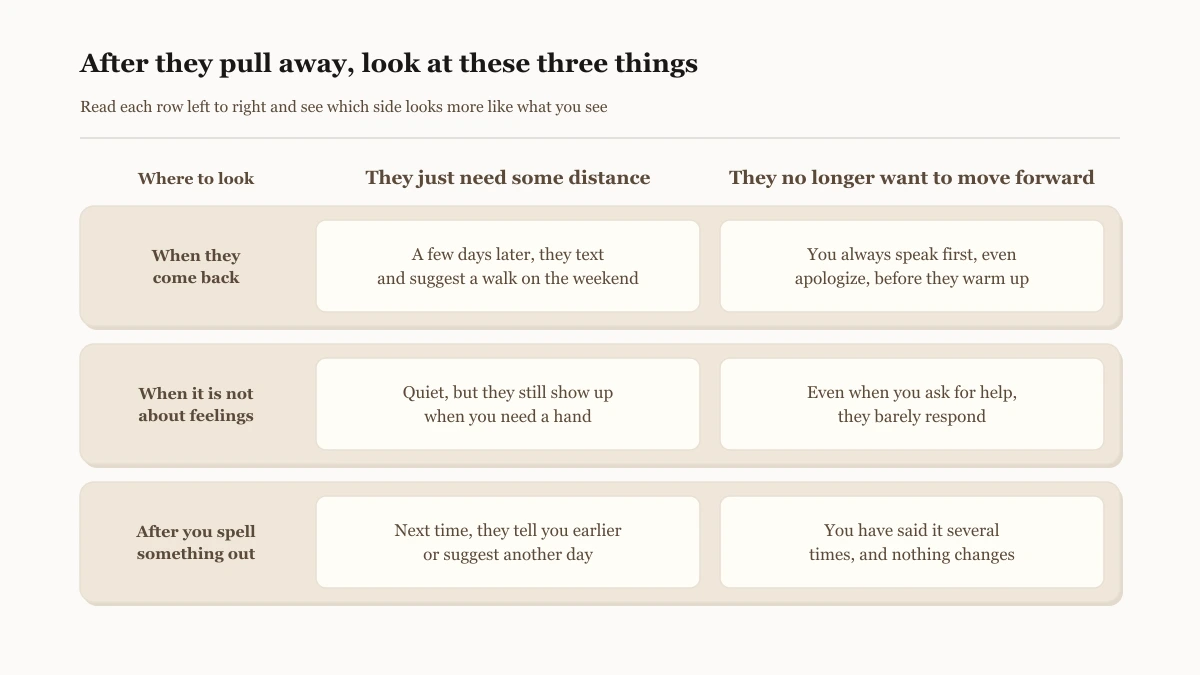
A few days later, they usually return, often with an ordinary text asking whether you have eaten, as if nothing happened in between. They may just need some distance, which is why they come back after a few days, or they may no longer want to move forward with you. From the outside the two look alike, so the difference has to be found in what happens after they return. Three things are worth looking at.
First, when they come back, do they come to you on their own? If they just need some distance, they are usually the one who reaches out after a few days. They send a message, suggest a walk on the weekend, or ask how the past few days have been, even if they never explain the silence. If they no longer want to move forward, many days can pass and they will not be the one to reach out. You always have to speak first and find something to talk about, and sometimes you are the one who apologizes before they warm up again. If it goes that way every time, I would see it as something different: the silence has become a way of getting you to give in first, and that is not the same as needing some distance.
Second, outside of talking about feelings, do they still look after you? From what I have seen, people with avoidant attachment say less and do more. They may rarely say “I love you,” yet they remember which place you said you liked. They show up when you need a hand, and they follow through on what they promised. If they say very little for a few days but keep doing these small things, I would take it that they just need some distance. But if they not only avoid talking about feelings but barely respond when you say you feel unwell or ask them for a favor, it is more than needing distance.
Third, after you have spelled something out, are they adjusting? Say you once told them you would rather plans not be canceled at the last minute. If they just need some distance, they may still want to cancel next time, but they tell you earlier or suggest another day. Imperfect as it is, you can see them trying. If they no longer want to move forward, you have said it several times and nothing has changed.
If you can see all three, here is how I would read it: they are staying in the relationship in the way they know how, and the days of distance look more like catching their breath. If all three are rare and have been for a long time, though, I think that may be more than an attachment pattern can explain. It looks more like they do not want to move forward with you. That is a hard answer to accept. What you have seen is real, and you can trust your own eyes.
When avoidant attachment becomes an excuse
There is one more situation worth naming. Some people keep “I’m just avoidant” ready at hand and use it as a reason not to take the relationship seriously. You say you wish they would respond a bit more, and they answer, “This is how I am. You knew that.” You want to talk about where the two of you stand, and they say, “I’m avoidant. Pushing me won’t help.” In their mouth, the word is not an explanation. It is a way to end the conversation.
To tell whether they are using it as an excuse, there are three things to watch for. First, when they bring up the word, are they explaining themselves, or telling you to stop asking? Someone actually facing the habit says something like “I know this is hard on you.” Someone using it as an excuse says the word, and the topic is closed. Second, does the distance only show up when something is being asked of them? If they are eager to see you when they want to, but the moment you need company or an answer they say they need space, that distance has been chosen. Third, have they ever once said “Let me try”? If it is always you who has to be more understanding, wait longer, and ask for less, while they do nothing at all, the word has become their reason not to change.
If this is what you are dealing with, start by stepping back from it: no more reading up on it for them, no more finding reasons on their behalf. Taking a relationship seriously does not require fixing an attachment pattern first. You can say what you need, clearly, once: “I know you need space, and I’m willing to give it. But I need to know you want to look after this relationship too, and that it isn’t always just me adjusting.” Then watch what they do next. If they start to change even a little, however slowly, keep watching the same things: whether they reach out when they come back, whether they look after you, whether they adjust. If they say “This is how I am, you have to accept it” one more time, then for them the word is only an excuse. At that point, you can turn your attention back to yourself and think honestly about whether what this relationship gives you now is what you want.
The next time they pull away
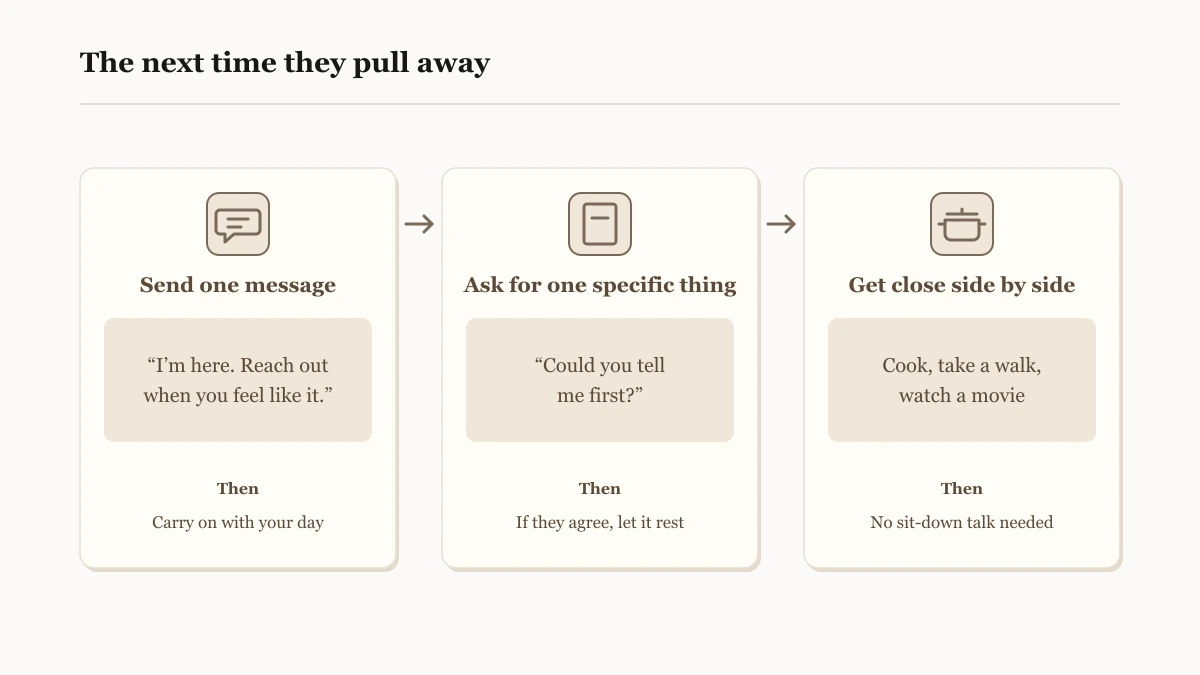
You are already trying to understand someone who works very differently from you. Here are three things you can do on your own.
Send one message that says you are here, then go back to your own days
When they say they want some time alone, you can send just this: “Okay, I know you want a few days to yourself. I’m here. Reach out whenever you feel like talking.” It does not ask why, and it does not ask for a date. All it tells them is that you are not angry and you are not going anywhere. If they reply with “okay” or a sticker, let the conversation rest there. If they do not reply, there is no need to send a second one.
Once it is sent, turn to the things already on your plate, get in touch with someone you have not talked to in a while, or go somewhere you have been meaning to go. It helps to make this the same every time: they step back, you send that one message, and you carry on with your life. That way you are not stuck watching your phone through the quiet days.
Swap “We need to talk” for one specific thing
Wait until they are back and things feel relaxed, and then say what you need. Leave out “our relationship” and “why do you always do this,” and name one thing they could do next time, for example: “Next time you need a few days alone, could you tell me first? If you let me know, I won’t be left wondering.”
If they say yes, let it rest there. This is not the moment to bring up everything else. When they do tell you first the next time, you might answer, “When you tell me first, I feel a lot calmer.”
If they say yes but still do not tell you the next time, bring it up again once they are back, in the same tone as before, about this one thing only, without dragging up the last time.
If they would rather not answer, or they say “You’re overthinking it,” you can say, “That’s okay. Think about it. I just want you to know this matters to me.” Then drop the subject for now. If they brush it off like this every time you bring it up, it means you have already said it clearly and they still do not intend to change.
Put closeness into doing things together
Here is how I see it: sitting face to face to talk about feelings is when someone with avoidant attachment tends to tense up most, while doing something side by side, like cooking a meal, going for a walk, or watching a movie, lets them relax. So when you want to feel close, suggest more of these. I believe that some things they usually find hard to say come out more easily while chopping vegetables or walking, without a special time set aside for a talk.
What you are asking for is reasonable. Fitting their rhythm means giving them some room, not shrinking your own needs. And if you have tried all of this and they still never pick up anything you have raised when they come back, then you have an answer in hand. Whether to keep waiting is something you can take your time with.
Two people who come close in different ways
They pull away again and again, and I believe the reason is mostly not that you did something wrong. They learned early on to look after themselves with distance, and in love that habit shows up most at exactly the moment two people are closest.
Wanting your messages answered, wanting the two of you to have things to talk about, wanting someone beside you when you are sad: this is what a relationship is supposed to have. As I see it, a person who needs distance and a person who needs closeness can still be good together, as long as both are willing to move toward the middle. By trying to understand them first, you are already moving toward the middle, and the closeness you want does not have to shrink just because they need more distance.
On the days they need distance, if it hurts, let it hurt for a while instead of rushing to convince yourself you are fine. If there is someone you trust, tell them how you feel, so you are not working through it alone. Whether to stay or leave can wait until you feel surer. When they reappear, take your time to see whether the two of you can find a distance that feels right for both.
Sources
Research and sources this essay draws on.
- Benefits of positive relationship experiences for avoidantly attached individualsJournal of Personality and Social Psychology, 113(4), 568–588
- Attachment theory and affect regulation: The dynamics, development, and cognitive consequences of attachment-related strategiesMotivation and Emotion, 27(2), 77–102