What Is Breadcrumbing? The Signs, and How to Stop Mistaking Crumbs for Love

For days now, the last thing in your chat with them has been a sticker. It was their answer to the “Thanks for spending today with me” you sent once you got home, after a dinner that ended with them walking you to the corner and saying, “I had a really good time today.” You’d felt the same way all night. You think back to how they smiled that night and wonder: “They were clearly happy that day. Does that count as liking me?”
What keeps you holding on is how good those few hours together were, so good it’s hard to believe it wasn’t affection. Then you part ways and everything between you goes back to nothing, so you keep replaying the day, hoping to find the answer inside it.
What is breadcrumbing?
Breadcrumbing is when someone gives you small, occasional pieces of attention, maybe a message, a like, or a short meetup, enough that you can’t quite let go, while the two of you never move forward and they have no plans to settle what you are to each other. The name comes from breadcrumbs: tiny pieces that keep showing up and are never enough.
An ordinary situationship changes over time. Either you talk more and see each other more until you end up together, or it slowly fades and you both go back to your own lives. This kind stays stuck at “a little.” They don’t come closer, and they don’t really leave.
Here is how I see it: there are two reasons it’s so hard to let go. First, everything they give is small, so you’re the one who fills in what it means. “What are you up to?” could mean they miss you or that they’re bored. Standing a little closer to you when you meet could be affection, or just a good mood that day. Someone who cares about them tends to fill in the version they’re hoping for. Second, it never fully ends. They haven’t said no, and they haven’t disappeared, so there is never a clear moment to let go, and stepping away always seems a little too early.
Three beliefs are especially likely to keep people here. One is “They reply, and they see me, so they must care.” Not quite. Replying and meeting up only show they aren’t ignoring you. From what I’ve seen, someone who cares about you starts setting up the next time you’ll meet and adds more things the two of you do together, rather than staying at chatting now and then and meeting now and then. Another is “They’re just busy, or slow to open up.” But the way I see it, busy people tell you which day is better, and slow people still move forward, just slowly; if months go by and not one of your meetups was planned ahead of time, I think it’s more than slow. The last is “At least they haven’t left.” Yet not leaving isn’t the same as staying. They haven’t gone, you haven’t gotten any closer, and the one waiting this whole time has been you.
Six signs of breadcrumbing
Some of these happen in your messages and some happen when you’re together. Each one starts with something they say or do, so you can hold it up against the way things have been between you lately.
They show up when you go quiet
You’ve gone a while without reaching out, and then this arrives: “Long time no talk, how have you been? You’ve totally disappeared.” It checks in on you and points out that you’ve been scarce lately. What’s missing is the everyday version of them. On the days you reach out first, they’re slow to answer, and they only warm up once you go quiet. From what I’ve seen, a message like this often lands right when you’re about to stop waiting, so you answer, and the “I’m done waiting” you decided on a few days ago gets set aside.
Plans never get past “someday”
Halfway through a meal they say, “Someday I’ll take you to the beach.” A few days later a text says, “We should totally go eat there!” These sound like invitations, but there’s no day attached. When you reply, “Sure, when?” they start talking about something else. The way I see it, saying “someday” doesn’t require them to set aside any time, and you’ve already started looking forward to it. Over time the list of somedays you remember grows longer, and the number that actually happen doesn’t grow at all.
They only see you when it happens to be on their way
“I’m near your place, want to grab a coffee? Just half an hour.” You meet, and the conversation is fun, but the time and the place were whatever suited them in that moment, and so was when it ended. You dropped what you were doing to go out. For you that half hour was something you made room for; for them it was on the way. So you’ve met plenty of times, and you’d still have a hard time naming one meetup they planned in advance.
They get close, and then say nothing
Walking down the street, they take your hand for a moment, then let go at the crosswalk. Neither of you mentions it afterward. The gesture had closeness in it, enough to keep your heart racing all night, but nothing was said after it. The next time you meet, they act the same as always, and you can’t tell whether it’s okay to bring it up. Eventually you’ve gone over those few seconds many times, because they were the closest the two of you have come to being a couple.
They watch your stories faster than they answer your texts
You post a story, and within minutes their heart shows up. Meanwhile the question you asked them yesterday still has no answer. They are paying attention, and they probably know most of what’s going on in your life, but they rarely start a conversation of their own. You often learn how they’re doing or what’s on their mind from their posts. So you know they’re around, and you still couldn’t say how close you are.
Asking what you are makes them go vague
Walking out of a restaurant, you ask, “Are we kind of together?” They smile and say, “Let’s not think that far ahead.” The next morning their good-morning text arrives as usual, as if you never asked. They keep texting and keep meeting up with you as usual, and they haven’t given you an answer. My take is that what makes this kind of reply so hard is that it isn’t a no, so asking again feels awkward, and you can’t tell whether you should go. Little by little, you stop asking.
You remember every one of their words and gestures this clearly because you take this connection seriously. Here is how I see it: once you’ve seen them clearly, it gets easier to know where to put your attention next.
Stop mistaking half-effort for love: it comes down to what it costs them
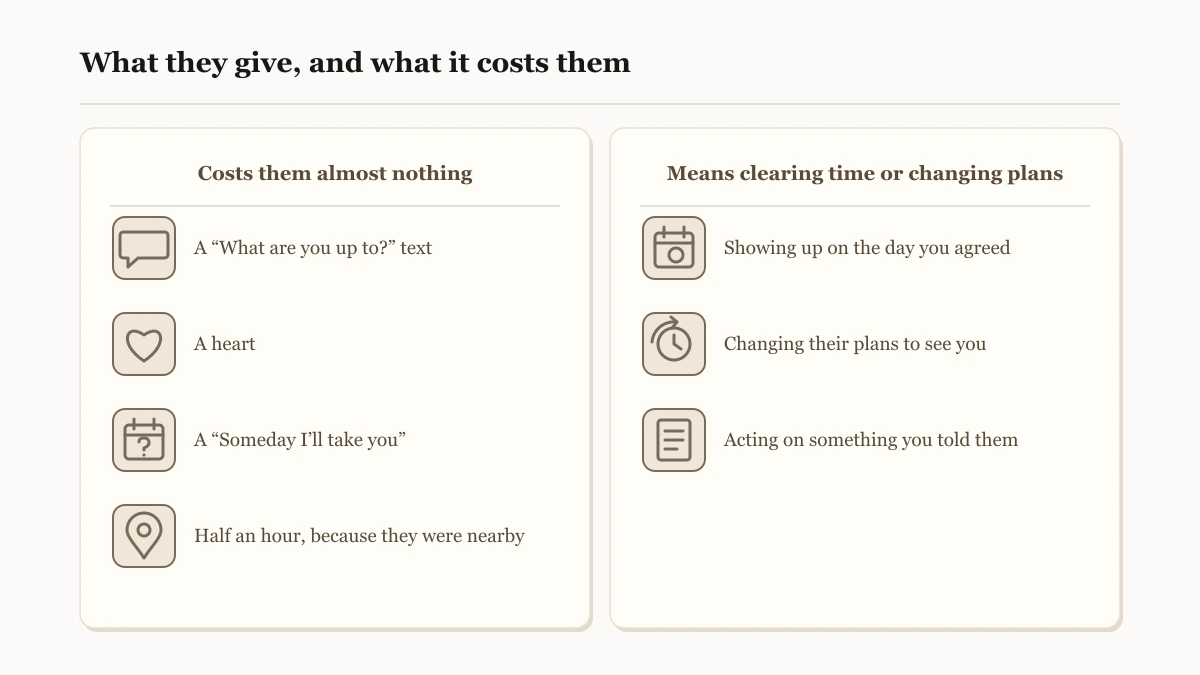
In my view, the difference is this: half-effort is whatever they can give without it costing them anything, and love costs a little time and changes a few existing plans.
Put the six signs side by side and everything they give is light. “You’ve totally disappeared.” “Someday I’ll take you to the beach.” A half hour on their way somewhere. A hand let go almost as soon as it was taken. A heart. “Let’s not think that far ahead.” The words take seconds, the on-the-way meetup doesn’t make them change a single plan, and afterward they’re back to their own day. My read is that people who want to be with you give these things too, but not only these. They clear an afternoon to see you, move something they’d planned so they can make it, and remember a place you said you wanted to go and then actually take you. Some people really are bad at texting: slow, brief, and then fully present in person and reliable about what they promise. That’s why what I look at is whether they spend time on you somewhere else, not how fast they reply. In my view, someone who answers slowly but shows up on time, every time, is not giving you half-effort.
Here’s a question to think about: “In the past month, of the things they did for you, which ones required them to clear time or change plans they already had?” It might be that they actually came on the day you agreed. It might be that something came up and they offered another day themselves. It might be that they set other things aside to stay with you through a hard night. If you can think of a few, I’d keep watching a while longer; they may simply move slowly. If you can’t think of one, I’d say that what you received this past month was mostly half-effort.
The next time they say “someday”
You don’t have to wait for them to figure things out on their own. Two things can start the next time they say “someday” or ask you to come out.
Answer their “someday” with a real day
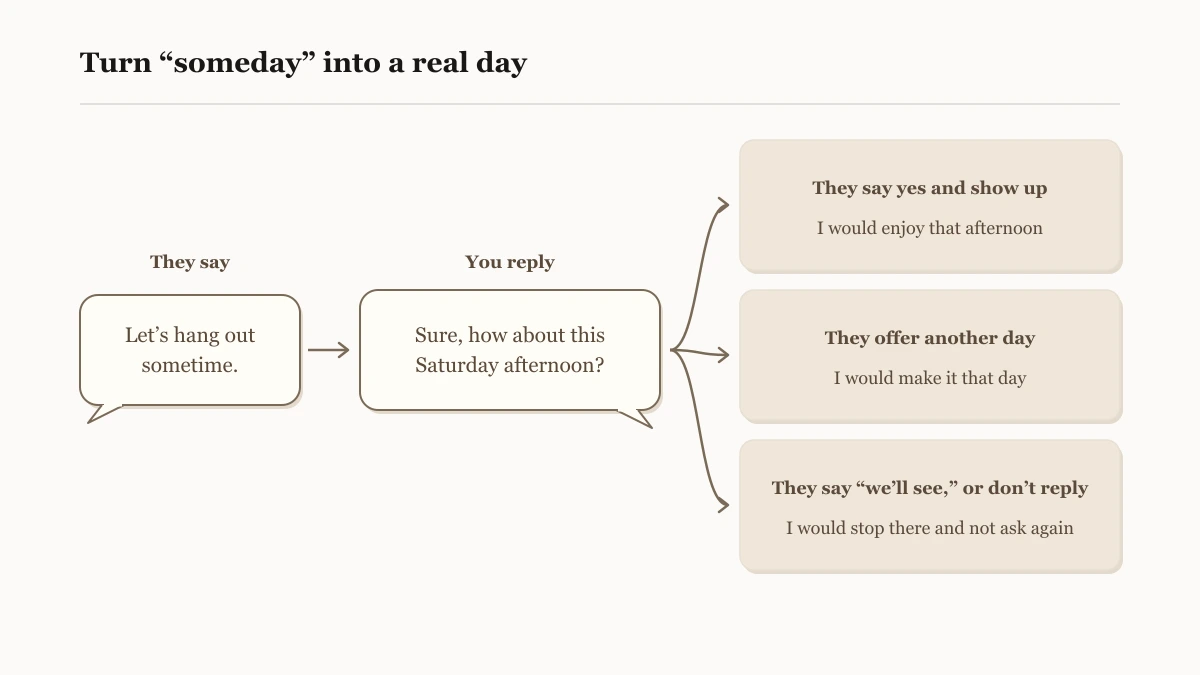
Next time they say “We should go eat there sometime,” whether it’s in a text or face to face, take them at their word and name an actual day: “Sure, how about this Saturday afternoon?” You’re answering an invitation they made themselves, so you don’t need to come up with a reason to ask. Unlike “When?”, a specific day asks for a yes or a no. The point is to turn a line that costs them nothing into something that asks them to set aside time. Then it can go one of three ways:
- They say yes, and they actually come. Enjoy that afternoon. I think it’s a good start, and from there the two of you can go at your own pace.
- They can’t make that day but offer another one themselves, something like “I’ve got something Saturday, does Sunday work?” Then make it Sunday. I’d count that as a step forward: they didn’t say no, and they offered another time themselves.
- They say “We’ll see when the time comes,” or don’t reply at all. I’d stop there and not ask a second time. You can say, “Okay, let me know when you’re free,” and keep that afternoon for yourself. To me, how they handle one real day will tell you more than many of their sweet lines.
On-the-way meetups and “What are you up to?” don’t count
Give yourself a fixed rule for what counts. A like, a view of your story, a “What are you up to?” or a half hour because they happened to be nearby doesn’t count as the two of you going out. A meetup with a day set in advance, one they cleared time for, does. Answer those small messages on your own schedule, with no need to reply right away or to write more than they did. When a last-minute invitation comes and you’re busy, tell them today doesn’t work.
This isn’t about making them anxious, and it isn’t a contest over who can act colder. Here’s why, as I see it: every time a message arrives or they ask you out for a little while, you think, “They still care about me,” and you’re willing to wait a bit longer. My guess is that once those stop counting, you’ll be less likely to start the wait over again each time, and after a while you’ll notice you spend less time waiting for them and have more time left for yourself.
You can want a love that isn’t just on the way
I believe you keep mistaking half-effort for love because there really is some warmth in the moments they give you, and when you like someone, you naturally want to take that warmth at its word. But for warmth to turn into love, someone has to be willing to spend time on it, and in this connection, the one spending time has always been you.
What you want is someone who clears time to see you and does what they say, a relationship that moves forward. I believe that’s how every relationship should be, and it’s completely reasonable to want it.
If, after comparing, what you have with them is breadcrumbing, the moments that made your heart race were still real; they just stayed where they were and never grew into more. Whether to walk away is something you can think over slowly. What you can do right now is take all those “somedays” they mentioned and turn them into days of your own. The beach they said they’d take you to, the place they said you’d eat at next time: pick a day with good weather and go, on your own or with someone who shows up when they say they will. If those were places you wanted to go anyway, you don’t need to wait for them to ask. What you want is affection you don’t have to keep guessing about, and starting today, your days don’t have to be spent waiting for anyone.
Sources
Research and sources this essay draws on.
- Psychological Correlates of Ghosting and Breadcrumbing Experiences: A Preliminary Study among AdultsInternational Journal of Environmental Research and Public Health, 17(3), 1116
- Young Adults’ Perception of Breadcrumbing Victimization in Dating RelationshipsSocieties, 13(2), 41