Can You Have a Happy Marriage If You Grew Up in an Unhappy Family?

When other people think about getting married, some of them think, “Something like my parents would be nice.” When you think about it, the only picture that comes to mind is the one you’re trying to avoid.
It hit you the first time you had dinner with your partner’s family. Their parents kept putting food on each other’s plates and teasing each other about embarrassing things from when they were young, and the whole table was lively. You laughed along, but inside you felt a little panicked, because the table you grew up at never looked like that. That night, one question wouldn’t leave you alone: “All I ever saw growing up was an unhappy marriage. Can I really give someone a happy one?” It wasn’t that their family was so wonderful. It was realizing you didn’t have a model to follow.
An unhappy family doesn’t mean an unhappy marriage
Here is how I see it: growing up in an unhappy family doesn’t mean your marriage has to be unhappy too. What your family decided is what you carry with you into a marriage, not how the two of you will live once you’re in it.
What you carry in might be habits, like keeping quiet when you’re upset or handling everything alone. It might also be something deeper, like not quite trusting the good days when they come. All of it built up, year after year, in an unhappy home, which is why it may make the decision for you before you’ve had a chance to think.
But anything you learned, you can also learn a different version of. You’re also not the only one in this marriage: what your home becomes is something you and your partner decide together, not something your parents decide. I’d say a person who knows what they’ve brought in with them has a better chance of keeping what they want and setting down what they don’t. The effect your family had on you is real, and you don’t need to pretend otherwise. You also don’t need to treat it as an ending you can’t escape, as if no matter how hard you try, you’ll end up walking your parents’ road.
Three kinds of unhappy homes, and what each one leaves behind
An unhappy family doesn’t look one way, and it doesn’t leave its children the same things. See which of these feels closest to the home you grew up in. Yours might be a mix.
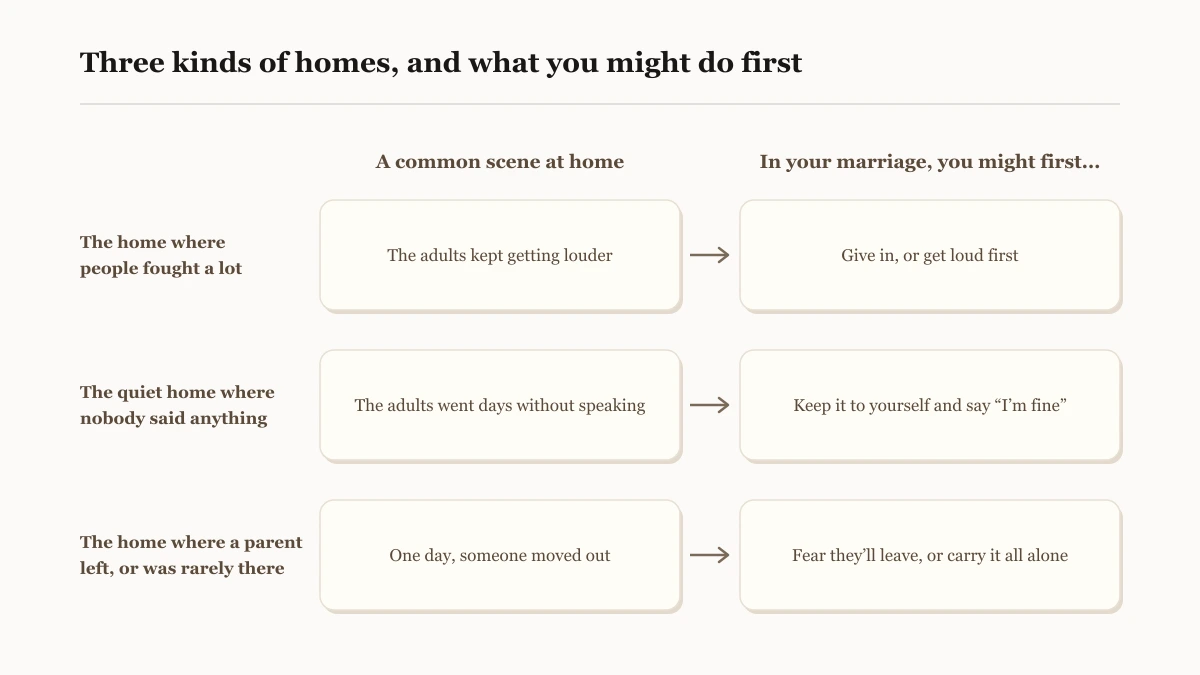
The home where people fought a lot
Halfway through dinner, the adults start arguing over something minor. The voices climb. Bowls and chopsticks get set down hard. Old grievances come out one after another. You keep your head down, finish eating, go to your room, close the door, and wait for it to go quiet. Now, in your own marriage, the moment your partner’s tone changes, you tense up. Sometimes you give in fast, just to get it over with. Other times you do the opposite and raise your voice first, as if whoever gets loud first can’t lose.
You picked up both of those, little by little, at that dinner table. In a home where a fight couldn’t be stopped once it started, you only ever saw two options: get out of the way, or be fiercer than the other person. My guess is that when your partner’s tone shifts, a lot of the time they are just tired or in a hurry, not trying to win anything. And whether you back away or push back harder, the actual thing the two of you disagree about never gets a real chance to be said.
The quiet home where nobody said anything
Nobody in that house raised their voice much. The adults would often go days without speaking to each other. At dinner the only sound was the TV. You could tell something was wrong, and no one ever told you what.
In your own marriage, when you’re upset, your first move is often to say nothing and wait for it to pass. When your partner notices and wants to talk, you pull back, say “I’m fine,” and change the subject.
In a home like that, staying quiet was the safest choice, because whoever spoke up seemed to be the one who broke the peace. From what I’ve seen, people who grew up this way usually do have feelings. What they rarely saw was someone saying “I’m upset” out loud and the household getting better because of it. In a marriage, though, “I’m fine” leaves your partner with nothing to go on but guesses, and I think that is often where the distance between two people grows: one wrong guess at a time.
The home where a parent left, or was rarely there
One day, one of the adults moved out. Or it was always one adult holding the whole household together while the other was hardly around. You learned early to read the grown-ups’ moods, and you learned early to do a lot of things yourself.
In your own marriage, that history can take one of two shapes. One is being very afraid of being left: after an argument you need to know right away that your partner is still there, and if they’re slow to answer a message, your mind goes straight to the worst case. The other is handling everything alone and rarely asking for help, as if leaning on your partner were dangerous. In a home where someone could suddenly be gone, checking that the other person is still there, or refusing to depend on anyone at all, were both ways of never being caught off guard again. In my view, the cost is that it’s hard to settle into a relationship. The two of you only had a fight, but what runs through your head is whether they’re going to leave, and that worry is more exhausting than the fight itself.
Finding yourself in one of these homes doesn’t mean you’ve done something wrong. These reactions were what you worked out for yourself as a child, in the place you were in. The people around you are different now, and so is the life the two of you are building.
What an unhappy home leaves inside you
The habits are only part of it. What an unhappy home leaves deeper down are a few feelings that keep following you. They rarely get said out loud, but they tend to surface whenever you think about marriage.
One is the sense that your family’s unhappiness had something to do with you. When the adults fought, went silent, or one of them left, you may have quietly wondered whether it was because you weren’t well-behaved enough, or because of you. From what I’ve seen, children easily take the adults’ troubles onto themselves, because it’s the only explanation they can come up with. As an adult, that can turn into checking what you did wrong the moment your partner seems unhappy. But whether your parents’ marriage went well was never a responsibility a child could carry.
Another is not quite trusting the good days. Your partner is kind to you, things between you are going smoothly, and still some part of you is waiting for the moment it all changes. In the home you grew up in, calm was often just the gap before the next thing went wrong. That unease comes from somewhere real: you watched good days suddenly turn too many times. So the calm you have now needs a little more time before you can believe it will stay.
A third is your picture of marriage itself. “Marriage” in your head may look just like your parents’ did: one person always swallowing things, two people living separate lives, or something that could fall apart any day. So you might not dare expect much from marriage and feel you just have to put up with whatever hurts, or, however good the relationship is, you might start backing away the moment marriage comes up. But I believe your parents’ marriage is just the one you happened to see. There are plenty of marriages where two people look out for each other and talk things over properly. You just didn’t get to see them as a child.
The last is the fear of seeing your parents in yourself. A certain tone in your voice, the way you turn and walk away, can give you a jolt. As I see it, you’re this afraid because you know better than anyone how hard those days were, and you don’t want someone you love to live through them too.
Copying it, reversing it, or choosing
Pick one decision in your marriage and ask yourself: “Am I doing this because it’s what I want, or because I’m following, or deliberately avoiding, the home I grew up in?”
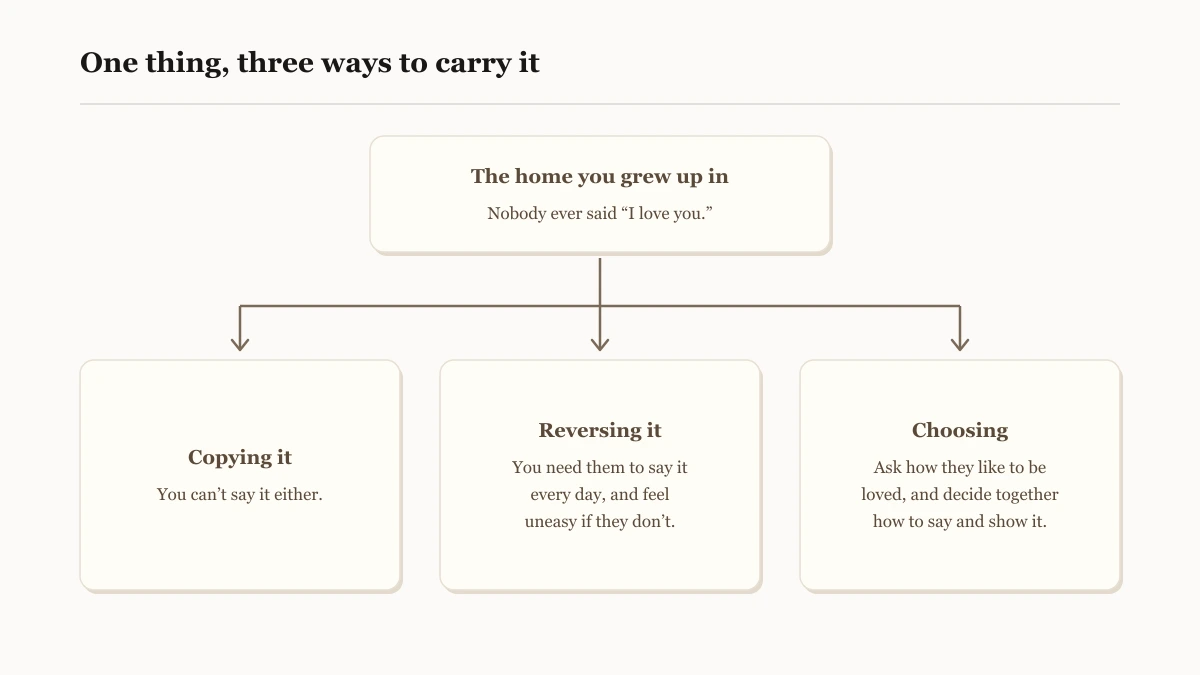
Take an example. Your family never said “I love you.” If you hardly ever say it in your marriage either, not because you don’t want to but because it feels awkward the second you try, that’s copying it. If you need your partner to say it every day, and the one evening they forget leaves you uneasy all night, that’s reversing it. It looks different from your parents, but they’re still the ones deciding, just in the other direction. If the two of you have talked about it, and you know what they like to hear and how you like to be cared for, and you’ve decided together how to say it and show it, that’s something you chose.
Copying and reversing are both very common, and noticing them is no reason to blame yourself. I would start with one small thing and slowly move it from copying or reversing to choosing. I believe the more decisions the two of you make for yourselves, the more this marriage becomes yours, instead of a replay of what your parents had.
Setting your own home’s way of doing things
You don’t have to make sense of your whole past before you start living your own life. You can begin either of these whenever you like.
Tell your partner about the home you grew up in
Choose a time when you’re both relaxed, like on a walk or after a meal, and tell your partner what the home you grew up in was like. It doesn’t need to be the whole story. One thing you remember is enough, and how it shows up in you in your marriage now. Something like: “In my family, nobody would speak for days at a time. So when I’m upset, I go quiet too. It isn’t that I don’t care about you. I’m just not used to saying out loud that I’m unhappy.”
The reason to say this is so your partner knows where your reactions come from and doesn’t have to keep guessing. My guess is that once they know, the next time you go silent, they’re less likely to read it as you shutting them out.
If your partner listens and then starts talking about their own family, listen back, without comparing whose home was unhappier. That way you’ll each know a bit more about what the other carried into this marriage. If they say “Got it” and don’t ask anything more, that’s fine too. What you wanted wasn’t a long talk; it was for them to know. And if they say, “That’s all in the past,” you can answer: “It is, but it still comes out sometimes. I’m telling you so you’ll understand me a little better when it does.” Then leave it there. You don’t have to push them to get it right now.
Pick one thing and decide your home’s own way
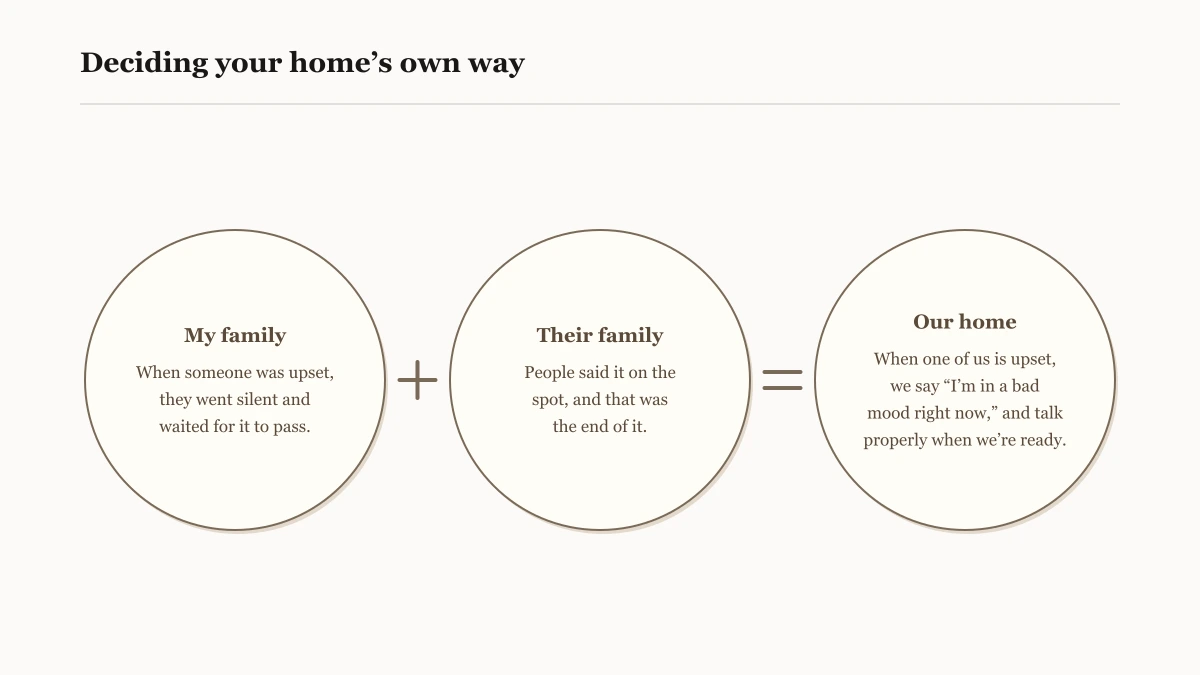
Choose something the home you grew up in didn’t handle well: what happens when one of you is upset, how important things get decided together, how holidays are spent. You talk about how your family used to do it, your partner talks about theirs, and each of you says which parts you’d keep and which you wouldn’t. Then decide on your own home’s version together. For example: “In my family, when someone was upset they went silent and waited for it to pass. In yours, people said it on the spot and that was the end of it. So here’s how we’ll do it: when one of us is upset, we say ‘I’m in a bad mood right now,’ and we talk properly when we’re ready.”
The point is to give your home its first habit that wasn’t copied from your parents and wasn’t done just to be the opposite of them.
If your partner says, “Anything’s fine, we’ll do it your way,” I would ask them to name one thing from their family that they like, so this habit has both of you in it. If they want to do it the way their family did, listen to why their family did it that way first, keep the parts you like too, and add something of your own. To me, once you keep a little from each side, the way you do it will be your home’s own. And if they say there are things from their own family they don’t want to keep either, start with one of those and change it together. Then you’re not the only one starting over.
Wanting a marriage that’s different from your parents’
If you’re worried you can’t give anyone a happy marriage, here is my sense of why: you’ve always believed that someone has to teach you what a happy marriage is before you can build one. No one ever really showed you, so you assumed you couldn’t do it.
Wanting a home warmer than the one you grew up in is a reasonable thing to want. I think everyone should have a home they can relax in when they walk through the door. You didn’t have that as a child, and now you want to make it with your partner.
You don’t need to change everything you brought from home all at once, and an old habit slipping out once doesn’t undo everything you’ve done so far. When it does, you can say to yourself, quietly, “That’s something I learned back then. It isn’t what I want.” You can also pay attention to a couple you know who get along well and notice how they usually talk to each other and look after each other. Your home together is only just beginning, and what it becomes can take shape one day at a time.
Sources
Research and sources this essay draws on.
- Explaining the Intergenerational Transmission of DivorceJournal of Marriage and the Family, 58(3), 628–640
- Interpersonal Mediators in the Intergenerational Transmission of Marital DysfunctionJournal of Family Psychology, 18(3), 519–529