What Is a Trauma Bond? Why It Gets Harder to Leave After They Hurt You

Maybe it was a knock on the door. Maybe it was your phone lighting up with “I’m sorry, I went too far.” Either way it came after you had already cried for a long time over the hurtful thing they said. You let them hold you, or you typed back “it’s okay,” and then you cried even harder. Underneath the tears there was relief, and a strange sense that the two of you were closer now than before the fight.
Later, once things were quiet, the question came back: why does the person who hurts me this much feel even harder to leave?
Going back to them makes sense
If you are reading this, you have probably heard “you should leave” more than once. You have likely said it to yourself, too. What you need right now is not another person telling you to go. You want to understand why you can’t.
So here is where I would start, because it may let you be a little gentler with yourself. When we are hurting, we go looking for the person closest to us. That is an ordinary human reaction. In this relationship, the person closest to you happens to be the same person who hurt you.
The things you haven’t said out loud
“When they’re good, they’re really good.” I believe you. They remember small things you mentioned once. They keep checking whether you feel better when you are sick. That kindness is real. The hurtful things they said are real as well, and you do not have to deny one before you are allowed to admit the other.
“They apologized. Holding on to it feels petty.” The apology ended that night, but the hurtful words had already been said. You still remember them because they hurt you. Accepting the apology and remembering what they said can happen at the same time. You don’t need to pretend they never said it just so the night can be over.
“I know I should go, but thinking about leaving hurts so much.” It hurts because your attachment to them runs deep. That pain tells you how much you care. It does not tell you to stay, and it does not tell you to leave. Whether you stay or go is something you can think through at your own pace.
“Did I do something wrong to make them treat me like this?” Even if you did get something wrong that day, it could have been talked through. Answering it with words that made you cry, or with days of barely speaking to you, was their choice. You did not choose it for them.
“Do I care about them too much? Is that why I can’t leave?” Caring about someone is one of the most precious things about you. You can’t leave because there is a cycle turning inside this relationship, and that cycle has a name: a trauma bond.
What a trauma bond is
A trauma bond is a strong, hard-to-break attachment to someone who keeps hurting you, one that grows deeper, not weaker, the more often the hurt comes back. It does not appear overnight. The same cycle ties it tighter, one turn at a time.
The cycle of love and hurt
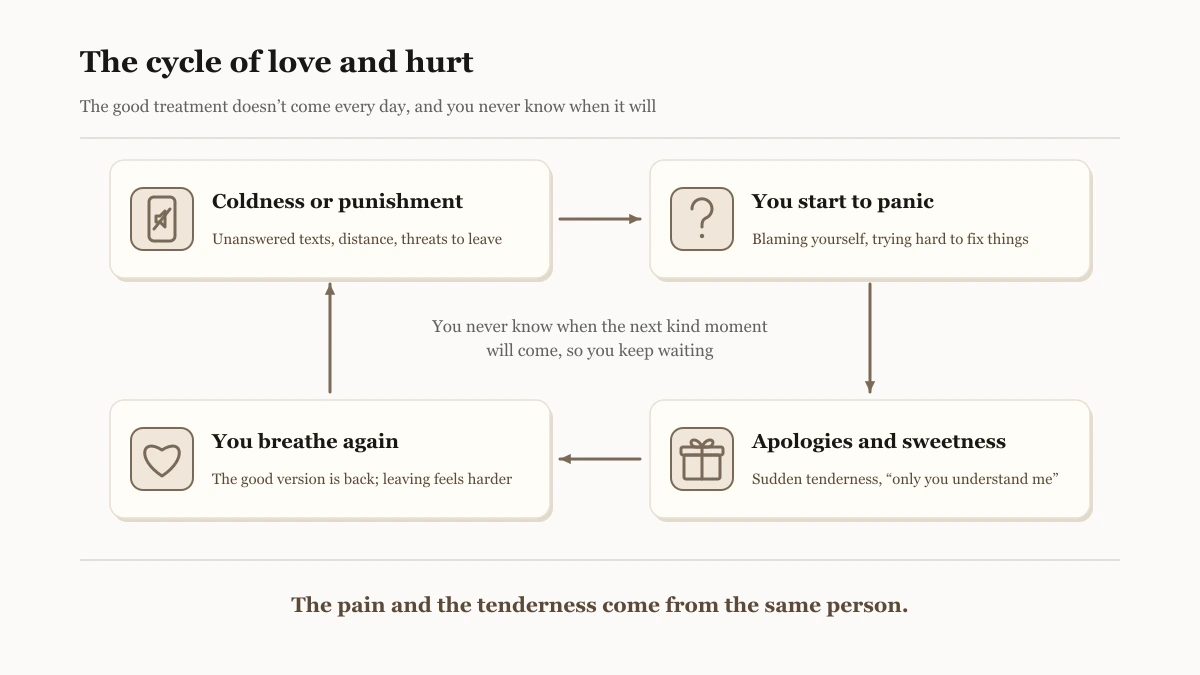
Relationships where a trauma bond forms often run on repeated manipulation. First comes the punishment. They suddenly go cold, leave your messages unanswered for days, embarrass you in front of other people, or say they want to break up. People often call this the silent treatment or emotional coldness. Then you start to panic. You go over everything you did and try desperately to fix it. That is when they come back. They apologize, turn suddenly tender, take you somewhere you love to eat, and tell you that you are the only one who really understands them. You breathe again, sure the good version of them is back. A while later, it all happens again.
This way of alternating good and bad treatment is known as intermittent reinforcement. The kindness doesn’t come every day, and you never know when it will. As I understand it, that uncertainty is exactly what keeps you waiting for it. You watch every word and every move, trying to earn it back, and when it finally arrives, you remember it especially vividly.
Fear and need, tied to one person
When the person who hurts you and the person who is tender with you are the same, your fear and your need end up pointing at one person. You are afraid they will turn cold again, and the only one who can make that fear go away is them. In my understanding, the mind struggles to pull those two feelings apart. Mixed together, they feel very much like a love you cannot put down, even an obsession you cannot walk away from. So even though you know they hurt you, leaving is still hard. In your mind, they are the one who comes back every time and comforts you until you feel better, and you rarely stop to think that the one who hurt you is also them.
It is not a bond forged through hard times together
Some people describe it as “we’ve been through so much together, that’s why it runs so deep.” A bond forged through shared hardship is two people facing something outside them and holding each other up until they get through. In a trauma bond, the pain does not come from outside. It comes from them. There is nothing the two of you are getting through together, only you, waiting for them to turn tender again. So this inability to leave is closer to a toxic, unhealthy attachment. The cycle tied it. It is not proof that your love runs especially deep.
Why being hurt makes you hold on tighter: each turn leaves you another reason to stay
So why does it get harder to leave after they hurt you? My answer is that every turn of the cycle leaves something behind in you that makes the next time harder to leave. From what I have seen, three things get left behind most often.
One more night of making up to remember. On those nights they are so tender they hardly seem like the same person. You remember those nights clearly, while the days they shut you out grow blurrier each time.
One fewer person to talk to. After each fight you tell other people a little less. Maybe you dread hearing “then just break up,” or maybe you are afraid of feeling even more embarrassed once you have said it. Little by little, when you are hurting, they are the only one left to turn to.
A little more doubt about yourself. Every time, you are the one who panics first, apologizes first, and fixes things first. You start to believe they treat you this way because you are not good enough. And the less good enough you feel, the more you fear that nobody else would want you if you left.
You can check this for yourself with one question: the last time they made you sad, who was it that finally helped you feel better? If the answer has always been them, or if no one but them even knows you cried that day, I would say that when you are hurting, they are already the only one you have. How clearly you remember the nights of making up, or how much you doubt yourself, is hard to change overnight. But reaching out to one more person when you are hurting is something you can do today.
Let someone besides them catch you
You don’t have to decide whether to leave. You don’t have to figure the relationship out first. You can begin today with something very small.
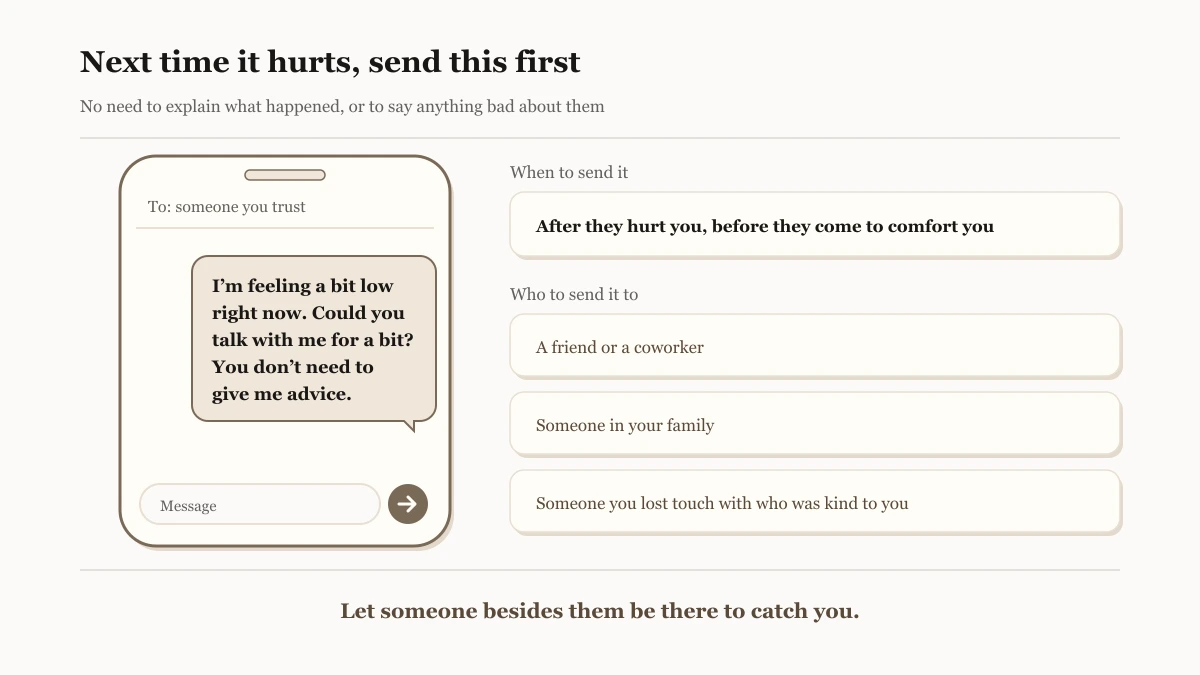
The next time they make you sad, let one other person know before they come to comfort you. Send a message to someone you trust: “I’m feeling a bit low right now. Could you talk with me for a bit? You don’t need to give me advice.” It could be a friend, a family member, a coworker, or someone you haven’t talked to in a long time but remember being kind to you. Even if you are in different time zones and they can only reply in writing, the message still goes through. You don’t need to explain what happened, and you don’t need to say anything bad about your partner. With that one sentence, someone besides them is there with you that night.
The second thing belongs to the night they apologize: make no decisions that night. Don’t agree to start over, and don’t announce that it’s over, either. You can tell them, “I heard you. I want to think about it on my own first, and I’ll talk to you tomorrow.” My judgment is that this is the night you most want to be close to them. They have turned so tender, and your relief is at its strongest, so a decision made then is easily pushed along by that relief. By the next day, you can see more clearly what you really want to do. Both of these can be hard the first time. You might type the message and delete it. You might still say yes that night. That is completely normal, and you can try again next time. You have already started noticing when you most need someone with you.
Four questions you are probably asking
My friends have told me to leave so many times. How do I even bring it up?
Tell them clearly what kind of company you want this time. You could say, “I’m not asking you to decide for me. I just want someone to hear me out.” My guess is that your friends keep urging you to leave because seeing you hurt is hard for them too. Once you say what you need, they have a chance to be there for you in the way you asked.
They say they’ll change. Should I believe them?
You can believe them. You just don’t have to decide on the day they say it. In my judgment, the day someone says they will change usually falls in the apologies-and-sweetness part of the cycle, so I would treat it as a promise that has not been proven yet. Whether they change will take a while to show. Watch whether the coldness and punishment come back, not how tender they were that night.
How do I know I’m not overthinking it, and they’re not that bad?
Look at whether you can say it out loud when you are hurt. You don’t need to count good days against bad ones. Just look at this: can you tell them, “What you said just now really hurt me”? Can you tell anyone else about it? If you can do both, there is still room in this relationship for your hurt. If you can’t even say it, and can only wait for them to comfort you, I would say what you are feeling is more than overthinking.
If I do leave, won’t it hurt even more?
It will hurt, and thoughts of them may keep coming back. As I see it, that pain is different from the one you live with now. You no longer have to guess which day they will turn cold, and you no longer have to be hurt first before you get any tenderness. You will also have practiced reaching for someone else when you are hurting, so on those nights after leaving, you will know who you can go to.
The tenderness you want shouldn’t cost you a hurt first
The cycle keeps turning because every bit of tenderness has to be paid for with a hurt first, and you want that tenderness so much that you keep getting through the hurt, again and again.
What can slow it down are the two small things already in your hands: let one more person know on the night it hurts, and don’t rush a decision on the night they apologize. If you stay after that, you will be staying because you looked at this relationship with a clearer head and chose to. If you leave, someone will be with you on the hard nights. Either way is better than now, when all you can do is stay inside the cycle and wait for the next kind moment.
Wanting to be treated tenderly is a reasonable thing to want. Good tenderness is there all along, without asking you to cry first.
Sources
Research and sources this essay draws on.
- Emotional Attachments in Abusive Relationships: A Test of Traumatic Bonding TheoryViolence and Victims, 8(2), 105–120