Together Every Day, Yet Strangers: The Scariest Thing in a Marriage Isn't the Fighting

It is a little after nine. The dishes are still in the sink and you tell them something that happened today. Something a co-worker said, maybe, or something you saw on the way home. Nothing big. You just wanted to say it. They say “mm,” and their eyes never leave the screen. You wait two seconds, swallow the second half of the sentence, and get up to do the dishes. The water is loud, loud enough that you cannot hear the living room, and then you notice something: you are relieved. While the water is running, nobody has to talk.
You turn off the tap, dry your hands, and stand there for a moment. The sentence comes up again. It is not the first time. We are together every day. Why am I still this lonely?
This piece wants to do two things. First, say out loud the sentences you have been keeping to yourself. Then tell you what actually turns two people into strangers, because it is probably not the thing you think.
You are lonely because you want the person, not the presence
Let me start here. Missing someone who is next to you every day is not strange. It is only rarely said.
It sounds like it should not make sense, so you have not quite admitted it to yourself. But missing someone is not about whether they show up. It is about whether they see you. They are present, fully present, and what you want is a different thing: when you say something, their eyes turn toward you. When you walk into a room, someone in the room knows you have walked in. You want the person, not the presence. It is one of the most ordinary kinds of missing there is in a marriage, and one of the least talked about, because whoever says it expects to be laughed at. You see each other every day and you miss them?
Wanting to be seen is part of what living with someone is. Feeling lonely about it means you still think of them as the one you want to be seen by. That is not a demand. That is you still caring.
One more thing before we go on. This piece is not going to tell you whether they still love you. That is a different question. This piece is about what is happening on your side of the table, because your side is the part you can do something about tonight.
A marriage without fights is not a marriage without trouble
You have probably told yourself this: at least we do not fight. Life is fine. Everyone’s marriage looks like this after a while. Half of that is true. A lot of marriages do look like this. It is the other half I want you to take seriously, because one study made it impossible for me to file “I do not feel anything” under “nothing wrong.”
Feeling nothing is itself worth taking seriously. Right now you feel like strangers and nobody is fighting. That does not mean nothing is wrong. It only means nothing is making noise.
The sentences you have not been saying
I want to say a few of them for you. You will not have all of them. I think you will recognize some.
“They are not a bad person. I just do not seem to be in their line of sight.” This is the hardest one to say, because they really are not a bad person. They earn money, fix things, remember the bills. You cannot point to a single thing and say, that one. The only thing you want to say is: I am here, do you see me? And that sentence has no specific event to attach to, so it stays unsaid, and it stays with you. Here is how I see it: not being able to name a fault of theirs does not make your feeling wrong. What you want was never for them to get some task right. It is for them to put their eyes back on you.
“I do not dare say I am lonely. It would sound like I am picking a fight.” Because lonely sounds like an accusation, as if you were saying they are not around enough. You are afraid they will frown, afraid they will say, am I not home every night, afraid the evening will be ruined. So you trade it for something smaller. Tired today. Nothing. Here is how I see it: lonely sounds like an accusation because you have been translating it into their fault for a long time. It was never that.
“At least when we fight, they look at me.” You would not say this to anyone, because it sounds like you want to fight. You do not. What you want is what happens during a fight: their eyes are on you, they are worked up about something, and that something has to do with you. Most of the time they are calm, so calm that you have started to wonder whether you are a person who can still cause any reaction in them at all. Here is how I see it: what you miss is not the fighting. It is those few minutes of being inside their field of vision.
“Maybe I am asking for too much.” You count what you want. One question about how your day went. Their head up at dinner. A few minutes of talk before sleep. The list does not look like much, and you still cannot get it, so you start to wonder whether you are greedy. Here is how I see it: all you want is to be seen, and that is not much. People conclude they are asking for too much when they have been asking for a long time without getting it, not when what they ask for is large.
“We talk about everything except us.” Next month’s bills, whose parents this weekend, whether the air conditioner needs repair, whose turn it is to take out the trash. The two of you can exchange dozens of sentences a day, every one of them useful, none of them about the two of you. Sometimes you wonder when you last talked about each other. Here is how I see it: it is not that you have stopped talking. It is that you talk about things, and the people are missing from the conversation.
These sentences have one thing in common. They are all true, they have all been sitting in you for a long time, and none of them has been said.
The thing itself: a stranger is someone you cannot say things to
First, what a stranger is. Not someone you do not know well. You know each other better than anyone. They know what you eat for breakfast, you know which drawer their socks go in, you could get through a whole day without looking at each other. A stranger, the way I would define it, is something else: someone you cannot say certain things to. You would not tell a stranger that you had a hard day, not because they are bad, but because there is no place between you for that sentence to land. And the moment a married couple becomes strangers is not the day one of them moves into another room. It is the day “I am lonely” becomes a sentence you cannot say to them.
So I would say the title is right. The scariest thing in a marriage is not the fighting. A fight is ugly, but the thing being fought about sits between two people, and both of them are looking at it, and both of them care enough to raise their voices. The scary thing is the sentences you keep inside so there will not be a fight. Every sentence you keep pushes the two of you one step further into separate rooms, and the other person does not know a sentence has been kept, which means they never get the chance to fix anything. You think you are protecting the marriage. You are only keeping it quiet.
I want to give you one question you can check tonight. Just one: the heaviest thing on your mind right now, do they know about it? If they do not, and you have not said it, then the two of you are already living the way strangers live. Who started it does not matter, because the step back does not change depending on who took the first step away.
Why it will not come out
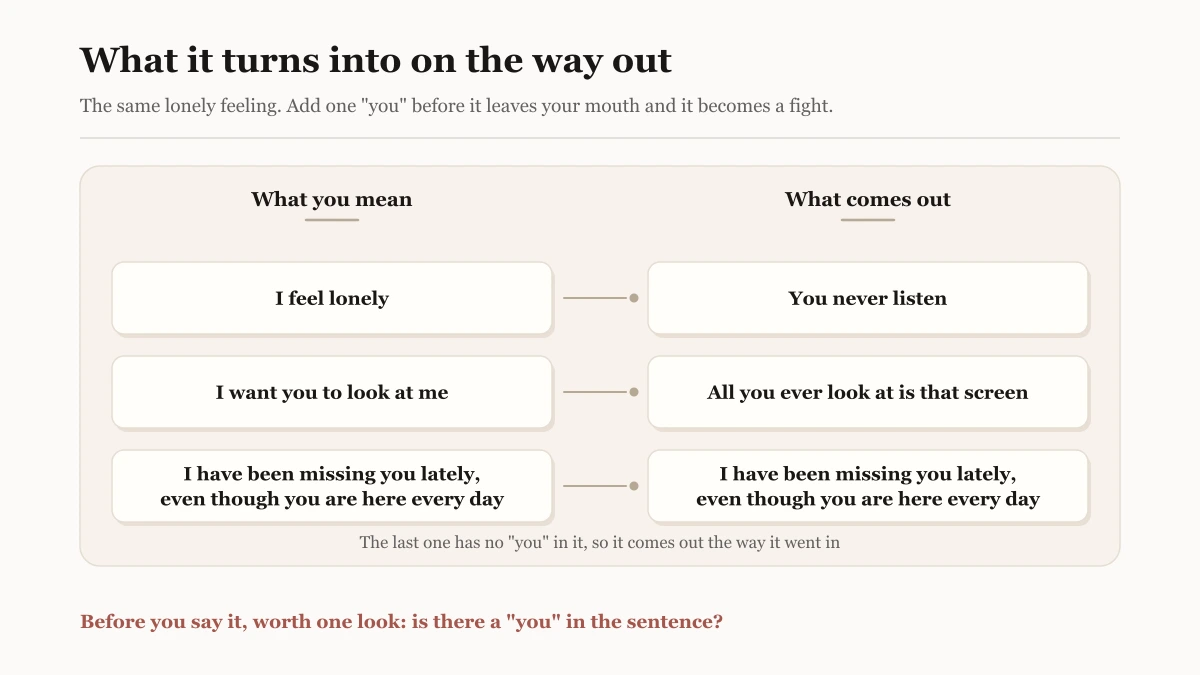
I doubt it is that you do not want to say it. You have tried, at least in your head, many times. And every time the sentence gets to your mouth, it turns into a different sentence first. In your chest it is “I am lonely.” At your lips it is “you never listen.” In your chest it is “I want you to look at me.” At your lips it is “all you ever look at is that screen.” You know the version with “you” in it starts a fight the moment it is out, and you have learned not to fight, so you stop it yourself and go do the dishes.
Here is how I understand it: the sentence gets translated into an accusation on its way out. Not on purpose. It has been sitting inside you so long that it has grown resentment, and the resentment walks out first. The problem was never saying it. The problem is whether the sentence you say has “you” in it. A sentence with “you” in it makes them the accused, and the accused defends or shuts down. A sentence with only “I” in it lets them hear a person telling them how they are doing.
So the sentence has to have only “I” in it.
Tonight, say one sentence you have been keeping
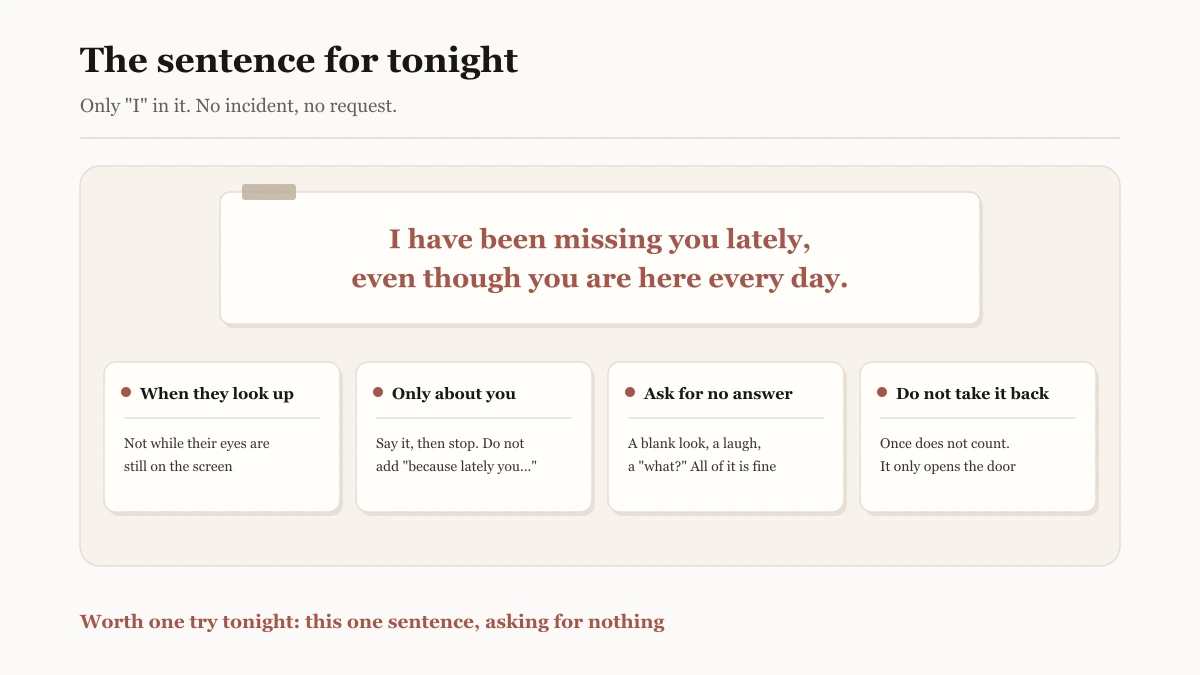
Here is what I would suggest. Tonight, do one small thing: say one sentence. Just this one: I have been missing you lately, even though you are here every day.
There is no incident in it, no request, nothing they did wrong. It only lets them know one thing: you are here, and you have been thinking about them. You do not need to work out how they will take it first. The point of this sentence is not their answer. It is that you finally said it.
This is how I would say it. Wait until they look up. Do not say it while their eyes are still on the screen. You want it to go into a person’s ear, not into the room. Say only how you are, then stop. Do not add “because lately you have not been listening.” The moment you add that, there is a “you” in the sentence again. Do not ask for an answer. If they freeze, if they laugh, if they say “what?”, all of that is fine. If there is no reaction, do not take it back. Do not say “never mind.” A sentence taken back is further away than a sentence never said. And that is it for the day. No explaining, no following up, no saying it again before you sleep.
What if they do not react? I will be honest. The first time, there may well be no reaction, or one you cannot read. What matters is not what they say in the moment. It is the next few days. Do they look at you a little longer, ask you one more question, slow down a little when they pass you? Once does not count. One sentence cannot pull back years of distance. It does one thing only: it opens the door.
If you do not sleep in the same bed, or you only see each other a few nights a week, say it once on a night you are together, and do not make up for the nights you are not. If you really cannot be in the same room, send it as a message, but make it one complete sentence. No sticker. No question mark. Let it sit there quietly.
The four things you will actually ask next
“If I say it and they do not react, won’t that be even more embarrassing?”
Here is how I see it: it feels embarrassing because you are waiting for them to grade you. But this sentence is not for grading. It has no right answer, and nothing they say can make it a wrong sentence. And I would say this: the moment you say it, you have already taken one step back from the stranger side, because a stranger is someone you cannot say things to, and you just said something to them. Whether they follow is what happens next.
“Isn’t this just asking them to pay attention to me? How is it different from people-pleasing?”
Here is how I would draw the line: the difference is whether you get bigger or smaller after you say it. Pleasing makes you smaller so they will stay: you put your needs away and buy one quiet evening. This sentence makes you a little bigger so they can see you: you put how you are in front of them, whether they like it or not. There is one test. After you say it, did you shrink? If you did, it was pleasing. If you did not, it was not.
“I have said it several times and they are still the same.”
Then this is no longer about the sentence. What is worth looking at now is whether they still react to anything in their life: they still have things to say to friends, still get fired up about work, still laugh at something on TV, and all of that disappears the moment they turn toward you. If that is what it looks like, it is a different thing, and I wrote about it in 5 Signs Someone Is Falling Out of Love With You. That piece has the fuller picture for that question.
“If this goes on, are we headed for divorce?”
I cannot calculate that day, and nobody can calculate it from tonight’s silence. But I would separate two things. Divorce is a decision. Being strangers is a state. A state changes every day, in the bad direction and in the good one, and pushing it back a little does not require making that decision first. The sentence tonight is not an attempt to save anything. It is a push on a state. If one day you really do have to decide, I hope you decide it after the two of you can see each other again, and not from two separate rooms.
The scariest thing is not the fighting
You are together every day and you feel like strangers, and the scariest thing in a marriage is not the fighting. It is that, to avoid the fighting, you kept the things you wanted to say, one sentence at a time, until even “I am lonely” was one of the things you kept.
I cannot tell you how they will take it. What I can tell you is that being strangers started with one sentence that was never said, so becoming familiar again can start with one sentence too. It does not need them to change first. It does not need a good moment. It does not need you to have worked out where this marriage is going. It only needs the two seconds when they look up, and you not taking the sentence back.
And one more thing you may not have thought of yet. You feel lonely at the sink. You miss them while they are sitting right there. You get hurt by a single “mm.” None of that is bad news. Here is how I see it: feeling lonely belongs to people who still want to be seen. The two of you are living the way strangers live right now, but that sentence is still in you. It has not died. It has only been a long time since anyone spoke first.
You have kept that sentence for them for a long time. Tonight it is worth letting it out. The person who says it is not waiting for an answer. They are putting two people back into the same room.