When It Starts to Feel Like You're the Only One Who Cares, What Has Actually Gone Wrong?

The question about the weekend came from you. So did the last one, and the one before that.
Maybe this time it was “are we doing anything this weekend,” maybe it was “have you thought about what we talked about.” They said sure. They said sounds good. Nothing in their voice was off. And then, phone face down on the table, it landed on you: that was your line again. The dates are yours to set up. The first word after a fight is yours to say. Their family’s birthdays are yours to remember. The trip is yours to plan. Even “have we been a bit weird lately” was yours to ask.
You probably have not said the sentence out loud to anyone, because saying it feels like filing a complaint against them. “It feels like I’m the only one who cares.” Under it there is a quieter one you barely let yourself ask: “If I stopped, would there still be an us?”
What I want to look at with you is who is actually doing the things in this relationship right now, and one move you can make tonight to put one of those things into their hands.
You opened this because you already started counting
You feel like the only one who cares because you really are doing a lot, and you are doing it well. There is always a next date, because you set it up. There is always someone who breaks the silence after a fight, because it is you. Their family’s birthdays always get remembered, because you remember them. From where they sit, these things simply happen. Only you know that each one happened because you spoke first.
My guess is that you are not here looking for a reason to leave. You are looking for a way to name this that does not end in “maybe I’m overthinking it,” and for somewhere to put that sentence down.
So let me set the edges. This essay will not ask you to stop, and it will not ask you to do more. It answers the question in the title, what has actually gone wrong, and whether one thing you do first can start to change it.
The things you say to yourself when nobody is around
“Am I asking for too much?” I think what you want is very small. Not flowers every day, not first place in their life. You want there to be days when you are not the one who has to speak first. It is small enough to feel embarrassing to say, and small is not the same as unimportant.
“If I don’t bring it up, will they ever?” Half of that may well be true, and that half has nothing to do with love. When something has not come around to a person in a long time, they forget it could be theirs. That is a habit, and habits can be redrawn.
“Do they even see what I do?” Probably less than you think, for a simple reason: you are too good at it. You finish things before they notice there was a thing. On their side, dates just exist and fights just blow over. Nothing “happened,” so there was no moment to see who made it happen. Being unseen here is a side effect of your competence, and it is a separate question from whether they have a heart.
“If I stop, does it all end?” I want to answer this one carefully. I would not test the relationship by quietly stopping. If you stop doing something they never knew you were doing, my read is that all they will feel is that something is off, without knowing what. You will get confusion, not an answer. There is a better road for getting a piece of the work back to them, and it starts with telling them first.
“Do they just not care?” Here is how I would answer. Someone who does not care has a very recognizable shape: they do not want the things you do. You ask to meet and they do not want to. You try to talk it through and they do not want to talk. You plan the trip and they do not want to go. That is probably not what you are looking at. They still want to see you, they still want to make up, they went on the trip. They just never start any of it. Wanting these things and being the one who starts them are two different questions. The answer you are holding, “it’s always me who starts,” answers the second one, and you have been using it to answer the first.
Every one of these questions is about them. What I notice is this: they do have a part in it. When something has not been theirs to start in a long time, they really do stop thinking about it, and I will not excuse that half for them. But what you can change is not their heart. It is the things themselves: how each one quietly became yours, and how one of them can go back.
What went wrong: caring became one person’s job
Let me lay the picture out. Every relationship has a handful of things nobody is assigned to. Setting up the next time you see each other. Bringing up what feels off. Remembering what the other person said. Speaking first after a fight. None of it is written down anywhere, and nobody hands it out. At the start it belongs to whoever thinks of it first, and both of you are thinking of it.
The way I see it, a person who cares does a little more, and that is natural. It is also where that person loses out, in three places. You think of it earlier, so you always move first. You cannot stand the gap, so before they have had time to think of it, you have already done it. And nothing that gets done well ever gets taken back, so the smoother you are at it, the more it looks like it was always yours. Do a little more for long enough and the thing becomes yours, and once it is yours, they stop having to think about it. They did not take their caring away. Someone started caring on their behalf. When something is being handled for you, you stop holding it in your head. That is not a flaw in love. It is what happens whenever one person has been handling something for long enough.
So on their side nothing is broken. The relationship looks fine from where they stand, and they cannot see what you see, because the part that is straining is being carried entirely by you.
I want to say this plainly: every single thing you do is good. The problem is that all of it lands on one person. Every date you set up is one more time you saw each other. Every first word you said ended a cold spell a little sooner. Nothing is wrong with the things. What is wrong is how they are split.
Here is the one place I would look, and you do not need to ask them, you only need to look once: is there anything in this relationship that would not happen if you did not do it?
If there is, that thing is the first one that stopped being both of yours and became yours alone, and it is also the best one to hand back first.
This can be looked at separately from “they stopped loving you”
The title asks what has gone wrong. My answer: most of the time the problem is in how these things get divided, and that question can be looked at separately from whether they still love you.
I know the two look alike. Someone who has stopped loving you does not ask you out, and someone who has gotten used to you doing the asking does not ask you out either. The picture from the outside is the same picture. The reason is different. The one who has stopped loving you does not want you anymore. The one who got used to you asking still wants you; it is just that they have not done any of these things with their own hands in a very long time.
There is one way to tell them apart, and it is not whether they go first. It is what they do after you have gone first: do they show up, or do they dodge? You ask to meet, and they come, or they start finding reasons. You bring up what feels off, and they listen to the end, or they say it is nothing and walk off. You mention their family’s birthday, and they go and plan something, or they say “can you handle it.” You plan the trip, and they go, or they somehow never confirm the dates. Showing up means they still want the thing, it just has not been theirs to start in a long time. Dodging means they no longer want even the things you start, and that is not a division problem anymore. What is fading is their will to be in this relationship at all, and what to watch then is how far they have pulled back, not how much you are doing. This essay is mainly about the first kind, and this is as far as it goes on the second.
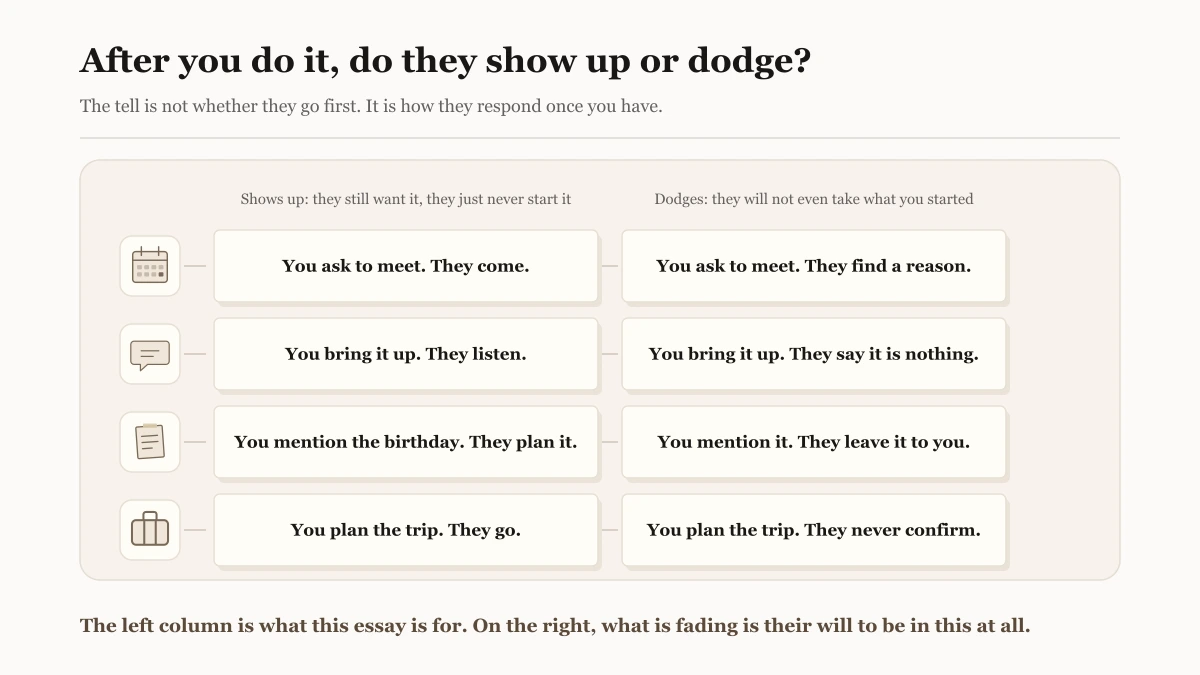
If what you see is “shows up, but never starts,” then your problem is the kind this essay can work with. The division can change, and that is the one thing I most want you to take from this. Once it changes, caring has a chance to land on them again, because a thing has to be in your hands before you can think about it. And once one thing is in their hands, whether they do it is something you will see directly, instead of reading their tone and their face for whether they care.
What to do: hand one thing back
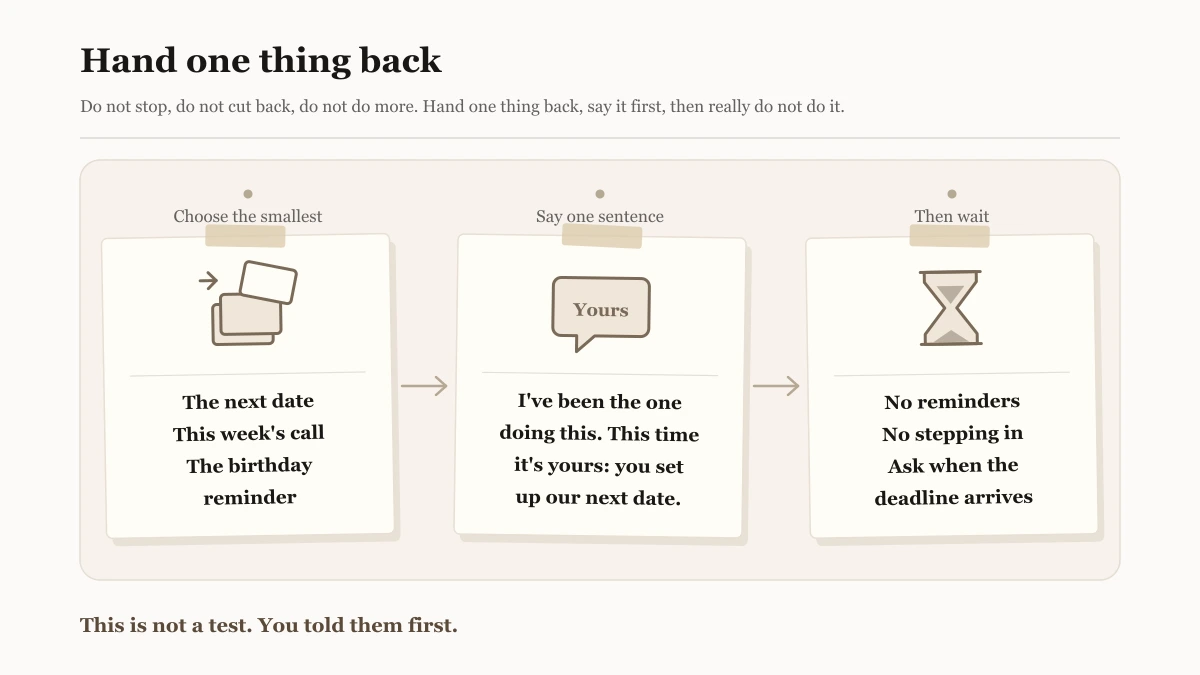
I would not stop, cut back, or do more. I would do one thing: hand one piece of the work back to them, say so first, and then really not do it.
Choose. Pick something you have been doing that would not happen otherwise, and pick the smallest one: the next date, this week’s phone call, the reminder about their family’s birthday. Do not pick the heaviest thing, like finally having the big conversation. Leave that for later. There is a second rule I find even more useful: pick the thing they would actually enjoy doing, not the thing you are angriest about. What you are angriest about may be that you always speak first after a fight, but “speak first after a fight” is almost impossible to hand over. If they love food, hand them “where we eat next.” The first thing they do should be something that costs them nothing to do.
Say it. One concrete sentence: “I’ve been the one doing this. This time it’s yours: you set up our next date.” You are handing over a thing, not a feeling. “Care more about me” cannot be handed over. “Set up the next date” can. Pick an ordinary moment to say it. Not in the middle of a fight, and not right after they have just done something else for you, or it turns into settling accounts. Say it and stop. Do not add “or never mind,” and do not recount how many times you have done it. One sentence is enough.
Wait. Really do not do it. No reminders, no quietly stepping in when they seem to have forgotten. Set a deadline in your own head, a week or ten days, and hold your question until then. The hard part of this step is holding back from doing it for them. By day three you will want to ask, or just book the table yourself and be done with it. What I do is type the reminder into the notes app on my phone and never send it. When the deadline arrives I look at it again and decide, and most of the time it is no longer needed.
One more thing before you do it: this is not a test. You told them first, and tests do not come with the answers attached. What you are doing is putting something that was always meant for two people back between the two of you, and letting them know it is in their hands now.
If you are long distance and mostly on text, the move is the same. “You call this week.” “You pick the time for our next video call.” Both can be handed over, and once they are, your phone stays on the table and you do not send first.
The point is that, for once, the thing has left your hands, and the moment it does, there is one thing in this relationship that is no longer done by you alone.
The four things you will ask next
“They did it, but half-heartedly. Does that count?” It counts. The first thing handed back will never look the way it looked when you did it. The restaurant may not be one you would pick, and the timing may be rushed. That is what it looks like when they do it, and it is not the same as not doing it. I would put your attention on “they did it” rather than “how well,” because how well can improve over time and only the first time is hard. Something you can say: “Thanks for setting it up. Next one’s yours too.”
“If I don’t remind them, they won’t do it. Isn’t that just waiting for nothing?” I would say no, because that week of waiting will show you something else: the thing did not get done, and the sky did not fall. One fewer date, and the relationship is still here. The birthday wish arrives a day late, and their family is fine. That tells you the thing can move slowly, and the space that opens up when it slows down is exactly the space they can walk into. Until now you have been filling that space too fast for anyone to step in. When the deadline arrives, something you can say: “I waited a week on that. I want to know if you remembered.” It is not an accusation. Say it and then listen to all of their answer.
“Doesn’t this turn me into someone who keeps score?” Here is how I separate the two. Keeping score is counting everything and saying nothing, until there is a ledger in your head they have never seen. Handing back is choosing one thing and saying it out loud first. One piles up inside you, the other gets set down between you. If you are worried about keeping score, the worry itself is a good sign. It means what you want is for the relationship to belong to two people again, not to collect reasons. The sentence you can say is the same one as before, “I’ve been the one doing this, this time it’s yours,” and the moment it is spoken, it stops being a ledger entry.
“What if I hand back a few things and they don’t do any of them? Does that mean they don’t love me?” By then, what you can bring to them has changed. You are no longer bringing “it feels like I’m the only one who cares.” You are bringing “I handed you three things and none of them got done.” Something you can say: “I handed you three things and none of them got done. I’m not asking you to explain. I want to know whether you don’t want to do them, or you don’t want this anymore.” Then listen. I believe their answer will be closer to what you need than any sentence in this essay. As for what changes first when someone is falling out of love, that is a different subject, and I wrote about it in The 5 Signs Someone Is Falling Out of Love with You.
Caring was always meant to be both of yours
You feel like the only one who cares because what you want is reasonable: a relationship is supposed to have two people who care the same, and all you want is to get back to that. The way I see it, this relationship has been tilted for a while now. The tilt is that everything landed on you; they got used to it, you got used to carrying it, and neither of you treated it as a problem until you started counting.
To set it straight, waiting for them to notice on their own mostly does not work, and tearing the whole relationship down to rebuild it is not needed either. What you can do tonight is hand one thing back, and give them a fresh chance to care. If they do it, the two of you start getting back to being two people, beginning with that one thing, and later you can hand back a second. If they do not, you are no longer guessing alone; you are holding one concrete thing you can talk to them about.
What you want was never for them to do a little more. It is for this relationship to become something two people care about together again, and that first step can be yours.