5 Signs Someone Is Falling Out of Love With You

It’s 11:40 pm and you’re scrolling up through your chat history again.
You’re not looking for anything in particular. You just want to check one thing: when was the last time they started a conversation?
Your thumb scrolls for a long time before it stops. Last Tuesday. And the message was “can you grab the package.”
You stare at that date, and a question surfaces — slowly, because part of you doesn’t want it to finish forming:
Are they falling out of love with me?
If that question is what brought you here, let me say this first: checking your phone at midnight is about the most natural thing you could be doing. Nobody knows the everyday rhythm of this relationship better than you — whether you see each other every day or say goodnight through a screen. So when the rhythm changes, you are built to be the first one who notices. Something feels off but you can’t name it — and that’s the worst part, not being able to say what exactly you’re grieving.
So that’s what this article is for: turning “I can’t name it” into “I can see it.” I’ll give you five signs. But let’s agree on something up front — these are windows to look through, not a verdict. By the end you won’t get a flat “it’s over” or “you’re imagining things.” You’ll get something more useful: a way to watch, a way to ask, and a way to hold on to yourself while you find out.
How love actually shrinks
One study left me with a comparison I haven’t been able to forget. The moment it captures couldn’t be smaller: one person says “hey, look at that bird outside,” and the other one either looks up or doesn’t. Couples whose relationships lasted had answered 86% of these little invitations. Couples who ended up divorcing had answered 33%.
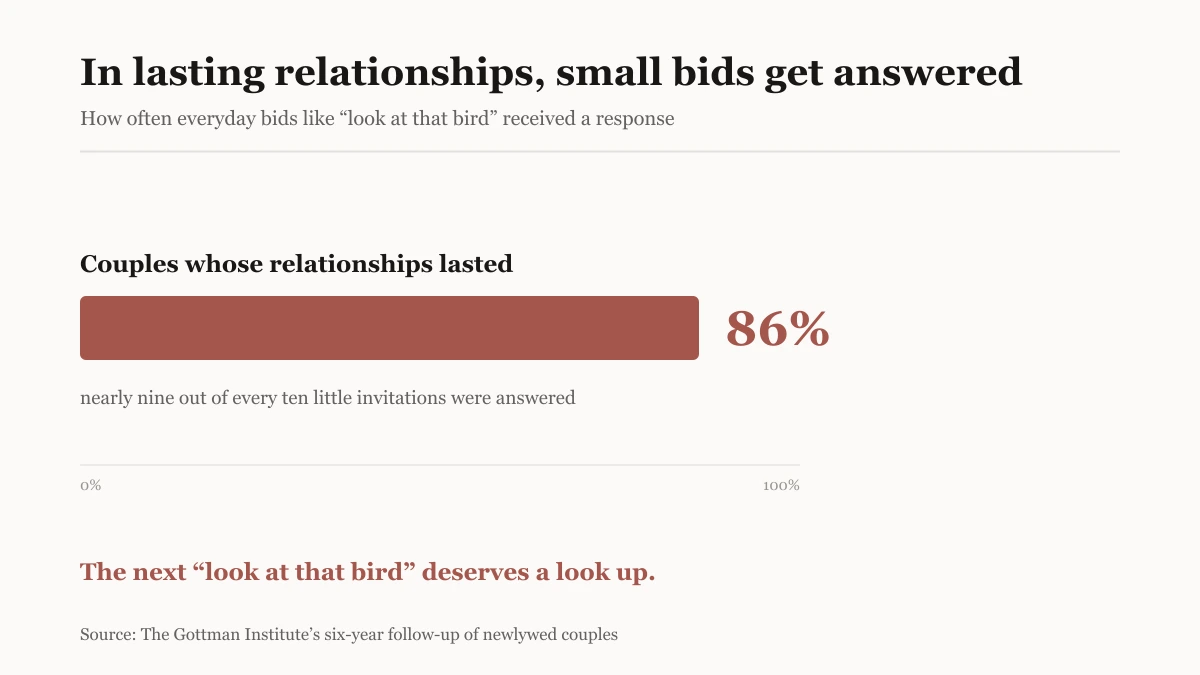
Here’s what I take from those two numbers: if you want to read the temperature of a relationship, the big days may not be the most accurate place to look — these three-second responses are. So if lately you keep feeling that you “can’t put your finger on it,” I’d ask you to take that instinct seriously. It may well be the sound of those small responses going missing, one at a time — it just needs a few words to explain itself.
Sign 1: Sharing has become a one-way street
Think back to when you first got together. They photographed their bubble tea while waiting in line, just to send it to you. They complained to you about the annoying guy in their meeting. They saw a very fat cat on the street and felt an urgent need to tell you about it.
And now? Their whole day has shrunk into the word “fine.” You ask how it went — fine. You share something of yours, and you get “haha” or “nice,” and then nothing. The two of you still talk. It’s just that the person starting the conversation is always you.
Why does this matter so much? One survey of people’s everyday exchanges found that intimacy is tied to moments where you share something and the response makes you feel understood and cared for. It looked at all kinds of relationships, not just romantic ones — but I believe it holds here too: intimacy doesn’t grow out of anniversaries or living under one roof. It grows in the moments that get caught. So when sharing turns one-way, you’re not just losing topics. They’re withdrawing their day — a piece of themselves — from you.
The line to watch: busy people go quiet too. My own way of telling the difference is whether they circle back — a busy person will drop a “can’t talk now, I’ll tell you tonight.” When even that stops, I start to worry that a story left unfinished with you no longer feels unfinished — or worth caring about — to them.
Sign 2: They can’t even be bothered to argue anymore
This is the sign most people misread. Fewer fights should mean things are better, right?
It depends on what disappeared. There are things the two of you used to fight about — them being late, your spending, whose family gets the holidays. Now the same things happen and all you get is “whatever,” “either way,” “your call.” It sounds like patience. But something in you feels uneasy, because you know the truth: they didn’t come around. They stopped negotiating with you.
An argument, however ugly, is still a two-person event. “Whatever” only takes one. And a different long-term record of couples holds a finding worth sitting with: among the couples who eventually divorced, one group didn’t fight their way there. On camera they chatted, disagreed, stayed perfectly calm — but the warmth was gone. No teasing, no softening, no reaching over. That group split up many years later than the loud, explosive one. They still split up.
So here’s my read: someone who still argues with you still cares how the argument ends. Someone who won’t even argue is already halfway out the door. Anger is a form of investment — and so is working things out calmly. What deserves your attention is “I can’t be bothered,” because sometimes that’s just leaving, written in a quieter font.
Sign 3: “Someday, we…” has vanished from their sentences
Early love can’t stop planning. Next long weekend, that concert next year, the exact breed of dog you’d adopt someday. Most of those plans never happen — that was never the point. The point is what they reveal: when this person pictures the future, you’re in the picture.
The way I see it, when someone starts falling out of love, the future tense often goes first. You suggest a trip next month and get “we’ll see.” You mention next year and they gently steer the subject somewhere else. My read is that it isn’t hostility. It isn’t even a tactic. They just can’t put a deposit down on a place they’re not sure they want to stay.
The line to watch: a person crushed by work also loses the energy to imagine the future — for a while. The difference is the scope. Are they tired of all plans, or only of plans with you? If they’re excitedly booking next month’s game with their friends while your trip stays parked at “we’ll see,” that gap is the signal.
Sign 4: Your small things stopped registering
I’ve always felt that loving someone does something to memory. They remember you hate cilantro, that your big presentation is Wednesday, that offhand comment about a restaurant you’d like to try. None of it is important — and that’s exactly why it matters. To me, being remembered without having to remind them is love in its most everyday clothes.
And my read is that when love recedes, this memory often goes early. You repeat things you’ve already told them. You remind them of dates they used to track on their own. The thing you were most nervous about this week comes and goes, and they forget to ask how it went. One by one, things that never needed a reminder start needing one.
The line to watch: people’s baseline memories differ — some folks can’t find their own insurance card. So don’t compare them to other partners. Compare them to who they used to be. The way I’d put it: they didn’t get forgetful. Their attention moved out.
Sign 5: You’ve caught yourself auditioning
This last sign isn’t in them. It’s in you — and I think it’s often the most accurate one.
Look at yourself lately. You draft texts before sending, editing “you never talk to me anymore” down to “you must be really busy these days.” You swallow the thing you need, because the mood is finally okay and you don’t want to spend it. They initiate once — once — and you’re so pleased it startles you.
You weren’t always like this. The scale tipped, and you started standing on tiptoe to level it. When love runs both ways, nobody has to perform this well. You started auditioning because some part of you already sensed that simply being yourself wasn’t holding them anymore.
If this one lands, I want to add something: it doesn’t mean you did anything wrong. It means you’ve been carrying more than one person’s share. I’ve written about that exact feeling in “I Like You, but I Will Not Prove It by Abandoning Myself.”
Before you count your score — wait
By now you may be ticking boxes. Three of five. Maybe all five.
Take a breath. These signs point at a direction; they don’t convict anyone. Life is full of things that make a person fold inward for a while — a project on fire, trouble in their family, a low season of their own. In those stretches, people also go quiet, lose the future tense, forget small things. And let me be honest with you about something: of these five signs, only the first two line up directly with the data — small bids going unanswered, and the warmth draining out of everyday interaction, have both been seen alongside relationships cooling. The other three are my own observation and judgment. And none of the five can see inside the specific person lying next to you, or on the other end of your calls.
So how do you tell the difference? I look at two things — and to be clear, these two are my own lens, not a finding from any paper. Treat them as angles, not answers.
First, scope. A low season is global: they’re flat with everyone, work included, friends included. Detachment is selective: they’re alive to the world and on mute only with you.
Second, repair. Someone who’s struggling usually patches it afterward — “sorry I’ve been off lately, it’s not you.” Someone on their way out often skips the explanation entirely — the way I understand it, explaining is something you do for a relationship you still intend to keep.
A two-week practice: the two-column note
Instead of another midnight scroll through old messages, here’s something more useful. It takes a pen and two weeks. It doesn’t require their cooperation. It doesn’t even require them to know.
Every night, for two weeks, write two columns — three minutes, no more.
Left column: what happened today. Only what happened, no interpretation. “I sent a restaurant link, read, no reply.” “They asked how my presentation went, unprompted.” Right column: what I made it mean. “Eating out with me annoys them now.” “Maybe they do still care.”
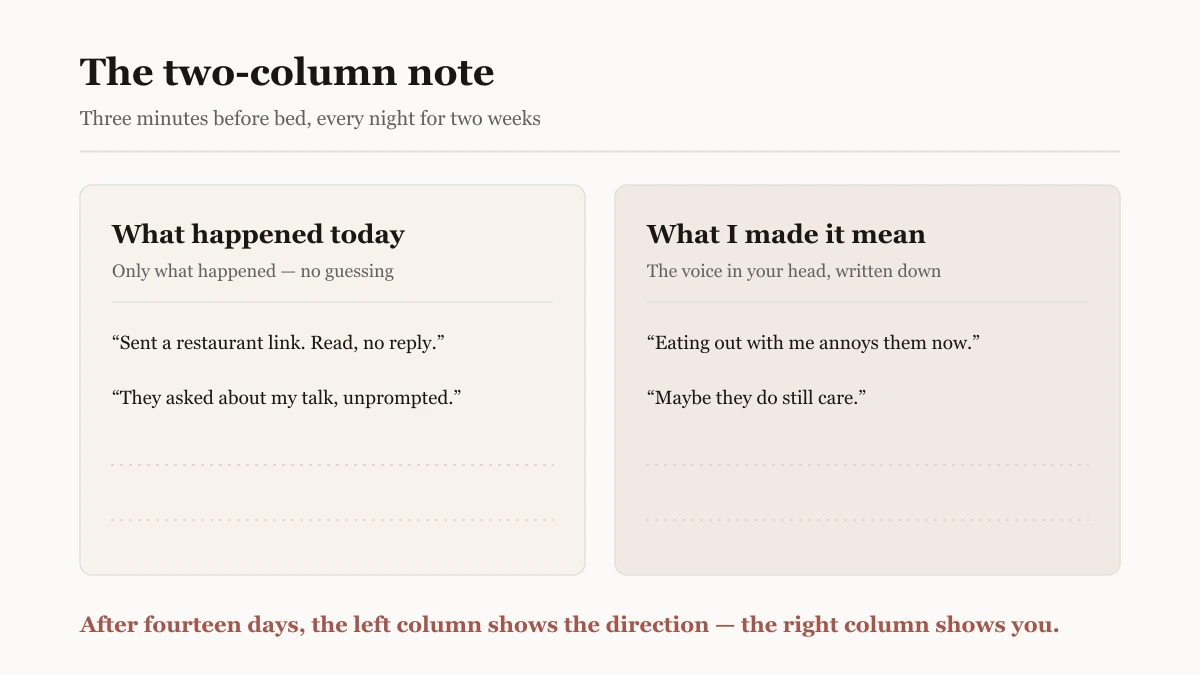
After two weeks, you’ll be holding two gifts. The left column gives you direction: on any single day, an off mood and a real exit look identical, but stretched across fourteen days, “occasionally distracted” and “steadily leaving” stop looking alike. The right column shows you yourself: which interpretations turned out to be overthinking, and which one keeps coming back. Some nights the left column will comfort you. Some nights the right column will show you how long you’ve been sad alone.
“Should I just ask them?”
If you’re asking that question, you’ve probably wanted to ask them for a while.
You can. But I’d avoid two things. First, don’t ask at peak emotion — right when they walk in, right after you’ve been crying, at two in the morning. Questions asked in those moments come out as accusations or pleas, and neither tone gets an honest answer. Second, don’t ask “do you still love me?” That question has exactly one safe answer. They will almost certainly say “of course, you’re overthinking” — and the topic closes, and you still won’t feel safe.
Ask something concrete instead, about what you’ve noticed and how it feels: “I’ve noticed I’m usually the one starting our conversations lately — have you felt that?” Or: “It’s been a while since we talked about future stuff. Do you feel it too?” There’s no accusation in those questions, so they don’t have to defend themselves — which means you have an actual chance of hearing something true.
Then hold on to their response, exactly as it happened. Did they pick the topic up, or wave it away? Whatever words they used, the response itself is the most honest record you’ll get.
Seeing it early means you still get to choose
I can’t tell you, from the end of an article, whether they still love you. The next fourteen days will be more honest than I can be.
But take this with you: the fact that you opened this page means you’ve stopped pretending everything is fine — and that matters more than you think. Pretending doesn’t pause what’s changing, and you’re already looking. The earlier you see clearly, the more options you still have. You can speak up, using a question like the ones above. You can keep watching quietly for a while. And if the answer turns out to be a hard one, you can begin, gently, to collect your energy and bring it back home to yourself.
And here’s something you may not be able to see yet. One day, looking back on this stretch of your life, what will matter most won’t be whether you kept this person. It will be that in your most anxious hour, you didn’t lose yourself — you still wanted the truth, you were still willing to be honest, you could still be kind to yourself. Those things don’t leave when a relationship does. They stay with you, and they travel well.
So whatever the answer turns out to be, it deserves to be seen honestly. I’ve come to believe that the ability to love fully and still be able to let go isn’t something anyone is born with — it gets practiced, one sleepless night like this one at a time. And if someday you find yourself facing the “after” questions, I’ve written “Is There Still a Chance? For Anyone Who Cannot Quite Let Go” — it’ll be there when you need it.
But that’s for later. Tonight, you’ve already done the hardest part: you stopped pretending. The rest, we’ll take one step at a time.