Is There Still a Chance? For Anyone Who Cannot Quite Let Go
In the first days after a breakup, there is really only one question in your head.
Not “what did I do wrong.” Not “what happens to me now.” Those come later. The one that arrives first, and keeps arriving, is short: is there still a chance?
People who ask it usually feel a little embarrassed about asking. The advice around you is remarkably uniform — let go, move on, time heals. As if still wanting them back were a failure of maturity. The research literature is considerably gentler about this than the people around you are.
The short answer: yes, the chance is real
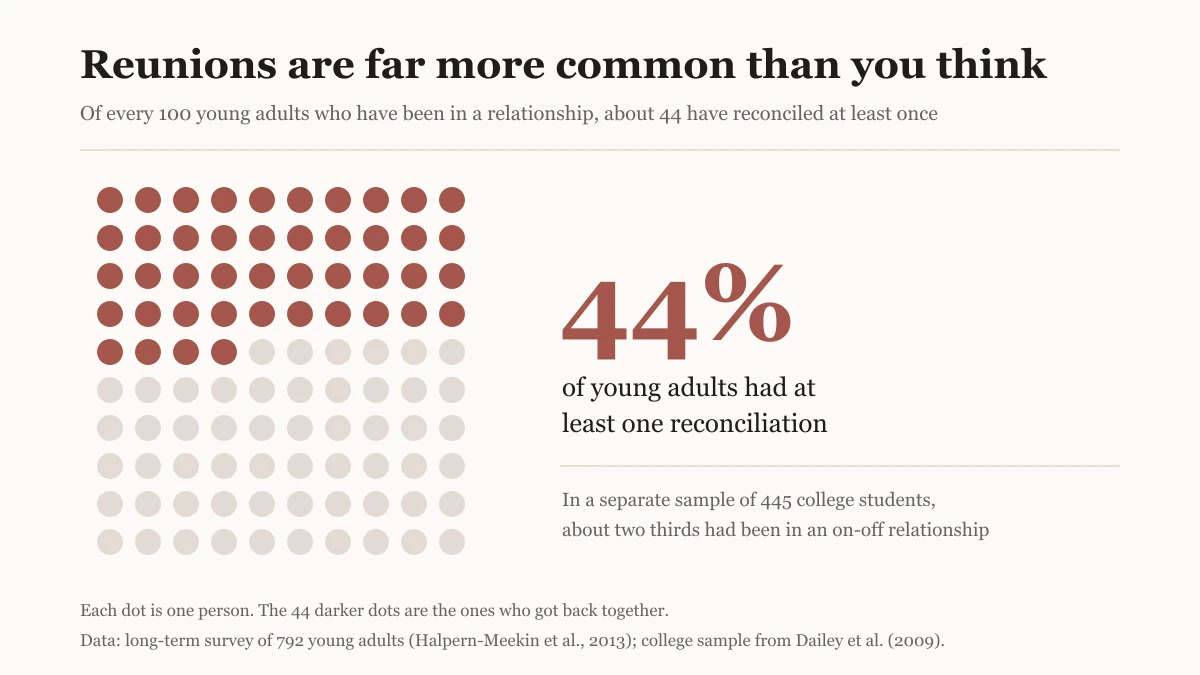
A long-term survey following 792 young adults found that among those who had been in a relationship in the past two years, about 44% had experienced at least one reconciliation — a breakup followed by getting back together.
A separate survey of 445 college students found a higher rate still: close to two thirds had been in a relationship that broke up and renewed.
Look at what those numbers actually say. Not “reconciliation is rare but occasionally happens.” They say that splitting up and finding your way back is one of the ordinary shapes a relationship takes. (That is the chart at the top of this piece: of 100 dots, 44 are filled in.)
So if you are still holding on to the thought — you are not strange, and you are not weaker than everyone else. A great many people have done the thing you are hoping to do.
A breakup is often a redefinition, not an ending
Someone went and interviewed couples who were living inside the on-again/off-again pattern, asking why they split and why they went back. The conclusion contains a line worth carrying around:
For these couples, a breakup “did not indicate the end of interdependence but rather a redefinition of the relationship.”
That sentence matters because it replaces an assumption.
In the moment, most people picture a closed door: together on one side, over on the other, nothing in between. But in real relationships, the period after a breakup is frequently not an ending. It is a state that does not have a name yet — both people still there, neither sure what they currently are to each other.
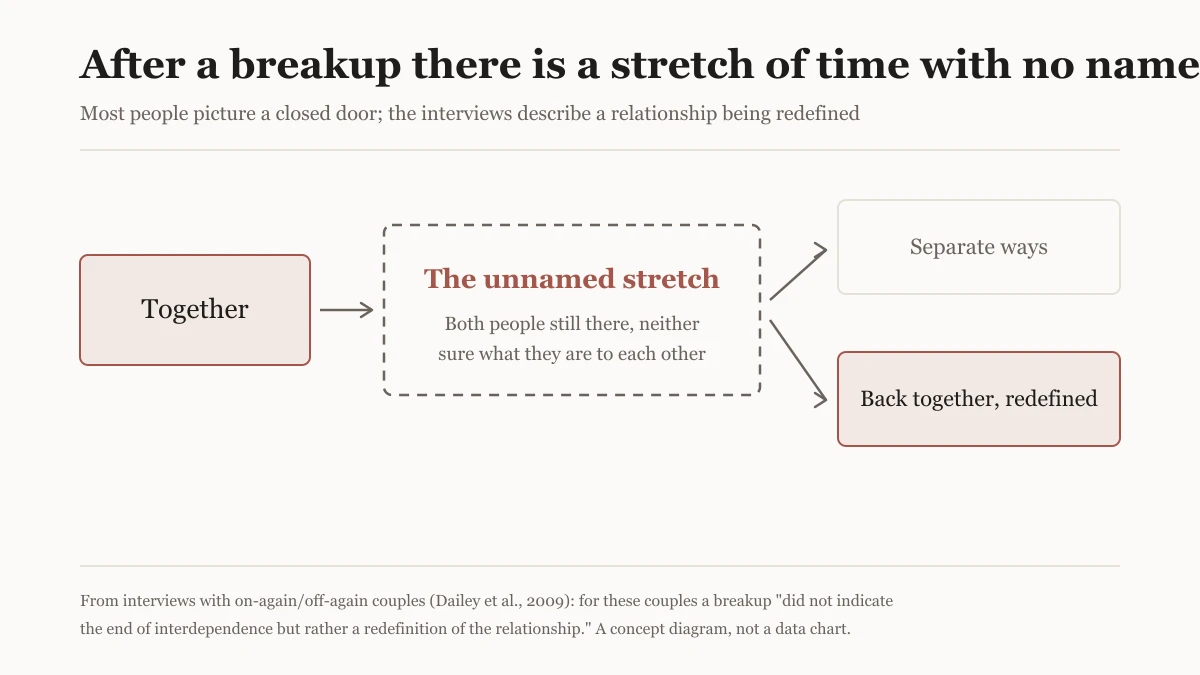
And it is inside that unnamed stretch of time that things remain negotiable.
When people actually go back
A survey of 274 people with on-off histories picked out several factors that showed up alongside “and then they got back together”:
- Lingering feelings for the ex — by far the most common, well ahead of everything else
- Uncertainty about what the breakup actually meant
- Not having started seeing anyone else
Together these point one way: the room for a reunion exists as long as the relationship has not been settled as finished.
Since that flexible period and the not-yet-decided feeling arrive together, I would not rush to trade one for a definite answer. You do not need an answer yet. And I think you are better off not going to get one.
The sentence that changes the whole approach
That same set of interviews also explained how reunions actually come about.
The answer is not that one person argued more persuasively, or used the right technique at the right moment. The interviewers’ account is that renewals happened when, after the breakup, the actual rewards of being together went up.
Sit with that for a second.
It means winning someone back is not a persuasion problem. It is a construction problem. The task is not “how do I get them to agree.” It is “how do I make going back genuinely worth more to them than it was on the day we ended.”
That sounds harder than a script. In practice it is easier, because it is something you can start on your own — you do not need the other person to cooperate first, and you do not need to catch them at the right moment.
What that looks like in practice
Turning the above into things you can actually do, here is what I would suggest:
Let the worst days pass first. One study had people predict how bad a breakup would feel, then measured them repeatedly across the three months that followed. What they overestimated was the intensity of the pain, not its duration — it hurt less than they expected it to. The useful implication: the feeling that you cannot survive this is partly the volume being turned up right now. It comes down. And once it does, you are capable of doing the things that actually help.
Do not push for an answer. Rather than asking for a commitment, let things stay discussable. If they have clearly said no, take that seriously: continuing to push is what converts “undecided” into “decided.”
Work on the specific problem. What ends relationships is rarely an abstract loss of love. It is usually one thing that kept happening. Come up with a concrete, sayable answer to that thing — not “I’ll change,” but “next time this comes up, here is what I will do.”
The difference looks roughly like this. “I’ll make more time for you” is a promise; “Wednesday evenings are blocked and I don’t schedule work then” is a practice. “I won’t talk to you like that again” is a promise; “when I notice myself getting defensive, I’ll say I need ten minutes” is a practice. Promises sound better. Practices sound clumsy — but only a practice can be checked against reality, and something checkable is exactly what your situation calls for.
Make the change visible now. Promises are worth the least right after a breakup, because everyone knows they were made under the fear of loss. What carries weight is that you are already doing it — whether or not they come back. It is also the only part you fully hold: you cannot decide whether they return, but whether the change actually happens has nothing to do with them.
Stay in low-pressure contact, not high-pressure pursuit. A message that needs no reply and a phone call demanding a decision do opposite things to a relationship. One leaves a door open; the other asks them to decide right now whether to walk through it.
So should you go no contact?
This is the most frequently asked question of all, and the answers online usually arrive with a number attached: thirty days of silence, first message on day seven, meet up after a month.
Here is what I checked: those day counts do not come from any data I could find. I went through the literature on on-again/off-again relationships and post-breakup contact and turned up nothing testing how many days of silence works best — if someone can point me to it, I will gladly add it and correct this passage. As far as I can see, those numbers were set by the industry that sells breakup coaching, and following them will not buy the certainty they imply.
The surveys above do have something to say about distance, though, and it points somewhere different from those rules.
Reunions show up more often while the other person has not started seeing someone else and has not settled the relationship as finished. Neither of those is achieved by disappearing, and neither is achieved by constantly showing up. They both point to the same posture: still present in their life, but not generating pressure.
The hard part is never really the rule. It is one very specific moment: the phone in your hand, the thread already open, or the number already pulled up, your thumb resting on the call button. You know the call might make things worse. You also know that if you do not make it, tonight will pass like the last one did.

There is no correct answer for that moment. But there is a question that helps: is the thing I am about to say for them to hear, or for me to feel better? Both are entirely human. The difference is that the second one usually does not need to be sent — write it down, look at it again tomorrow, and that is generally enough.
So instead of asking how many days to go silent, ask two sharper questions:
- Is this contact giving them something, or asking them for something?
- If they were never coming back, would this thing I am doing still be worth doing?
The first question filters out most of the behavior that costs you ground — pressing for answers, re-explaining yourself, asking to be understood are all forms of asking for something. The second filters out most of the changes that will not last: anything done to be witnessed stops the moment nobody reacts to it. What you do for your own sake survives, and that happens to be the version that carries weight.
As for whether to pull back for a while, the honest answer depends on you. If every contact leaves you more out of control and more desperate to press, then distance is not a tactic. It is something you need for your own sake.
Finally
Getting back together usually gets discussed at two extremes: either the right technique will win them back, or wanting a reunion at all means you have not grown up.
In fact reunions are common — you are not an outlier. There is an unnamed stretch of time after a breakup in which things are still open. And whether a reunion lasts depends on whether something genuinely improved while you were apart.
So if you still want to try — that is not immaturity.
Just remember what you are trying for. Not the day before the breakup; that version already demonstrated that it did not work. What you are reaching for is a better one.