Everything Was Fine, Then They Vanished: Why Being Ghosted Hurts So Much

The last message in the chat is yours. Above it sits the “good night” they sent the evening before everything stopped, and a little further up, the plan you made together to see an exhibition this weekend. The next morning you asked what time they wanted to leave. No reply came. You sent a few more messages and tried calling once. Now you keep scrolling up through the conversation, looking for the moment it went wrong, and one question keeps circling: “We were fine. How could they just disappear?”
What hurts most right now is that you can’t even tell whether this counts as a breakup. Nobody said it was over. You’ve already been sad for days, and yet you’re still holding the phone, telling yourself to wait a little longer.
What ghosting is
Ghosting is when one person in a relationship ends it without ever saying so. There is no breakup conversation and no explanation, only silence: messages go unanswered, calls aren’t picked up, and sometimes your account is blocked. Disappearing takes the place of “Let’s break up.” People also call it being “vanished on.”
When someone goes silent after an argument, it usually follows a fight, and the point is to cool down first. When someone drifts and grows cold, the replies get slower and shorter over a stretch of time you can see. Ghosting is different from both of those kinds of quiet: everything was fine one day, and the next day every channel goes quiet at once, with no fight and no warning.
So if you keep looking back for an argument or a cold spell and can’t find one, there’s no need to blame yourself for not seeing it sooner. From what I’ve seen, ghosting often comes with no visible turning point beforehand.
Why ghosting hurts so much
As I see it, ghosting hurts this much because it takes away the ending, the reason, and the goodbye all at once, and leaves you with nothing but a silence that never answers. That pain comes from four places.
There is no ending, so you are left waiting
No one ever said the word “over,” so the relationship just hangs there. You don’t know if it has ended, so even after days of sadness, you still can’t stop waiting. I think every time your phone lights up, your first thought is that it might be them. When it isn’t, the waiting resets. By the end of the day, switching back and forth between grieving and waiting has worn you out completely.
There is no reason, so you end up blaming yourself
When no one tells you why, your mind goes looking for an answer. You pull up the last few days of messages and read them line by line. Was it something you said? Did you reply too late that night? Is there something about you that wasn’t enough? Almost every reason you can find points back at you, because you can see nothing at all of what was happening on their side. To me, this is the cruelest part of ghosting: they left no explanation, so the only material you have to explain it with is yourself.
It was so sudden that even the good times start to look doubtful
The person who wished you good night was gone the next day. My guess is that this drop makes you go back and question the time you had together. Do the things they said still count? Were you the only one who took those happy days seriously? Follow that thought far enough and you start to doubt your own judgment of people, wondering whether you’ll be able to believe your own feelings the next time you fall for someone.
You never got to speak, so the pain has nowhere to go
There is so much you want to ask and say. You might even want to be properly angry for once. But nobody is on the other end listening. Your messages get no response and your calls go unanswered, so the sadness and anger just keep circling inside you. In my view, that is part of why it lasts so long. Feelings that never find a way out keep pressing down on you.
How to find your way out of the pain
My suggestion is this: don’t wait for them to hand you an ending. Draw the line under this relationship yourself, then slowly bring your attention back to your own life. Some of what they never gave you, you can give yourself, and none of these steps depend on a reply from them. You can begin today.
Give the silence a deadline
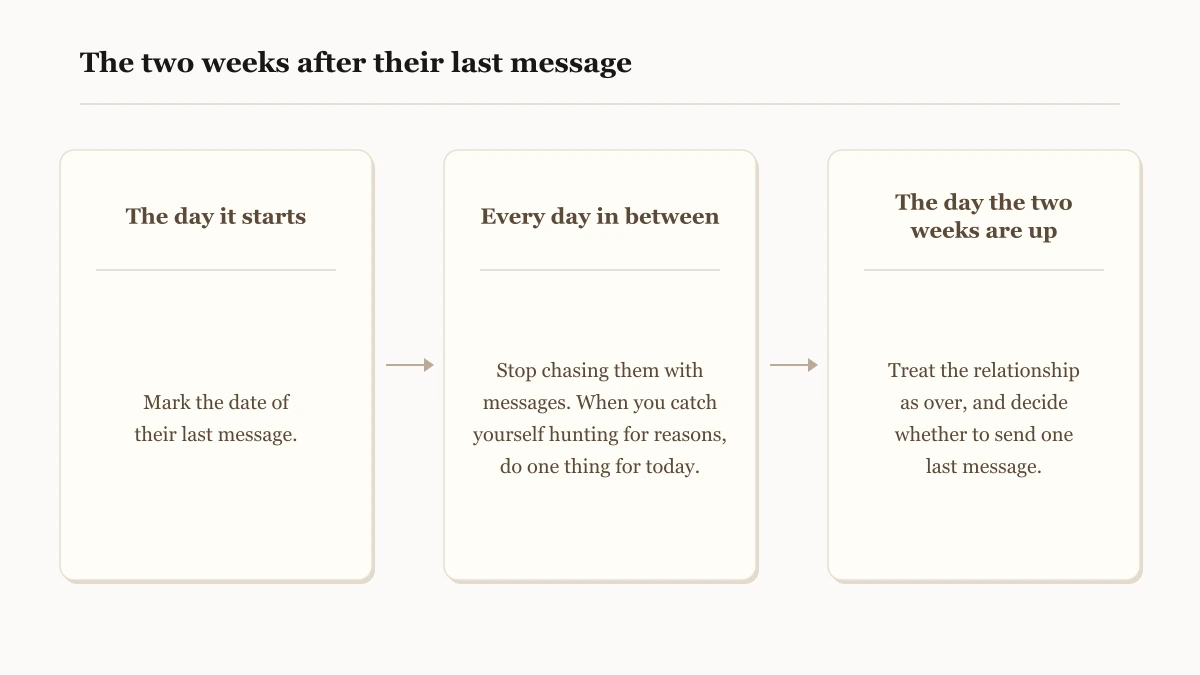
If nobody is going to call it over, you can pick the date yourself. I’d suggest two weeks, which is enough. Count them from their last message, and mark that starting day on your calendar. For those two weeks, stop chasing them with messages and calls; whatever you have already sent can stay where it is. If two weeks pass and you have heard nothing at all, treat the relationship as over. That day is also a good moment to think about whether you want to send one last message.
Setting a date doesn’t mean you’re forbidden to feel sad after it. It means that from that day on, you no longer have to wait.
When your phone lights up after that, you don’t have to wonder whether it’s them. When you’re sad, you can simply be sad, without also waiting for them at the same time.
Maybe what you can’t let go of is the fear that something has happened to them. If you happen to know someone in their life, ask once. Once you know they’re safe, stop there. The way I read it, if they’re safe, this silence is something they chose, and you don’t need to keep looking for the reason on their behalf.
Stop searching for their reasons
When your mind starts replaying those last conversations again, pause and say to yourself: “I don’t know why they did this, and that question isn’t mine to answer.” Not knowing can be an answer in its own right. Choosing to end a relationship by disappearing says something about the way they chose to end it. It isn’t a score they gave you as a person.
After you pause, swap that thought for one thing that belongs to today. That could be replying to a message someone else sent you, getting tomorrow’s work ready, or clearing off your desk. The urge to search won’t stop the first time. Each time it comes back, swap it again.
Keep the good days
Because they left by disappearing, it is tempting to throw out the whole relationship. But I believe the happiness you felt during those days was something you really lived. The meals you shared and the things you laughed about happened to you, and you don’t need them to vouch for any of it. Whether they meant it at the time is something you have no way of knowing now, and you don’t have to rush to a verdict about them. What you can be sure of is that you meant it, and their leaving doesn’t change that.
For now, move the photos and messages into a folder you won’t see every day. There’s no need to delete them yet. When you can look at them someday without it hurting so much, decide then whether to keep them or delete them.
Give the things you want to say somewhere to go
You can send one last message, or not send anything. Both are fine. If you do send it, my advice is to keep it to one message and say only your side: don’t ask why, and don’t ask for a reply. Something like:
We haven’t talked in a long time, so I’m taking it that we’ve broken up. Thank you for the time we had together. I’m going to take good care of myself.
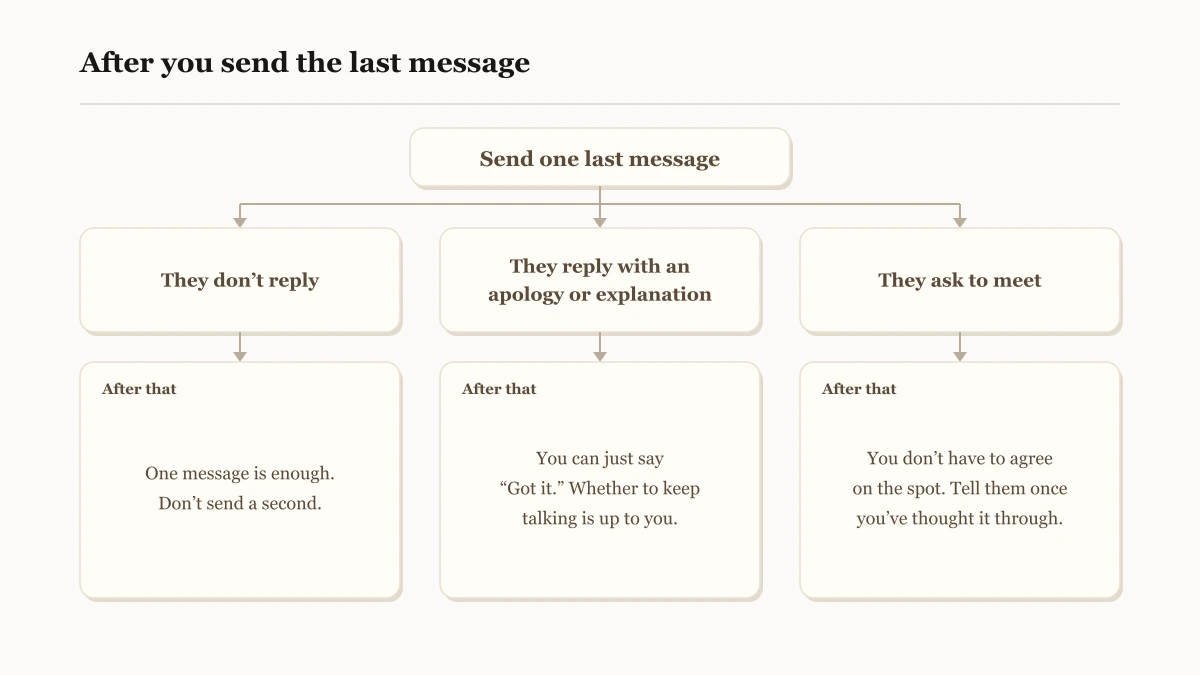
The point of this message is not to bring them back. It lets you say the ending out loud yourself. After you send it, one of three things is likely to happen:
- They don’t reply. The relationship stops here, and one message is enough.
- They reply with an apology or an explanation. You can simply answer “Got it.” Whether to keep talking is up to you, and you don’t have to jump into a conversation just because they’ve finally said something.
- They ask to meet, or say they want to start over. You don’t have to agree on the spot. You could say: “I need to think this through first. I’ll let you know when I have.”
If you’d rather not send anything, you can tell someone you trust everything you would have said: what they did, how sad you are, how angry you are. Once those words are spoken, your feelings have somewhere to go, and you aren’t holding them in by yourself.
Put away the things left halfway
Because it ended so suddenly, a lot of things were left halfway: the exhibition you planned to see this weekend, the jacket they left at your place, the conversation still pinned to the top of your chat list. Seeing them every day, I’d say, keeps reminding you that the day it stopped hasn’t passed yet.
You can put them away one at a time. Cancel the exhibition, or go with someone else. Put the jacket in a bag somewhere out of sight and decide later whether to give it back. Unpin the conversation and let it sink down the list like any other chat. Every item you put away is one less reminder waiting for you each day.
If they show up again much later
A few weeks later, a message might suddenly arrive: “Long time no see, what have you been up to?” The tone is casual, as if you’d talked yesterday.
You don’t have to reply right away. For me, whether to reply at all depends first on whether they’ve accounted for the time they disappeared. If you want to ask, one question is enough: “What happened during the time you suddenly disappeared?” If they’re willing to explain properly, then decide whether to keep talking. You could meet once to finish the conversation, or you could hear them out and leave it there.
They might play dumb instead: “What do you mean, disappeared? I just had a lot going on.” Or they might skip your question and carry on chatting about something else. In that case, send one clear message that closes the matter: “You didn’t contact me at all during that time, and I’ve taken it that we’ve broken up. If you don’t want to explain, then this is where we end.” After that, if they send more light, casual messages, you don’t need to answer them. If they turn up again a while later, you don’t need to explain yourself a second time. Mute the conversation, so their messages don’t pop up while you’re busy living your life.
They never said goodbye, but you can still end it well
My sense is that the pain of being ghosted drags on because there is never a point where you can stop. No day is clearly the day it ended, and no sentence lets you nod and accept it. The questions nobody answers are left for you to keep asking yourself, over and over.
Wanting some kind of explanation is a reasonable thing to ask for. To my mind, two people who were together owe each other at least the knowledge that it’s over; that is the most basic thing a relationship asks for. It hurts this much because you took this relationship seriously.
It’s all right that the last message in that chat is yours. That is what it looks like to have been sincere. Live the days ahead at your own pace, and keep doing, one by one, the things you had already planned. They never said goodbye, and you can still move forward well.
Sources
Research and sources this essay draws on.
- Emotional experiences of ghostingThe Journal of Social Psychology, 164(3), 367–386
- Ghosted?: Navigating strategies for reducing uncertainty and implications surrounding ambiguous lossPersonal Relationships, 27(2), 433–459
- “I Guess I’ll Never Know…”: Non-Initiators Account-Making After Being GhostedJournal of Loss and Trauma, 25(5), 395–415