What Is a Toxic Relationship? Common Signs to Look For

Back home that night, the words “toxic relationship” came up as you scrolled, and you started reading. Several of the lines sounded familiar enough to stop you: having to say where you are at all times, being made the joke in front of other people, every argument somehow ending with you as the one at fault. Earlier that evening, the food had barely reached the table when your phone lit up. “Where are you? Who are you with?” You took a photo of the table, sent it, waited until it showed as read, and only then could you turn back to your friends and pick up the conversation where it had stopped. Now you close the page, and the question is still there: is my relationship toxic?
You clicked into those pages because something has been making you uncomfortable, and instead of pretending it isn’t there, you want to see it clearly. You also still care about this relationship, which is why you want to know what it has become.
The questions you keep turning over
“If this really is toxic, how can I still love them this much?”
You can love them deeply and still have been hurt in this relationship; the two don’t cancel each other out. Here is how I see it: you still love them, but that doesn’t mean you have to pretend you weren’t hurt.
“I’m always the one who apologizes after a fight. Does that mean the problem is me?”
How often you apologize says nothing about who was right. Think back to the last time you said sorry. Did you say it because you saw what you had done wrong, or because the evening would not move on until you did? If it was to get through the evening, that apology was a way to end a hard silence, and it doesn’t mean you actually did anything wrong.
“They’re good to me sometimes too. Is it still toxic, then?”
The good times are real, and I’m not asking you to treat them as fake. Good and bad can live in the same person, so counting the good days won’t tell you whether this relationship is toxic. What tells you is what happens on the other days.
“They’ve been under a lot of stress lately. Shouldn’t I be more understanding?”
Wanting to understand them is a kind impulse. To me, understanding means seeing someone’s struggle and choosing to carry a little more, in an amount you decide. If every time they are under stress, you are the one absorbing their temper and their coldness, what you are carrying has gone past understanding.
“Maybe I just get upset too easily?”
When the same words and the same treatment keep coming back, getting upset again and again is a natural response. Rather than asking whether you get upset too easily, I think the better question is whether the things that upset you happen too often.
What a toxic relationship is
The meaning
I would explain “toxic relationship” this way: one person in a relationship repeatedly treats the other in certain ways. These might include controlling where the other person goes and whom they see, belittling them, refusing to accept their feelings and memories, punishing them with coldness and silence, or making them pay for saying no. Over time, the person on the receiving end goes along with their partner’s wishes more and more often, and the relationship hurts you more than it supports you. The key word is “repeatedly.” Every relationship has a harsh sentence or a badly handled fight now and then. The phrase describes the same treatment showing up again and again until it becomes how the two of you relate.
How it differs from ordinary fights and rough patches
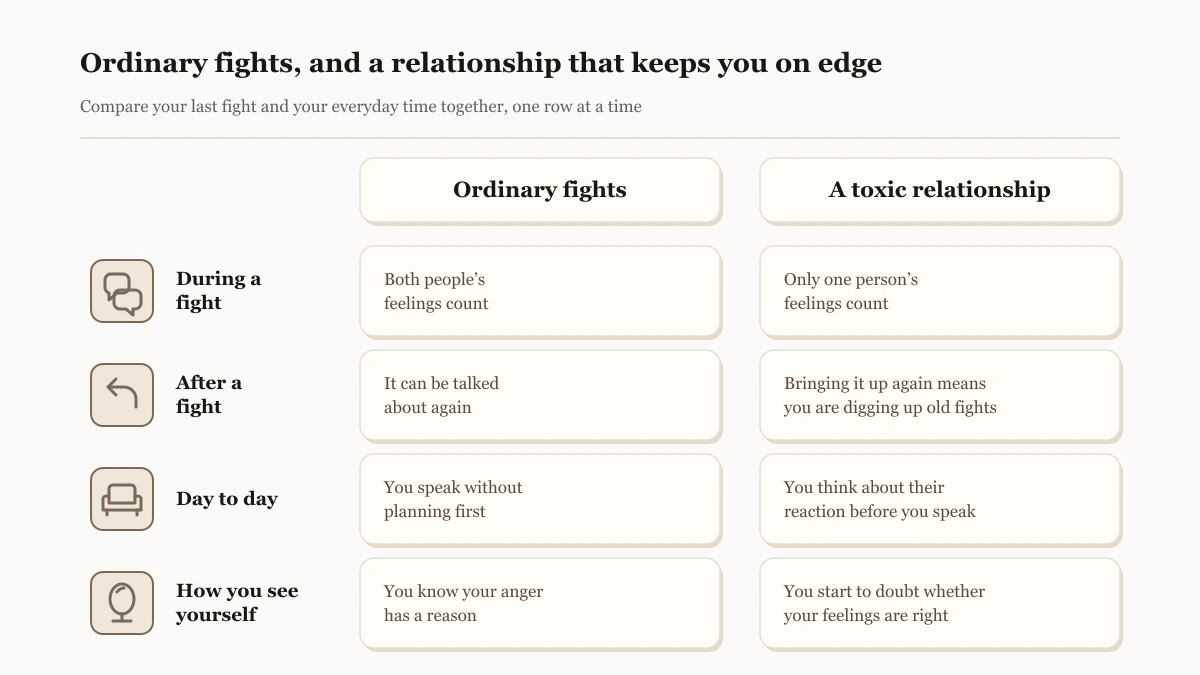
All couples argue, and all couples go through rough stretches; neither of those makes a relationship toxic. From what I have seen, ordinary arguments go both ways. Each of you says how you feel, and each of you hears the other. Afterward, whatever started it can be raised again, and when you’re angry, your anger is treated as having a reason.
In a toxic relationship, the same things keep happening, and they always lean the same way. The same person gives in, the same person gets told they’re overthinking, and the same person gets accused of dragging up old fights for wanting to talk it through. Over time, you become more and more careful around them.
Two common misunderstandings
The first is “They keep tabs on me and get jealous because they love me so much.” I believe they may care about you a great deal. Someone who cares can feel jealous and can say, “You two seem really close, and it makes me a bit uneasy.” That is telling you how they feel. But deciding whether you can go, or whom you can see, takes the choice out of your hands.
The second is “A toxic relationship must be full of screaming.” Not really. Often it is quiet: a joke made in front of other people, a sigh when you get home late, a “you’re remembering it wrong.” Each moment is too small to bring up, which is why it can take a long time before you notice it yourself.
Common signs of a toxic relationship
They need to know where you are and who you’re with
You have to say where you’re going before you leave and send a photo when you arrive. If you’re slow to reply, the calls come one after another. Sometimes it’s your phone: they want to read your messages or have your passcode, because “if you haven’t done anything, why can’t I look?” So you start planning how to report in before you go out, and thinking about how they’ll read a message before you reply to anyone else.
They make you the joke in front of other people
In front of others, they say you’re clumsy, that you can’t even get the small things right. Everyone laughs, and so do you. In private, when you say it bothered you, the answer is “It was just a joke. Can’t you take a joke?” Little by little, you learn to laugh along in public and work through the comment alone afterward.
Your feelings and your memory keep getting rewritten
You tell them something they said that day really hurt, and they say “I never said that,” “You’re remembering it wrong,” or “You’re just overthinking it.” By the end, the argument is no longer about what they said. It’s about why you care so much, and somehow you’re the one apologizing. Later, before you even mention that something hurt, you are already doubting your memory or coming up with their excuse for them.
Their jealousy becomes something you have to explain
You talked with someone a little longer than usual, or left a comment under someone’s post, and that means a whole evening of explaining. After an afternoon apart, the first thing you deal with when you get back is their mood, not whether you had a good time. Over time, you work out how you will explain a conversation before you even have it, and sometimes you just keep it short.
Saying no comes with a price
You say you’re too tired to go out tonight. They say, “Fine. You never care what I want.” For the next few days, every small thing brings it back up: that night you didn’t stay with them. One no turns into days of cleanup. So before you say no, you add up the cost, and you end up saying yes.
They go quiet until you give in
After an argument, they stop answering messages and calls, and won’t look at you when you’re together. They don’t say how long it will last or what they’re angry about. The silence only ends when you go to them and say sorry first. Now, the moment their expression changes, you put away whatever you were going to say so it can’t become a fight.
Extra sweet after a fight, and then it happens again
After a big fight, they’re suddenly gentle. They bring you your favorite food and promise it won’t happen again, and for a few days things are so good you think it’s all behind you. Then one day, the same thing happens. During the good days, you become even more careful, hoping to make them last.
Your life gets handed over a little at a time
At first you just skip one get-together because they’d be upset. Then a hobby you love gets set aside because they think it’s a waste of time. Then you barely have any time to yourself. You never said you were giving these things up; each time, it just felt easier to skip it this once. In the end, before doing anything at all, you ask yourself whether they’ll be upset.
Is my relationship toxic?
The first thing I would look at is whether you are always on edge around them. You may recognize one or two of the eight signs above, or several. In my view, the count isn’t the point; even a good relationship can show one or two of them once in a while. What matters is whether being on edge has become the normal way you are together. Ask yourself: “When you’re with them, are you relaxed, or are you constantly checking whether you’ve said the wrong thing?”
Relaxed means you speak without rehearsing; if you say something wrong, it’s just wrong, and you both laugh it off. On edge means you run every sentence past their likely reaction first, and one wrong word leaves you anxious for the rest of the night. If thinking about time with them brings up that rehearsing feeling first, and it has been that way for a long while, my judgment is that this relationship has taken on a toxic shape.
What to do: write down what happened
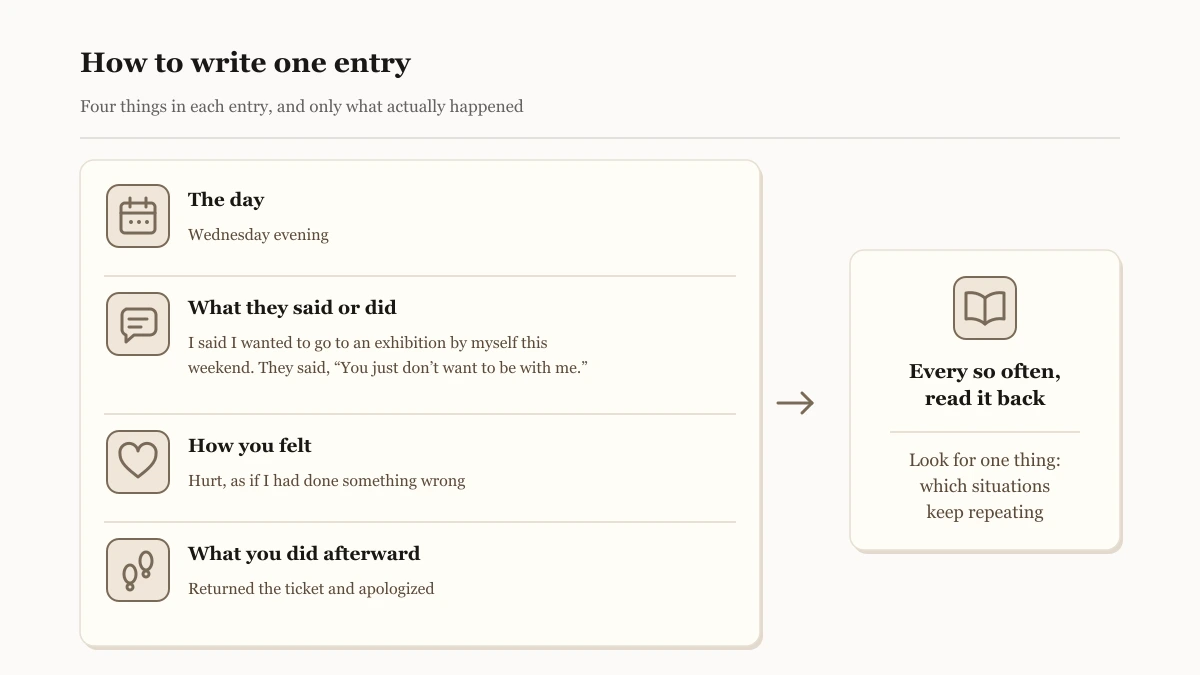
Stopping to look closely at a relationship that unsettles you is already a hard thing to do, and you are doing it. Starting today, I suggest writing down what happens. Keep it somewhere only you can see, such as a notebook or a note on your phone that only you open. Each entry gets four things: the day, what they said or did (in their own words where you can), how you felt in the moment, and what you did afterward. For example: “Wednesday evening. I said I wanted to go to an exhibition by myself this weekend. They said, ‘You just don’t want to be with me.’ I felt hurt, as if I’d done something wrong. I returned the ticket and apologized.”
Only put down things that actually happened. What they were planning in their head, or what kind of person they are, can stay out of it. Every two or three weeks, find a quiet moment and read it back, looking for one thing only: which situations keep repeating.
My reason for starting here is that, from what I have seen, what this kind of relationship most often wears away is your trust in your own memory. The next time you hear “I never said that,” you’ll have your own record to check. It’s written for you. It isn’t evidence for confronting them, and it isn’t there to help you win.
Four things you’ll probably ask next
Should I tell them, “I think we’re toxic”?
I’d leave the word “toxic” out. It sounds like a verdict, and my guess is they would hurry to defend themselves, and the two of you would end up arguing about whether the word fits. It’s easier to start with one thing that just happened, something you both remember, and talk only about how you felt: “What you said about me in front of everyone just now really hurt.” Then stop there. You don’t need to follow it with a list of everything they’ve done before.
My friends say they’re bad for me, and I don’t want to hear it. What do I do?
It’s okay not to want to hear it. You can listen to what your friends saw without accepting their conclusion. “They’re bad for you” is a judgment. “At dinner that night, they called you stupid in front of everyone” is something that happened, and that is the part you need. Next time it comes up, you could say: “I know you’re worried about me. I want to think it through myself first. Can you tell me what you saw that day?”
What if they find what I’ve written?
Keep it somewhere they don’t normally open, and don’t overthink it. That might be a small notebook that stays in your own bag, or a note on your phone with its own passcode. Write it in a way that makes sense to you; a date and a few key words are enough. This record is for you, and I hope you can write it without worrying the whole time about being seen.
Once I see that it’s toxic, do I have to break up?
Not necessarily, and you don’t have to decide today. My view is that whether to stay is a big decision, and it should rest on what you have seen clearly, not on one terrible night. Here is one small thing for today: pick something you would normally check with them first, like where to go this weekend or what to have for dinner, decide it yourself this time, and follow through. The feeling of deciding things for yourself can start coming back from something that small.
Your feelings have always counted
This is how I see it. You doubt yourself now because, all this time, every time you were checked up on, made fun of in front of others, or told you had remembered it wrong, you became a little more careful. After enough of that, you started waiting to see their reaction before you trusted what you felt.
Wanting to take good care of this relationship while no longer living on edge every day is a reasonable thing to want. In a good relationship, you can relax around the other person, say the wrong thing now and then, and keep your own friends and your own time. What you want is simply what a relationship is supposed to look like.
My suggestion for the days ahead: the next time you catch yourself about to swallow your words around them, just notice that you are doing it, without rushing to blame yourself. When someone asks how you are really doing, try telling them a little of the truth. And keep some time each week for something that is only yours, whether that means seeing someone you want to see or doing something you have not done in a long while. None of this needs their permission, and none of it asks you to decide anything today.
Whether to stay can wait until you see things more clearly. Whichever way you go, I believe you will be choosing with your own feelings in hand, not only their version of events. You have always been the one who could feel that something was off. From today, you can also be the one who believes that feeling.
Sources
Research and sources this essay draws on.
- Measuring Emotional Abuse in Dating Relationships as a Multifactorial ConstructViolence and Victims, 14(1), 39–53
- Is Psychological Aggression as Detrimental as Physical Aggression? The Independent Effects of Psychological Aggression on Depression and Anxiety SymptomsViolence and Victims, 24(1), 20–35