What Do You Do When There's No Love Left in Your Marriage? Questions to Sit With Before You Stay or Go

Tomorrow’s groceries. That was the first thing either of you said today, and you only noticed after you had answered.
The two of you are in the same living room, each looking at your own screen, a coffee table and a whole day between you. You answered the question about groceries, and then you sat there and checked: nothing. Not even irritation. You have been carrying a sentence around for a while now, and tonight it is there again: there is no love left in this marriage. What do I do?
You do not hate them. They have never done anything that would count as betrayal, never raised their voice, and what you ask of them gets done, the broken things get fixed. You have tried to name what they did wrong, and you cannot.
What “no love left” actually means
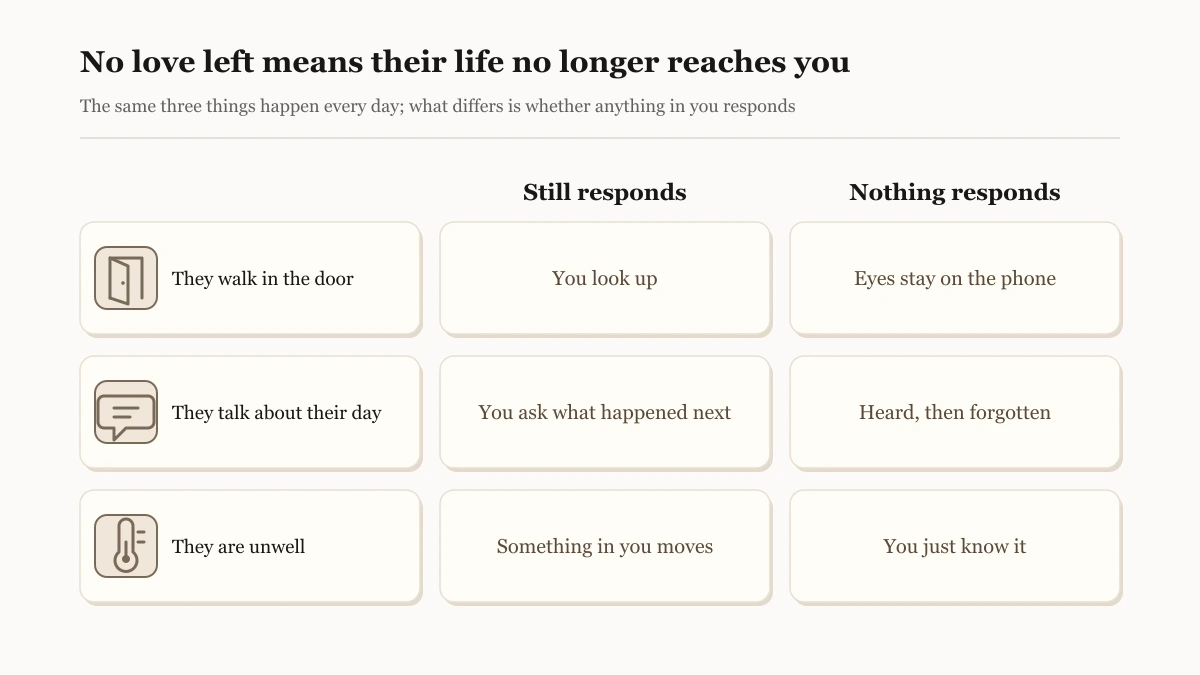
Those words get said too fast, so let me slow them down. No love left is not hate; if you hated them you would still have the energy to fight. It is not dislike either; if you disliked them you would want to get away from them. I would define it as something very concrete: their life no longer reaches you.
When love is there, their life gets in. They walk in the door and you look up. They tell you some small thing that happened today and you ask what happened next. They are unwell and something in you is unwell too. When there is no love left, all of that still happens every day. It just stops at your edge. They walk in and you know they are home, and your eyes stay on the phone. They tell you about their day and you have forgotten it by the time they finish. They are unwell and you know it, and nothing in you moves. They are still in your days. Their life just is not your business anymore.
One thing I want to say before anything else: this does not require anyone to have done something wrong. They did not, and neither did you. And I doubt you came here for permission to leave, or for a reason to stay; you have read both kinds of articles and afterward you were still in the same chair. What you want to know is what this thing actually is, how it got this way, and whether there is a question you have not yet asked yourself before you decide.
How love goes missing
Here is how I see it: love is not taken away by anyone on a particular day. It is left unattended by two people at once. Unattended looks like this. You want to tell them something, they are busy, you think never mind, later, and later never comes. They forget something that mattered to you, you are disappointed, but saying so would turn into a fight, so you think never mind, not worth a fight. They do not notice you are off today, you wait for them to ask, they do not, you think never mind, they are probably tired. Every never mind is small, too small to remember, and they pile up for years. Love does not vanish in one go. It goes a little at a time, every time you swallow what you wanted to say, every time they fail to see you and you do not point it out. Love left unattended is a two-person matter. It is just that the person who first notices it is gone is usually you.
Something left unattended does not come back on its own; that much is true. But I would put it this way: it has not disappeared. It has stopped. A stopped thing needs someone to move first before it moves again.
The sentences you have not said out loud
You have probably only half-said these, even to yourself. Let me finish them, and answer each one.
“Am I being selfish?” The way I see it, a person who stops to ask that question still has their partner in the picture. Someone who only thought of themselves would not pause here, and you have paused for a long time. You have been thinking about them all along. What you do not know is how long you are supposed to keep doing that.
“They have done nothing wrong. Isn’t this unfair to them?” Feeling fading does not require anyone to have done something wrong. They did not, and neither did you. What you have done is tie “they are not at fault” to “so I cannot go,” and those are two separate things. The first is about them. The second is about the two of you.
“I’m not even sure whether I still love them.” Not being sure is normal, because whether you love someone is not a thing you can think your way to. What you are sure of is that you feel nothing for them right now. What you are not sure of is whether to go on. Those are different: feeling nothing is the situation as it stands, going on or not is a decision, and a situation does not turn into a decision by itself. Someone has to do something in between.
“If I leave, will I regret it?” Here is my honest answer: the people who regret leaving are mostly the ones who left to escape a kind of life, and did not look closely at what they were leaving. You have not looked closely yet, so you cannot answer this one today. That is not bad news. It means you still have time to look.
“At my age, is it even worth going through this?” Age makes leaving harder, that is true. It does not make “there is no love left” any easier to live inside. The feeling you have at night in that living room does not get lighter because of the number of years behind you. Whether it is worth it depends on how you want the years ahead to go, not on how many you have already spent. Every one of these sentences asks whether you are allowed. Not one of them asks the actual question.
Four questions that have answers
The question to start with is not “do I still love them.” That one has no answer you can reach by thinking; you can sit in the living room all night and only get more tired. The four below can be answered, every one of them, and tonight.
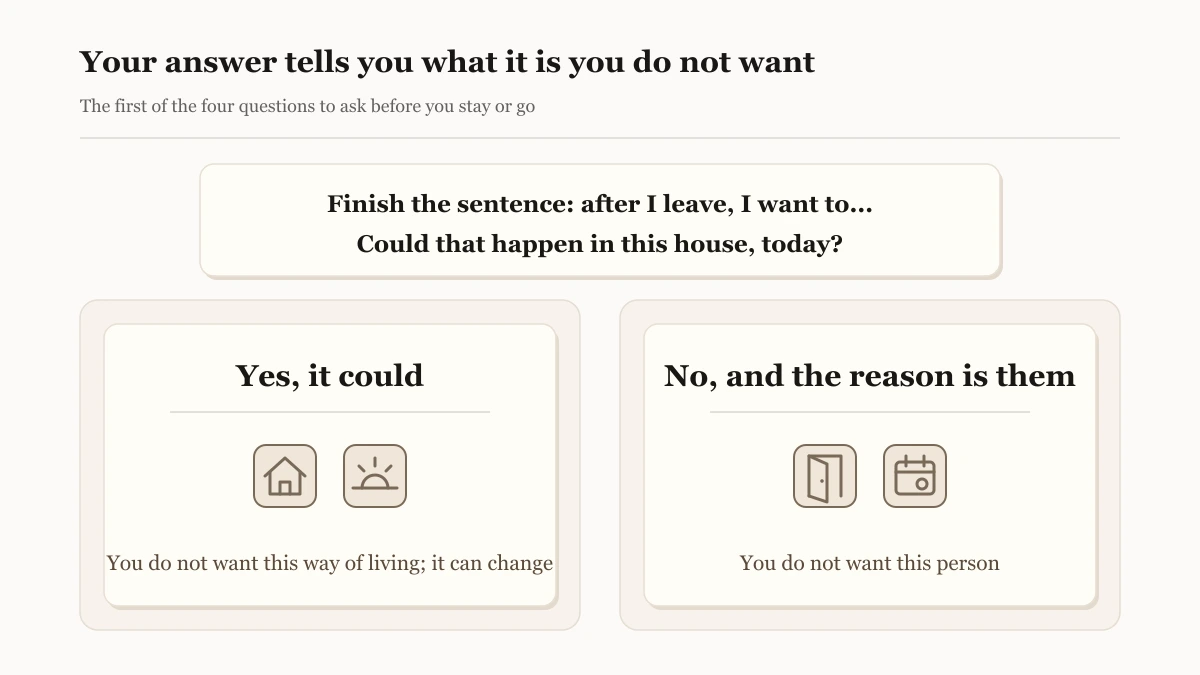
Is it this person you do not want, or this way of living?
Look at this one first: is it this person you do not want, or the way the two of you live now? Many people who say there is no love left actually do not want this life: one sentence a day, two phones, weekends with nothing planned. And because they are the only other person inside that life, all of the not-wanting has been charged to them.
The test is simple. Take a piece of paper and finish the sentence “After I leave, I want to…” with something concrete: travel alone, redo the living room the way you like it, have dinner with friends without checking in, stop facing someone who does not talk.
Then look at what you wrote and ask whether it could happen in this house, today. If it could, what you do not want is this way of living, and a way of living can be changed without changing the person. If it could not, and the reason it could not is them, then it really is them.
If tomorrow they became what you have been hoping for, would you stay?
Take this one seriously and actually picture it. Tomorrow morning they ask how you are. At dinner they look at you. On the weekend they suggest going somewhere. When you talk, the phone goes face down. Exactly the version of them you have been hoping for, for years. Now: would you stay?
If yes, then what you are waiting for is a change, not an exit. You do not want a new person, you want a different version of this one, and it is very possible they have no idea you are waiting. A change nobody knows you are waiting for has no way to arrive.
If no, then “there is no love left” is not something you said in anger, and not a thought that surfaced because you have been worn out lately. You already know that even if they changed, you would not want to stay. It is not a comfortable answer, but it is a clean one: what you have to deal with is leaving, and you can stop waiting for them to change, and stop giving the two of you one more chance after another.
Among your reasons to stay and your reasons to leave, is even one about them?
I think this is the question that matters most. Let me guess at your reasons to stay: the house you bought together, what your family would say, the habit of the years, not knowing how to live alone, your age. And your reasons to leave: freedom, a fresh start, being treated well, not wanting to keep wearing yourself down like this.
Each of those reasons is legitimate, and I would not tell you any of them is small. But read the list again and look for one thing: which of these is about them, the person? Staying: is it because of them, or because leaving is hard? Leaving: is it because of them, or because you want a different life? If they are missing from both columns, I would put it this way: you have not started deciding about this marriage yet. You are deciding how to arrange your life. That is an important decision and it deserves to be made, but it should not go by the name “there is no love left,” because in that decision the person you married is not present at all.
Is it the marriage you want to end, or the days spent thinking about it?
Thinking about whether to leave every night, and again every morning, is exhausting. It gets exhausting enough that sometimes all you want is a decision, any decision, so you can stop thinking.
That tiredness has a different cure than deciding today. The cure is to decide when you will decide: pick a date, write it down, and until that date you do not have to reopen the question every night, because you already know the day is coming. If what you want to end is the thinking, a date ends it. If what you want to end is the marriage, there are three things you need to know first: whether it is them or this way of living you do not want, whether you would stay if they changed, and whether they are in your reasons at all. Once those three are clear, when the date arrives you have something to decide with.
The four questions above you can ask alone, tonight, without confronting anyone and without telling them a thing. And once you have, you will notice that “there is no love left” was covering four different things: not wanting this way of living, waiting for a change, finding leaving too hard, and wanting the thinking to stop. Each has its own remedy. Bundled together, they turn into a question with no right answer.
So what do you do?
My answer: let them know first, then decide. Not the other way around.
Three reasons. First, right now you are the only one who knows there is no love left. You have been at this for months and they have not said a single word in it; they do not know a decision is being made. Because they do not know, nothing they have done these past months is a response to it, and yet you have already been filing what they do as evidence.
Second, you did not lose this love alone, and whether to go looking for it is not something you can decide alone either. One person can decide to leave. One person cannot decide “let’s try again.” That takes them knowing, and them being willing, before their share of it exists.
Third, you need their answer to decide. Once they know, do they want to find the love again with you, or not? That is the single most important thing standing between staying and leaving, and you do not have it yet. What you hold is only your own half. Let them know first, and what you decide about is a marriage with both people in the room. Decide first and tell them after, and what you decided about is a marriage they never attended, with no chance to speak for themselves.
How to let them know
It takes one sentence. This is the one I would suggest: “I’ve been thinking a lot about us lately. I don’t want to think about it alone. I’d like to find a day to talk.”
There is only “I” in it. No verdict, no request for them to change, no announcement that you are leaving. You do not need to have planned what you will say on that day. The sentence has one job: they finally know that something is being decided, and that they are in it.
Say it when they look up, not while their eyes are on a screen. Then stop. Do not go on to explain why, because the explanation, once it starts, tends to turn into a list of what they have not done. If you barely speak these days, or you are already living apart, a message works too, as long as it is the whole sentence and there is no question mark on the end.
After you have said it, you do not have to talk that night, and you do not have to ask them to answer right away. You can set a date in your own mind and, until then, watch what they do: whether they come to you to talk, whether they ask what is going on, whether they start doing things they never used to. When the date arrives, what they did is their answer.
The questions you will actually ask next
“What if they ask straight away whether I want a divorce?”
Answer honestly: “I don’t know yet. That’s why I want to think about it with you.” It is true. You do not know yet; you have only been thinking for a long time. If they ask that question, the way I see it, they have understood how heavy this is. You do not owe them an answer in that moment. What you are offering is a seat.
“What if they simply refuse to talk?”
Not talking is an answer too. They know, and they chose not to come in; that is what they chose. From here the deadline is yours to set, not their silence’s. You can tell them, “I’ll wait until this date, and before then you can bring it up any time.” If the date comes and they still have not come to talk, then you know: they chose not to. You can take that answer and decide with it, and you do not have to keep waiting.
“If I stay, isn’t that just settling?”
My answer: it depends on what you are staying for. Settling is knowing you want something else and staying anyway. If you stay because of this person, or because once they knew they were willing to change alongside you, then you are staying for what you want, and that is not settling. If you stay only because of the house, the family and the habit, because leaving is too hard, then it is settling, and you will know it yourself.
“If I leave, will I regret it?”
My answer: people who leave after seeing clearly do not regret it. The ones who regret it are mostly the ones who left before they had looked. If you do what this piece describes, ask the four questions, let them know, wait for their answer, then you leave with three things clear: what you do not want, that they knew, and what they chose. I believe a leaving like that will hurt, and will not be regretted.
No love left is not the end
No love left in your marriage does not mean you did something wrong, and it does not mean the marriage is over. It means something has gone unattended for a long time.
You can be the one who moves first. Let them know, then see how they respond. If they respond, the two of you have a chance to find the love again, and the change nobody had picked up gets picked up for the first time. If they do not, you have the answer you need in order to leave, and when you go, you go having seen clearly. Either way, you will no longer be sitting alone in the living room, deciding a two-person marriage that nobody has said out loud.
That is the one thing I most want to leave with you: love goes missing because both people stopped speaking first, for a long time. Speak first, and the love has a chance to come back; and if it does not come back, that is when you can leave with a clear mind.
Sources
Research and sources this essay draws on.
- Discernment Counseling for "Mixed-Agenda" CouplesJournal of Marital and Family Therapy, 42(2), 246–255
- Interest in Marital Reconciliation Among Divorcing ParentsFamily Court Review, 49(2), 313–321