Close for Months but Still Not Together: What Are They Thinking?

A few weeks ago they said, “Next time I’ll take you to that place.” You still remember it. They haven’t brought it up since.
Tonight the two of you talked late again. They sent a goodnight, and you sat looking at the chat, wanting to type one more thing, and didn’t. You talk every day. You know what they like and what has been bothering them lately, and they remember the small things you mention. And still, all this time later, you aren’t together.
The question you’ve asked yourself so many times comes back:
“What are they actually thinking?”
You keep wanting an answer because you care about this person in earnest, and you are hoping, just as earnestly, that this can go somewhere. You have given them a lot of your attention these past months. Wanting to know where you stand is about the most natural thing there is.
The thoughts that keep circling
“They’re so good to me. How could they not like me?”
The kindness you feel from them is real. But someone can be good to you because they like you, or because they like having company and are used to you being around, and kindness alone won’t tell you which. Here’s how I’d tell them apart: people who like you and want to be with you usually want you to know what you are to each other. If they keep being good to you but never bring up what you are, that kindness doesn’t yet show they want to be with you.
“Is something about me not enough? Is that why they won’t commit?”
For a relationship to move forward, both people have to want it to. You already do. The one standing still is them, so there’s no need to search yourself for reasons in their silence. They choose to spend time talking with you every day, which says there are things about you that make people want to come closer.
“If I ask, will they stop reaching out?”
You’re afraid because what you have right now matters to you. I think telling them what you want doesn’t demand an answer today. If they stay, what the two of you have is still there. If one honest sentence makes them walk away, what you have now couldn’t have lasted much longer anyway, and at least you won’t be bracing for that day.
“They said they don’t want a relationship right now. Should I keep waiting?”
You can, but you get to decide how long. They said “right now.” My suggestion is to believe what they said and plan your life around the present, instead of adding “they’ll want one eventually” to the end of it.
“They get jealous, too. So why won’t they say we’re together?”
Caring who you go out with isn’t the same as wanting to be with you. Jealousy costs them nothing. Saying they want to be together means taking on responsibility for the two of you.
What a situationship is, and why it stalls
What it is
A situationship is when two people do what couples do, texting every day, talking late into the night, going out just the two of you, caring who the other is getting close to, without ever agreeing to be together. At the start, it’s usually two people feeling things out: whether the other feels the same, whether being together is comfortable. There are butterflies, hopes and a lot of uncertainty in that stretch. As I see it, that’s normal, and plenty of relationships begin this way.
How to tell it has stalled
While you’re still feeling things out, something between you keeps changing. The conversation goes from polite to anything goes, seeing each other goes from now and then to a regular thing, and you start learning about their friends, their family, their past.
A stall is when that change stops. Compare now with a few months ago. You talk about roughly the same things and see each other about as often, you still haven’t met the people in their life, and they don’t know much more about yours. Not further apart, not any closer. Just stuck.
My view is that a situationship can stay like this for so long because as long as nobody speaks up, nobody has to face an answer. You’re afraid that asking would cost you what you have, and they don’t have to answer a question they haven’t thought through, or would rather not answer. Neither of you says anything, and life goes on as before.
What they’re thinking: this works for them just as it is
My view is that what they are thinking, most likely, is “this is fine as it is.”
Look at what they have right now. Someone says good morning to them every day, listens to how their day went and remembers the things they mention in passing. Whenever they want someone to talk to, you’re there.
Then look at what they don’t have to give. They don’t have to say what you are to each other. They don’t have to see only you. They don’t have to introduce you to the people in their life, and they don’t have to answer what happens next. They have all the good parts of almost-dating, and none of the extra weight a relationship would bring.
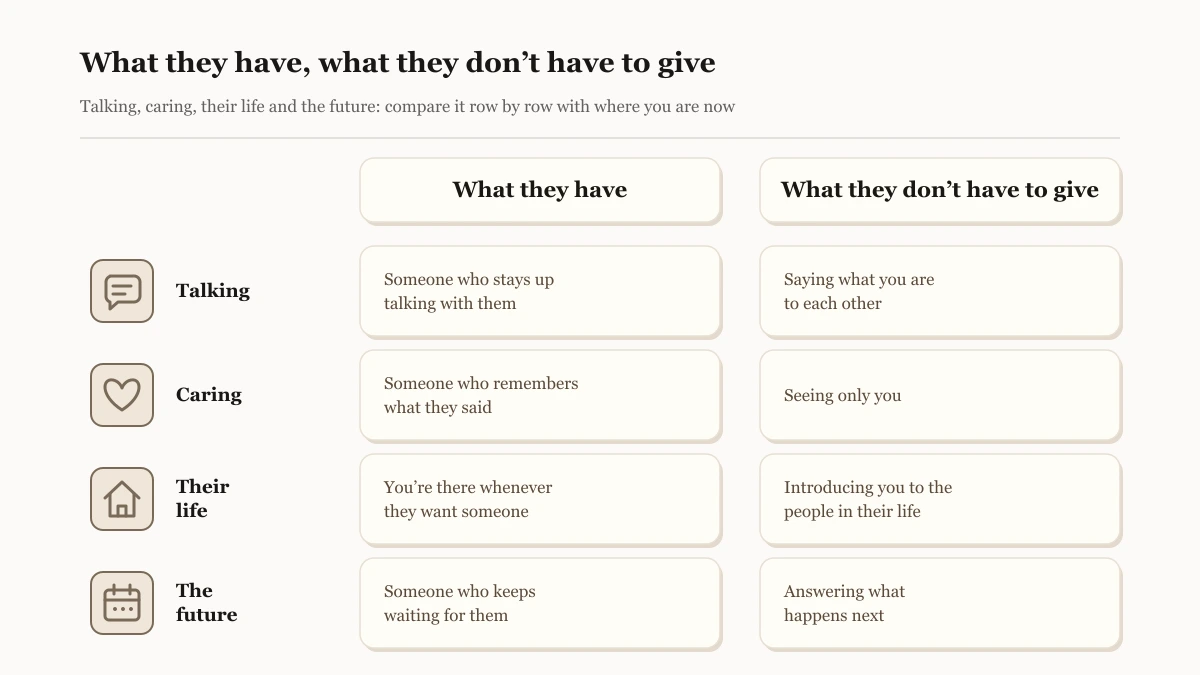
Why would this feel like enough to them? My guess is that the reasons differ from person to person. They may like you, but not enough to want to change their life as it is. They may like the feeling of being on someone’s mind while feeling unsure about a relationship itself. They may worry that being together would cost them the ease of how things are, or that if it ever ended, they would lose you as a friend, too. Or they may still be looking at other people. The reasons vary. What they share is this: as things stand, it’s enough for them. And I think people rarely push forward on their own from a place that already feels like enough.
There’s one question that can show you whether this is where you are:
“In all these months, has there been anything they would risk losing you over if they didn’t do it?”
When they’re slow to reply, you wait. When they cancel plans at the last minute, you say it’s fine. When they never mention the future, you stop asking. If you think about it for a long time and nothing comes to mind, then in my eyes, the way things are costs them nothing, and so they have no reason to change it.
None of this means the way they treat you is fake. They may truly like you. But whether to say it out loud has always been their choice to make, and so far, they have chosen not to.
What you can do: decide how much longer you’ll wait
You can’t decide what they think. How much longer you wait, though, is yours to decide, starting today.
First, circle a day on the calendar. Not too far away. Close enough that when you think of it, you know you can make it. Next to it, write: “By this day, I want to know whether they want to be with me.” Put it somewhere you’ll see daily, in your phone’s calendar or on a calendar on your desk. I suggest this because the hardest part of a situationship is not knowing how long it will go on like this. Once there’s a circled day, you know the latest point by which you’ll have an answer, and you set that point yourself. They didn’t hand it to you.
Second, tell them once that what you want is to be together. This isn’t asking “What are we?” It’s telling them what you want. You could say:
“I like you, and what I want is to be with you, not to keep going like this. I don’t need an answer right away. I just wanted you to know.”
Say it in person or by message, and if most of your contact is over text anyway, a message is just as good. Say it once. After that, you don’t need to keep checking whether they’ve thought it over, or to hint or test in other ways. Once it’s said, you both know the same thing: you want to be together, and they know it.
Third, when the day comes, do what you wrote down. If they say they want to be together, you start a relationship. If there’s still no answer, or the answer is still “let’s see,” then they no longer hold the place in your heart reserved for the person you’re waiting on. You don’t have to delete them or fight with them. You just stop keeping your weekends free for a message that might come, and stop turning everything they say over and over in your head.
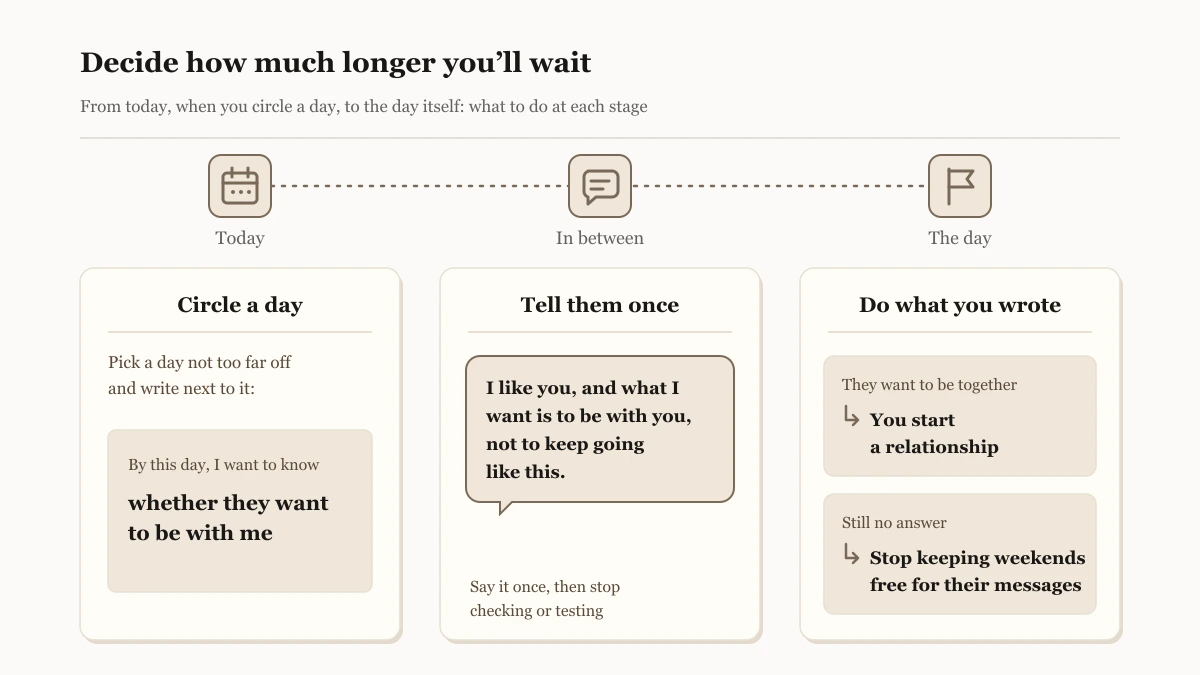
Circling a day, saying it once, following through: none of it needs their permission, and you could start tonight.
Four questions you’ll actually ask next
They said, “Isn’t this good the way it is?” How do I answer?
You can say yes, as long as you add that it isn’t everything you want: “This is good, but I want more than this. I want to be with you.” I would answer that way because a question like theirs makes it easy to reply only to the first half and keep the sentence you really meant to yourself.
Should I tell them about the day I circled?
In my judgment, no need to mention the date. Tell them what you want. The date is something you give yourself, a reminder not to wait indefinitely. Wanting to be together is the part they need to hear. With the date kept to yourself, what you do when it arrives only needs your own agreement.
They’ve suddenly been extra sweet lately. Should I push the day back?
No. If they reach out more and spend more time with you, you can enjoy it, but being sweet to you and being clear with you are different things. What you’re waiting for is whether they want to be together. They haven’t said, so the day stays where it is. If they want to move forward, the clearest way is to say so, and no amount of extra sweetness can stand in for that.
What if the day comes and I still can’t let go?
Not wanting to let go is normal, and you don’t have to wait for the feeling to fade before you do what you wrote down. You don’t stop liking someone you’ve liked for months because of one day on a calendar. The feeling can take its time. All you need to do, from that day on, is stop making waiting for them part of every day.
That evening, plan something for yourself that you already love and that has nothing to do with them: a movie you’ve been meaning to see, a place you’ve wanted to eat at for ages, a walk you haven’t taken in a long while.
Wanting a relationship that’s clearly defined is completely reasonable
Situationships drag on because, while things stand still, the hard part keeps landing on the one who waits. You’re the one watching for messages, the one guessing what they think, the one setting other possibilities aside.
Wanting something clearly defined is completely reasonable, and you don’t have to fold that wish away to keep things as they are. What you can change is the length of the wait. How much longer is up to you. If they say they want to be together, you got what you were hoping for. If there’s still no answer, you no longer have to spend each day guessing what they think, and you can slowly bring back to yourself the attention you’ve given them these past months. Either outcome beats guessing forever.
Someday, when you look back on this stretch, what you remember may not be whether they finally said it, but that you finally made a decision for yourself. You can care about someone this sincerely, and with that same sincerity, decide for yourself how long you will wait.
Sources
Research and sources this essay draws on.
- The Principle of Least Interest: Inequality in Emotional Involvement in Romantic RelationshipsJournal of Family Issues, 27(9), 1255–1280