Am I an Anxiously Attached Lover? For Anyone Who Finds Being in Love Exhausting

“I have to go do something.” Then nothing.
Since then you have checked your phone three times, scrolled up through the conversation and back down again, and started wondering whether the “mm” they sent this morning meant something. Someone asked if you were okay and you said yes. You were telling the truth. Nothing is wrong between you, they have not done anything, and you are still worn out by the end of the day, a day on which nothing happened. Somewhere in there a question surfaces: “Why does being in love make me this tired?” You never finish the thought, because the question behind it is harder to look at: “Am I asking for too much?”
The tiredness is real, and it shows up even when nothing is wrong
Let me start with the part that is easy to miss. This is not the tiredness of a relationship in trouble. You did not fight today, they said goodnight last night, and you are tired anyway, because what wears you out is not what happens in the relationship. It is what does not happen: the stretch with no reply, the words that did not follow the “mm”, the “I’m busy” they never said out loud.
I doubt you opened this looking for one more piece of evidence that you are “annoying”. You have collected enough of that on your own. What you want to know is where the tiredness comes from and whether there can be less of it, and I will answer both.
One more thing about this kind of tired, and I hope you see it before anything else: it has no direct connection to how good the relationship is. On a good day you are tired too, because the thing that tires you is happening inside you, not between the two of you. That sounds like bad news. I read it as good news, because what happens inside you is something you can reach.
The things you say to yourself and never out loud
You have probably only said these halfway, even to yourself. I will finish them.
“Am I annoying?”
The first person to run out of patience with this tiredness is you, not them. When you ask that question, they have not said the word “annoying” once. You said it for them.
“Are they about to give up on me?”
They never said that either. You wrote that line on their behalf, and they are still here. That is the one thing you can be sure of, that they are still here. Everything else is dialogue you drafted for them in advance.
“Why does everyone else make love look so easy?”
Other people wait for replies too. The difference is what happens in their head while they wait. They are waiting for a message, and while they wait they can shower, watch something, fall asleep. You are waiting for an answer, the answer to “are they still here?”, and until that answer arrives you cannot get on with anything. The waiting is not what tires you. It is that, the whole time you wait, you are answering for them in your head.
“I know they’re busy. Why can’t I stop?”
Because “they’re busy” answers why they have not replied. It does not answer the question you are actually asking, which is whether they are still here. You know they are busy, but “busy” and “still here” are two different questions, and you cannot stop because the second one has not been answered by anyone yet.
“Am I asking for too much?”
What you are asking for is actually very small. One line, “I’m busy, I’m not upset”, would do it. The thing you want is small. You just want it many times, because each time you get it, it only settles you for a moment, and when the next reply comes slowly you have to ask for it again. The amount was never the problem. It is the same small thing, asked for too many times.
Every one of these five questions asks whether something is wrong with you. Not one of them asks about the thing that is actually making you tired.
Four things that look different from the outside and are the same thing inside
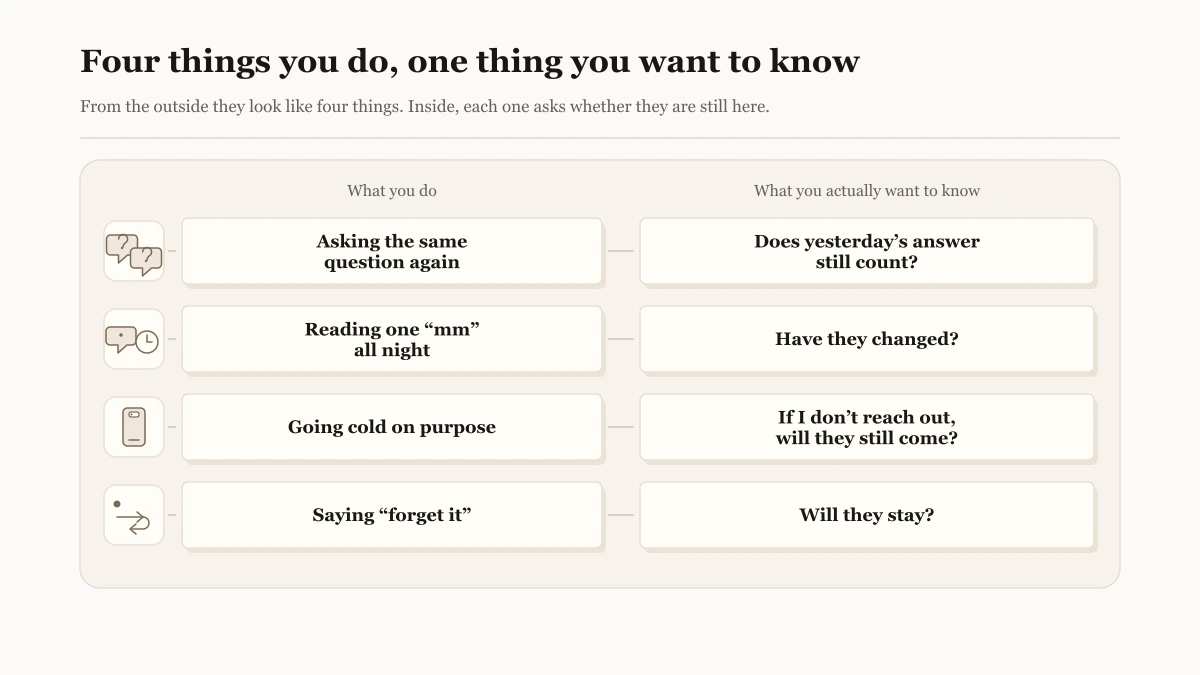
Here is what you do every day, told twice each time: once as it looks from the outside, once as it feels from the inside.
Asking the same question a second time
Yesterday you asked “are you upset with me?” and they said no. Today their reply came slower than usual, and you asked again. From where they sit, this was settled yesterday, and they cannot see why it is back. From where you sit, yesterday’s “no” kept you calm until last night. Today one reply came late, the worry came back, and so you asked once more. You did not forget their answer. The answer simply stopped being enough.
One “mm” that lasts all night
They reply with “mm” and go back to whatever they were doing. From the outside it is one syllable. From the inside, you have set that syllable next to the one from two days ago and the one from last week, and three of them in a row become a conclusion: they have changed. If there is a time difference between you, one syllable has to last even longer. A whole night on your side may be one unfinished afternoon on theirs.
Going cold on purpose to see if they come looking
You leave the message unanswered, or you answer in as few words as possible. From the outside it looks like a sulk. From the inside you want to know one thing: when you do not reach out first, will they still come to you? You cannot bring yourself to ask that directly, so you ask it by going quiet. My judgment is that going quiet is a very hard question for anyone to hear.
Saying “forget it” when you cannot hold on any longer
“Forget it.” “Never mind.” “Go do your thing.” From the outside it looks like you are walking away. From the inside you are asking them to stay. What you say is “forget it”. What you mean is “stay”. The sentence you mean is the one you cannot get out, because saying it would be admitting that you are afraid they will leave, so you turn it around and say the opposite.
Asking again, spending a night on one “mm”, going cold, saying “forget it”: from the outside they are four different things. Underneath, they are all doing the same job. They are checking whether the other person is still there.
So here is a question only you can answer: the last time you felt calm, how long did it last? If the honest answer is “until the next message”, then I would say what you received was a reply, not calm.
Why it is so tiring: you never stop checking whether they are still here
This is how I would answer the question in the title. You are tired because you are doing one thing all the time, checking whether they are still here, and that one thing never gets to stop. Every message, every expression, every word they say before walking out the door gets fed into the same question. They reply, you settle for a moment, then the next reply comes slowly and you have to check again.
You are the only one doing this, and they do not know you are doing it. It happens entirely inside you. What they see is only the surface: the question you asked, the two days you went quiet, the “forget it”. So when you tell them you are tired, they cannot follow and you cannot find the words, because the thing that tires you is something nobody can see.
This is not all on you. They own half of it. Every time they say “I have to go” without saying where or for how long, you have to check one more time. There is no malice in it. They simply do not know that after that sentence, you will keep waiting until they are back.
My judgment is that the checking can become rarer, and the first step does not depend on them.
Say the question out loud: ask the small one, not the big one
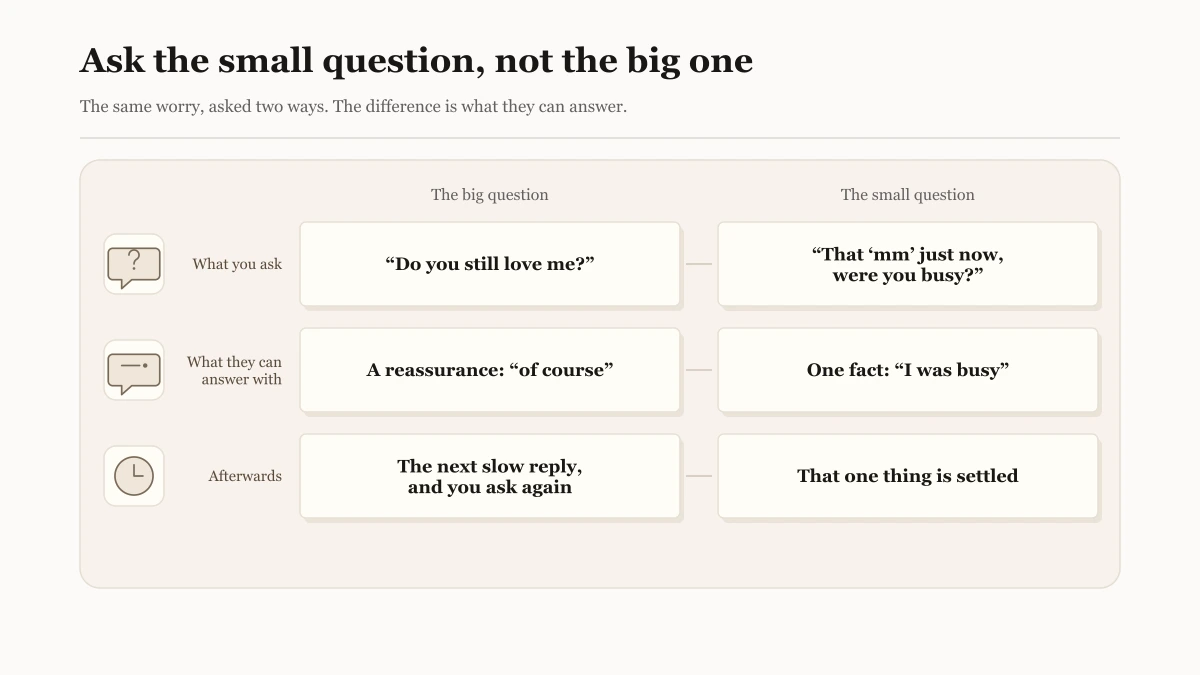
The whole method fits in one line: ask the small question, not the big one.
“Do you still love me?” is the question in your head, in its raw form. It is too big. The only thing anyone can answer with is a reassurance, “of course”, “yes”, and a reassurance lasts until the next wave of worry. “That ‘mm’ just now, were you busy or were you upset?” is a small question. It has an answer, and once they give it the matter is closed. You walk away with a fact, not a reassurance.
So the line can sound like this: “That ‘mm’ just now, it made me a little nervous. Were you busy?” There are three things in that sentence: the message, your nervousness, and a question they can actually answer. What is not in it is “do you not love me anymore” or “you always do this”.
Ask about one thing, and only today’s thing. Today’s “mm” and last week’s “mm” do not go into the same question. Last week’s is gone, and if you bring it back now they cannot answer it, and you will not get what you came for.
Ask, and then stop. They say “busy”, and that is the end of it. Do not follow up with “then why did you type it like that”. Follow up, and the big question walks right back in.
Before you ask again, before you spend a night on one “mm”, before you go cold, before you say “forget it”, ask yourself one thing first: “what is it I want to know?” Then say that out loud. My judgment is that you will find it is the same thing every time, whether they are still here, and that this is a question they can answer when it is asked directly.
There is one more thing, and it is best said on an evening when you are not anxious. Pick a night when the two of you are fine and tell them: “Before you go do something, tell me roughly how long. Then I won’t keep checking my phone.” There is no blame in that sentence and no request that they change. It just names the thing you most often need to check, so that they know it exists.
Whatever they answer is fine. If they say “busy”, that one thing is settled. If they say “a little upset, actually”, then at least you know what about, and that can be talked through. My judgment is that either answer beats the one you were writing for them in your head, because the one you write for them is usually the worst one.
So, am I anxiously attached?
“Anxious attachment” describes the way a person gets close to other people. This is how I would explain it. Everyone learns one thing early on: when I need someone, will someone be there? Some people learn a steady answer, someone was there when they needed them, and so as adults they do not need to keep checking. Some people learn an unsteady answer: sometimes there, sometimes not, sometimes only there if you cried loudly enough. So they learn to check first and relax second, and one check is never quite enough. That way of getting close follows you into love, and there it turns into asking again, spending a night on one “mm”, going cold, and saying “forget it”.
If you have done these things, and recognised them the moment you read them, then this is probably how you get close to people. I want to stay here a little longer, because I know what your first reaction to the words “anxiously attached” is: so it is my fault after all.
It is not an illness, and it is not something you did wrong to end up with. It is the way of getting close to people that you learned as a child, and like the way you walk, it formed slowly over years. There was never a day when you decided on it. And this way has a good side: you notice when they are talking less than usual today, you remember what they said last week about wanting to eat, you are the first to show up when something happens to them. What tires you is keeping watch on whether they are still here. It is not the caring itself.
So there is no need to feel bad about being this kind of person, and no need to blame yourself for asking one more time today. You are loving someone in the way you learned to. The way can be adjusted. The person does not need replacing.
For the anxiously attached reader
I want to say a few things to you directly, to close.
First, when they have not replied, do not ask yourself “are they still here?” Ask yourself “where are they right now, and what are they doing?” Only they can answer the first question. The second one you can answer with a moment of thought: they said they had a meeting, so right now they are in the meeting; they said they were driving home, so right now they are on the road. Once you have that answer, put the phone down, go and do your own thing, and let them finish. It will not make the worry disappear, but while you wait you at least know where they are, instead of staring at the phone and guessing whether they are still here.
Second, keep one thing a day that has nothing to do with them, something that leaves you feeling you are doing alright: a run, a piece of work you have been putting off, dinner with a friend. Calm comes from two places, what they give you and what you give yourself. My judgment is that the first kind lasts until the next message and the second kind lasts longer, and right now you are living almost entirely on the first.
Third, when you have asked one more time, do not turn on yourself. You checked once more, that is all. Let it go once it is done, and do not add a second layer of tiredness on top for having asked. What you can manage today is one fewer round of blaming yourself, not zero questions.
People who love this way are not worse at love. They love harder. The way I see it, once someone who loves hard knows where to put that effort, the noticing, the remembering and the caring become the best things they bring into a relationship, and those are things you already do. The earnest way you love was never the part that needed changing. The only thing that needs changing is how you check.