Why Does Loving Someone Feel This Exhausting?
Nothing dramatic is happening. No screaming fights, no betrayal. Your partner is not a monster. And yet your entire day hangs on this relationship. A slow reply, and you re-read everything you sent. A flat tone, and you audit yourself for mistakes. At midnight they are asleep, and you are awake, replaying one frown from the afternoon.
You love hard. You are also running on empty. And you cannot even complain, because — what exactly would you complain about? Nothing is technically wrong.
So let me say the most important part first. This is not proof that you are bad at love. It is not proof that you love too much. It is not a personality flaw. You are stuck in a pattern that feeds on itself — I call it the drain: slowly consuming yourself inside the very relationship you are trying so hard to protect. This essay is about that drain. What it looks like. Why it is so hard to walk away from. And the two exits that actually lead out. Not all of this is my opinion: the claims that carry hope here come from research that tracked real people through real breakups and real recoveries, and I will tell you what kind of data each one is when we get there.
I used to be the one pushing them away
Let me start with my own story.
When I was young, I was in a relationship where I tormented myself daily. I believed true love conquers all. I spent every day imagining how beautiful our future would be. And at the same time I was clingy and hypersensitive. Anxiety, rumination and fear took up most of the space in that relationship. I called it loving deeply. What it actually did was push my partner further and further away.
It took me years to give those days their real name: emotional drain. Not deep love. Drain.
Here is the cruelest part: the drain disguises itself as effort. You check their messages again because you care. You rush to apologize first because you fear losing them. You parse the tone of every sentence because you want to do better. Each act, taken alone, looks like devotion. Added up, they dig a hole in you — and your partner can feel it. People who are watched that closely start to suffocate. And people who suffocate step back.
The loop: the tighter you hold on, the further they drift
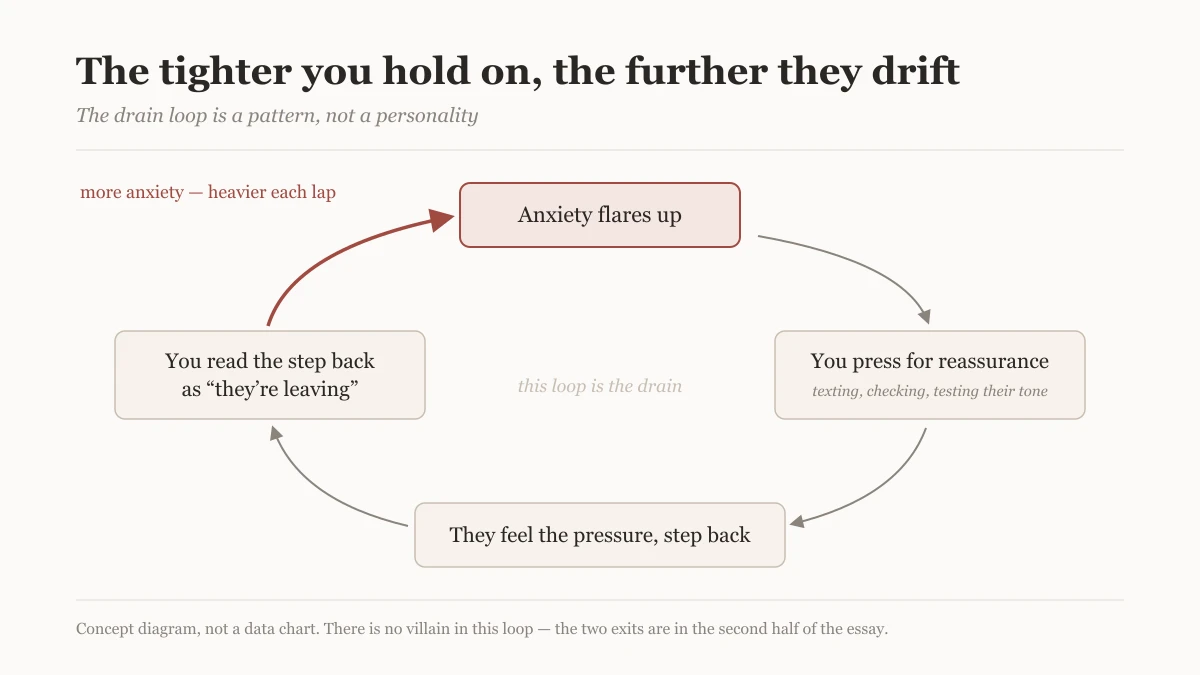
Eventually I understood that the drain is not a personality. It is a loop. The diagram at the top of this essay is exactly that loop:
Anxiety flares up. You press for reassurance — texting again, checking their feeds, testing their tone. They feel the pressure and step back half a step. You read that half step as “they’re leaving,” and the anxiety comes back heavier. Around again. Heavier each lap.
There is no villain in this loop. They are not heartless. You are not unreasonable. You are two people pedaling the same machine faster and faster. This is also why “just hold it in this time” rarely lasts: holding it in is drain too, and the one night it finally bursts out cancels all the holding that came before it.
The loop does not only spin while you are together. Plenty of people break up inside it and then reconcile inside it: too heartbroken to stay away, then drained all over again once they return. If that is you, you are far from alone — in one survey of college students, nearly two-thirds had been through this kind of on-again, off-again cycle. But I owe you honesty here, said gently: the data tracking on-off couples also finds that the more times people break up and get back together, the heavier their anxiety and low moods tend to run. That is not a verdict on your strength. The cycle itself has a cost, and whoever stands inside it is the one paying.
So the real question was never “how do I hold it in next time.” The real question is “how do I climb off the loop.” I got off through two things — and only later found their echoes in the literature.
Exit one: take the halo down, and look at the actual person
The first thing: remove the halo you have placed on them.
When a draining relationship is hard to leave, the reason is rarely “it is good now.” It is “it was good once.” You remember their gentlest days, that one sentence they said, the future the two of you sketched together. On hard nights those scenes play on their own, laying a soft-focus filter over the very person who keeps you anxious.
But memory edits. It keeps the highlight reel and cuts most of the ordinary, disappointing footage. And so you end up forgiving the whole film based on the trailer.
Here is an exercise I would suggest. It is uncomfortable, and it works. Take a sheet of paper and make two columns: what they once gave you, and what they give you now. On the left, the scenes you cannot let go of. On the right, only the recent stretch — what they actually did, what being with them actually felt like. No explanations allowed. No “but deep down they really…” Only things that happened.

When you look at the actual person clearly — not the remembered one, not the imagined-future one — you may find that you no longer need their approval. That moment already frees half of you. Because the fuel this drain burns is precisely the thought: “I still want them to approve of me.”
Exit two: become a person who stands on their own
The second thing goes deeper: become an independent person.
I eventually admitted where my drain came from. I had a hand-it-over mindset: I handed the whole question of “did I have a good day” over to my partner, and waited. I hoped they would be more attentive, steadier, quicker to understand me. When they delivered, I was calm. When they did not, I panicked. It went wrong far more often than it went right — and every time it did, I was sure the problem was theirs.
It took me even longer to see the truth: the problems that looked like theirs were actually my homework. Please do not read that as self-blame. It is the best news in this entire essay. If your calm can only be issued by someone else, you will spend your life waiting for it. If it is your homework, then the key is in your hand.
“Become independent” sounds abstract, so here is a concrete starting point: rebuild “who I am.”
The biggest hidden cost of a draining relationship is that your self gets signed away piece by piece. Your schedule bends around them. Your mood tracks theirs. Even what you like goes blurry. Part of why separation hurts so much is that you lose not just a person — you lose the “me” that was tangled up with them.
Sorting yourself out is itself a form of recovery. And you can start it alone, with nobody’s permission and nobody’s cooperation. Set aside a quiet stretch of time and write down who you are now: what you like, what you care about, who you want to become once you are out of this drain. Keep the subject of the sentences you — not them. You will probably notice how long it has been since “I” was the subject at all.
There is also a blunter version: take back, one by one, the things you shut down for this relationship. The friends you stopped seeing. The hobbies you stopped touching. The sleep you stopped getting. Every piece you reclaim is a piece of weight you stop handing over.
If you decide to leave — or if they left first
Once the halo is down and you have started reclaiming yourself, some people discover the relationship can still be repaired: two people can slow the loop down together, and that is a real possibility. Others arrive at a different conclusion: the relationship itself is where the drain comes from.
If you decide to leave, I will not pretend it does not hurt. The first stretch is genuinely dark, especially at night. But two things are worth taking out and looking at in the darkest hours.
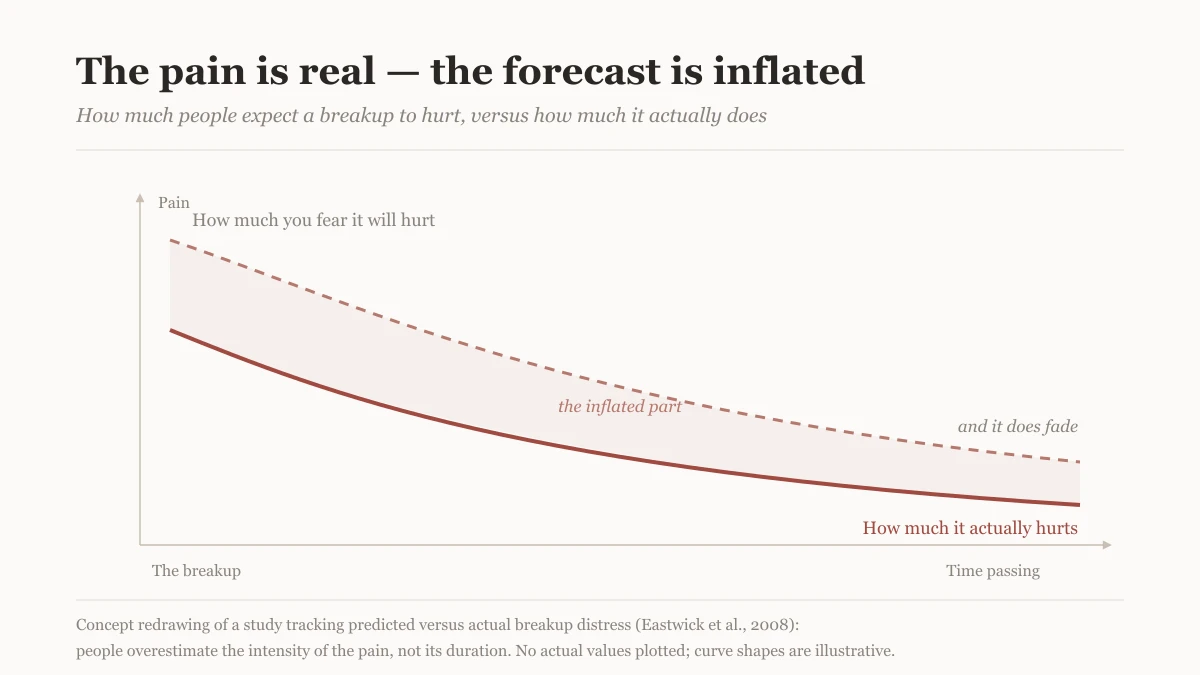
First: the size of the pain is not what you think it is. People have been tracked through breakups, their predictions collected beforehand and their actual pain measured as the weeks passed. The consistent pattern: we overestimate the intensity of the pain, not its duration. The forecast in your head tonight — “I will not survive this” — is itself inflated. The pain fades, and it fades sooner than you believe.
Second: the way you talk to yourself changes how fast you recover.
The method is so simple you will be tempted to dismiss it: use on yourself the exact words you would use on your best friend. If your best friend called you at midnight, crying, asking “maybe I’m just not enough,” you would never answer “correct — you are too clingy.” You would say: “You tried so hard. The relationship made you this way. You were not born this way.” Now turn around and say that sentence to yourself, word for word.
And if they were the one who walked away? Let me leave here, unchanged, the words I wrote to myself many years ago: do not cry over losing someone, because your life was never anyone else’s to complete. If someone leaves you, feel sorry for them — losing someone this good is their loss.
When I was young, I thought that line was bravado. Much later I understood that it is the summary of both exits. Once the halo is down, they are just a person. Once you stand on your own, their leaving cannot take your foundation with it.
Leave the drain, and you finally get to grow
Looking back now at the younger me — awake at midnight, re-reading messages that had already been read too many times — what I want to say is not “how foolish you were.” It is: “You worked so hard. But the exit was never in them. It was in you all along.”
If you keep only a few lines from this essay, keep these:
- The drain is not deep love. It is love bent out of shape — and it disguises itself as effort.
- Take the halo down and look at the actual person. Then take back, piece by piece, the self you signed away.
- Do not cry over losing someone. Your life was never anyone else’s to complete.
As for “could we still find our way back?” — some people stop the drain and truly restart with the same person, better this time. Others stop the drain and finally let themselves off the hook. If getting back together is still on your mind, I wrote about exactly that question in Is There Still a Chance? For Anyone Who Cannot Quite Let Go. But whichever way you eventually go, the order is the same: stop the drain first. Grow yourself back first.
Leaving a relationship that endlessly drains you is how you get to grow. That sentence cost me an entire relationship to learn. It is yours now — take it with you.