I Like You, but I Will Not Prove It by Abandoning Myself

You are not foolish. You can see what is happening. You know how often you swallow the sentence you wanted to say. You know that every “it’s fine” carries something that is not fine at all. You know that waiting for an uncertain person can make the rest of your life smaller.
And still, when you imagine walking away, you remember their gentlest moments. You still care. You still wonder whether one more act of patience might change everything. Maybe if you understand more, ask for less, and become a little easier to love, they will finally choose you.
Please do not punish yourself for that hope. The question is not whether you should ever give. The question is whether your giving is helping two people move toward each other, or teaching you to move farther and farther away from yourself.
A daily-diary study of sacrifice in intimate relationships found an important difference between giving to move toward love and giving to run from fear. Sacrifices made to create closeness or express care were associated with better personal and relationship experiences. Sacrifices made to avoid conflict, rejection, or loss were associated with poorer well-being and relationship quality. This does not make every compromise harmful. It points to a kinder, more useful question: not only “What did I give up?” but “What was I afraid would happen if I said no?”
You are allowed to keep liking them. You just do not have to keep using pain as your receipt for sincerity.
Not every compromise is self-betrayal
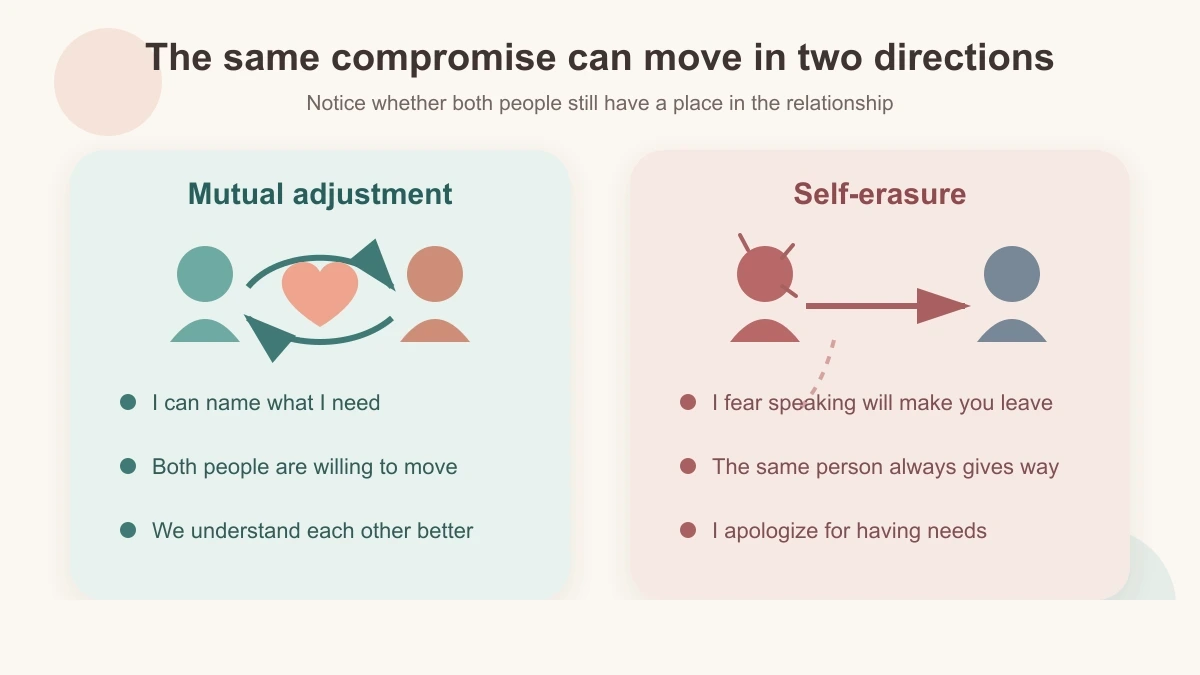
Love requires movement. Tonight you go to their favorite restaurant; next week they come to the place you have wanted to see. You carry more when they are exhausted; they take over when you have nothing left. Healthy adjustment can still be inconvenient. It can include disappointment, tense conversations, and mistakes. But you remain present inside it.
You can say, “I don’t like this,” without first proving that you are reasonable. You can name a need without believing that one honest sentence will cost you the relationship.
Self-erasure feels different. It is not one evening spent doing something you would not have chosen. It is the gradual lesson that your preferences are safest when they do not appear. You say it is fine because you fear being called difficult. You always apologize first because a long silence feels like the beginning of abandonment. They cancel, and you rush to invent an excuse for them. They become inconsistent, and you respond by working harder to prove that you deserve consistency.
From the outside, the relationship may look peaceful. Inside, every conflict has simply been moved into your body, where you carry it alone.
Here is a question I would use to tell the difference: After this compromise, can I still be fully myself? If the answer is yes — if you chose freely, and your needs still have a place — you may be practicing flexibility. If the answer is no, but you are terrified not to agree, then the problem is not that you are insufficiently generous. Fear is making the decision for you.
You may be protecting the hope of being chosen
Some attachments are hard to release not because the present gives you so much, but because the future still seems possible. You have waited this long. You have given this much. If you stop now, was all of it wasted? If you hold on a little longer, will they finally see what you have been offering?
You end up building a relationship with “maybe.” Maybe they will become available after this busy season. Maybe they will commit when they feel ready. Maybe your patience will eventually be cherished. None of those possibilities is absurd on its own, which is why leaving can feel so hard. But those possibilities show only that you are still hoping. They do not show that the other person is responding, investing, or willing to build a clear relationship with you now.
You may keep hope while also looking clearly at what is already happening. Do not ask only, “Could they love me one day?” Ask, “Are they responding to me now in ways I can actually receive?” Do not count only the rare nights when you feel perfectly close. Look at ordinary days. Are you able to rest, speak, and matter in the decisions that affect you?
One set of studies on psychological needs in romantic relationships measured autonomy with statements such as feeling free to be who you are with your partner. Across the studies, greater fulfillment of autonomy, competence, and relatedness needs was associated with better personal and relationship well-being, less perceived conflict, and less defensiveness. The authors also noted that the findings were correlational, so they do not establish a one-way cause. But they give us a grounded test: healthy closeness does not merely let you approach another person. It leaves room for you to exist as yourself.
Do not begin with leaving; begin with a pause
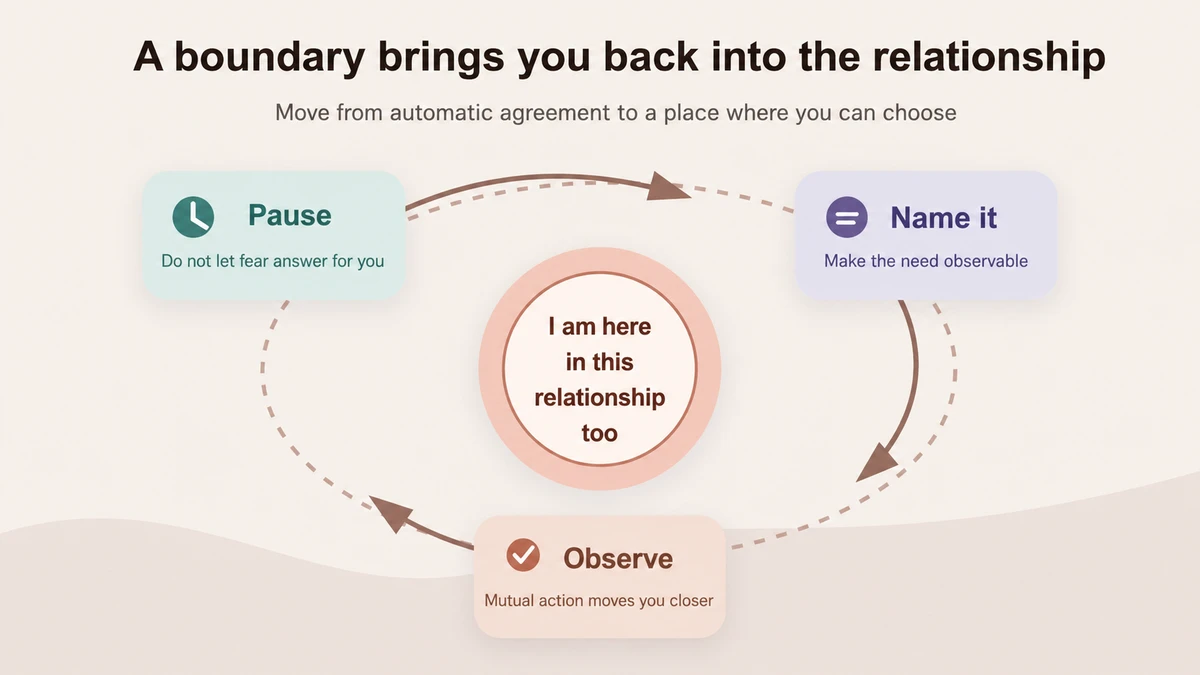
The word “boundary” can sound like a door slamming. People hear it and imagine an ultimatum, no contact, or a breakup. But the first purpose of a boundary is not to push someone out. It is to bring you back in.
Start with the smallest pause. The next time they make a request, change a plan at the last minute, or ask you to wait again without a clear end, do not answer automatically. Say, “I need to think about that. I’ll get back to you.” No accusation. No performance. You are simply creating a space where fear does not get to answer before you do.
Inside that space, write three kinds of sentences:
- What am I genuinely willing to negotiate?
- What do I need to have respected?
- If the same thing keeps happening, how will I take care of myself?
These three sentences are not threats; they clarify your boundaries. A threat tries to control what the other person does. A boundary explains what you will do with your own time, body, attention, and access if the situation remains the same.
For example: “If plans keep being canceled at the last minute, I will stop holding an entire evening open for an invitation that is not confirmed.” You are not controlling whether they cancel. You are deciding that uncertainty will no longer own your evening.
Make the need observable, then watch the response
“Care about me more” is honest, but it does not tell either person what care would look like. I would turn the need into something concrete enough to recognize:
“If you cannot meet this week, please tell me directly instead of disappearing until the last minute.”
“I understand that you need time. I cannot stay indefinitely in something with no direction. I need to know whether you want to build a committed relationship with me.”
“When we disagree, I need us to finish the conversation. I cannot keep guessing what a cold silence means.”
After you say it, resist the urge to add a long closing argument proving that your request is reasonable. Stop and observe.
Someone who wants to build with you will not always respond perfectly. They may have limits you do not like. They may need practice. But they will try to understand. They will describe what they can and cannot do. They will help look for a workable agreement.
Someone who mainly wants the comfort of your giving may turn the existence of your need into the problem. You are “too sensitive,” “too demanding,” or “overthinking.” Or they offer a burst of sweetness that makes you forget the question, until the same pattern returns.
You are not convicting a person on the evidence of one difficult conversation. You are moving your attention from promises to patterns. A promise can be beautiful for one evening. Mutuality becomes visible across ordinary days.
“If you really liked me, you would not make this a big deal”
That sentence can land exactly where you are most vulnerable. You already fear that your love is not enough, so you rush to prove it again. But sincerity is not a pass that removes the other person’s responsibility. You can like them and still value your time. You can understand their situation and still need clarity. You can offer care without accepting a relationship that appears only when they need something from you.
A study of dating couples found that greater authenticity — acting in line with one’s values and needs, and being open in close relationships — was associated with constructive relationship behaviors such as self-disclosure, trust, and accommodation. Those behaviors, in turn, were linked with more positive relationship outcomes and personal well-being. It is not a formula promising that authenticity guarantees a happy ending. It does show that being real is not the enemy of intimacy. A relationship that can hear the truth has a chance to know the real you.
You can answer calmly: “I am bringing this up because I care. My feelings are not a punishment for you. They are part of the relationship too.”
If a person can like you only when you have no needs, what they like may be your compliance, not your whole self.
So should I leave?
I cannot make that decision from outside your life. Your relationship has details, history, practical constraints, and genuine affection that no short rule can hold. But you can look for evidence.
After you speak clearly, do they try to understand what you mean, or do they argue only with your tone? Do they name a change they can realistically make, or use a grand promise to end the conversation? Over the days that follow, does the action appear? Does it last beyond the moment when you stop being upset? In this relationship, are you becoming more able to tell the truth, or simply getting better at editing yourself in advance?
If both people are willing to move, there may be something to repair. Repair does not require one person to win. It requires both people’s needs to be heard and answered with care.
If you are the only one who ever moves, and each boundary is met with ridicule, punishment, or withdrawal, the question may no longer be “How else can I prove my love?” Ask instead: “Are their actions responding to what I need? If not, what can I stop giving today so that I stop getting hurt in the same way?”
If you are too exhausted to tell love from emotional drain, read Why Does Loving Someone Feel This Exhausting?. If your mind knows there is no future but your feelings cannot stop, I Know This Has No Future. Why Can’t I Stop Loving You? speaks to that different kind of attachment. Neither asks you to become indifferent overnight. Some paths become walkable only after they become visible.
Protecting yourself does not make your love less real
You may still miss them. You may set a boundary and cry immediately afterward. You may type the honest message and want to delete it. Their name may still soften something inside you.
None of that means the boundary was wrong. Boundaries are not rewards we earn after our feelings disappear. They are choices we make while the feelings are still here: I will not spend myself to purchase an answer.
I hope you can practice a different kind of sincerity. I like you, so I am willing to be honest. I also care about myself, so I will not pretend that everything works for me. I am willing to move toward you, but I will not leave my voice, time, and dignity behind just to arrive.
If the other person is willing to walk too, you may meet in a place that is more honest than the one you occupied before. If they leave because you stopped erasing yourself, the loss will still hurt. But you will no longer be keeping a relationship alive by slowly removing the person who is supposed to be living inside it.
You do not have to stop liking them today. Today, give yourself a little of the gentleness you have been giving away. It is all right to miss them. It is all right to move slowly. From here on, though, you no longer have to be hurt in order to prove that your heart was sincere.