I Know This Has No Future. Why Can’t I Stop Loving You?
You already know.
Maybe they said it clearly: they can only be your friend. Maybe there is a distance, a commitment, or a difference in the lives you want that will not disappear. Maybe nobody ever said goodbye, but every time the two of you move closer, you are the only one taking a step.
You are not confused about the evidence. You could probably explain the whole situation sensibly if it belonged to a friend.
And yet, when the night gets quiet, you still think of them. A line in a song stops you. Your hand opens the conversation before you have decided what to say. You type something, reread it, and delete it. The shame begins to feel larger than the longing itself: I understand that this will not happen. Why can I not make my own heart understand?
Please do not use that question as a weapon against yourself. Knowing that something has no future is a judgment. Stopping loving someone is a series of adjustments, and those adjustments do not all happen at once.
Here is one fact that may remove a little of the shame. Among a group of young adults whose breakups had happened within the previous six months, about 70% still thought about their former partner every day. That number cannot stand in for every breakup or every unrequited love. It is enough to tell us that reality can change before feeling has moved out—and that you are not uniquely weak because it happened to you.
You did hear the answer. Different parts of you simply reach an ending at different speeds.
Reason understands a sentence. Attachment recognizes repeated experience.
Reason is good at processing explicit information: they are not going to choose me; this relationship cannot continue; we are heading toward different lives. You may understand those sentences in seconds.
Attachment was not built by one sentence. It remembers whom you looked for when you were afraid, whose name you wanted to send good news to, and which person came to mean safety, recognition, or home. Those links grew through repeated moments of turning toward someone. It makes sense that they do not withdraw neatly on the day you make a correct decision.
In a large online survey, attachment-related anxiety was associated with greater preoccupation after a breakup, more persistence around the loss, and stronger attempts to reestablish the relationship. That does not give us permission to label you from a paragraph, and it does not mean an attachment pattern writes your future. It gives us a gentler possibility: when somebody has become one of the places where you seek steadiness, the impulse to move toward them may stay louder than reason for a while.
You can therefore know that waiting is hurting you and still want their message. That does not make you inconsistent. The part that evaluates reality has accepted the ending. The part that looks for safety is still calling the old name.
Love is not only a thought. It can remain a direction of approach.
People may tell you, “Just stop thinking about them.” But longing is not a notification you can disable in settings.
A small brain-imaging study recruited people who had recently been rejected but remained intensely in love with their former partners. When participants saw a photograph of the person who had rejected them, regions involved in reward, motivation, craving, and emotion regulation responded. This does not establish that love is an addiction. Two experiences using some of the same neural territory do not become the same experience. The more careful conclusion is simpler: rejection can change the facts of a relationship without instantly canceling the direction of approach your brain has learned.
A name, a photograph, a familiar street, or the sound of a particular alert can briefly light that direction again. You may think you have returned to the beginning. Often, a cue has merely found an old route.
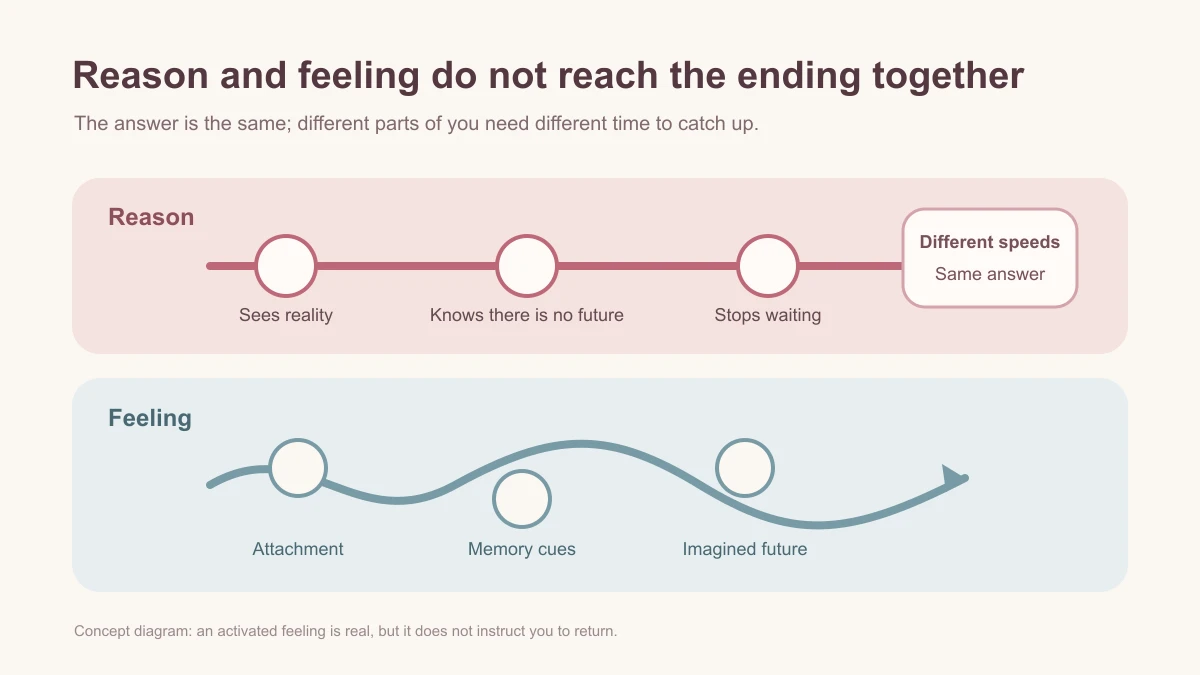
This distinction matters: being activated is not the same as being instructed to return. A song can restore the feeling for a few minutes without solving any of the reasons the relationship could not continue. A social post can make hope flare without changing the answer you were given.
The feeling is real. The feeling is not a command.
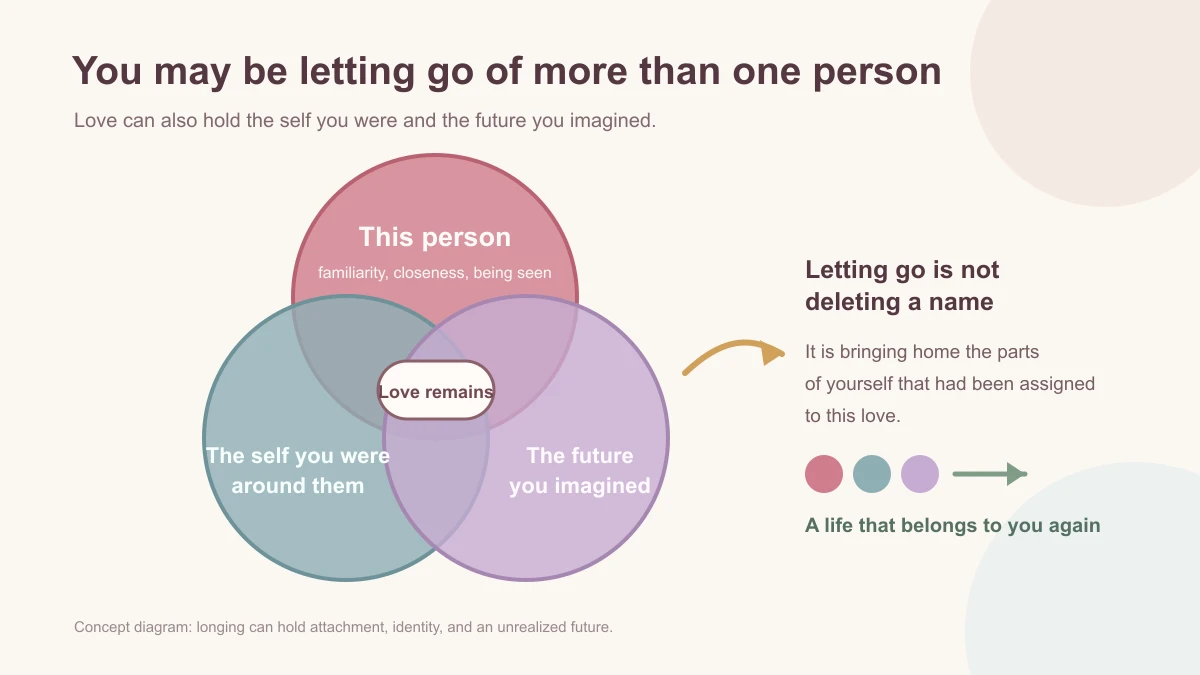
You may be grieving more than one person.
A close relationship quietly edits the answer to “Who am I?” You learn their favorite places. You know their friends. Certain evenings become shared territory. When you make a decision, an idea called “we” begins appearing without effort.
Even if the two of you were never formally together, sustained hope can reserve space in the future: one day they will understand; one day the timing will be right; one day the two of you will stop missing each other.
Across several studies of breakup and the self-concept, people experienced changes in the contents of the self and reduced clarity about who they were. Lower self-concept clarity, in turn, uniquely predicted emotional distress after the breakup.
This helps explain why letting go is larger than deleting a contact. You must rearrange the evening that used to belong to them, choose a new first person for good news, and answer questions that once began with “we.” Unrequited love can leave a similar vacancy. You may not have lost a shared household, but you lost the place you had been keeping open for one.
When you say, “I cannot let go of them,” there may be several quieter sentences inside it:
I cannot let go of the tender version of myself that existed around them.
I cannot let go of the person who believed so completely in that future.
I do not know where to put my life if I remove this hope.
If that is true, your work is not only to forget a person. It is to bring home the parts of yourself that had been assigned to the relationship.
When there was no real ending, hope can remain suspended.
An ending that clearly happened is painful, but it has a shape. The stories that are often hardest to organize are built from almost, perhaps, and if only. Because the two of you never had to live through the ordinary friction of a shared future, imagination can preserve a version of the relationship that reality never got the chance to wear down.
I would make one careful distinction: a possibility once existed; that does not mean it exists now. Their tenderness may have been real. Their moments of closeness may have been real. The way they made you feel that something could happen may also have been real. And their present choice not to build this relationship can be real at the same time.
You do not have to turn every good memory into a lie in order to accept the ending. You only have to stop using past tenderness to renew the contract of present waiting.
Do I have to make myself hate them?
I would not make hatred the only exit. It can help to write down the incompatibilities, the injuries, and the needs that remained unanswered so that memory does not preserve only the brightest scenes. But if you must prosecute the person every day to keep yourself from returning, they still occupy the center of your life.
One experiment tested several ways of regulating feelings after a breakup. Thinking deliberately about an ex-partner’s negative qualities reduced reported love feelings, but it also made participants feel worse in the moment. Distraction toward unrelated pleasant subjects improved how they felt without immediately reducing how much they loved the ex-partner.
That difference offers a compassionate and practical lesson: helping yourself through tonight and reducing love over time are different jobs. A shower, a walk, dinner with a friend, or a familiar film may not make you stop loving them. That does not make the action useless. It carries you through the sharpest part of the wave. When you have more capacity, you can look clearly at what this relationship offered and what it repeatedly could not offer.
You do not need hatred as proof that you are finally rational. “There are things I truly love about this person, and they still cannot walk forward with me” is already a complete goodbye.
Should I contact them?
If the other person has never given you a clear answer, you may choose one calm, direct conversation that does not require them to manage your emotions. If the answer has already been clear, I would not use contact as a method for changing it.
When you want to send a message, separate missing them from taking action. Write the answers in a note first. What triggered me just now? What am I actually asking them to give me—comfort, selection, or a small reopening of hope? If I do not contact them, is there any part of that need I can meet without them tonight?
You can miss a person without messaging them. You can be in pain without placing that pain in their hands and asking them to resolve it. You can still love them and respect a clear no. That is not emotional suppression. It is how you preserve choice while feeling is loud.
If you are unsure whether the person has actually declined the relationship or has only begun to withdraw, read When Someone Pulls Away, Should You Move Closer?. Look for reciprocal movement before deciding that you should stay.
What can I do when the longing hits without warning?
I would not begin with the question, “What if I never get over this?” That question is too large for any one midnight. Take care of this wave instead.
Name what is happening: a cue found me; I am longing; my body wants to return to what is familiar. Then put the phone slightly farther away and change the physical scene. Stand up. Drink water. Move into a room with light. Contact someone with whom you do not have to perform strength. You do not need them to insult the person you love or analyze every message again. You can say, “I am having a difficult moment. Talk to me about something else for a little while.”
Prepare alternate routes for triggers you already know. If you repeatedly open their profile, mute it or remove the shortcut. If deleting photographs feels unbearable, place them in a folder you do not cross every day. If a particular café collapses the whole afternoon, use another street for now.
Distance is not a tactic designed to make them miss you. It can simply be a way to stop delivering the same stimulus to a wound every day.
Letting go does not have to mean reducing love to zero.
Many people imagine recovery as a blank test: until I no longer think, hurt, or care at all, I have failed. That standard turns every unexpected memory into evidence that you are back at the beginning.
I prefer a different definition. Love may still exist, but it no longer owns the only central place in your life.
You schedule something unrelated to them because you want it. You return an evening once spent waiting for a message to friends, movement, sleep, or a skill you have wanted to learn. You visit a place without shared memories so that new experience does not always have to stand behind the old story. These actions may look as if they are avoiding the relationship. In fact, they are answering the question beneath it: Who can I still become without this person?
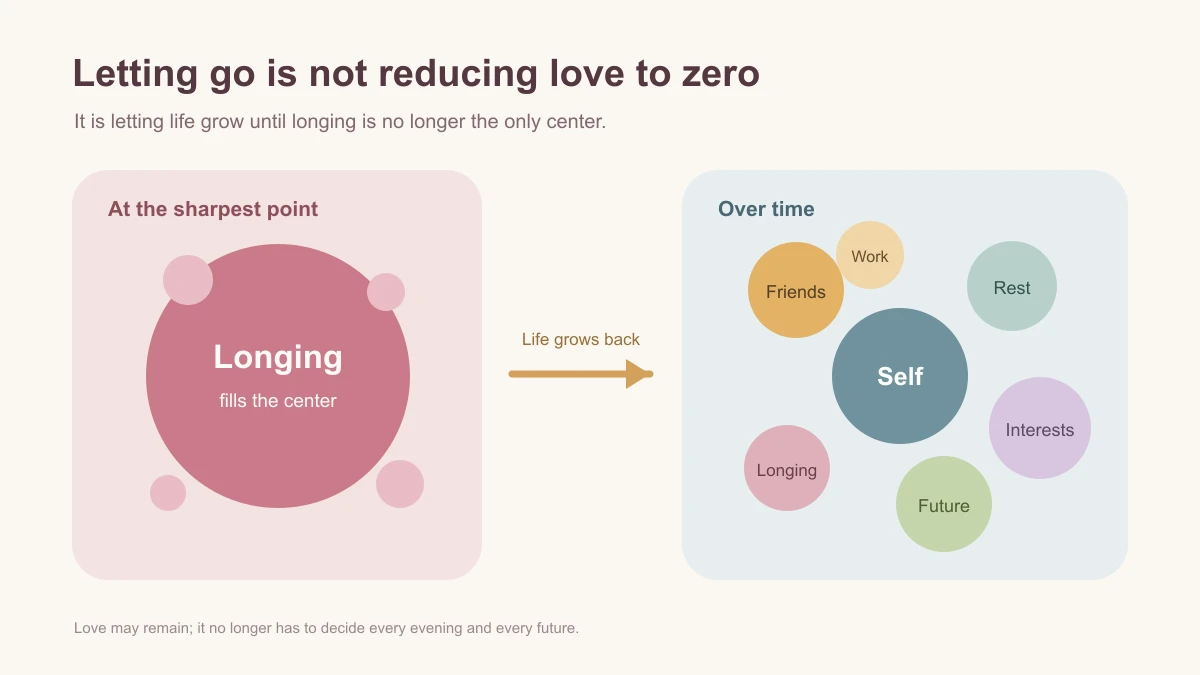
The diagram does not throw the love away. It makes life larger around it—large enough to contain friendship, sleep, curiosity, work, private joy, and a future that does not need this person’s permission.
One day, you may still think of them. The difference is that the thought no longer decides how you spend the evening, whether you return, or whether you deserve love. It becomes one true feeling that passed through your life, not the whole sky above it.
If this pain has made it hard to sleep, eat, or function for a long time, or if you are thinking about harming yourself, please let a trusted person and a qualified mental-health professional help carry it. If you need immediate protection, contact emergency services where you live. Asking for help does not make the love dramatic. It means you no longer have to hold its entire weight alone.
You do not have to stop loving them today.
Today, you can stop punishing yourself for still loving them. Then do one small, concrete thing that brings you back to your own side. Feeling may not obey an order to leave. But as your life grows back, inch by inch, this love will no longer have to be the only sky you can see.