Should You Go No Contact After a Breakup? What It Can Really Do for You

Some people online swear that thirty days of no contact will bring an ex back. Others say there’s no reason the two of you can’t stay friends. The more you read, the less sure you are whose advice to take.
What you do know is the routine. You scrolled their chat far enough down the list that you don’t see it anymore, and every night before bed you scroll back down anyway, open it, check whether their profile picture has changed, and close it again. It takes a few seconds. Then the rest of the night goes to wondering how they’re doing, and it feels like the day you broke up all over again. Somewhere in there is the question that brought you here: “Should I just go no contact?”
Should you go no contact after a breakup?
My suggestion is this: if you still can’t let go of them, go no contact for a while, and start with three months. The point of a fixed length is to spare you from waking up every morning and deciding all over again whether today is the day you reach out. When the three months are up, you look at where you are and decide whether to keep going.
By no contact I mean three things: you don’t message them first, you don’t look at what they post, and you don’t ask other people how they’re doing. Whether you block them or unfriend them is a question of how firmly you do it, not what no contact is. Some people block an ex and still search for their name every day. Others never block anyone and genuinely go a long time without opening the profile.
Before you start, depending on your situation, you can send them one message: “Let’s not be in touch anymore. If something practical comes up, just message me about that.” It says only what happens next. It says nothing about how you feel now, and nothing about later. My guess is that once it’s been said, they won’t have to wonder whether something has happened to you, and you won’t have to agonize over explaining yourself every time you don’t reply.
You might work at the same company, sit in the same class, or still have things to sort out, like belongings to return or an account you both use. Then a few conversations can’t be avoided, and no contact means talking about that one thing only, stopping when it’s handled, and skipping the “how have you been.”
What no contact can’t do
There are two things no contact can’t do: it doesn’t guarantee they’ll come back, and it can’t make you stop missing them any time soon.
Start with whether they come back. Once you stop reaching out, whether they notice, and whether they come looking if they do, is their own decision, not something going no contact can sway. From what I’ve seen, a lot of people start no contact still quietly holding on to that hope. If every day of it is spent waiting for them to notice, waiting for them to message first, then your days still revolve around them. All that’s changed is that instead of checking their posts, you’re checking whether they’ve shown up.
Then there’s missing them. You’ll still think of them now and then after you stop talking, maybe when you order the dish they always liked, or when you pass someone on the street who looks like them from behind. But that doesn’t mean no contact has failed. The way I see it, missing someone doesn’t just switch off one day because you’re no longer in touch.
What no contact can actually help with is on your side.
What no contact can really do for you
It helps to think of no contact as stopping three things you do every day, each of which makes you hurt a little more.
Stop checking their posts, and your mood stops following their day
It’s lunch break, and you open their story. A place you’ve never been, a table of people you don’t know, and them in the corner of the frame, looking like they’re doing fine. You put the phone away, and nothing gets done all afternoon.
After a breakup, their posts become the only window you still have into their life, so every photo gets studied. Are they over it already? Who are they spending time with? Have they forgotten you this fast? None of those questions has an answer, but you carry them around all day anyway. So whether you have a good day ends up depending on where they went today.
When you stop looking, your day goes back to being decided by your own things: how work went, whether dinner was good, whether you slept. At first the urge to look will be strong. I’d guess that after a while, there will be afternoons when they don’t cross your mind at all.
You can start with the easiest step:
- Easiest: mute their posts. They stay on your friends list; they just stop appearing in front of you.
- A step further: unfollow them.
- All the way: block them.
Pick whichever one you can manage today.
Stop sending and stop waiting, and you stop guessing every day
Two weeks after the breakup, they send you a photo of the place the two of you used to go. No words. You spend the whole evening on it. Are they thinking of you, or did they just walk past? Should you reply? What could you say that doesn’t look like you care too much? By the time it’s almost light out, you still don’t know.
As long as messages are going back and forth, you’ll reread every line they send, and when they don’t send anything, you’ll read meaning into the silence. I think the harder part is that the moments you most want to text them tend to be the moments you’re hurting most, and plenty of what gets typed then is something you’d regret seeing the next morning. Maybe it’s late and you can’t sleep. Maybe a song comes on that you used to listen to together. Maybe something happened that you badly want to tell them about.
Once you stop sending and stop waiting, there’s nothing left to decode. Whether they messaged today, and what they meant by it, stops being a question you have to answer every day. And you won’t send something on your worst night that you can’t take back.
Here, too, you can go one step at a time. The easiest is turning off notifications for their messages, so nothing from them pops up while you’re eating or working. A step further is archiving the conversation so it’s out of your chat list. The firmest is blocking them.
Stop rereading old messages and photos, and you stop living the ending again
You’re lying in bed, scrolling up through your old messages to the first months, when they said so many things that made you happy. Then you scroll down to the last few days, the replies getting shorter and shorter. By the time you’ve read it all, it’s nearly morning.
Rereading old messages is sometimes more than just remembering. You’re searching as you read: where it started to change, whether saying something differently that day would have changed anything. Each time through, you walk those last weeks again, and the ending is always the same.
When you stop rereading, the memories don’t go anywhere. They just stop being taken out every night so you can hurt over them again. I believe that someday, when it doesn’t hurt as much, you can look again if you want to, and what you’ll mostly see then are the times you were genuinely happy.
There are three ways to go about this as well. The easiest is a promise to yourself not to open them for these three months. A step further is moving the photos into an album you rarely open, so they don’t show up on your main photo screen. Most thorough is exporting the conversation, saving it somewhere, and deleting it from your phone. None of these asks you to throw the memories away. They just move them somewhere you don’t walk past every day.
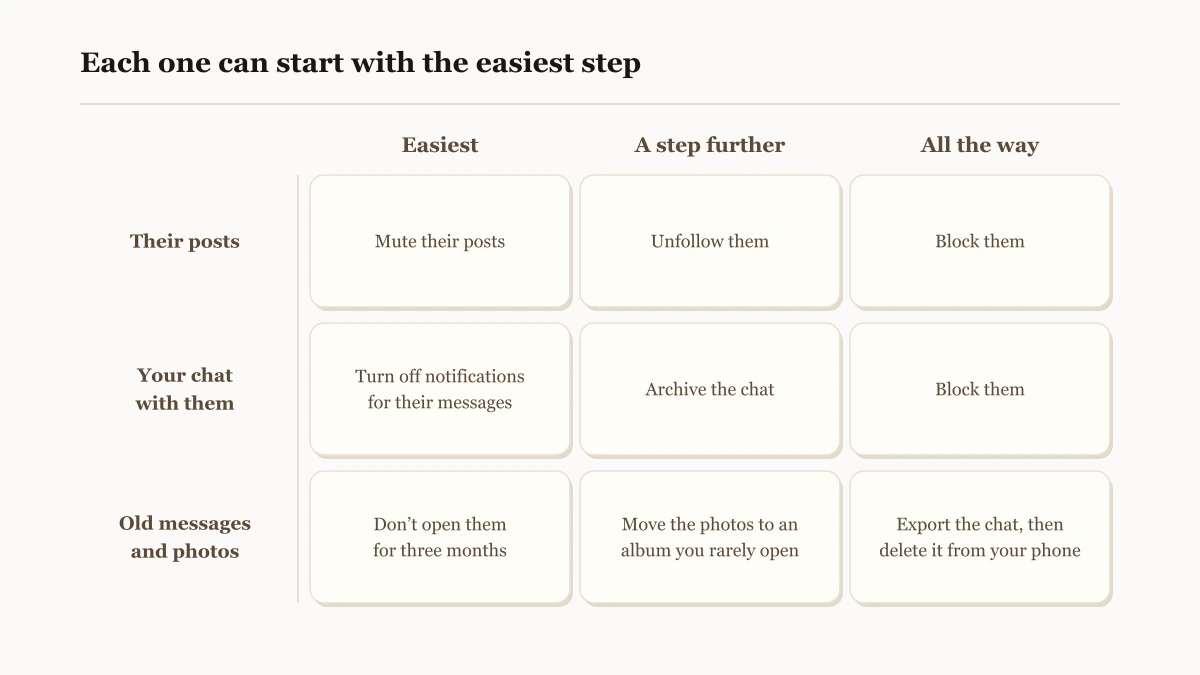
You don’t need to reach the last column on all three. Pick one box in each row that you can manage today, and when you feel ready a few days later, move one box to the right.
Three months in: how to tell you can stop
When the three months are up, ask yourself one thing: when their name pops up, does it change your mood for the whole day? It might be in someone else’s post, in your phone’s suggested contacts, or in a passing remark from someone who mentions them.
If it still does, if seeing their name means spending the afternoon thinking about them, I’d suggest another three months. That doesn’t mean you’ve done badly. Rather, this relationship still matters a great deal to you, and you need more time than you expected.
If it hurts for a moment and then you go back to what you were doing, then to me, whether to get back in touch, and whether to be friends, is yours to decide however you like. If you want contact again, an ordinary hello is a fine way to start. If you don’t, simply staying out of touch is a perfectly good ending too.
When they message you first
Often the hardest part of no contact isn’t holding back from texting. It’s when they text first. Getting this far means you’ve already done a lot for yourself. What’s left is working out which kind of message this is.
If it’s something practical, like belongings that need returning or an account you share, answer that and only that: “Just mail the things to me, thanks.” Don’t ask how they’ve been, and don’t explain why you’ve been out of touch.
If it’s a message to chat, something like “how have you been?” or “you suddenly crossed my mind,” you’re free not to answer. If leaving it unanswered will keep nagging at you, you can send: “Thanks for asking, but let’s stay out of touch.” You don’t have to work out why they suddenly reached out. All you need to decide is how you’ll respond.
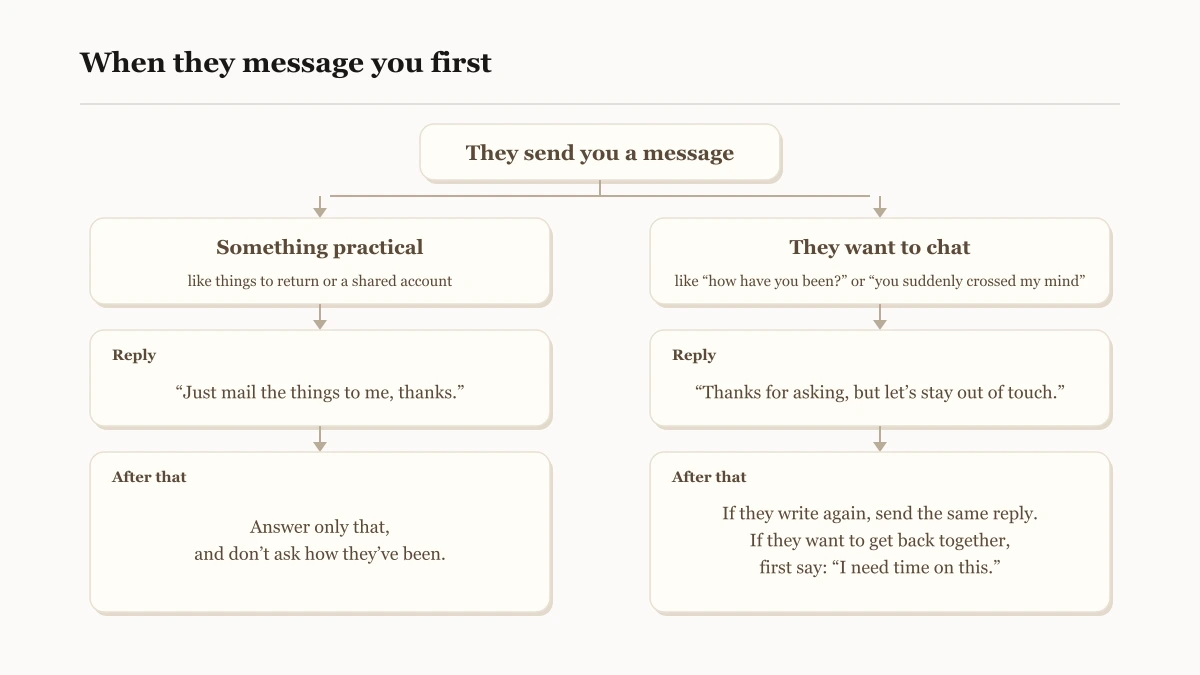
If they write again afterward, reply with the same line or don’t reply at all. You don’t owe a fresh explanation each time. And if they say they want to get back together, my suggestion is not to decide in the middle of no contact. You can say, “I need time on this. I’ll tell you once I’ve thought it through.” Wait until you can read their messages calmly, and then think about whether you want to go back.
After a breakup, take your days back first
Here’s how I think about why it’s so hard not to reach out after a breakup. You still care about them, and for now that care has nowhere to go, so every day it drifts back to their chat window and their posts. Your hand opens their name on its own because your heart hasn’t caught up with the fact that the two of you are apart.
Wanting to feel better is the right thing to want. Missing them is natural too. The no contact I mean isn’t about pretending you don’t miss them. It’s about being able to think of them and still eat, sleep, and get on with your own things, without letting that longing throw your days off.
Over the next few days, you could swap your home screen photo for a view you love, and leave your phone a little farther from the bed at night. This weekend, you could do something you kept putting off because your two schedules never lined up. You don’t need to do all of it; one thing today is enough. Over these months, bring your days back to looking like your own, one at a time, and it’s fine if that goes slowly.
Sources
Research and sources this essay draws on.
- Romantic breakups on Facebook: new scales for studying post-breakup behaviors, digital distress, and surveillanceInformation, Communication & Society, 18(5), 492–508
- Romantic Partner Monitoring After Breakups: Attachment, Dependence, Distress, and Post-Dissolution Online Surveillance via Social Networking SitesCyberpsychology, Behavior, and Social Networking, 18(9), 491–498