They Said They Don't Love You Anymore. Can It Still Be Saved? First, Tell a Fading Love From a Broken Relationship

A few words were all you got. The dishes were done, it was Sunday night, and your partner sat at the far end of the couch, quiet for a while, before saying, “I’ve been thinking about this for a long time. I think I don’t love you anymore.” When you asked what that meant, they said they did not know how to explain it. You fell asleep very late, with one question going around in your head: “Is there any way to save this?”
What you may be holding on to most is how little those words tell you. You do not know why they said it, which event it was or when it began, or whether anything is left for you to do.
They Said They Don’t Love You Anymore. Can It Still Be Saved?
Here is how I see it: it may still be possible, but you first need to work out whether what they are describing is a fading love or a broken relationship, because what helps in one case is very different from what helps in the other.
Without that distinction, effort easily goes to the wrong place. Keep apologizing for a love that has faded, and your partner may have even less idea how to respond, since they cannot name anything you did wrong. Plan a trip to lift the mood in a relationship that has broken, and whatever brought you here is still sitting where you left it. Once you are home, everything may be just as it was before you went.
Saving a relationship takes two willing people, and one person’s effort is not enough. What you can do is first do your own part well, then see whether they are willing to work at it with you. Your partner may have been thinking about this for some time before saying it, while that night was the first you heard of it. So it makes sense if your first talk settles nothing. Deciding whether to save this takes several conversations, and you do not have to get an answer out of a single one.
What a Fading Love Looks Like
A love has faded when nothing major has happened between you, yet the care your partner feels and their wish to be close to you have been shrinking little by little. They may have no particular complaint about you and may not dislike you at all. It is just that when they think of you, the old urge to see you and talk to you is no longer there.
In daily life, they still answer your messages and remember what you asked them to do, but they seldom bring up their own day. Once you have settled where to go this weekend and who is booking the table, the conversation is over. When you are upset they ask, “What’s wrong?” and then their eyes go back to the phone. You argue less often too, though nothing has been talked through. They simply do not feel like talking about it much anymore.
A few things may lie behind this slow fade. Days fill up until most of what you say to each other is about things to be handled. It has been a long time since you did anything new together, so what you know about each other is years old, and you might struggle to say what is bothering them now or what they enjoy. Then there are the small disappointments that seemed too minor to mention and sat so long that even the wish to mention them went away. Seldom is any of this one person’s fault, and none of it happens overnight.
What a Broken Relationship Looks Like
A relationship has broken when something, or the same thing again and again, has hurt one or both of you. You no longer trust or respect each other as much, and the matter is still not dealt with.
It might be an affair or getting too close to someone else, a lie about something important, or promises made and repeatedly not kept. It might also be harsh words said in a fight that nobody ever came back to, or one issue you have fought about for years, with each round stopping in about the same place.
Your partner may be the one who caused the break, or you may be, or you may both have a share. Work out which, because what comes next depends on it: the person who did wrong and the person who was hurt have very different things to do.
The signs in the way you get along are hard to miss. Bring up what hurt and a fight starts, or you both have a silent agreement to steer around it. Old grievances keep coming back, and whoever was hurt has to stop at every sentence and consider whether it can be believed. Sometimes one of you has barely started talking when the mood shifts, and being near each other makes you both tense.
Anger and sadness can mean you still care about the relationship, or only that the hurt has not healed yet, and they do not have to mean wanting to go on. That is true for either of you, and only your partner can tell you which it is for them.
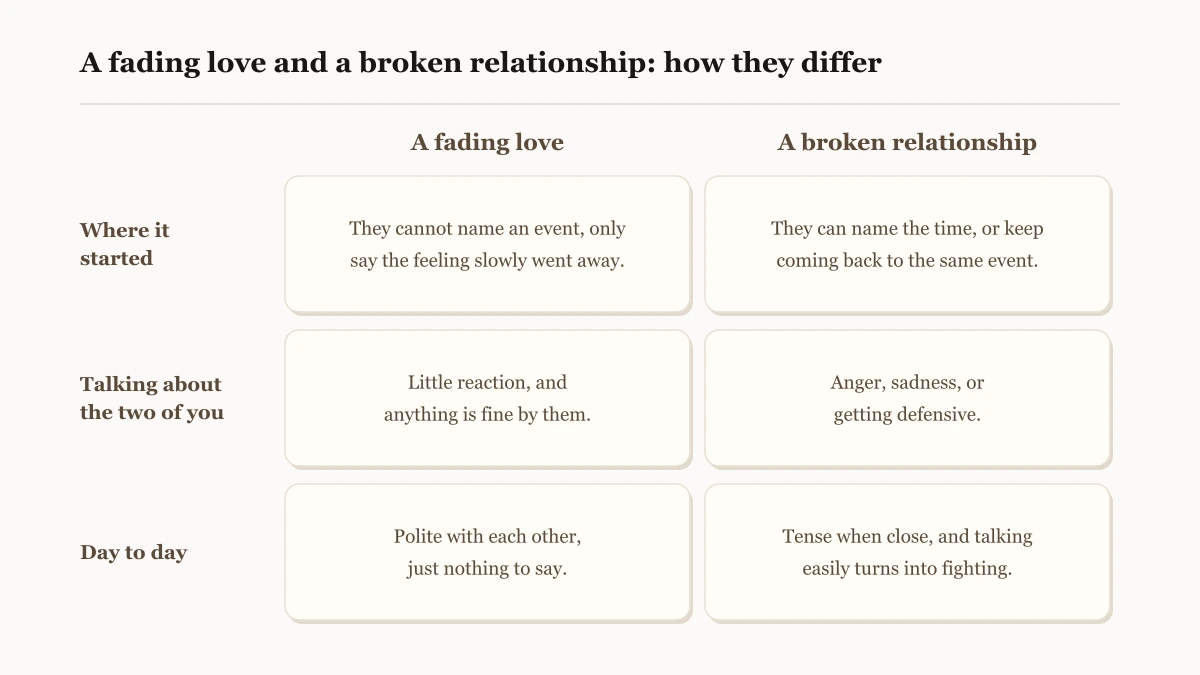
How to Tell Which One Your Partner Means
Whether they can name where it started, whether talking about the two of you stirs any emotion, and how you get along day to day can each only point one way or the other. The most direct way is still to ask. Wait until you are both fairly calm, then say it in person or send it as a message:
When you said you don’t love me anymore, I want to hear what you mean. Did something happen that made you feel this way, or did the feeling slowly go away? And have you already decided to separate, or are you still thinking about it?
What comes next depends on the answer. If they can name an event, the steps are in “If the Relationship Has Broken, Here Is How to Try to Save It.” If nothing happened, the feeling simply went away, and they are still thinking, the steps are in “If the Love Has Faded, Here Is How to Try to Save It.” If they have decided, the steps are in “If They Have Already Decided.” Sometimes the two get mixed together: your partner says they feel nothing, yet if you ask further back, you arrive at the same event. In that case you can start with what broke the relationship.
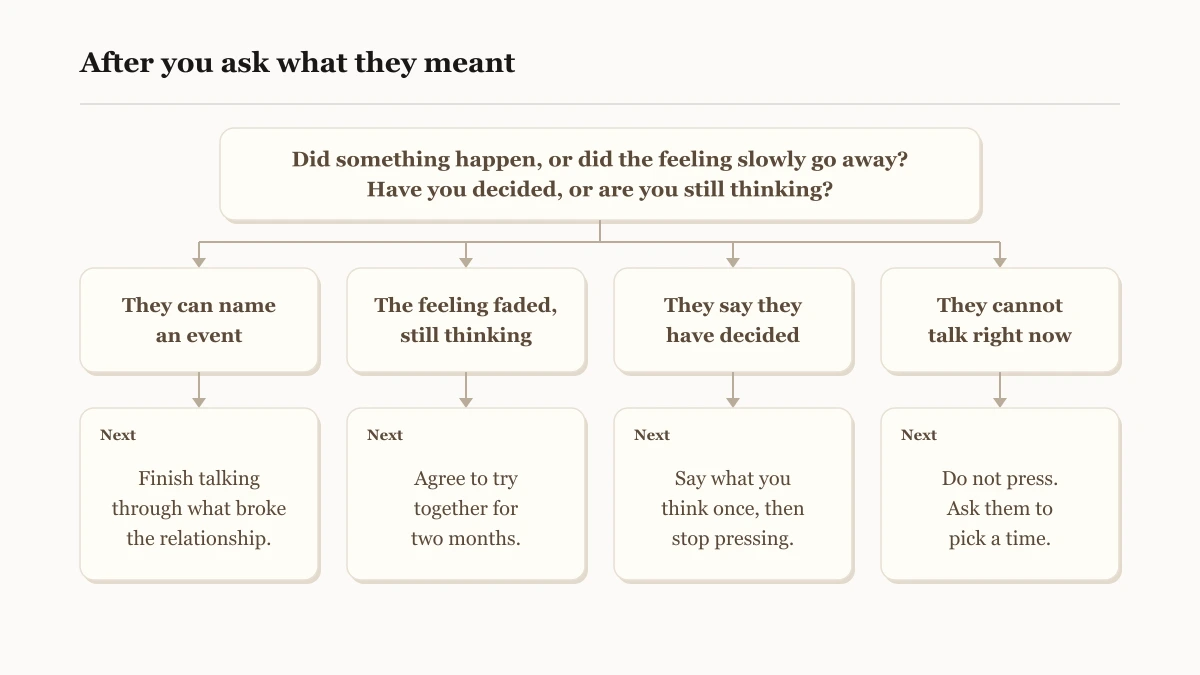
They may also reply that they cannot talk about it right now. Do not press them for the moment. Just answer, “Okay, I hear you. Would this weekend or next weekend be better for talking again?” If they never pick a time and keep refusing to talk, they may not be ready to work on saving this with you right now, and the steps for that are in “If They Have Already Decided” too.
If the Love Has Faded, Here Is How to Try to Save It
With a fading love there is no single event to apologize for or fix. The work is giving the two of you something to talk about and something to do together again, and these four steps can go in order.
Agree on a period of time instead of asking them to take it back
They have only just told you they no longer love you, so asking them to take it back now may be more than they can do, and you would both just be stuck. It is more workable to ask them to try for a while with you:
I’m not asking you to say you love me right now. I’d like you to try this with me for two months, and then we’ll have a proper talk.
If they agree, avoid asking every day whether they feel anything, since each time you ask, they have to check their feelings all over again. If they say no, ask whether they have already decided to separate, and get that clear first.
Do something together that neither of you has done
You may want to take them back to the restaurant you used to love, hoping to bring that old feeling back. But they feel nothing right now, and sitting at the same table may not change that, which could leave you both feeling worse. It is better to try something new to you both, such as a class neither of you has taken, a mountain you have not climbed, or a dish you learn to cook from a video. If you live far apart, you can agree to watch the same new series and then talk on the phone after you finish it.
Take turns choosing, and go along once even when your partner’s pick does not appeal to you. There is no need to discuss your feelings while you are doing it. Fumbling and laughing together gives you something to talk about later.
Get to know them again, without making every talk about the relationship
What you know about them may be years out of date, so start by asking about their life right now:
What’s been the most annoying thing at work lately?
Hear the answer out and ask for a detail or two, without steering back to “So how do you feel about me?” Tell them what is going on with you as well, whether it is something odd that happened at the office or a movie you saw recently. Their replies may be short at first. A few days later, simply ask about something else.
When the two months are up, ask them one question
Choose an evening when nobody is in a hurry, and ask in person or by message:
In these two months, was there any time you felt happy being with me?
If they can name one, plan more times like it, then talk together about whether to keep going. If they cannot, go back to the question of separating and talk it through properly. The feeling may come back, but nobody can promise that. At least after these two months, you will both have a clearer idea of the answer.
If the Relationship Has Broken, Here Is How to Try to Save It
Just being nicer to each other or waiting for time to pass may not get you past a break like this. What broke the relationship has to be talked through first.
Finish talking through what broke the relationship, and do not skip it
Whoever caused it, you can open with this:
Of what happened between us, which part is still the hardest for you to get past? I want to hear all of it, and I’d like you to hear all of mine.
If you are the one who was hurt, you can reverse the order and ask them to hear you out first. Whoever is listening should hold off on explaining why things went the way they did, and should not rush to say sorry as a way of closing the subject. When the other person finishes, say back what you heard so they can confirm it, for example, “The hardest part was that after it happened, neither of us ever brought it up again, right?” You do not need an outcome today, or to get as far as who forgives whom. If you cannot get through it all, set another time.
If your partner caused the break, say clearly what you need
This case is especially hard, since you are the one who was hurt and they are the one saying they no longer love you. Wanting to save the relationship does not mean what they did has to be dropped. You do not have to call the hurt nothing, and you do not have to rush to forgive them. If you want to keep going, tell them directly what you need:
I want to keep going, but I need you to tell me clearly what happened that day and what you plan to do from now on.
If they are willing, go through it one piece at a time: what happened that day, what they will do from now on, and how you can ask them about it when you feel uneasy. If they are not, you would be the only one left trying to save this relationship. That would be very hard, and you can start thinking about whether you want to go on.
If you caused the break, apologize for the specific thing
“I’m sorry, I shouldn’t have done that” is too light, because it does not show them you know what you did. Say what you did and what it has done to them:
That day I told you I was working late, but I was actually having dinner with someone else. I lied to you. You stopped being able to trust what I say, and I caused that.
Do not follow it with “But back then you also…” From here on, answer truthfully whatever they ask, and bring up on your own what might worry them, such as who you are seeing today and when you will be back. Months later they may ask again what you and that person talked about that day, or whether you saw them again. Answer truthfully again instead of saying, “I already apologized, what more do you want?” You cannot decide for them how long letting go will take. What you can do is show them, time after time, that what you say and what you do now match.
If you both have a share, both approaches apply: each of you says clearly what you did and what the other’s actions did to you.
If it is the same fight over and over
Pick the issue you fight about most. At a time when you are not fighting, agree on one concrete way of handling it. Say you always end up fighting over plans canceled at the last minute: you could agree that canceling happens the day before, and that if something truly comes up that day, the person calls. Try it for two or three weeks, and adjust it together if it does not work.
If every talk turns into a fight you cannot finish, agree first on how to stop. Either of you can say, “I need to pause. Let’s talk again tomorrow night at eight,” when a fight feels close, and you both come back at that time and stick to this one issue. If talking face to face starts a fight the moment you begin, try writing instead: put what you want to say in a message, send it, and let the other person read it and answer the next day.
If the hurt keeps happening and your partner has no intention of stopping, saving the relationship is not what you need most right now. What you need first is to be somewhere you feel safe.
If They Have Already Decided
My suggestion: say what you think properly, once, and then believe what they tell you.
Even if they say they have decided to separate, you can still say what you want to say, and you do not have to swallow it to keep up appearances. You can do this in person or by message, and once is enough:
I’d still like to try again. That’s where I stand. If you’ve already decided, I’ve heard you, and I won’t keep asking.
If they say they want to think some more, agree on a time to talk again. If they still say they have decided, do what you said you would do: no more begging, no more asking why again and again, no arranging things meant to bring them back. All of that would only make this last stretch harder for you both. What remains is the practical side of separating, such as how to collect your things, who to tell first, and, if you live together, what happens with your home, and you can take these slowly.
Saving It Does Not Mean Getting Them to Take Those Words Back
“I don’t love you anymore” leaves you stuck because all you have heard is the result. It does not tell you when they began to feel this way or why, or whether they are sad right now or feel nothing at all. You do not know where to begin, so all you can do is guess.
Saving the relationship, then, is not about making them change their answer. It is about the two of you saying what has gone unsaid, and then deciding together whether to go on. Nobody can promise you in advance that the feeling will return, but only once those things are said can you learn where the trouble really is. Maybe they will be willing to try, and then you are staying with your eyes open, which is steadier ground than drifting along in the dark. Maybe they will still leave, and then you have said what you wanted to say and heard their reasons from them directly, so you no longer have to guess alone why they went. Either way, you are better off than you are right now, holding one short sentence and nothing else.
Sources
Research and sources this essay draws on.
- A Phenomenological Study of Falling Out of Romantic LoveThe Qualitative Report, 18(19), 1–22
- Beyond Good or Bad: The Four Evaluative Quadrants of RelationshipsPersonality and Social Psychology Review, 30(1), 83–110
- One foot out the door: Stay/leave ambivalence predicts day-to-day fluctuations in commitment and intentions to end the relationshipEuropean Journal of Social Psychology, 51(2), 294–312
- In the wake of betrayal: Amends, forgiveness, and the resolution of betrayalPersonal Relationships, 17(2), 253–278