They Ended It: How Do You Get Through the First Few Weeks?

Most of the day holds together. You get through what has to be done, you talk to people, and you still laugh when you do. Then, half a meal in, your phone is already up and the photo is already taken, and there is nobody to send it to. That is one of the few times a day when everything stops, you cannot do anything at all, and you are left holding on. That is when the question turns up: how do you get over being left?
What you are actually here for
Not a line about how it gets better with time, and not a method for winning them back. You want to know what to do with the hours left in today, and the same hours tomorrow.
So here is something worth knowing first, because it will save you from blaming yourself a few times: these weeks do not improve a little each day. You felt almost steady yesterday and today you are flattened again. That is not a relapse, that is what this stretch is like.
The sentences you have not said out loud
“I could not even get a reason.” You could not, because the answer sits with them, and how much of it you get is theirs to decide. You can go and ask, but even once they have said everything they are going to say, tonight still has to be lived through. So my view is that these weeks are the wrong time to spend your strength on that answer, because it will not make tonight easier.
“Was it something I said?” My judgment is that a relationship people actually lived in does not stop because of one sentence. You are going back through everything you said because that is a thing you can still do, and by the end of it you find that nothing you could change is in today. The same goes for “had they wanted out for a long time, and I was the only one who did not know?” I do not know when it started for them, and you will not either; even with a date in your hands, dinner still has to happen and that walk home still has to be walked.
“How did I not get even a small chance?” Because ending is not like starting: being together takes two people agreeing, ending takes one. You did not get a chance because this decision never had to pass through you, not because someone weighed you up and found you short. Not being treated as one of the people deciding is the part that hurts, and it says nothing about what kind of person you are. And as for “everyone else seems to have moved on, and I am still here”: what you see is how other people look now, not the weeks when they were at their worst, and those weeks are mostly invisible. You are holding your hardest days up against everybody else’s edited ones.
Some of those questions are aimed at them and some at yourself, and they all want the same thing: an answer that explains this. That answer is not in your hands right now, because part of it waits on them and part of it waits on time. What is in your hands is the hours left in today.
A breakup takes more than a person. It takes the places they had in your day
They had fixed places in your day
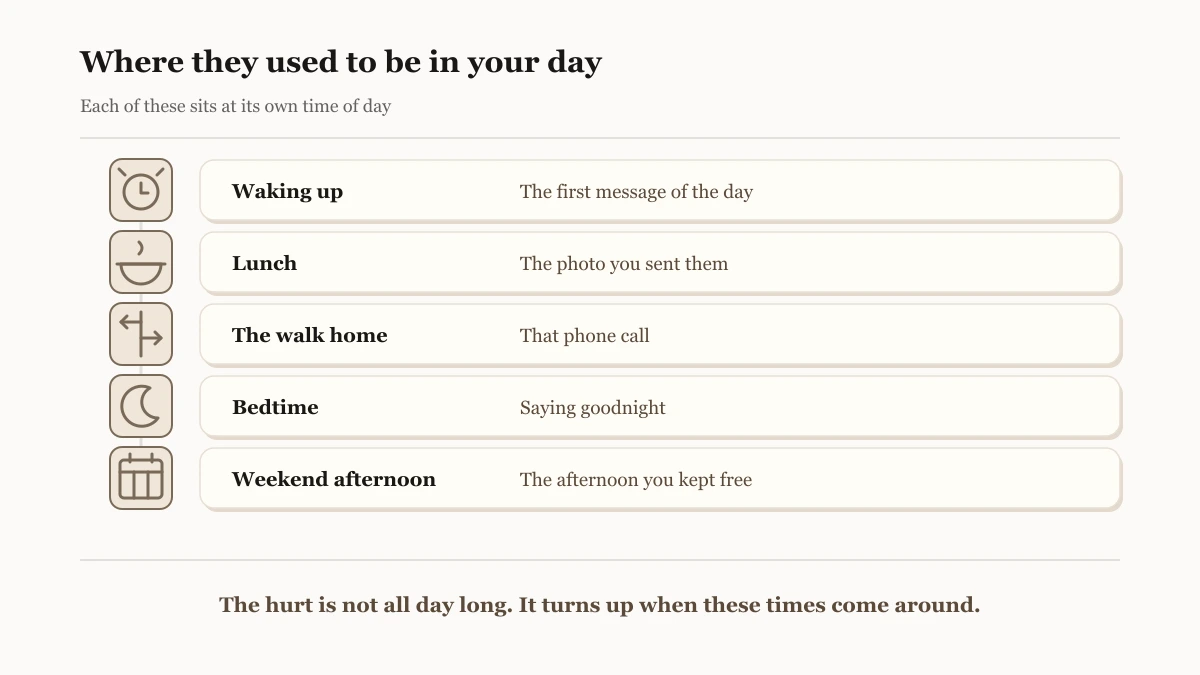
The first message when you woke up. The photo you sent them at lunch. The call on the walk home. Goodnight. The weekend afternoon you kept free. None of that appeared in a day; it went in one slot at a time while you were together, and every one of those slots sits at a fixed hour.
Which is why the hurt runs on a timetable
You are fine all day, and then that hour arrives and you go down. It is not weakness. Something used to happen at that hour and now nothing does. It is also why the hurt comes several times a day with stretches of nothing in between: it is not switched on from morning to night, it follows those slots, and it shows up when they do.
A timetable is something you can get ahead of
Here is where I think this becomes useful. It is not landing at random, you know roughly when it is coming, and that means you can put something into that hour before it arrives. I am not going to tell you it stops hurting once you do. What I will say is that when something else is happening in that hour, you are less likely to be stuck in it with nothing at all to do.
And none of it has to wait: not on an answer from them, not on you working anything out first, not on you feeling steadier. You can do it today, and it is small enough to be within reach of the state you are in right now.
How do you get over being left: deal with those hours first, not with them
You cannot decide whether you miss them today, and you cannot decide what mood you wake up in tomorrow. You can decide what happens in those two hours tonight, and that part is entirely yours.
The order matters here. It is not think your way through it first and then live; it is get through the days first, and once you have some strength back, the unresolved parts become something you can handle. Those hours turn survivable one at a time, and that is how the weeks turn survivable one at a time. This is also not an instruction to fill your calendar. Three a day is enough, and they should be the three worst ones.
What to do: put something into the three hardest hours
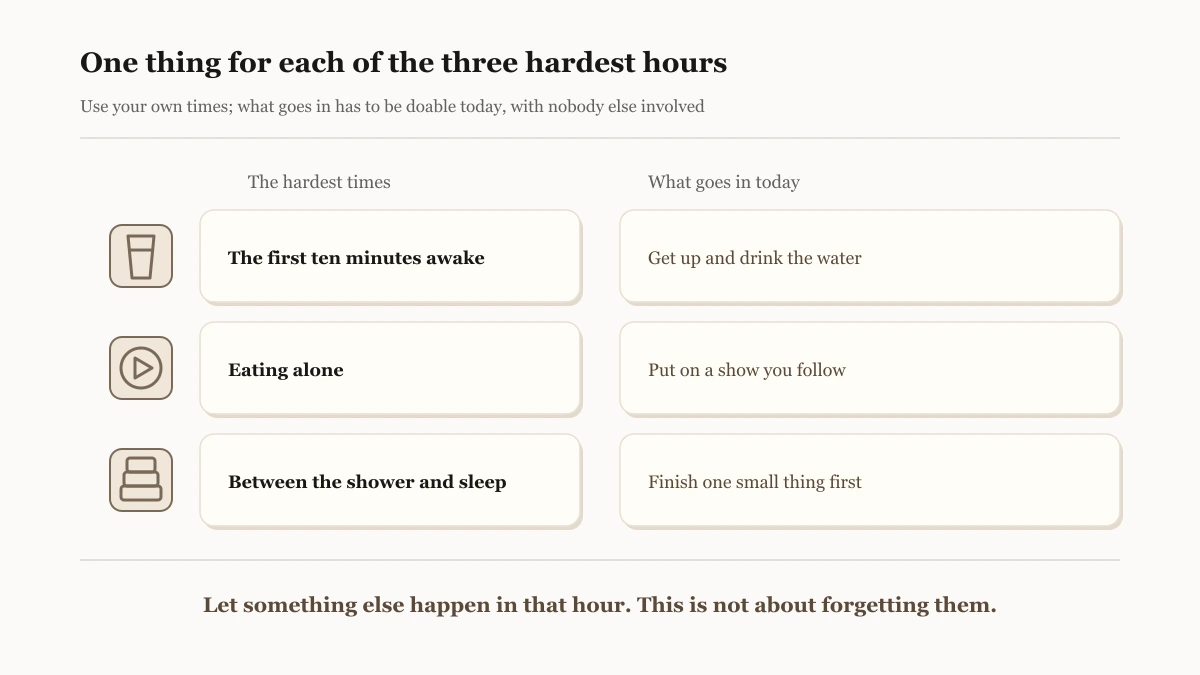
First, write down the three hardest hours of your day. The test is not “what reminds me of them”, because that list never ends and half your flat qualifies. The test is “which three times of day am I dreading”. My judgment is that most people end up with something like the first ten minutes awake, eating alone, and the stretch between the shower and falling asleep. Yours may be different, so write your own, and keep the list where you can see it.
Second, put one thing into each of those hours, something you can do today without anyone else involved. It has to be concrete enough to say out loud: do not lie in bed with your phone for those ten minutes, get up and drink the water; when you eat alone, put on a show you follow so there is sound in the room; between the shower and sleep, finish one small thing before you get into bed, whether that is laying out tomorrow’s clothes, washing up, or clearing the table.
This is not about forgetting them, and it is not about pretending to be fine. It is about something else happening in that hour, so that you are not sitting in it empty-handed. One more thing, before you try: getting it wrong the first time is normal. You may drink half the water and sit back down on the bed, or have the show on without hearing a word of it. That is fine. The same hour comes around again tomorrow and you can put something in it again.
You also do not have to fill all three today. Take the worst one, put something into that hour alone, and leave the other two until tomorrow. And you do not have to feel better before you start: drinking the water is already the start.
Four things you are going to ask next
“Can I ask them why?”
You can, once. Know what you are getting first: what they are willing to say, which is not the full reason and not necessarily the main one. If you do ask, here is how I would put it: “I am not asking you to reconsider, I just want to know what you were thinking at the time.” That sentence is clear about what you want, and it asks them for nothing else.
“My friends keep telling me to get out of the house, and I do not want to move.”
Not wanting to move is normal, and these weeks do not need a full calendar. What you need is not a better mood, it is someone nearby. Pick something that does not take much talking: it could be a walk, a meal, or getting through one film together. Say something if it comes, say nothing if it does not, and do not perform being fine over dinner.
“How do I know whether I am getting better?”
Do not measure today against yesterday. Look at the three hours you wrote down and see whether there are fewer of them, or whether they are shorter. A whole evening was unbearable, and later it is only the part between the shower and sleep; all three hours were bad, and later only bedtime is. The change is slow enough that you cannot feel it while it happens, which is exactly why it goes on paper, where you can see it move.
“They look completely fine. Why is it only me?”
Because you did not start on the same day. By the time they said it, they had been thinking for a while, and you were not inside that stretch; your first day was the day you heard it. What it is actually like inside them I do not know, and you cannot see it from outside either. The only distance you can measure is your own, so there is no need to hold your first week against whichever week they are in.
Those hours in your day are still yours
These weeks hurt this much because several hours of your day used to be theirs, and now each of those hours empties out on schedule. Put something into them and the empty ones grow fewer, not because you have forgotten anyone, but because something else is finally happening at that time.
Some days you will manage it. Those days will not be days you miss them less, but they will be days when you had something in your hands at that hour. Other days you will manage nothing at all and spend the whole evening lying down, and that is allowed, because the same hour returns tomorrow and you can fill it again. Both of those days are better than now, when those hours are empty and there is nothing in your hands.
One more thing I want you to know: you have done more in these weeks than you are giving yourself credit for. You have been getting up, getting things done, laughing in front of people, and right now you are working out what to do with tonight. That is not merely holding on. That is moving, only perhaps slower than you wanted it to be.
They have stepped out of your day, and those hours did not go with them. Put one thing in today and another tomorrow, and those places will slowly take on a shape that is yours, a shape you put back together with your own hands, one day at a time.
Sources
Research and sources this essay draws on.
- The emotional sequelae of nonmarital relationship dissolution: Analysis of change and intraindividual variability over timePersonal Relationships, 12(2), 213–232
- Predicting the onset of emotional recovery following nonmarital relationship dissolution: Survival analyses of sadness and angerPersonality and Social Psychology Bulletin, 32(3), 298–312
- Participating in research on romantic breakups promotes emotional recovery via changes in self-concept claritySocial Psychological and Personality Science, 6(4), 399–406