They Went Cold During the Talking Stage. Can You Bring the Spark Back?

Yesterday you talked until neither of you wanted to go to sleep. Today their replies have collapsed into a few dry words. You offer a new thread; they return hours later without a question. Your phone is quiet. Your mind is not. Did I say something wrong? Did they meet someone else? Should I send one more message and rescue the mood?
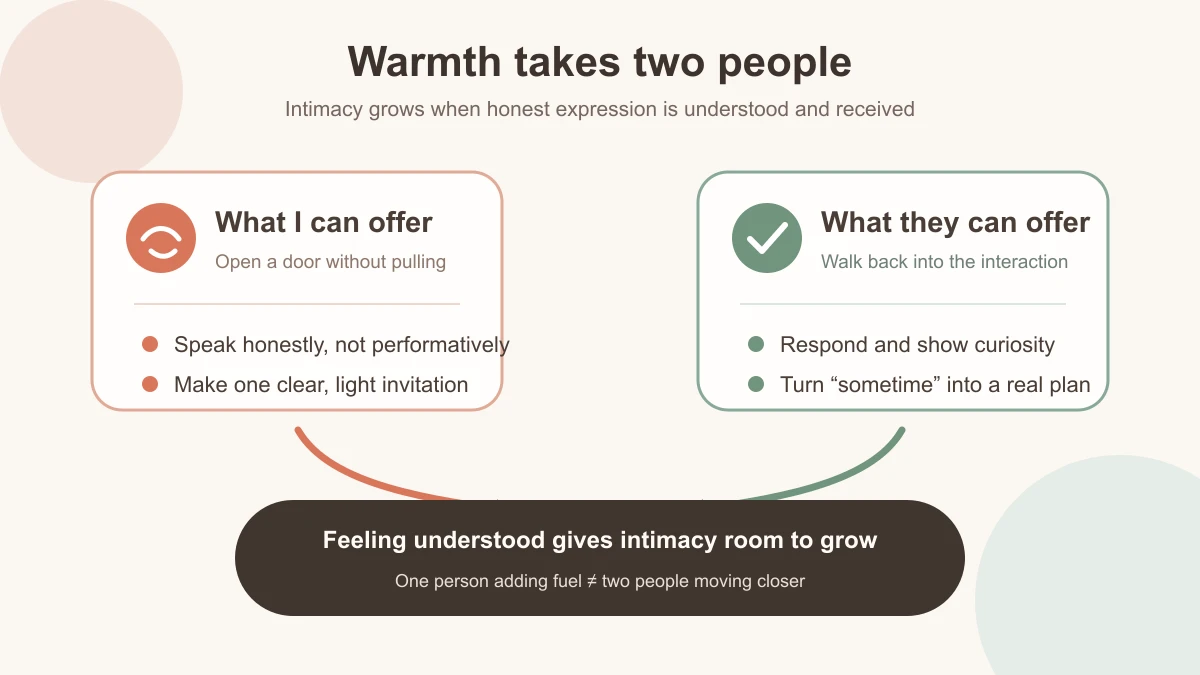
First, let me take some of the embarrassment out of wanting to fix this. A sudden change in rhythm is unsettling. Reaching for the connection does not make you needy or foolish. But more messages, a more polished performance, and a larger sacrifice are not necessarily what restores closeness. Research that tracked people interaction by interaction found that self-disclosure was tied to intimacy partly when the other person’s response felt understanding, accepting, and caring. Warmth is not a fire one person can revive by adding fuel alone. You can offer something real. The other person still has to receive it.
This is not a guide to playing hard to get. I will not give you a line that promises to make someone chase you again. Instead, we are going to turn panic into questions you can actually answer. Was this one slow day or a continuing retreat? How can you check in without turning the check-in into pressure? If there is still warmth here, what gives it room to return? And if there is not, how do you keep yourself intact while you learn that?
Do not guess why they went cold. Notice what changed.
An anxious mind hates an empty space. It fills the space quickly: they are busy, they are testing me, they think they have already won me, they found somebody else. Any of those stories could be true. Any could be wrong. Once a guess hardens into an answer, you start responding to a person inside your head instead of the person in front of you.
I once wrote about this exact situation and said that people often cool down when they feel they have nearly “gotten” you. I would keep the three warnings from that earlier essay. I would not keep that premise. I do not know what is happening in another person’s mind, and neither do you. You do not need to convict them of a motive before you are allowed to protect your peace.
What you do know is behavior. Compare the recent exchanges with this person’s own normal rhythm. Are the replies only slower, or has their curiosity disappeared too? Do they pick up anything you say, or must you keep supplying oxygen? When they cannot make a plan, do they suggest another time, or does every invitation die inside “we’ll see”?
One short reply is not a verdict. A direction repeated across several interactions tells you more: less initiative, thinner content, vaguer plans — and nothing left between you when you stop dragging the conversation forward. You may never learn the private reason. Seeing that you are currently doing all the maintaining is already useful information.
The three things you most want to do may take you further from yourself
When someone grows distant, the silence itself is not always what clouds your judgment. More often, it is the urgency created by the fear of losing them. The problem is simply that the following moves may buy a reaction without creating the mutual closeness you actually want.
Do not perform for their attention
Pretending a message went to the wrong person. Dropping a random reaction sticker with no context. Turning every Story into an indirect announcement that says, please ask me what this means. The issue is not that these tactics are insufficiently clever. The issue is that you become increasingly busy controlling their response and increasingly unable to say what you truly mean.
Of course you can share something you genuinely want to share. Ask yourself one clean question: would I still post or send this if they never saw it? If yes, it belongs to your life. If no, you may be turning yourself into bait.
Do not wear their interests as your personality
A shared interest can be wonderful. It is not an entrance exam. If you truly love the same team, band, game, or kind of film, enjoy that common ground. If you do not, honesty can sound like this: “I don’t know much about it, but I want to know what you love about it.” Curiosity does not require sameness.
A large synthesis of work on self-disclosure found that the connection with liking was not merely about how much a person revealed. The quality of disclosure and whether it fit the situation mattered. A speed-dating study found another human distinction: desire that was specific to one person was positively reciprocated, while a general tendency to desire everyone was negatively related to being desired. Neither result predicts what your person will choose. They do offer a useful reminder. What makes someone feel seen is not “I can become whatever you like.” It is “I am still myself, and I am paying attention to you.”
Do not double your effort to purchase a reply
They take one step back, so you do twice as much. More check-ins. A gift. A surprise. An offer to solve something they never asked you to solve. Beneath all that care, an unspoken ledger can begin to form: after everything I have done, shouldn’t you come closer now?
The problem is not generosity. It is using generosity instead of clarification. When you are afraid to ask whether they still want to know you, you may offer more care and hope their reply will answer the question. In a longitudinal study of romantic partners, excessive reassurance-seeking was associated with earlier partner-initiated rejection. That is an association, not proof that one extra message drives a person away. Still, it gives us a good reason to distinguish asking once from asking repeatedly until the other person produces the answer that can finally calm us.
You can send one more message — without putting a hook in it
If your connection had been steady and the recent cooling did not include an explicit rejection, I think you can initiate once. Do not vanish in order to make them panic. Do not send a relationship postmortem. Send something short, true, and easy to answer freely.
For example:
It feels like our chat has slowed down lately. I’m not sure if you’ve just been busy. If you still want to talk when you have space, I’m here.
Or replace another vague “what are you doing?” with a concrete, light invitation:
You mentioned that movie last week. I’m planning to see it Saturday afternoon. If you still want to go, come with me. No worries if the timing isn’t right.
Both messages do the same important thing. You do not pretend to be indifferent, and you do not demand immediate proof. You open a door without standing in it and pulling.
How long should you wait before sending it? I do not believe in a magic number of days. One person checks their phone only a few times a day; another normally chats every hour. The same silence means different things inside different rhythms. Use their usual pattern and the content of your last exchange, not a countdown invented for strangers on the internet. Once you have sent one clear, low-pressure, answerable message, do not stack another one on top to make it ripen faster. Let the response itself become information.
Bringing back the spark is not getting one reply. It is seeing them walk back toward you.
A heart reaction, a quick “sorry, busy,” or one suddenly electric night can flood your body with relief. But what makes a connection worth staying in is not a brief return of heat. It is the return of mutuality.
I look for three things. First, they do not merely reply; they ask, build on what you said, and leave you feeling that your actual message was heard. Second, they show initiative instead of waiting for you to strike every match. Third, they help turn the vague into the concrete. If they cannot make a plan, they offer another time. If they say they want to see you, they help make seeing you possible.
None of these needs a perfect score in a single conversation. The talking stage is awkward. People have deadlines, sick relatives, bad weeks, and moments when language fails them. Look for direction, not perfection. When you take one honest step, do they take any step toward you?
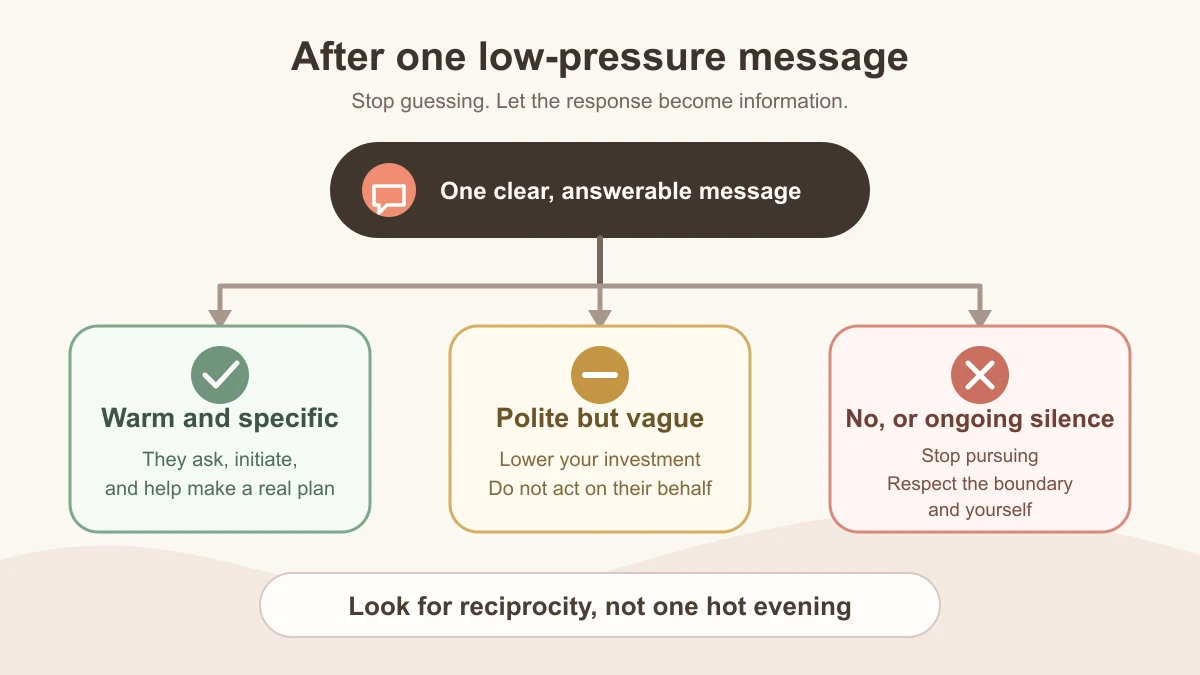
If the reply is warm and specific, start again with one easy shared experience. You do not need to force the relationship back to yesterday by midnight. If the response is polite but endlessly vague, lower your investment and return attention to the rest of your life. If they reject you clearly, accept the answer. If they continue not to respond after you have left room, accept the level of participation they are showing you. Silence may not be the explanation you deserve, but it is still information about what they can offer now.
What if they come back — and then disappear again?
The hardest connection to release is often not one with no hope. It is one where hope lights up occasionally. They return warmly and everything feels restored. Then they recede, and you work even harder to recover that one good night. Eventually you may be chasing less after the person than after the relief of finally being answered.
When that happens, I stop asking only, “Do they like me?” I also ask, “Does this way of relating let me remain steady and recognizable to myself?” Affection can exist while someone lacks the willingness or capacity to approach consistently. You do not need to prove they are a bad person before admitting that the rhythm is bad for you.
Your boundary can be plain:
I like being with you, and I would be open to continuing this. But getting very close and then disappearing for long stretches doesn’t work well for me. If you do not have room for this now, I will respect that and step back too.
After you say it, your actions have to finish the boundary. Do not announce that you are stepping back while continuing to check their activity through Stories, friends, alternate accounts, or manufactured accidents. Stepping back is not a punishment. It is the end of making your emotional state wait for someone else to issue a paycheck. If you are already caught in the loop of checking, asking, and crashing, I wrote about reclaiming yourself piece by piece in Why Does Loving Someone Feel This Exhausting?.
You can create the conditions for closeness. You cannot do both people’s approaching.
So, back to the question: they suddenly went cold. How do you bring the spark back?
My answer is to pause before you try. First find out whether there is still room for both people near the fire. Stop performing. Stop becoming a replica of their preferences. Stop using more effort to purchase reassurance. Send one honest message that leaves them free. Offer a real shared interest or a concrete, low-pressure invitation. Then allow their response to count.
If they walk back toward you, the warmth was not manipulated into returning. The two of you began to understand and receive each other again. If they do not, you did not lose them because you failed to send the perfect follow-up or make the perfect sacrifice. You learned sooner that this connection did not currently contain enough mutuality.
Do not reshape the bright, interesting, lovable parts of yourself beyond recognition just to keep someone nearby. That was the line from my old essay I most wanted to preserve. I would add one more now: the right kind of closeness will not require you to disappear before the other person appears.