How Long Should the Talking Stage Last? Signs You're Heading Toward a Relationship, or They're Just Playing Around

You text almost every day. You have been out together, just the two of you, more than a few times. They remember that you don’t eat cilantro, and they remember the thing that kept bothering you last month.
Then someone asks, “So what exactly are you two right now?” You hesitate, say “Not together yet, I guess,” and catch yourself off guard with the answer. Even now, nobody has said “Let’s be together.” All the way home, one question keeps circling: “What are we, really?”
You keep coming back to it because you care about this person and want to know whether the two of you are moving forward. My guess is that two questions are tangled up inside it. Is it normal for this to drag on? And are they serious, or just playing around? Both questions have things you can actually look at, so you do not have to keep guessing alone.
How long is a normal talking stage?
I think there is no standard length for this stage. More than how much time has passed, what matters is whether your place in their life has been growing, little by little.
Some people start dating after a few weeks. Others take it slowly and only settle things after several months. Length on its own tells you very little, because every talking stage moves at its own pace. Maybe you see each other almost every day, or only once in a long while; maybe you live in the same city, or far apart. Two people a few months in can have seen each other a very different number of times, and know each other to a very different degree. In my view, measuring yourselves against how fast other couples got together only makes you more anxious, and it does not show you where the two of you have actually gotten to. A slower pace is not necessarily a bad sign, either. The way I see it, getting to know someone takes time. When two people are willing to spend that time understanding each other, going slowly can still lead them to being together.
That said, this stage should not drift forever without a direction. I would suggest a simple point in time to keep in mind. If you have been seeing each other regularly and talking almost every day, and three months in nobody has brought up “what are we,” it is fine to ask. That point is only a reminder that by then you are allowed to want to know where this is going.
Are they serious, or just playing around? Look at these four places
By “just playing around,” I mean they want the company and the butterflies of this stage without any plan to be with you. They will rarely say that out loud, but it shows up in a few places in how the two of you spend time together. Here is my read: someone who is serious about being with you slowly lets you into more of their time, in front of more of the people in their life, and into their plans. When someone is just playing around, the times they reach out, the places you meet, and what you talk about look about the same month after month.
When they reach out
A person who takes you seriously has no fixed time for reaching out to you. During the day they send you small pieces of their life, maybe what they had for lunch, a cat they saw on the street, or a song they just heard, and they ask how your day is going. You are someone they think of from morning to night. Someone who is just playing around tends to show up at the same kinds of times: in the evening, on a weekend with nothing to do, or when they are in a bad mood. During the day they go quiet and take a long time to answer your messages, then suddenly turn warm at night. Your conversations seem to happen only in the hours when they are free and want someone around.
How you make plans
When they are serious, they ask ahead of time and check which day works for you. The plans vary: lunch during the day, an exhibition, a walk nearby, and sometimes a place where other people are around too. Seeing you is something they put on their calendar, not something they think of when they happen to be free. If they are just playing around, the plans are usually last minute, often a message that same evening asking, “Want to meet up later?” The timing always suits them. You only ever meet where it is just the two of you, rarely with anyone else around and rarely during the day.
Whether the people around them know about you
With someone who plans to be with you, the people around them, maybe friends, coworkers, or family, have probably heard of you. You come up when they talk, and when there is a chance, they bring you along to their get-togethers so you can meet the people they care about. When they are only playing around, it feels like only the two of you know this exists. When you run into someone they know, they introduce you as “a friend” or skip the introduction altogether. When you ask about the people in their life, they rarely let you meet.
The “someday” they talk about
When they mean it, the “someday” they mention slowly becomes real. The mountain they said they wanted to hike with you ends up with a date. They bring up things they want to do with you next month, or even next year, without being asked. When they are just playing around, “someday” mostly lives in your chats. It sounds lovely when they say it, but when it comes time to pick an actual date, the answer is “Let’s see” or “I’m pretty busy lately.” Months go by, and none of those someday plans ever happen.
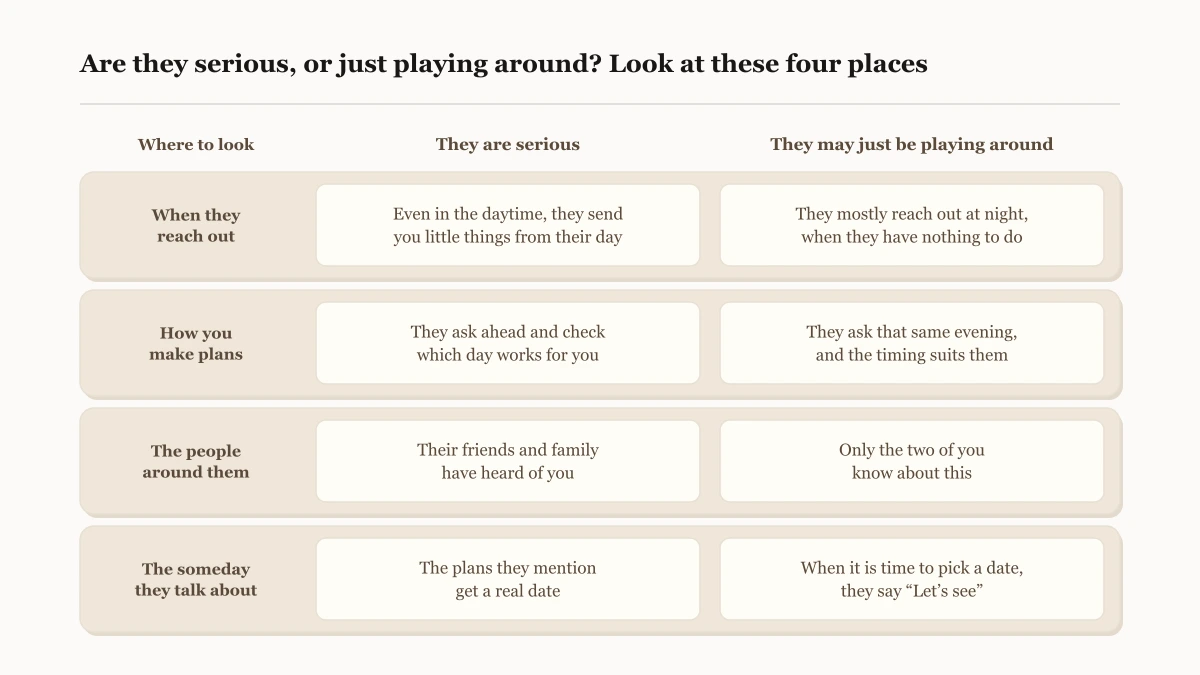
Once you have gone through all four, here is how I would read it. If most of them are moving forward, they are serious and are letting you into their life in their own way, a little at a time. If most of them have not moved for months, then from what I have seen, it looks more like they are just playing around. At least so far, they have not wanted more. You might also see both, for example someone who reaches out during the day but never lets you meet anyone they know. My guess is that this person may still be unsure and has not decided whether to move forward.
In all three cases, the times they were kind to you may well have been sincere. Whether they plan to be with you, though, shows in whether they let you into their life, not in how nice they are to you.
Taking one step forward
Having checked these four places, you already hold some answers you can see for yourself, which is steadier ground than guessing. For each of the next two things, the first move is yours.
Pick the place that hasn’t moved, and make one invitation
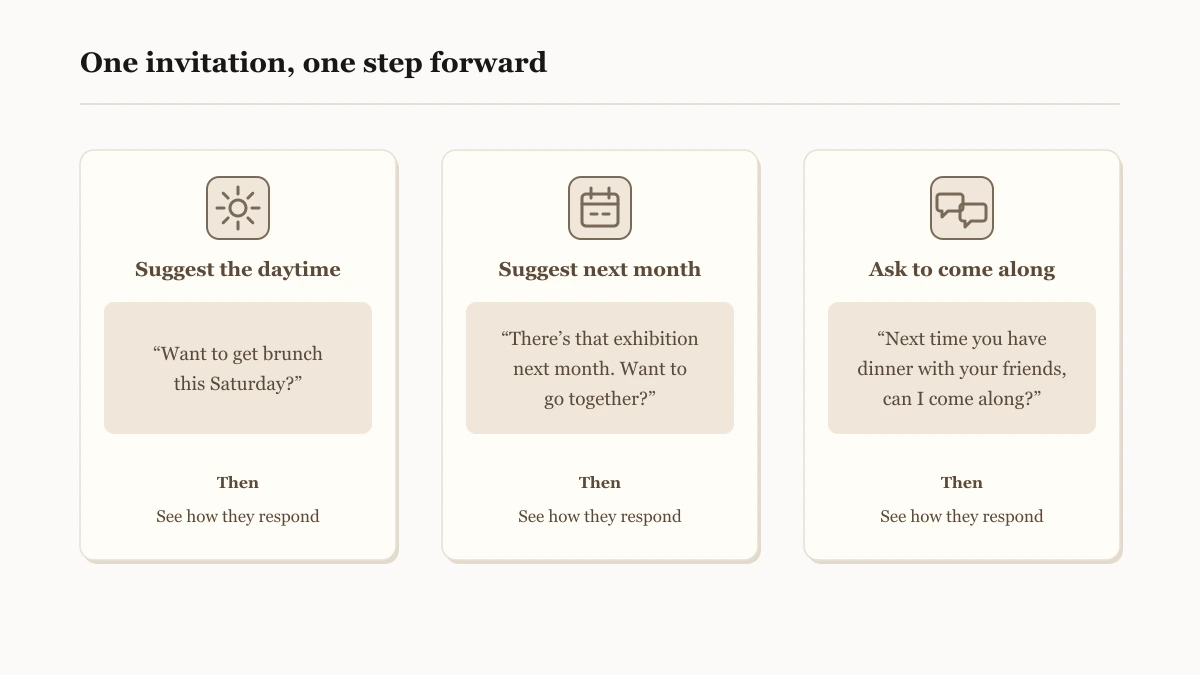
Out of these four places, pick the one that has clearly stayed still. Then make one invitation that says what you want out loud. If they only ever reach out at night, suggest the daytime: “Want to get brunch this Saturday?” If the someday plans never happen, suggest something next month: “There’s that exhibition next month. Want to go together?” If you have never met anyone in their life, just ask: “Next time you have dinner with your friends, can I come along?”
This is not a test. Seeing each other in daylight, having plans actually happen, meeting the people they care about: these are what you want in the first place. I believe putting that into one invitation is far clearer than waiting for them to think of it.
If they say yes and actually show up, enjoy the day, and after a while pick another place and make the next invitation. If they say yes but keep rescheduling, you can wait out the first time. The second time, you can say, “No worries. Let me know when a day works for you.” Then leave the next move with them and see whether they come back with a plan. If they turn it down without offering another time, I would suggest not rushing to ask again. Keep their answer in mind and look at it alongside the rest the next time you compare.
My suggestion is three months: then ask once how they see the two of you
My suggestion is three months. If you have been in this stage for three months and these four places have mostly not moved, wait for a moment when you are both relaxed and ask once: “I really love the time we spend together. I’d like to know how you see us.” You do not need to push them to put a label on it right then. What you want to hear is what they actually think.
If they say they want to be together too, have a proper talk about where to go from here, like how often you will see each other and whether to let the people around you know. If they say they are not sure, you can ask first, “What are you unsure about?” After you have listened, tell them where you stand: “I’m willing to give us a bit more time, but I’d like us to be moving forward.” Over the following stretch, watch whether they start to change.
If they say they like things the way they are, I think that sentence is already an answer: for now, they do not plan to move forward. You do not have to argue, and you do not have to decide right away whether to leave. You can, though, start putting your own life back at the center and fill your time with things that have nothing to do with them, like seeing people you have not seen in a while, or putting something you have always wanted to learn on your calendar. Whether this stage goes on can wait until you are clearer about it yourself.
Wanting to be taken seriously is the most natural thing in the world. You can take it slowly, and you can give them time, but you do not have to shrink what you want just to hold on to what you have now. In my view, if they are willing to move forward, this finally has a direction. If they are not, you find out sooner and stop guessing alone for months.
For you, still in between
I believe this stage so often drags on because both people are afraid that the moment someone speaks up, the good part will disappear. You worry that asking will get you turned down, and they may not have figured out how to answer, so neither of you says anything, and the days just keep going by.
What you want is someone who lets you into their life, where plans actually happen and the people around you know about the two of you too.
If, after looking at all this, it seems they are just playing around, it is natural to feel hurt, and everything you put into this was real. The way I see it, what this shows is that what they want right now is different from what you want. The care you bring to liking someone belongs with a person who is just as serious about you. From here, put yourself first again: stop fitting yourself around their last-minute invitations, stop waiting up for their messages late at night, and give your time to people who answer you sincerely and to your own life. You can also let them know what you want: “I want a serious relationship. If that is not what you have in mind, let’s leave it here.” Once you have said it, follow through. If that makes them start taking this seriously, you will be able to see the change. If it does not, you have already made a decision for yourself. Loving yourself, right now, means no longer trading your hopes for their occasional warmth.
While you wait for that answer, there are a few small things you can do for yourself. When they are slow to reply, get on with what is in front of you instead of watching the chat window. Make weekend plans with people you want to see, rather than keeping the whole day open waiting for them to ask. Keep one evening a week for something you love that has nothing to do with them. Whether to keep going or stop does not have to be decided today. Liking someone always comes with some waiting and some not knowing, and through all of it, you can still take good care of your own days.
Sources
Research and sources this essay draws on.
- Information seeking beyond initial interaction: Negotiating relational uncertainty within close relationshipsHuman Communication Research, 28(2), 243–257
- Measuring the sources and content of relational uncertaintyCommunication Studies, 50(4), 261–278