Does Caring Too Much Make You Worth Less?

The message is sent. You are already rereading it, one word at a time.
Was that too fast? They took half a day to answer you. You answered in three minutes. Was it too much? You explained the whole story, and then you added a sticker at the end.
You turn the phone face down. A minute later you turn it back over. And there it is again, the line you have read in comment sections, heard from friends, watched play out in every show: people do not value what comes easily.
If part of you is now wondering whether to cool down, here is the first thing worth saying. You did not invent that idea. You have heard it many times, and everyone who repeats it sounds certain. Of course you are using it to check yourself.
What follows is not an argument for taking your warmth back. It is an attempt to split this question into pieces small enough to be useful, and then to hand you a few things that work better than pretending to be busy.
Your instinct did catch something real
Start with a finding that should make you feel less foolish, because you are not imagining this.
In one study, college women looked at the profiles of several men and were told those men had already seen their profiles. Then they were placed in three situations. Some were told the men liked them a lot. Some were told the men liked them an average amount. And some were told it was uncertain, that the men might like them a lot or might not.
Comparing the first two groups gave the answer most of us expect: being told someone likes you makes you like them back. But the group that found the men most attractive was the third one, the women who did not know where they stood. Those same women also reported thinking about the men the most.
That was a first-impression experiment with college women looking at strangers online. It cannot tell you much about a connection that already exists. But it does support one thing: uncertainty makes a person cross your mind more often.
So the advice you keep hearing is not made of nothing. Uncertainty really does put you in someone’s thoughts more often, and that part holds up.
But the advice claims something larger. It claims this is why they will value you. The finding only reaches as far as how often they think about you. Being thought about often and being wanted closer are not the same thing. That difference comes back later.
“Too available” is actually two different things
Here is what I think you are really afraid of.
It is not the three minutes. There is no principled difference between answering in three minutes and answering in three hours. The fear underneath is a different sentence: if I hand over this much of myself, do I become worth less?
Psychologists draw a line between two ways of caring about other people, and I find it genuinely useful here.
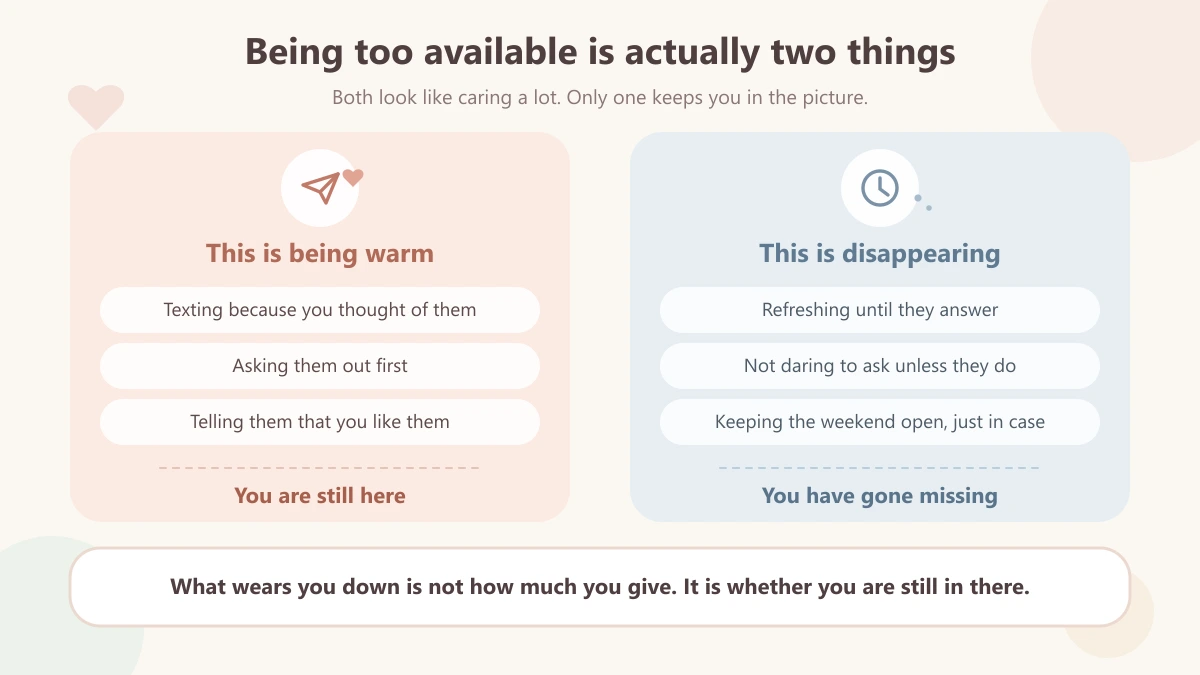
The first is warmth: caring about someone, giving to them, wanting them to be all right. It is a positive trait. The second is warmth with yourself removed from it: caring just as much, while handing over your own needs, your own time, and your own judgment, and starting to read your worth off the other person’s reactions.
The two researchers who proposed this distinction ran four separate studies, and all of them pointed the same way. Both traits often appear in the same person, but only warmth with yourself removed lines up with psychological distress and a negative view of the self. Ordinary warmth does not.
They also suggested an order in which it happens. The more someone depends on other people to tell them how they are doing, the more of their time, energy and attention goes to those people, and the more they stop tending to their own needs. The strain usually arrives after that, not before.
This is work about defining a distinction, not a prediction about how any particular relationship will go. But it supports one sentence well enough: what wears people down is not how much they give. It is whether they are still in there.
Which means “too available” quietly covers two very different things:
- Texting because you thought of them. Asking them out first. Telling them you like them. You are still present in all of these.
- Refreshing the screen until they answer. Not daring to ask unless they ask first. Keeping the whole weekend open in case they say “are you free today?” This is where you go missing.
Now look again at the message you just sent. Did you send it because you wanted to tell them that thing, or because you were afraid of being forgotten?
Neither answer is embarrassing. But they call for different responses. The first is simply how you communicate, and you can keep doing it. The second is not a problem with being forward. It is anxiety asking to be looked after.
Separate three things before you change anything
If you could not answer that question straight away, there is a small way to see it more clearly.
Open your notes app and write three headings: what I actually did, what I made it mean, and what I actually want.
Under the first, write only observable behaviour. I replied within three minutes. I asked them out yesterday and they said maybe. I have started the conversation three times this week. Do not write “I am too clingy,” because that is already a verdict rather than an event.
Under the second, write the part your mind supplied. They must think I have nothing going on. Now they will not value me. People who chase are worth less. These thoughts deserve to be seen, but they have not happened yet.
Under the third, write what you would want if no rule were watching. I want to know whether they take this seriously. I want a version of this where I am not constantly guessing. I want to keep liking them without auditing myself every night.
Most people find the same thing when the columns are side by side. The pain is rarely in the first column. It is in the second, where a borrowed rule is being used to grade you.
Mystery is not the same as hiding
There is one more question to deal with, and I think it is the real appeal of “just be cooler.”
If I say everything plainly, do I lose all the mystery?
Let me ask what mystery actually is.
If mystery just means “they do not know what you are thinking,” then leaving messages unanswered will absolutely produce it. But that kind of not-knowing is empty. They cannot read you because you have given them nothing to read. There is very little to guess at, and once it is guessed, it is gone.
There is another kind of not-knowing. They know you like them, because you told them. They still do not know why rain makes you want to walk somewhere. They do not know how far along you are in the thing you have been learning. They do not know what happened between you and the friend you have kept since school. That kind of not-knowing is full, and there is always another layer under the one they just found.
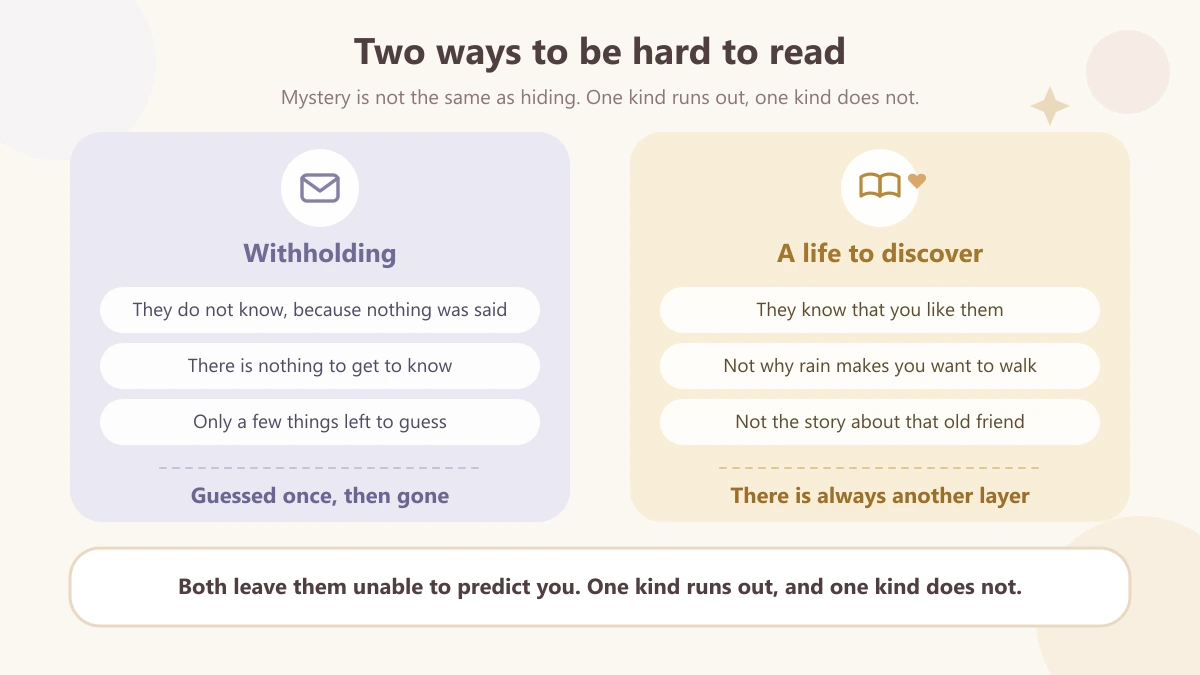
Both leave someone unable to predict you. The difference is that one runs out, and one does not.
That is why I am not worried about honesty costing you your appeal. Saying you like someone spends exactly one answer. You are still full of parts nobody has opened yet.
Four things that work better than pretending to be busy
None of these need the other person’s cooperation. You can start today.
One: make your life genuinely full instead of performing fullness.
The test is a single question. If they never found out about this, would you still want to do it? If yes, it is your life. If no, you are building a schedule for an audience, and you will be the first one exhausted by it. Said out loud, the real version sounds like: Wednesday evening I have that class, and I do not book anything else then. Not: Wednesday I should look unavailable.
Two: be clear about liking them and keep your own time.
Many people treat these as a choice, as though you either show enthusiasm or keep your distance. They fit together, and they are clearest together. “I really like talking to you. I have a class Wednesday, but any evening after that works.” Your feelings are in that sentence, and so is your calendar. Nothing is hidden, and nothing is being held open for someone else to pick from.
Three: make the getting-to-know-you part mutual.
In a well-known experiment, pairs of strangers spent about forty-five minutes taking turns answering a set of questions that escalated in depth. Compared with pairs who made small talk, they reported feeling closer afterwards. That was a laboratory setup and it cannot promise the same result in your life, but it points somewhere useful. Closeness is built by taking turns handing over something real, not by giving everything or withholding everything.
So ask about them as well as talking about you. Not interrogation, not “what did you do today,” but “the decision you mentioned earlier, which part of it was hardest?”
Four: when they talk, let them see that you caught it.
This sounds small and almost nobody does it. When they finish telling you something, do not rush to change the subject or supply advice. Say the thing underneath first: “So you were pretty unsettled by that.” Let them know which part you actually heard.
The first three are about handing yourself over. The fourth is about catching them. None of them require you to play a character.
So should I reply instantly or not?
My answer is: do whatever you are actually doing.
If you are on your phone, you saw it, and you want to answer, answer. I have not found evidence that deliberately waiting two extra hours makes someone like you more. I have looked through the literature on early attraction and self-disclosure and cannot find that result. If somebody can find it, I would be glad to add it here and correct this paragraph.
If you are busy, out with friends, or in the middle of something that needs your attention, answer when you are done. That delay is not a tactic. It is your life happening. From the outside these two look identical. From the inside they are nothing alike.
The only real difference is whether you are staring at the conversation calculating how eager a fast reply would look. If you are, the cost of that is landing on you, not on them.
If I am always the one starting things, does that mean they like me less?
I do not want to answer this in one line, because what you need is a way to judge it.
Look at what happens after you start something.
Sometimes they catch it. You suggest a plan and they find a time. You share something and they ask a follow-up question. Days later they still remember the detail you mentioned. In that case it barely matters who opened the door. Some people never learn to go first, but this one walked toward you once you did.
Sometimes they only catch the reply itself. You text, they answer. You ask, they agree. But they never add anything, and they never ask you anything. Stretch that over time and every piece of forward motion belongs to you.
You do not have to decide today. Give it two or three weeks. You do not need to deliberately hold back during that time. Just keep one question in view: did they ever come to you first? That question is far more useful than “am I too much,” because it asks about things that actually happened rather than about your worth. If you recognise yourself in the second pattern, I Like You, but I Will Not Prove It by Abandoning Myself covers how to turn a need into something a person can actually respond to.
Does playing hard to get work, then?
I am not going to declare that it has no effect.
That first experiment already told us uncertainty makes someone think about you more. So if what you want is for them to pay you more attention this week, playing hard to get can genuinely do that.
But what I actually want to say is two other things: what it buys, and whose effort keeps it running.
It buys frequency of thought. Being unable to stop thinking about someone and wanting to move closer to them are different states. The first is attention getting stuck, the second is a connection going somewhere, and the second one is usually what you came for.
As for the effort, all of it is yours. Sustaining uncertainty means keeping track: how long they waited, how long you should wait, which sentence you cannot say, which photo you cannot post. You spend more and more effort managing the version of you they can see, and less and less saying what you actually mean. Meanwhile the question that started all this, whether you are worth enough in this connection, has not been answered at all. It has only been postponed.
There is one more thing. This approach filters people. Someone willing to work at an unclear signal and someone willing to get to know a clear one are not always the same person. Uncertainty tends to keep the first kind.
So I would treat playing hard to get as a tool rather than a rule. If you want to try it, that is yours to choose, and I do not think anyone who has tried it did something wrong. I would just rather you knew what it can and cannot give you before spending your energy there.
One note: if your actual situation is that they are running hot and cold and you are wondering what to do, that is a different question. They Went Cold During the Talking Stage. Can You Bring the Spark Back? is about that side of it.
You do not have to be hard to read to be worth liking
Back to the question in the title.
Do people value you less for caring openly? My answer is no. What drains people is not the volume of warmth. It is whether they are still inside it. You can keep being the one who texts first, says it first, shares the good news first. That is not a weakness. That is how you meet people.
There is only one thing to watch. The moment you start reading their reply speed as a verdict on your worth, the line has slid from “I care about them” to “I am waiting to be told how I am doing.” The thing to take back is not your warmth. It is that measuring stick.
You could start with something small tonight. Put one evening this week aside for something you genuinely want to do. Not so that someone can see how busy you are, just because you want to. Then let the phone sit quietly in your bag while you do it.
They might message you. They might not. Either way, that evening belongs to you. Keep yourself where you are, and everything else has somewhere to happen.