They Said Just Friends. Do I Stay in Their Life?

A message arrives. Same tone as always, telling you about something funny that happened today.
You read it three times before answering. You type “ha, that’s great,” and then your thumb stops over the send button for about three seconds. What you are weighing in those three seconds is not the reply. It is the question you have never said out loud: am I still waiting for them, or do I honestly just want to be friends?
You already asked. They already answered. They did not stall, did not leave it vague, and they said it carefully: you are great, it is just better if we stay friends. Afterwards you kept talking, kept sharing the same group chat, and they still come to you when their day goes badly. Nothing looks broken. Only you know that things which used to be easy now take effort.
If you have not said it yet, that is a different road, and there is a piece here about it: Should You Tell Them? First, Ask If You Can Bear to Lose Them. This one is for after the answer, when you still see them every day.
Hearing a no and walking away take two different kinds of strength
You stayed because there is something here you actually like. You finish each other’s sentences, the ease between you is not something you invented, and all of it really happened. Their answer did not turn any of it into a lie.
A refusal is one sentence. You understood it in seconds, and after you understood it you did not make a scene or keep pushing, which you handled better than you give yourself credit for. But understanding is a single judgement, while walking away is a long series of small decisions you have to make again every day. You made that judgement once and it was done. But whether to answer this message now, whether to follow this thread, whether to read that line of theirs one more time, all of it comes back and asks you again tomorrow.
The same friendship costs the two of you different things
When they message you, for them it is a conversation. For you, every conversation comes with an extra task: put the feeling somewhere they cannot see it, then answer in a normal voice. The stretch of time they found easy is a stretch you got through.
Here is how I would describe where the two of you are standing. They are keeping a friendship. You are keeping a friendship plus a secret nobody can find out about. Same conversation, and when it ends they walk away from it while you are still tidying up.
This is not them being careless, because they almost certainly have no idea what you are tidying. And the work has been yours alone from the start, so of course you are tired.
Three versions of staying, and they are not the same
“Staying in their life” sounds like one thing. I would split it into three, because they lead somewhere quite different from each other.
You genuinely want to be their friend
You like talking to them, you like what they recommend, and even if they never change their mind you would still want to know how they are doing. Being that kind of friend still tires you out, but it does not leave you feeling emptied, because you are not waiting on anything.
You are waiting for a date on the calendar
You stay because something still seems possible: once they know you better, once the person they are with now is out of the picture, once the day comes when it clicks. You might never use the word waiting. But if you replay every conversation afterwards looking for anything different in them, you are waiting.
You do not really want to see them, but cutting it hurts more
You do not particularly want to see them any more, but the thought of never hearing from them again is worse, so you leave things where they are. Leaving things untouched is the version most easily mistaken for friendship, because on the surface you are not doing anything.
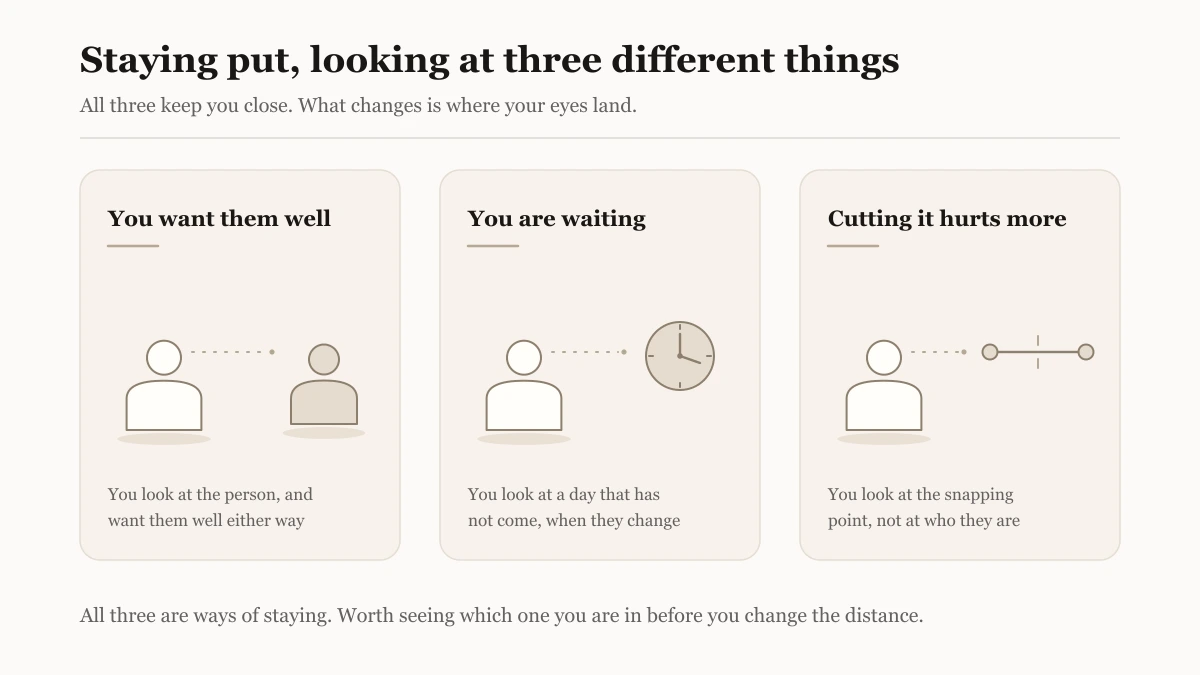
The way I see it, all three are reasonable and none of them needs explaining to anyone. To work out which one you are in, there is a question you can ask tonight: if someone guaranteed you right now that they will never change their mind, would you still want to talk to them? It is not a right or wrong answer. Watch which sentence surfaces first.
What to stop is not missing them, it is what you do for them
I am not going to tell you to stop missing them. That switch is not in your hand. What actually wears a person down is not the missing anyway. It is what you do afterwards.
Those things are small, small enough that you never count them. Reading the same exchange a fourth time. Working out whether “anyway, talk later” meant something. A story pops up, and you decide whether to open it, then whether to react. Somewhere they might show up, and you decide whether to go, whether that is a weekend gathering or a group chat you are both in. Keeping a weekend clear in case they ask. Counting, in the group chat, who they answer fastest and how long yours took. Added together, that is more tiring than a whole evening of talking to them.
Here is something you can start today. For the next week, every time you do one extra thing for them, write one line in your notes. Only the action, not the feeling, and no commentary. “Reread the chat, ten minutes.” “Turned down Saturday dinner in case.” “Opened their story three times.” That is enough.
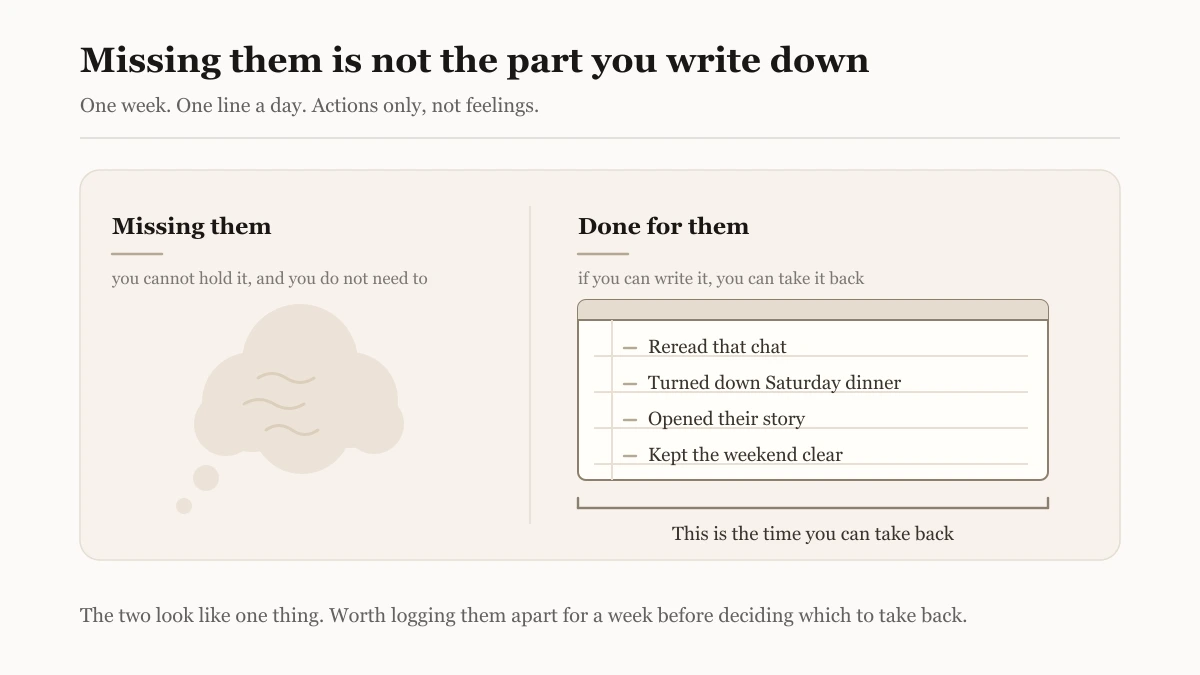
At the end of the week, read the list once. The point is not to hold it against yourself. The point is to see where that time was originally going: sleep, a call with a friend, the last episodes of something you never finished. Nobody else can see this bill, which means nobody else can take it back for you. Starting next week, pick the easiest line on that list and simply do not do it.
This time the boundary is not set for them
Usually a boundary is something you draw with a person who did something. I do not think this is that kind of situation. They did not lie to you, they did not leave it hanging, they were clear about what they can offer. So there is nothing to ask them to change, and you do not have to cast them as the villain in order to step back.
Which means the thing to decide is not whether they can come to you. It is whether you are there every single time. Those are very different: whether they can come to you needs them to cooperate, whether you are there every time only needs you to know.
Concretely, here is what I would suggest. Messages can wait, and you do not have to answer instantly to prove you are fine. You do not have to turn up every time they are somewhere, and whether you go can depend on whether you feel up to it that day rather than on whether they will be there. You can listen when they are struggling, and you do not have to be the one who always catches them, because that position is heavy and one person carrying it for long enough will buckle.
If you look back and see that you were not only waiting but also saying yes to things you did not want, that is a different situation, and I Like You, but I Will Not Prove It by Abandoning Myself is about how to say so.
Why the waiting keeps starting over
What really keeps a person in place is not the big hope that they will change their mind one day, because you do not fully believe that one anyway. It is the small things. They sent one more message than they had to. They remembered something you mentioned in passing ages ago. They called you when they had been drinking. They finished arguing with someone else and said you are still the one who gets it.
Every one of those small things resets the clock on “give it a bit longer.” You think you have come a long way, and one sentence puts you back at the start, and it will not feel like going backwards. It will feel like progress.
I would suggest separating two things. Being good to you and wanting to be with you are not the same thing. They can keep being good to you and never be with you, and through all of it they are not lying to you and they do not owe you. They are good to you, and they are not going to choose you. Both of those can be true at once.
Once the two are apart, the small warmth does not disappear. It just loses the power to reset your clock.
Should you go quiet, and for how long?
The purpose first. The distance here is not a move to win them back, and there is a test that tells the difference: if you start counting the days until they notice, until they ask what is wrong with you, that is not distance, that is waiting in a different shape. Real distance does not need them to know, and it does not need any reaction from them. It is handling something else, which is sparing you the decision, every single day, about whether to look.
There are two things to separate here as well. Them still being in your life is one thing; you opening their page every day to see where they went and who they talked to is another. What has to stop is the opening of that page, not having them in your life at all.
So you do not have to unfriend anyone, block anyone, or make it into an event. What you do is turn “should I look” from a daily decision into something you have already decided. Give yourself a concrete rule, once a day, or nothing once the evening starts, and then follow it. The shape of the rule hardly matters. What matters is that you stop negotiating it with yourself every single time.
The costs deserve an honest mention too. If you show up less, the friends you share will notice, whether that is a gathering or a thread. There will be places where you had a seat and are not there. And the evenings that open up will be hard at first, because you will suddenly see how much of your time had been going to them. All of that will happen, and I am not going to tell you it does not hurt.
As for how long, I would not count it in days. The measure is a state you can check yourself: when they come to mind, the first thought is no longer how they will see you. From there, moving closer again or further away are both fine, and either one is finally your own choice.
The day they are with someone else
This day is worth saying out loud. You might hear it from a mutual friend, or catch it halfway through scrolling. You have imagined it already, and it will still land differently, because when you imagine it you are braced and when it actually happens nobody gives you warning.
It will hurt, and I am not going to tell you it will not. What I can offer is a few small things, none of which need them to cooperate. Make no decisions that day, so no congratulations, no deleting everything, no demanding an explanation. I suggest that because what you decide in a moment like that is mostly there to make the moment easier, not to serve the person you will be tomorrow. Do not go looking for details either, who this person is, how long they have known each other, how you two compare. Not one of those answers will make the day any lighter. What is left is to do the things the day already had in it, go to work if it is a work day, eat when it is time to eat. What you need that day is not to feel better. It is to know that you still function.
When someone asks what happened between you
You do not owe anyone an announcement or an explanation. If a mutual friend asks, one line covers it: “Nothing’s wrong, I’ve just been busy.” Nobody is entitled to the full version, this is between you and them, and they are not going to be explaining anything on your behalf either.
If they keep pressing, you can add one more: “Really, nothing’s wrong. I just want a bit more of my time back.” That one is true, so you can say it without flinching.
You can stay, and you can stand further back
Whether you stay or stand further back does not have to be settled today, and it is not a decision you cannot revise later. Start by taking back the things you do for them, and then look again. If you still want to talk to them after that, the two of you are genuinely friends. If instead you feel something in you relax, that is an answer as well.
Here is something you may not have considered. When they asked you to be friends, they were describing what they can do, not what you can do. They were honest and they were clear about their own position, and there is nothing wrong with that. But nowhere in that sentence does it say what it costs you. That box was left blank, and you have been the one filling it in.
You have already been honest once. It was hard and you did it anyway. This time the person you have to be honest with is yourself, which is hard in a different way, and you have already shown you are capable of it.