Stuck in an Undefined Relationship? How to Take Care of Yourself

They remember how you take your coffee. They pull your coat closed when the evening turns cold. They make a detour to walk you home, stay over, and tell you things they do not share with most people. Then a friend asks, “So, are you two together?” and you realize you do not know what to say.
You are not confused about everything. The closeness is real. So are the feelings you have invested. What you do not know is what that closeness means to them. You do not know whether you may expect another weekend, whether you are both dating other people, or whether asking either question could make the whole arrangement disappear.
Wanting language you both understand does not mean you need to force a conventional label onto every connection. It means you want to know whether the two of you are making choices from the same information, and that is a reasonable need to name.
A longitudinal study followed 135 romantic couples for six weeks. During weeks when people felt more uncertain than they usually did, they saw conversations about the relationship as more threatening to themselves and to the relationship. They avoided those conversations more and engaged in them less. Avoiding more relationship talk in one week was also associated with greater uncertainty the following week. These findings show that the two patterns move together over time, but they do not establish that uncertainty necessarily causes silence or that avoiding the conversation necessarily creates more uncertainty. What they do support is this: the more urgently you need clarity, the more dangerous asking for it can feel.
Your silence may not come from indecision. You may be protecting a connection that still gives you warmth. You may also be protecting yourself from an answer that could hurt. Yet when silence is the only form of protection available, the cost tends to return to your own life. You leave evenings open, revise your expectations after every change, and keep supplying explanations for why the other person moves close and then far away.
A relationship can be real without a traditional label
Some people never use “boyfriend,” “girlfriend,” or another familiar title and still have a clear agreement. They know whether they are exclusive, how they make time for each other, what happens if someone becomes interested in somebody else, how they ask for space, and whether they return to difficult conversations. Their language may be unconventional; their expectations are still shared.
The painful part is often not the missing word. It is the unequal distribution of uncertainty. You organize your time, body, and emotional life as if a relationship is developing. The other person approaches when closeness feels good but keeps the option to say, “We were never together,” whenever responsibility appears. The question is no longer only what to call each other. The question is whether you are choosing this connection while knowing its actual terms.
You are allowed to be comfortable with an unlabeled relationship. You are also allowed to want commitment. Neither need is automatically more enlightened. What matters is whether both people know what the arrangement is, genuinely agree to it, and have room to state their own limits.
Separate three things before you decide: facts, interpretations, and needs
When a relationship is undefined, one tender evening can quickly become evidence, hope, and a promise at the same time. Take a sheet of paper and make three columns. You do not have to defend anyone, reach a verdict, or decide your entire future while you write.
In the first column, write known facts. Include only actions you could verify. How often have they initiated plans? When they cancel, do they offer another time? Have they said they do not want commitment? Do they avoid letting friends know about you? When you say that something hurts, do they stay present long enough to hear it? “They care deeply about me” is not a fact in this exercise. Neither is “They are just afraid.” Those are interpretations.
In the second column, write my interpretation. Put down the meaning you have added to the gaps: They only need more time. Work is overwhelming now, but everything will change later. They invited me to that special place, so I must be part of their future. These thoughts are not evidence that you have done something wrong; they simply have not yet been confirmed by the other person’s words and sustained actions.
In the third column, write what I need. Do not write, “I need them to prove that I am worth choosing.” Name an observable condition instead: I need to know whether we are exclusive. I need changes of plan to be communicated instead of leaving me waiting. I need a way to introduce each other that we have both agreed on. I need to be able to raise a concern without being shut out for days.
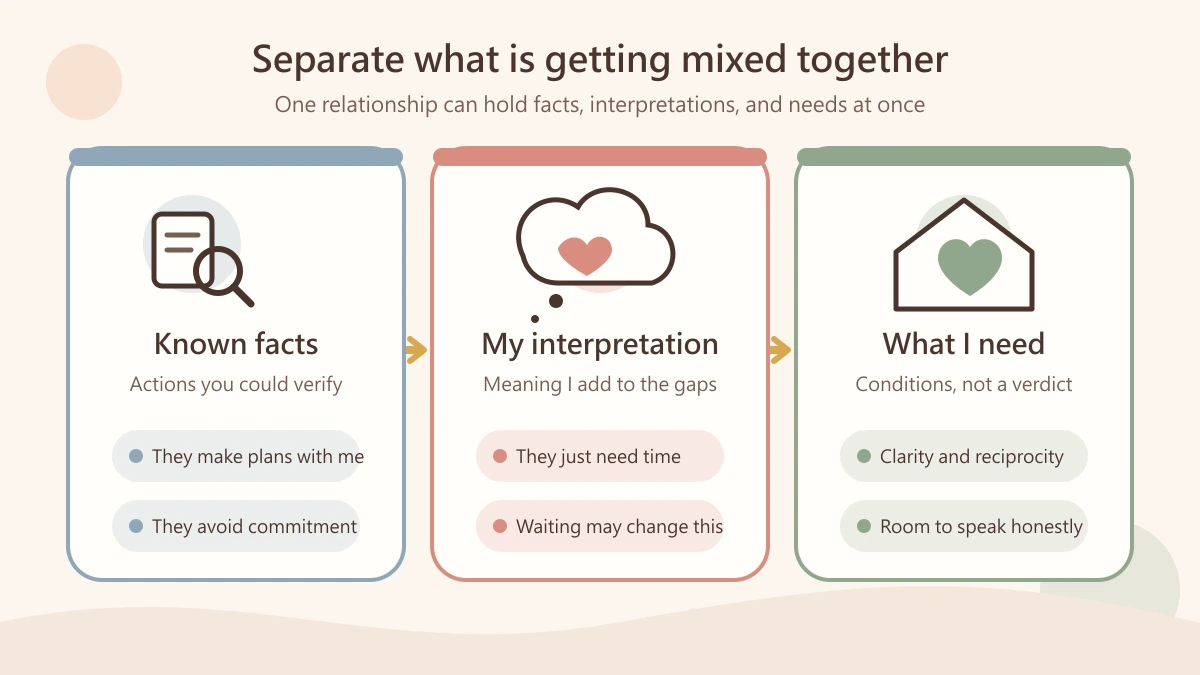
Now notice whether the three columns line up. If the facts and your needs are far apart, and “maybe someday” does most of the work between them, choose the one question from the third column that affects you most. For example: “Are we only dating each other?” or “Are you willing to make regular plans with me?” Ask it the next time you meet, then use the following two to four weeks to see whether their actions match their answer. If they answer clearly and follow through, you have a reason to keep learning about the relationship. If they avoid the question, keep changing the answer, or nothing changes in practice, reduce how often you meet and how much you invest instead of waiting for another vague “maybe later.” This lets you make your next choice from what they actually do, not from what you hope they may do someday.
Should you ask for a label? Start with what you actually need to know
If you ask only, “What are we?” the other person may answer, “Why do we have to define everything?” The conversation then gets stuck on a word. Your real questions may be more concrete. Are you both free to pursue other people? Do they want to build toward a stable partnership? If your needs differ, are they willing to negotiate rather than letting you carry the adjustment alone?
I would make the question answerable and explain how the answer affects your choices. You might say:
I really enjoy being with you, and I want to keep getting to know you. I also need to understand whether we are dating only each other and whether you want to move toward a committed relationship. You can be honest with me.
Or:
I can accept that you may not be ready for commitment. I cannot keep investing without knowing what we each expect. I want to understand what you are willing to offer now. If we want different things, I need to make choices from that information.
Neither statement forces a preferred answer. It gives the other person truthful information: you have feelings and needs; you are willing to hear their limits; and you will no longer hide your own limits to keep the connection comfortable.
If you fear that the conversation will make you lose them, let that fear have a sentence too. Then finish the question. Are you afraid of losing a person who is willing to face the relationship with you, or an arrangement that works only while you do not ask about it? If one honest question makes them pull away, it does not mean you ruined the relationship by asking. It shows that they are currently willing to share closeness but not willing to define where the two of you stand.
That answer can still hurt. Clarity is not painless. Its value is that you no longer have to organize your life around a promise that was never spoken.
If they say “Let’s just see what happens,” watch three things
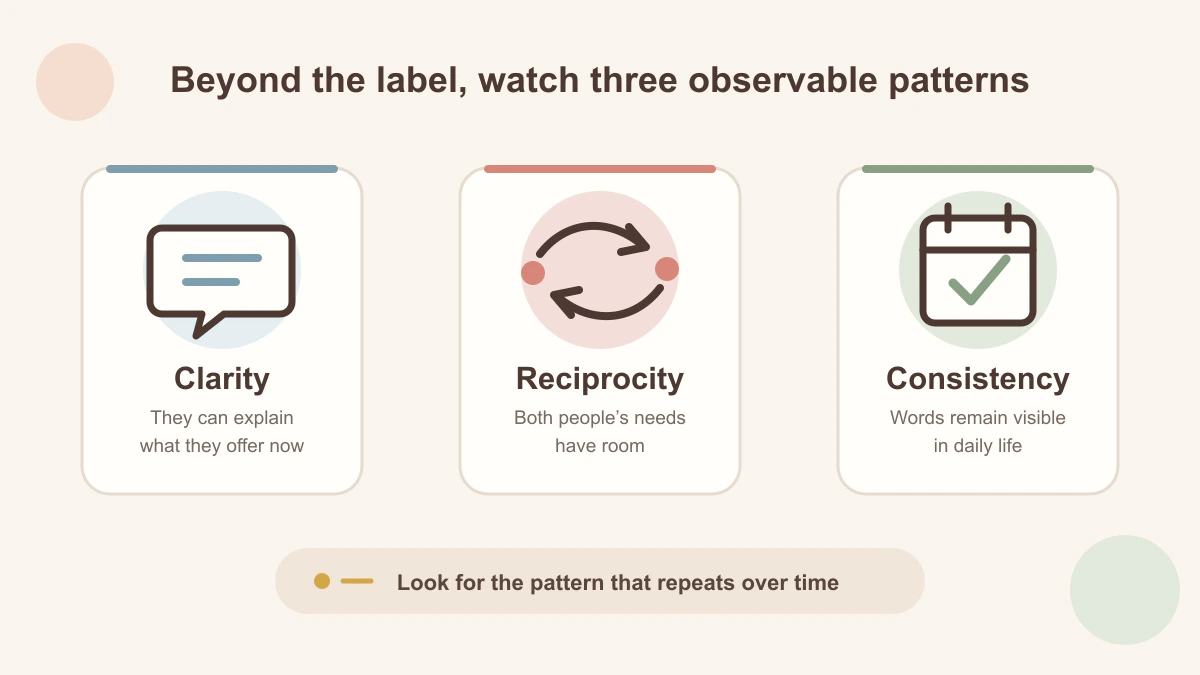
“Let’s see what happens” can be an honest request to move slowly. It can also postpone every decision while the current arrangement continues. The sentence alone cannot tell you which one is happening. Instead of guessing their motive, watch for three observable patterns.
Clarity: Can they say what they are and are not willing to offer now? “I am not ready to promise a long-term relationship, but I am willing to date only you and tell you if that changes” may not be the answer you want, but it is understandable. If the only answer is “do not overthink it,” you still do not know whether you are exclusive, how you will make time for each other, or whether they want to move toward a stable relationship. None of the original questions has actually been answered.
Reciprocity: Is there room for both people’s needs? They may need a slower pace, and you can listen. You may need exclusivity or dependable plans, and you should be able to say so. You may discover that your needs are incompatible. What cannot become permanent is one person setting every condition while the other absorbs every consequence.
Consistency: Can their words be found in ordinary behavior? If they say that you matter, do they make time, repair a missed plan, and return after a difficult conversation? Do not use one beautiful evening to explain an entire relationship, and do not use one awkward answer to condemn it; instead, look for the pattern that repeats over time.
You can follow up with: “When you say we should see what happens, are you willing to talk about exclusivity, communication, and how we make time for each other? If you cannot answer that now, I will make choices based on what is available now.” This does not trap someone inside a title. It stops “natural” from meaning that you carry every cost of uncertainty.
If you are not ready to leave, stop putting your whole life on hold
You do not have to decide whether to stay forever or leave before caring for yourself. You can keep seeing them for now and observe what they do next while protecting your own schedule, friendships, and important plans, so the rest of your life does not begin revolving around this relationship.
Return the time you have been keeping available “just in case” to your own calendar. This is not a tactic designed to make them chase you. It is not a disappearance test. It simply means you do not reserve every evening for an invitation that has not been made. See your friends. Take the class. Rest when you planned to rest. If an invitation comes, decide whether you are free and whether you genuinely want to go.
Bring your level of investment back in line with what is actually agreed. If you have never discussed shared finances, do not take on financial obligations because of an imagined future. If you have never discussed exclusivity, do not silently assume it. If certain forms of intimacy require safety, commitment, or more trust for you, name those conditions before participating. You are not punishing the other person. You are refusing to use an unconfirmed future to justify a major decision today.
Find one person who can hear the whole story. Choose someone who will not push you to leave every time you are hurt or declare everything solved whenever the other person comes close. Ask them to look at your three columns with you. Let them notice whether you have been sleeping, doing your work, keeping friendships, and making plans that do not depend on this relationship. You need more than an answer about the relationship. You need help remembering the person who is living around it.
If being chosen has started to feel like proof of your value, read Do I Like Him, or the Possibility That He Might Choose Me?. If you repeatedly remove your needs to preserve closeness, I Like You, but I Do Not Want to Prove It by Abandoning Myself offers a more concrete way to speak.
A label is not a grade; clarity is a need you may name
You may receive the answer you hope for. You may learn that the two of you want different relationships. Asking cannot guarantee the outcome. It can stop guesswork from making decisions about your time, body, and hope on your behalf.
You do not have to cancel your needs because you are still attached. You can care about this person and say, “This arrangement does not give me enough stability.” You can choose to observe a little longer and still return tonight’s open time to yourself. Those choices do not require the other person’s approval.
You do not have to answer, “Should I leave forever?” today. Ask a question that belongs to the life you are living now: If this relationship stays exactly as it is for a while, what part of my investment do I need to take back so that my life can remain whole?
It may be an evening, a financial burden you should not yet carry, a need you keep swallowing, or a plan you have postponed. Take back one of them. You are allowed to wait and see whether a relationship becomes clearer. You do not have to become less clear about yourself while you wait.