Do I Like Him, or the Possibility That He Might Choose Me?

Let me begin with something that may help you breathe a little easier: thinking about him constantly does not mean you are failing to see what is happening. It does not mean you are deliberately keeping yourself stuck.
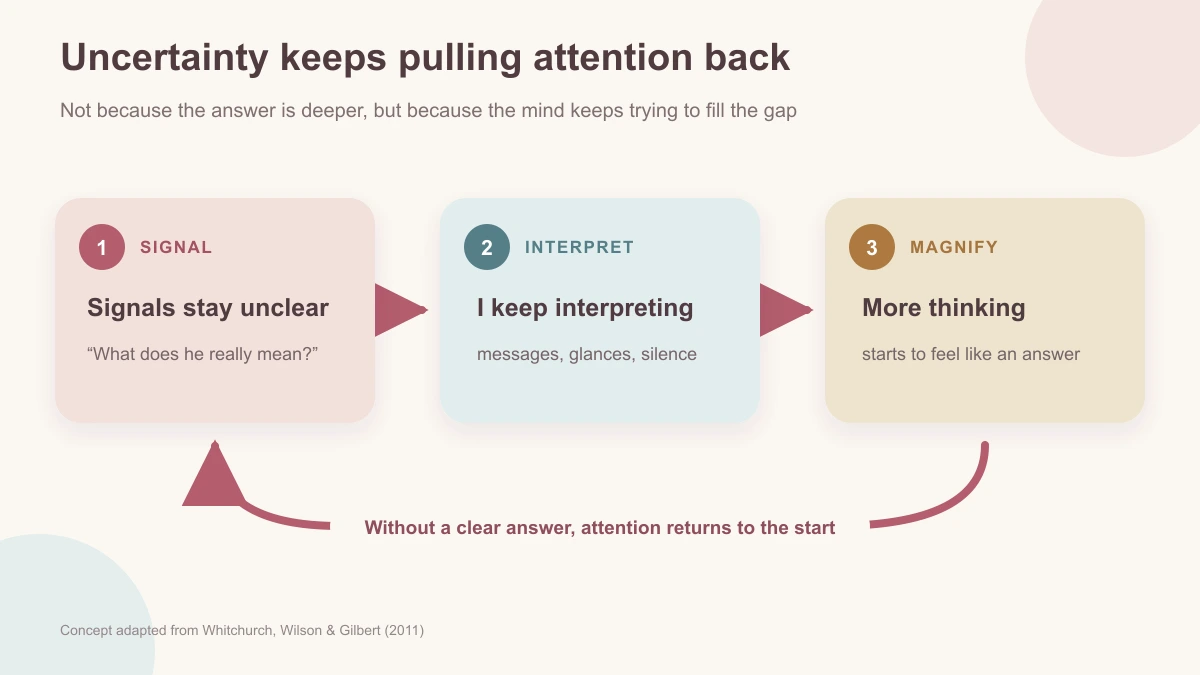
One experiment set up a simple situation. College women viewed the social media profiles of men who had supposedly seen their profiles. One group was told, “These men like you a lot.” Another was told, “Their interest in you is only average.” A third group learned only that the men might feel either way, so they never received a clear answer. That third group thought about the men most often and rated them as the most attractive.
That result cannot tell you whether this particular man is right for you, and it cannot explain every complicated attachment. It points to one useful possibility: uncertainty itself can keep pulling your attention back to a person.
When you never receive a complete answer, your mind keeps returning to the evidence. You replay a message, a glance, a warm evening, and the sudden distance that followed. You try to build “Will he choose me?” from fragments. The more space the question occupies, the more important he can begin to feel. Then the weight of all that thinking gets interpreted as proof of love.
Your feeling is real. The useful question is not whether you invented it. The question is: how much of this feeling comes from knowing him, and how much has accumulated while you waited for an answer?
Uncertainty can turn “I want to know” into “I cannot stop thinking about him”
A clear rejection hurts. Clear affection can let you rest. The place in between often keeps you the busiest: he moves close and then far away; he says you matter but will not say what he wants; just as you prepare to leave, he offers a moment of tenderness.
That pattern leaves too many unfinished questions. Was that sentence a hint? Did he take hours to reply because he was busy or because he was losing interest? Does viewing your story mean he still cares? You may believe that you are simply thinking about him. Often, you are trying to finish a story that has refused to give you an ending.
In that social-profile experiment, the people who never received a clear answer thought about the men more often, and that repeated thinking was part of why attraction became stronger. That does not mean every inconsistent person is manipulating you. It does not mean every ambiguous relationship follows the same formula. It gives you a less punishing explanation for why stopping feels hard: unclear signals may keep sending you back to guess what he means.
The next time “I miss him” appears, do not argue with it. Complete the sentence instead:
What part of him am I missing right now? Am I missing something we actually shared, or am I trying to learn whether he will choose me?
Both answers are allowed. Naming them separately turns one unmanageable fog into feelings you can actually meet.
Why being chosen can feel like an answer to “Am I enough?”
Sometimes you are not only waiting for a relationship. You are waiting for a certificate.
If someone this difficult to reach finally chooses me, then I must be special. If he once rejected me and later changes his mind, then perhaps I have finally defeated whatever made me feel inadequate. If he prefers me to someone else, then I can stop wondering whether I am forgettable.
It makes sense to want that reassurance. Being liked touches deep needs: to be seen, valued, and given a secure place in another person’s mind. The problem begins when you start using his response as the main evidence for whether you are enough. Then every change in the relationship feels as if it is grading you.
A series of studies described “relationship-contingent self-esteem,” a form of self-worth that depends heavily on what is happening in a romantic relationship. In an event-based diary study, daily relationship events were more strongly tied to changes in self-esteem among people higher in this pattern, even after the authors accounted for several related qualities.
This is not a diagnosis for anyone who cares about a partner’s response. It is a reminder: you may care whether he chooses you without treating his choice as a verdict on whether you deserve love.
Ask yourself: if he clearly said he wanted a relationship with you today, what would you most hope to receive from that answer? Would it be, “I finally get to build a mutually committed relationship with someone whose character I know and respect”? Or would it be, “I finally proved that I did not lose, and that I am worthy of love”?
The first answer asks whether two people can live well together. The second needs his choice to prove that you are enough. You may honestly feel both. You do not need a perfectly pure motive before you are allowed to call something love. But if proving yourself occupies most of the space, leaving can feel like more than losing him. It can feel like admitting that you failed to be chosen. That extra burden can make you tolerate ambiguity you would otherwise refuse.
You may also be grieving a self who has not happened yet
Perhaps you have imagined who you would become with him. More confident. More adventurous. Finally settled. You picture trips, shared mornings, the look on your friends’ faces when the relationship becomes official, or the relief of no longer feeling left behind.
None of those scenes may have happened. Losing them can still hurt, because you are not letting go of a blank space. You are letting go of a future you have rehearsed many times.
Several studies of romantic breakups found that the end of a relationship involved changes in the content of people’s self-concepts and reduced clarity about who they were. Lower clarity was also associated with greater emotional distress. Those studies concerned established relationships, so they should not be treated as a direct explanation of an undefined connection. They do help us understand a broader truth: a relationship can become difficult to release because the story of “me” has already begun to include “us.”
When you ask whether you like him, do not list only his strengths. Look for any life transition you have stored inside him: once he chooses me, I will feel attractive; once he chooses me, my real life will begin; once he chooses me, I will no longer be the person people leave.
Those wishes deserve care. They do not all have to be fulfilled by him. The life you hoped he would unlock may contain doors that you can begin opening yourself.
Separate three layers before you demand one answer
Take one sheet of paper and make three areas: the person, being chosen, and the imagined future. Write only what you can name clearly.
Under “the person,” describe the man you actually know. Avoid “he is special” or “our connection is intense.” Write about his character, values, way of treating people, and behavior on ordinary days. How does he handle disagreement? Does he follow through? When you are hurting, is he curious about your experience, or impatient for the discomfort to disappear? Include what you dislike. A portrait that permits only flattering details is an aspiration, not a person.
Under “being chosen,” write what his approval would prove. Perhaps it would mean that you are attractive, that you beat a rival, that you are not always the abandoned one, or that your waiting was not wasted. Do not mock these answers. They usually touch a part of you that needs comfort. That is exactly why they need to be visible instead of quietly driving every decision.
Under “the imagined future,” write the story you have arranged for the two of you: travel, living together, being introduced to friends, no longer feeling alone, or becoming the version of yourself you expected to meet only after the relationship began. Beside each item, mark whether it is a plan you have discussed and invested in together, or a scene only you have rehearsed.
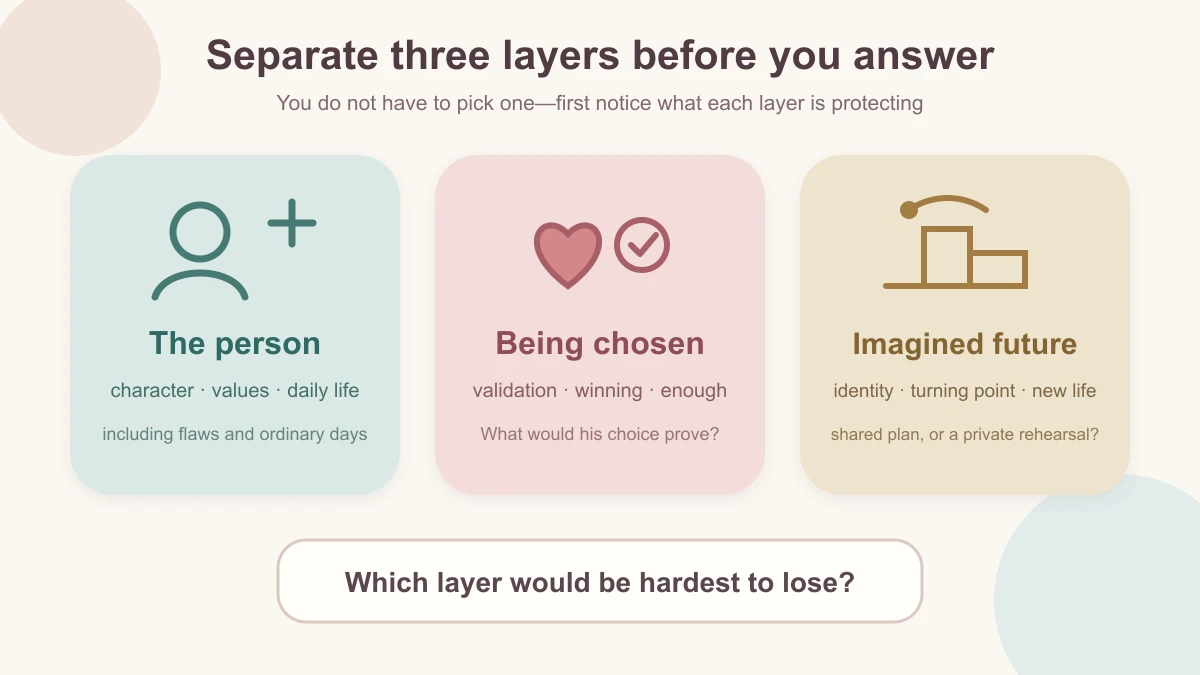
Do not score the page. Ask one question: which area would be hardest to lose?
Now turn that question into three concrete tests:
- If you knew for certain that he would not choose you, which specific qualities would you still admire? If you can clearly name his character, values, and way of treating people, then part of your feeling is genuinely about the person himself.
- If you stopped imagining what life after becoming a couple would look like and considered only your interactions now, do his actions make you feel respected and secure enough to keep knowing him? If they do, you are responding to more than a future you designed.
- If he stopped moving close and pulling away and instead gave you a clear, steady answer, would your interest drop sharply? If it would, part of what has been holding you may be the stimulation of uncertainty, not only his character or the way you relate.
None of these answers is a sentence passed on your heart. They simply separate needs that were previously tangled together, so each can receive the right kind of care.
Try an “events and meanings” page
If the three areas still feel too abstract, draw two columns. Label the left side “What happened” and the right side “What I made it mean.”
The left side should contain only events you can describe without guessing at his motives: he asked to see me; he said he did not want commitment; he messaged after I stopped initiating; he canceled and did not suggest another time.
The right side contains your interpretations: he is secretly afraid of being hurt; he only needs more time; the message proves he cannot live without me; if I stay patient, everything will change.
The interpretations on the right do not mean that you did anything wrong. People naturally try to make sense of signals. The exercise simply keeps fact and hope from wearing the same clothes. Once the columns are separate, it becomes easier to notice whether you love someone who is actively building a relationship with you or someone who exists mainly inside explanations.
Put the page away and return to it after a night of sleep. Do not force yourself to make a permanent decision at the peak of emotion. Find one action you can take today: ask one clear question, stop inventing an excuse for one broken agreement, or return an evening you had left empty in case he called.
Should I ask him directly, or should I cut contact?
If neither of you has ever said what you want, I think one direct question is reasonable. Ask what he is willing to build, not whether you are good enough to deserve it.
You might say: “I have feelings for you, and I need to know whether you want to pursue a real relationship with me. If you do not, please tell me directly so I can take care of myself in the reality we have.”
Then let behavior be part of the answer. Clarity is not only “I care about you.” It is a willingness to define the relationship, make room for it, and address the differences that come with it. If the response contains only soothing ambiguity, that is information: he is not currently offering the clarity you need. You do not have to turn another period of waiting into a final exam.
If he has already said no, less contact does not have to be a punishment. It can be a temporary decision to stop letting every notification grade your worth. You do not need to announce a dramatic forever. You can mute his updates, move the conversation out of immediate view, and ask a friend to walk with you when the urge to message becomes intense. The aim is not to prove that you are over him. It is to give your attention a chance to return to a life that does not require his response.
If he does want a relationship, do not treat being chosen as the end of the story. Knowing each other is only beginning. Watch whether you can tell the truth, survive disappointment, and adjust mutually on ordinary days after the thrill of finally having an answer. If you notice that you keep disappearing to keep the relationship, I Like You, but I Will Not Prove It by Abandoning Myself is about bringing yourself back in.
Your feelings do not need to pass a purity test
You may discover that you genuinely like him and genuinely long to be chosen. You may admire real parts of him while also placing an imagined future on his shoulders. That does not make the feeling counterfeit. A heart is not a multiple-choice question with permission to mark only one answer.
What matters more is whether, after seeing these different forces, you can stop giving one person’s decision authority over your whole life.
You can keep caring about him while taking “Am I enough?” back from his hands. You can grieve the future that did not happen and ask what you truly wanted inside it: tenderness, understanding, belonging, adventure, or permission to begin again. Some of those things can grow through friends, family, meaningful work, creativity, therapy, and the choices you make for yourself every day.
Perhaps you will still choose him when you see everything clearly. Perhaps the mystery, competition, and fantasy will recede, and you will realize that very little remains. Either answer deserves to be seen honestly.
You do not have to decide today whether this is “really love.” Replace that impossible test with a kinder question: Which part of this feeling is getting to know him, and which part is asking him to issue a certificate about me?
Seeing where these feelings come from does not mean you have to decide today whether to stay or leave. It simply helps you make that decision without treating “Will he choose me?” as the only question that matters. You can still hope for a future with him while making room for a life that does not wait on his decision.