He Asked Me to Cook for Him in the Middle of the Night. Was That Love, or Emotional Blackmail?

Your phone lit up in the middle of the night.
The message was short: “Can you come over? I really want the beef noodle soup you make.”
You looked at it, then at the time. You typed back that it was too late, that you had to be at work at seven. You sent it.
The three dots appeared. Stopped. Started again. What finally came through was:
“If you never put anything in, how are we ever getting married?”
You put the phone down. The strange part is that you did not get angry. You started counting. What you did for him last. What he did for you last. Whether something has shifted over the past few months.
By the time the sky started to lighten you were still awake, and you were no longer thinking about noodles. You were thinking about the question you never asked out loud:
I said no. Does that mean I don’t love him enough?
A lot of people are chewing on some version of this right now, because of a story that went everywhere — an influencer and his ex-girlfriend, a bowl of beef noodle soup at four in the morning, and opinion online splitting into two camps, one saying the request was far too much to ask and the other saying it was just noodles. I am not going to rule on which of them was right; that is their business, and all any of us ever sees is the part that got posted. What I actually noticed was a third group: the people who finished reading and did not go and judge the couple at all. They turned it on themselves. Would I have gone? When I said no last time, did someone say something like that to me? This is written for that third group, and last night, that is exactly what you were doing.
Look at what actually just happened
What you said no to was going over in the middle of the night to make a bowl of noodles.
What you are now auditing is yourself.
Those two things are a long way apart — one is whether to go out for an hour tonight, the other is what kind of partner you are. You crossed the distance in about a second, and the bridge you crossed it on was that sentence.
When I am trying to work out what a sentence like that is doing, I use one very simple test: is he unhappy about this thing, or about who you are?
- “I really wanted that. I’m disappointed you can’t come.” → This is about tonight.
- “If you never put anything in, how are we ever getting married?” → This is about what kind of person you are, with your shared future thrown in as collateral.
The difference is not volume, and it is not who is right. It is whether the sentence is about the incident, or about the person.
And that difference decides something very practical: a sentence about the incident finishes; a sentence about you cannot. It does not hand you a problem, it hands you a conclusion about yourself — and problems can be solved, while conclusions can only be turned over again and again.
So is this manipulation?
In Chinese-language internet talk there is a shorthand people reach for here: PUA. As I see it used, it has drifted a long way from the pick-up artist scene it came from, and now points at roughly this — wearing someone down psychologically until they lose confidence in themselves and start doing what you want. It is a word the internet grew. I have been through the Chinese-language explainers and counselling-service write-ups on it and could not find one agreed, rigorous definition — it points at a set of behaviours rather than at any psychiatric diagnosis. If someone can point me to a more precise one, I would be glad to add it and correct this paragraph. The usages I run into also vary so widely that the word has lost most of its edge; people reach for it when a boyfriend forgets an anniversary.
So I am not going to use it to convict him for you. I would rather give you something you can check yourself.
What makes that kind of pressure work is not how harsh the words are. It is that it does not change what should happen about tonight. It changes what you think you are.
“I’m disappointed you can’t come” — you say sorry, and it is over. “If you never put anything in, how are we ever getting married?” — now what you have to deal with is the verdict he just passed on you. The first one ended last night. The second one followed you into this morning, and it will follow you for a few more days.
So let me say the thing directly: the fact that you are asking whether you love him enough is itself the evidence that the sentence worked. It successfully changed the subject from “should I cook tonight” to “what kind of person are you” — and you have already started writing your answer.
I want to stop here, though, because the next part matters just as much.
I am not going to tell you he did it on purpose. Plenty of people say things like that without running any kind of playbook. He may have learned that exact move from watching his parents. He may be frightened of being left and reaching for the thing that pins you in place. Motive is not something I can read off a text message, and neither can you — and if you try to work it out at four in the morning by replaying the conversation, you will usually just feel worse.
The good news is that you do not need to settle the question of motive before you can deal with this. Whether he meant it, learned it, or was just having a terrible night, the result for you is identical: what you set out to decide was whether to go over tonight, and what you ended up doing was grading yourself as a person.
And whichever the cause was, the work is the same — pull the sentence about who you are back apart from the thing that actually happened last night. That is what the next few sections do.
The answer is not in the request. It is in what happened after you said no
The phrase “emotional blackmail” comes from a 1997 book by a psychotherapist. Her definition is not “asking for something unreasonable.” It is: threatening you with some kind of punishment so that you will do what they want.
The useful part of that definition is that the request itself is not where the answer lives.
So you can stop trying to settle whether asking someone to cook at four in the morning is reasonable — that argument runs forever, and the posts and threads that story generated are demonstrating it right now. You have already moved past that square anyway: you said no, and you saw what he did with it. That is the information.
It usually lands in one of two places.
One: he is disappointed, and then he handles it. Orders delivery, makes instant noodles, gives up and goes to sleep. He might sulk. But by morning it is over, and the no cost you nothing.
Two: he does not accept the no. Three days of cold silence, a sudden inventory of things you did wrong six months ago, a flat “I guess you’re not who I thought you were,” or your shared future placed on the scale.
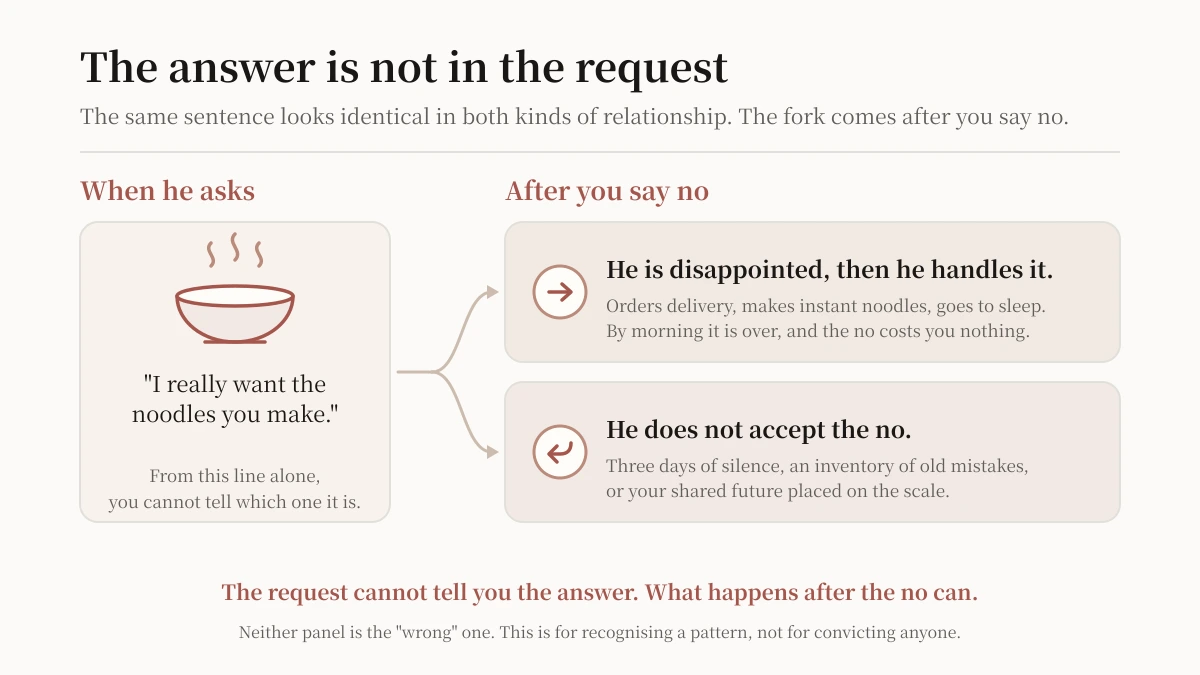
What you got last night was the second one.
I am still not going to tell you that means he does not love you. My own view is that people at four in the morning, tired and denied something they wanted, often say things harsher than they otherwise would — which is not a defence of him, only my reluctance to let one sentence define a whole person.
But I would like you to notice one thing: if saying no always costs you something, then every yes that follows is no longer something you chose.
You are not agreeing because you want to. You are agreeing because you cannot afford what happens if you don’t. From the outside the two look identical — you are the only one who can tell them apart, and that gap is what slowly wears you down.
So do you love him enough?
Now back to the question you were actually asking.
There is a two-week diary study of people in dating relationships. Every day they wrote down what they had given up for their partner — going to something they did not want to go to, changing their own plans, swallowing something they wanted to say — and, crucially, why they did it.
The reasons sorted into two kinds. Forward-facing ones: I want him to be happy, I want us to feel closer, I wanted to. And backward-facing ones: I was afraid we would fight, I was afraid he would be upset, I was afraid of losing this.
On the days built on the first kind of reason, people reported better personal wellbeing and better relationship quality. On the days built on the second kind, both ran the other way. That data can only say those things showed up together; it cannot say which caused which.
But it makes one thing clear: the number of times you gave in was never the unit love is measured in.
If it were, the most loving thing you could possibly do would be to give yourself away entirely — and the data points the opposite direction. Down that road, relationship quality goes down, not up.
So the question “does saying no mean I love him less” is, I think, the wrong question. It assumes love equals concession — and that equals sign was drawn for you, last night, by someone else. The question worth asking is this one:
When I did those things for him, was I doing them because I wanted to, or because I was afraid of what would happen if I didn’t?
If most of the time it has genuinely been because I wanted to, then saying no once last night subtracted nothing. You were tired, and tired is just tired — it says nothing about what kind of person you are.
If you notice that lately it has been drifting toward because I was afraid he would be angry, or go silent, or bring it up for weeks, that usually means the relationship has been teaching you something recently: you are only safe when you give in. That shift happened between the two of you rather than inside you — and it is something you can actually talk about.
Three questions you can answer without him
There is one more angle I find far more useful than “does he love me.”
There is a body of work on close partners that reports something like this: when a partner sees you as, and treats you as, something close to who you most want to be, you are also more often observed moving toward it. The people who proposed it named it after Michelangelo, who described carving as releasing the figure already inside the stone.
Two things I should be straight about. That work can say those things appear together; it cannot say which one caused the other. And it is about movement toward an ideal — what happens in the opposite direction is not something it directly answers. I bring it up because it hands you a far better question than “does he love me.”
So here are three questions. What makes them good questions is that the answers are entirely in your hands — they need no cooperation from him, no change from him, and no verdict from you about what kind of person he is:
- Since you met him, have you become someone who likes herself more, or someone who doubts herself more often?
- The last thing you did for him — when you think back on it, does it feel warm, or does it feel sour?
- After an argument, what stays in your head: the thing you argued about, or what he said about who you are?
If your answer to the third one is the second half, that is usually not something you added yourself. It is because the second half is what he was actually talking about.
Next time, you can say it more completely
You said no last night, and there was nothing wrong with saying it. But if you want it to be harder, next time, for someone to get from “you are not coming tonight” all the way to a verdict on what kind of partner you are, you can break it into three parts:
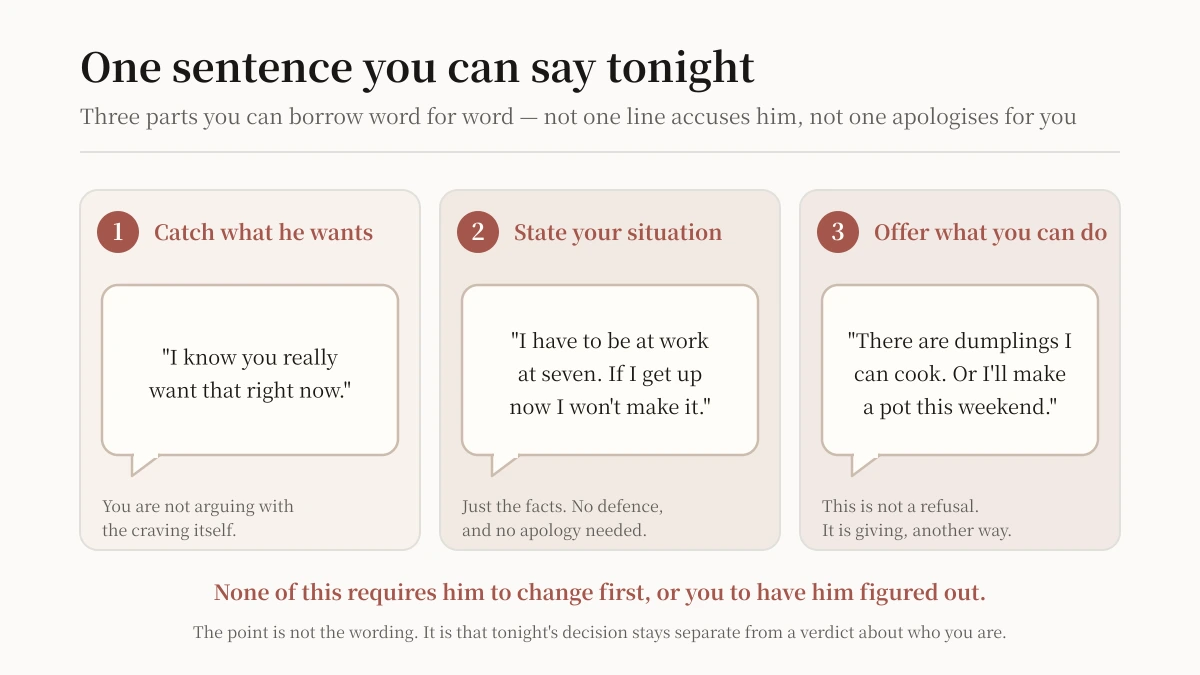
- Catch what he wants first: “I know you really want that right now.”
- State your situation. Just the facts — you do not owe a defence: “I have to be at work at seven. If I get up now I won’t make it through tomorrow.”
- Offer something you can actually do: “There are dumplings I can cook. Or I’ll make a whole pot this weekend.”
Not one line accuses him, and not one line apologises for you.
And if that sentence about marriage comes anyway, you can answer with one line that pulls apart the two things he tied together:
“I didn’t come tonight because I have to be at work at seven. Whether I want a future with you is a separate question. Please don’t put them in the same sentence.”
The point of that line is not to win. It is to change the subject back — from who you are to what happened tonight. Whether he agrees is a separate matter. What matters is that you do not change the subject along with him — that grade on who you are is one you can decline to take on.
If you find that even the first three sentences are hard to get out, that is probably not about last night. For that part, I would suggest this one: Afraid They Will Dislike You, So You Say Yes to Everything.
The four questions you are actually going to ask next
“I said no once and immediately started auditing myself. Am I overthinking it?”
No. That sentence is built to produce exactly this effect — it swaps an incident for a conclusion about you, and a conclusion cannot be dealt with and put down. It can only be turned over.
To make it stop, you have to turn it back into a question — what actually happened last night.
“He got upset. Isn’t that already my answer?”
One time tells you nothing, truly.
As I said earlier, I am reluctant to let one sentence define a whole person. That does not make it hurt less — it did hurt, which is why you were awake all night. But you probably would not want to be summed up by your own worst five minutes either.
I would watch three. Not three refusals — the next three times you say what you need, watch how he takes it. Once can be a bad night. Three times is a pattern. A pattern is far more honest than a single incident, and much more reliable than anything you can work out at four in the morning.
“I’ve cooked so many times already. Isn’t it too late to bring it up now?”
It is not too late. And you do not have to relitigate the past — the moment you do, it becomes a fight, and the thing you actually wanted to say never gets said.
Just talk about this one time. If you want a single line to connect it to everything before: “I always did it because I wanted to. What I’m telling you now is that I don’t have it in me right now.”
That accuses no one, and it makes something important clear: every previous time was a gift, not an instalment. A gift cannot be used as grounds for the next demand — which is exactly what “you never put anything in” gets wrong.
“So should I break up with him?”
I am not going to decide that for you, and I do not think today is a good day to decide anything — you did not sleep, and you have just spent hours being pushed to audit your own character. A decision made in that state is not one I would trust myself.
But here is a far better question than “does he love me”:
In this relationship, can I say “I don’t want to” without paying for it?
If you can, what you have is a communication problem. Those can be worked on, and usually are.
If you cannot, you are dealing with something else — and that something else will not disappear because you cook a few more bowls of noodles, because the problem was never the noodles.
If where you are right now is I still love him, but I don’t want to keep proving it by giving myself up, I would suggest this one: I Like You, but I Will Not Prove It by Abandoning Myself.
You did one thing right last night
I want to give the last part of this to the thing you actually did last night, because I doubt you have looked at it this way.
You said: it’s too late, I have to be at work at seven.
That was you saying what was true about your own situation — and saying it while knowing, at some level, that there would be a cost. My read is that doing that usually means you still care enough to risk telling the truth; when someone has genuinely stopped caring, making something up is far less trouble.
Today you only need to do two things.
First, get some sleep. This is not avoidance. You have been awake all night, and I do not think that is the right moment to be reaching conclusions about yourself. Look at the same events after you have slept and they may well weigh differently.
Second, write two lines on a piece of paper. Nobody else needs to see it, and it is not ammunition for an argument.
Line one: what he asked for. Only what happened. Not what you think he was thinking. Line two: what you actually wanted to say. One sentence.
Your second line may surprise you, because it usually is not “I didn’t want to cook.” It is something like I wanted you to ask whether I had work in the morning, or I want there to be one time when you get up in the night for me. That sentence is the thing you actually need to talk to him about — and it is a far better conversation than “were you emotionally blackmailing me.” He can respond to the first one. The second one tends to turn into an argument neither of you can win.
As for whether you love him enough: you do not have to answer that today, and you do not have to answer it alone.
Before you close this page, though, I want to hand one sentence back to you: what happened last night was that you were tired.
Just that someone who has to be at work at seven did not have it in her, at four in the morning, to go out one more time. That is the whole size of the thing — and it was that sentence that inflated it into a verdict on who you are. You are under no obligation to accept those dimensions.
Today you get to shrink it back to its actual size, and then sleep. The rest can wait until you have.