Afraid They Will Dislike You, So You Say Yes to Everything

Someone asks in the group chat, “Could you help this weekend?” You already have work to finish. You know you need rest. Your fingers move faster than your thoughts anyway: “Sure. No problem.”
For a moment, relief arrives. Nobody is disappointed. The tone of the conversation stays warm. Then you open your calendar and begin moving your own plans out of the way. A second feeling follows: Why am I always the one who says yes?
If that sequence feels familiar, you do not have to order yourself to become fearless overnight. Your quick yes may be doing a very specific job. It protects you from the few seconds in which someone might frown, stop replying, call you difficult, or decide that you are not generous enough. Agreeing closes that frightening possibility before you have to feel it.
Researchers studying young dating couples found that people who expected rejection more anxiously also reported more self-silencing inside their relationships. A second paper using the same group of couples found that people who silenced themselves more often reported conceding more during conflict and poorer communication overall. Their partners reported more frustration and discomfort after interacting with them. They do support one useful understanding: people often make their own voice smaller in an attempt to protect connection, but removing honest information does not automatically create closeness.
The goal, then, is not to remove your kindness. It is to let your kindness include you. You can care about another person’s feelings without making every person’s satisfaction your responsibility.
A yes can be a way of buying immediate safety
Some yeses are freely chosen. You understand the time and effort involved, and the choice still fits what you value. You might become tired, but you do not spend the whole task waiting for the other person’s gratitude to prove that your sacrifice was worthwhile.
Other yeses mainly reduce the tension in front of you. You agree before checking your schedule. You immediately hope the other person will notice how much you gave up. The task has not begun, but part of you is already counting how far you moved away from what you wanted.
You are not deliberately creating resentment. When “no” instantly connects to “They will be angry,” “They will stop inviting me,” or “Everyone will think I am selfish,” agreeing can feel like the fastest way to turn off an alarm.
That is why “just be brave” is usually not enough. First, you need to notice what happens in the second before yes. Try this question:
If I knew this person would not leave or punish me for declining, would I still want to say yes?
If the answer remains yes, the help may be something you genuinely want to give. If the answer changes, do not scold the part of you that wanted to agree. You have learned that this yes contains both generosity and fear of losing connection. Those two motives can exist together. Seeing both lets you make a more deliberate choice.
Separate the request, the prediction, and the need
Open a note on your phone and make three headings: What happened, What I predict, What I need.
Under “What happened,” record only the visible request. A colleague asked whether I could cover the weekend shift. A friend asked me to stay on the phone tonight. My family wants me to cancel an existing plan. Do not write “They desperately need me” or “They will turn against me if I refuse.” Those statements already contain an interpretation.
Under “What I predict,” write the reaction you fear. He will think I am selfish. She will not invite me next time. My manager will decide I am uncooperative. My family will say that I have changed. These predictions deserve attention, but they are not events that have already happened.
Under “What I need,” write what you would choose if you did not have to soothe anyone first. I need one evening without work. I am willing to listen to my friend, but I can only talk briefly tonight. I can help my family with one part, but I will not cancel my plan. I need to understand the scope of this project before I commit.
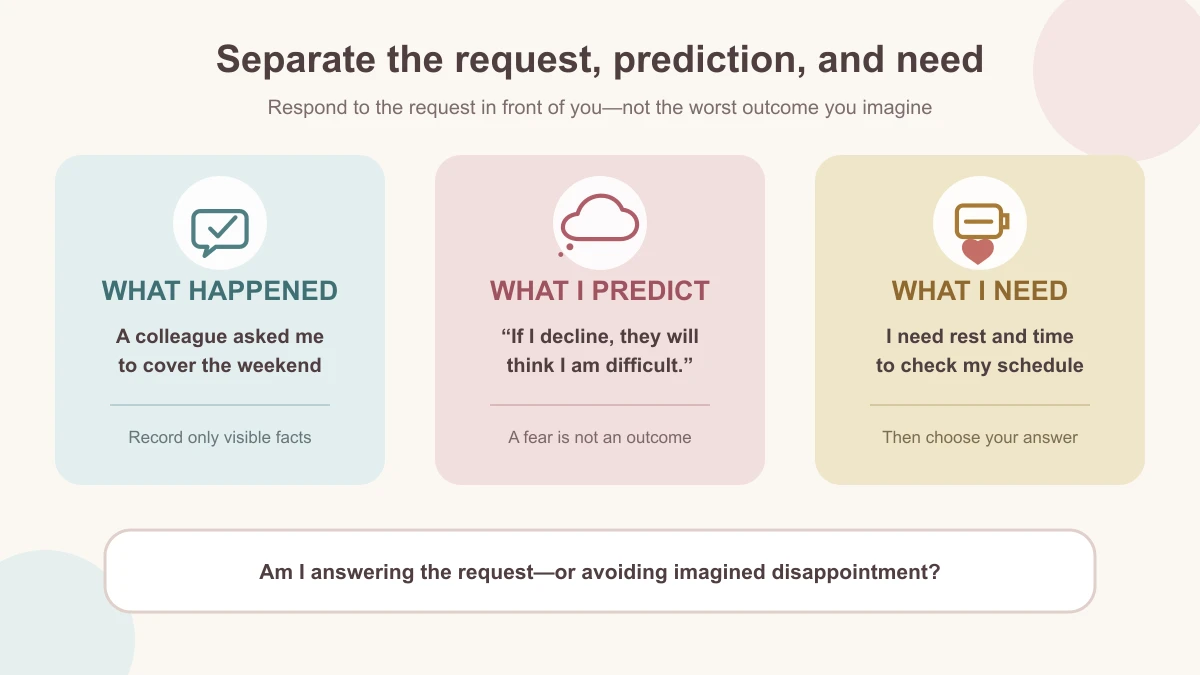
Once the three are separate, you do not have to decide immediately whether you “should” refuse. Ask a smaller question: Is the yes I am about to give responding to the request that actually exists, or to the worst reaction I can imagine?
Your colleague made a request. They have not yet said that declining proves you are uncooperative. Your friend is hurting. They have not said that you must abandon everything tonight. Your family may be disappointed, but disappointment is a feeling they can experience; it is not an instruction that automatically cancels your plan.
This exercise does not ask you to ignore other people. It keeps a reaction that has not happened yet from making the decision for you.
Before you learn to say no, learn not to answer immediately
For many people, the hardest part is not finding a reason to decline. The request appears, and the yes has already escaped. I would begin with a smaller practice: do not require yourself to say no every time. Practice creating a pause.
You can say:
Let me check my schedule and get back to you.
Or:
I cannot answer yet. I want to think about what I can realistically do.
In person, you might add a real return time: “I need to check a few things. I will tell you this evening.” The promise matters. A pause is not disappearing, and it is not keeping someone uncertain forever. It is a short space in which your answer can become accurate.
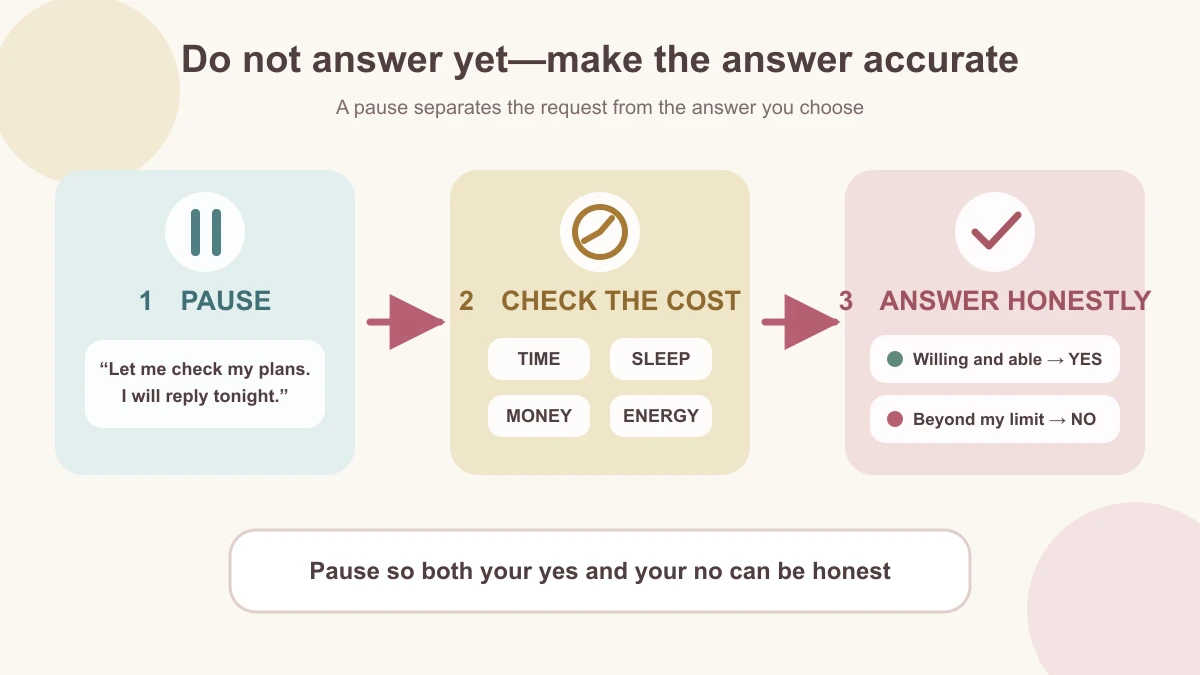
When your body is less tense, calculate the actual cost of yes. How much time will it take? Which existing plan will move? Will you pay with sleep, money, concentration, or recovery time? If the cost still fits and you want to give it, say yes. If it does not, your next task is not to invent a reason that nobody could possibly challenge. Your task is to state the limit.
The pause also lets you notice an important difference. Sometimes you want to help but need to change the form. You cannot spend the whole evening on the phone, but you can listen for a short while. You cannot take over the project, but you can answer one specific question. A deliberate yes can have edges. It does not have to become unlimited access to your time.
A clear no does not require a courtroom defense
When being disliked feels dangerous, a refusal can become a long legal brief. You apologize, list every reason, explain how unusual the situation is, and promise to compensate later. The more material you provide, the more it sounds as though the other person may cross-examine each point. “It will not take long.” “Everyone else is busy.” “You can rest tomorrow.” Soon you are back in the position of having to agree.
I would keep a refusal to two possible parts: the clear limit, and an alternative you genuinely want to offer. The alternative is optional. If you have no capacity, the limit is a complete answer.
At work: “I cannot cover the shift this weekend. I can prepare the handover notes by Friday, but I will not be available on site.”
With a friend: “I cannot go out tonight. I do not have another opening this week, so I will reach out when I can make a plan.”
With family: “I know you hoped I would come, but I already have a commitment that day and I am keeping it.”
With someone who needs support when you are depleted: “I know tonight is hard. I can stay with you for a short conversation, and then I need to rest. If you need longer support, let us think about who else you can contact.”
None of these sentences guarantees that the other person will like your answer. They tell the truth about what is available. If you often remove your needs to preserve a relationship, I Like You, but I Will Not Prove It by Abandoning Myself explores how to turn a hidden need into a request another person can actually respond to.
Be careful with a common trap: offering an alternative that you do not want because you believe every no must be softened into a smaller yes. “I cannot do Sunday, but I can do Monday” is useful only if Monday truly works. Otherwise the alternative simply moves the cost to another day.
If they really are disappointed, watch how they handle it
The other person may genuinely feel disappointed. They expected help and now have to rearrange something. They wanted to see you and learned that you are unavailable. Disappointment does not prove that your choice was wrong, and it does not automatically mean the relationship is unsafe.
Watch whether the other person can remain in relationship with you while disappointed. They may sigh, need a moment, or tell you that they wish the answer were different. Then they begin looking for another solution. They still recognize that your time and consent belong to you. That response shows that the relationship has room for two different answers.
Another person may keep asking until you reverse the decision. They may become cold to punish you, use their past generosity as a debt you must repay, or turn one refusal into “You never care about me.” When that happens, do not immediately offer a new yes to restore the mood. Record what actually occurred. Then ask: If every limit brings this same pressure, how much choice is this relationship allowing me?
This question is more useful than trying to find magical wording that prevents all disappointment. The issue may no longer be your phrasing. The issue may be whether the relationship can include information that the other person does not prefer.
Practice where the cost is smaller
You do not have to begin with the person whose reaction frightens you most. Start in a lower-cost moment. Decline the extra item at a shop with “No, thank you.” When a friend asks what you want to eat, replace “Anything is fine” with one place you actually prefer. When a colleague asks for immediate help, say, “I will finish what I am doing and then tell you what I can take on.”
Afterward, compare what happened with what you predicted. Perhaps the person accepted the answer. Perhaps they looked briefly disappointed. Perhaps they asked a question and then moved on. You are not trying to prove that no will never cost you anything. You are collecting fuller information: some people can receive your limits; some relationships need negotiation; some arrangements work only while you keep agreeing.
When that last pattern appears, the question changes. It is no longer “How can I phrase this so they feel no disappointment at all?” It becomes “Is this relationship willing to know a version of me who has limited time, real needs, and different answers?”
This practice may feel uneven. You might pause successfully one day and agree too quickly the next. That does not erase what you learned. Return to the three headings. What was requested? What reaction did you predict? What did you need? Repetition helps you notice the choice earlier, before resentment has to announce it later.
Someone can be disappointed without you having done something wrong
You can remain a person who helps, notices other people, and sometimes walks an extra distance for a relationship. Learning to refuse does not have to turn you into someone colder. It returns generosity to choice instead of letting fear make every decision.
The next time yes begins to leave your mouth, you do not have to force out a dramatic no. Replace the answer with: “Let me think and get back to you.” Then separate the event, the prediction, and the need. Offer what you truly want to give. Let the part for which you have no capacity remain unavailable.
Some people will welcome a clearer version of you. Some will need time to adjust. A few may have preferred the version who always adapted. You cannot keep every person satisfied. You can slowly learn who is willing to keep relating to you after you give an honest answer.
Begin somewhere small today. Replace one automatic “Anything is fine” with the food you actually want. Replace one instant yes with a pause. You are not pushing connection away. You are giving connection a chance to meet the whole person who is already there.