Growing Up Without Enough Love: The Signs It Leaves in Your Relationships

“All good, you?” In the end, that was the whole reply. A friend had asked how you were doing lately, and you had typed a long answer about the thing that was stuck at work and the nights you couldn’t sleep, read it over, and deleted it word by word.
Only after you put the phone down did it come back to you: last month, when you and your partner disagreed, you were the one who apologized first. When a coworker offered to help, you smiled and said you’d handle it. Now you’re wondering whether all of this comes from the same place. “Did I grow up without enough love, and is that why I’ve always felt so insecure with people?”
What stopped you wasn’t that one message. It was noticing that with friends, with a partner, with coworkers, you do the same thing: you put your own needs away first, then say it’s fine as if nothing happened. Pausing to look at that is already a way of treating yourself well.
What “growing up without enough love” means
It doesn’t have to mean nobody took care of you. Often there were meals, school, someone to take you to the doctor. What was missing was a response to how you felt. When you were sad, nobody came to ask what had happened; when you were scared, nobody stayed beside you; when you were happy, nobody was happy with you. Or the love came with conditions, and you had to do well, be good, act grown-up, before you got a little praise. Psychology calls this childhood emotional neglect: a child’s emotional needs go unseen and unanswered for a long stretch of time.
It may have happened like this. Your parents may have been working long hours and often away, someone at home may have been ill and needing care, your parents may not have known how to show feelings themselves, or a younger child at home may have drawn away the adults’ attention. Your parents may have had their own struggles, such as heavy pressure at work in those years, or being worried about things at home themselves. But understanding their struggles doesn’t mean denying how it affected you: when you needed someone to respond as a child, you often waited and nobody came, and that really happened.
Here is how I see it. A child learns that “my needs can be spoken” by speaking them and, again and again, getting an answer. A child who keeps waiting for an answer that doesn’t come finds another way to look after themselves: not needing anything, getting everything done first, reading the adults’ faces, or stepping away from whatever might let them down. Those strategies protected you then. So as an adult, with friends, partners and coworkers, you still reach for the same ones.
With friends
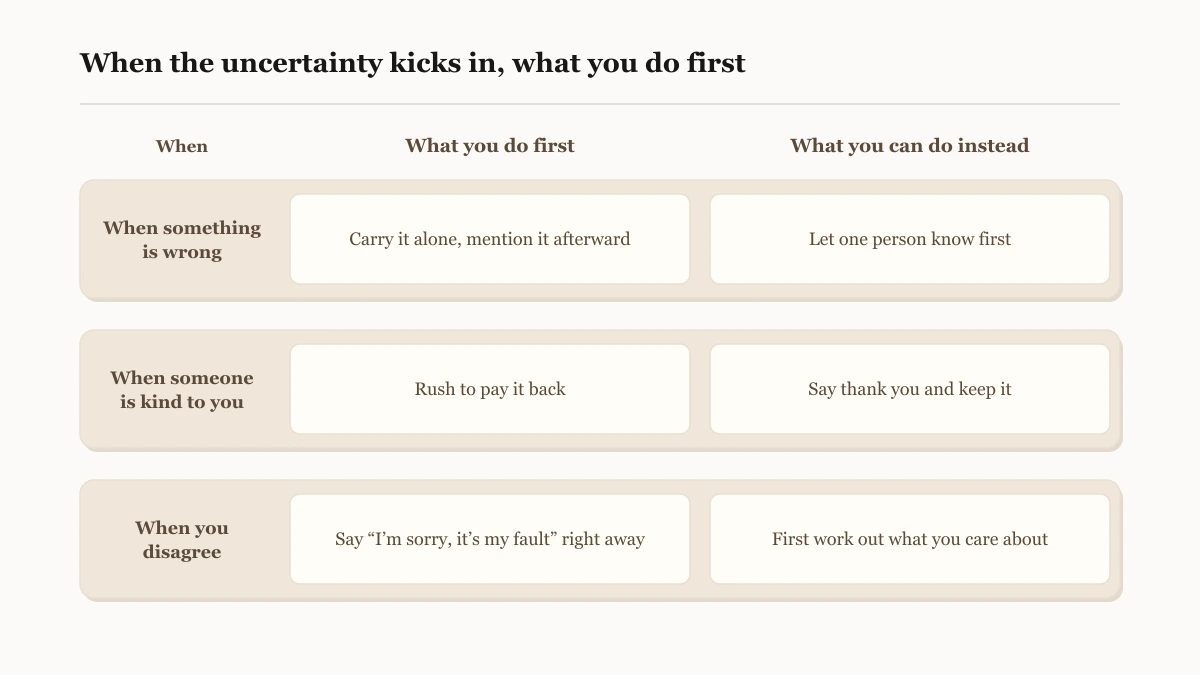
When something is wrong, you carry it alone
Something went wrong at work and weighed on you for days, and you worked through all of it on your own. Only later, in some passing conversation, did you mention it lightly: “That stretch was actually pretty rough.”
Your friend was surprised and asked why you hadn’t said anything, and you couldn’t quite explain. Saying it just felt like giving someone trouble. What you were afraid of in that moment was saying it and having nobody respond, which seemed worse than never saying it. Over time, the people around you came to see you as strong, and very few of them know what you look like when you can’t hold it together.
When someone is kind to you, you rush to pay it back
A friend gives you a birthday present, and your first thought as you open it isn’t happiness. It’s what you’ll give them on their birthday, ideally something even more thoughtful. If someone buys you a meal, it stays on your mind until you’ve bought one back. To me, that hurry isn’t politeness. Part of you doesn’t quite believe kindness will stay, and as long as you owe it, it feels like it could be taken back at any moment. So you settle every kindness quickly, as if that’s what makes the two of you even.
In love
It’s hard to say what you want
Your partner asks how you’d like to spend your birthday, and you say “something simple.” They ask where you want to go this weekend, and you say “up to you.” You do have places in mind and things you’ve wanted to do for a while, but by the time the words reach your mouth, saying them feels like making demands.
From what I’ve seen, people who weren’t answered when they asked as children often grow up saying even “I want” very quietly. What they learned back then was this: if you don’t ask, you won’t be disappointed.
The closer you get, the more uneasy you feel
The better things are, the more often you think about losing them. The more considerate your partner is, the louder a voice inside asks how long this can last. Sometimes you step back first and act a little cooler on purpose. Sometimes you say something harsh to see whether they’ll leave because of it. My guess is that early experience taught you that the closer you get, the more it hurts when you’re let down, so you would rather brace yourself in advance than be caught off guard.
In an argument, you apologize first
The moment you disagree and the air turns tense, before you’ve worked out where the problem lies, you’ve already said, “I’m sorry, it’s my fault.” You aren’t trying to settle who’s right. You want the two of you back to normal as fast as possible, because what scares you in that moment is that this one bad mood might be enough for them to stop wanting you. But the more often you apologize first, the less often the thing you actually care about ever gets said.
In groups, at school or at work
You have to be useful before you feel allowed to stay
On a group project, you volunteer for the most tedious part. At a work dinner, you’re busy pouring drinks and checking that everyone got food. When there’s nothing left to do and you’re just sitting there, you feel uneasy all over. I think it’s because of an idea you picked up very early: you have to be useful to people before you have the right to be there. So it’s hard for you to stop, because when you stop, you worry your place there will disappear.
In a group, you often feel like the extra one
Everyone is in the middle of a great conversation, and you laugh along while wondering whether you should have come at all. When someone doesn’t pick up on what you said, you check yourself for what you got wrong. I believe that much of the time, the people around you aren’t trying to leave you out at all. That sense of being extra is an old experience of going unnoticed as a child, surfacing again in a room like this one. And in the end, you come away more tired from a crowd than from being alone.
If you recognized yourself in more than one of these, there’s no need to rush into sadness. These are reactions you learned as a child to look after yourself. They have reasons behind them, and I believe they can be changed, slowly.
The insecurity underneath these signs
My view is that underneath all of these signs is the same uncertainty: you’re not sure that if you say what you need, anyone will really be there to take it in.
Because of that uncertainty, you developed three ways of coping. The first is to stop needing: you carry problems alone and keep quiet about what you want, so you can’t be turned down. The second is to give first and earn a place: you rush to repay kindness and grab the extra work in a group, as though that’s what lets you stay. The third is to get ready to be left: you grow uneasy as a relationship gets better, apologize the moment you argue, and feel like the extra one in a crowd, all while waiting for a disappointment you believe is bound to come.
This insecurity is really a prediction you learned long ago: needing people usually ends in nothing. When you were small, that prediction may often have been right. But the people around you now are not necessarily like the adults you had then.
To get a sense of how strong it still is, think back to one thing. The last time you were really hurting, did you let anyone at all know? It might have been a bad exam result, a few sharp words from your boss, or just an evening when you felt low for no reason you could name. If you got through it alone and only mentioned it lightly much later, or never mentioned it, then from what I’ve observed, the insecurity is usually still making the decisions. If you did let one person know, even with nothing more than “I’m not in a great mood today,” then something has already changed. You gave someone a chance to keep you company.
Does having these signs mean you grew up without enough love?
Not necessarily. These signs can come from elsewhere too: a past relationship that hurt you, a stretch of time when you were left out at school or at work, or simply an unusually stressful season.
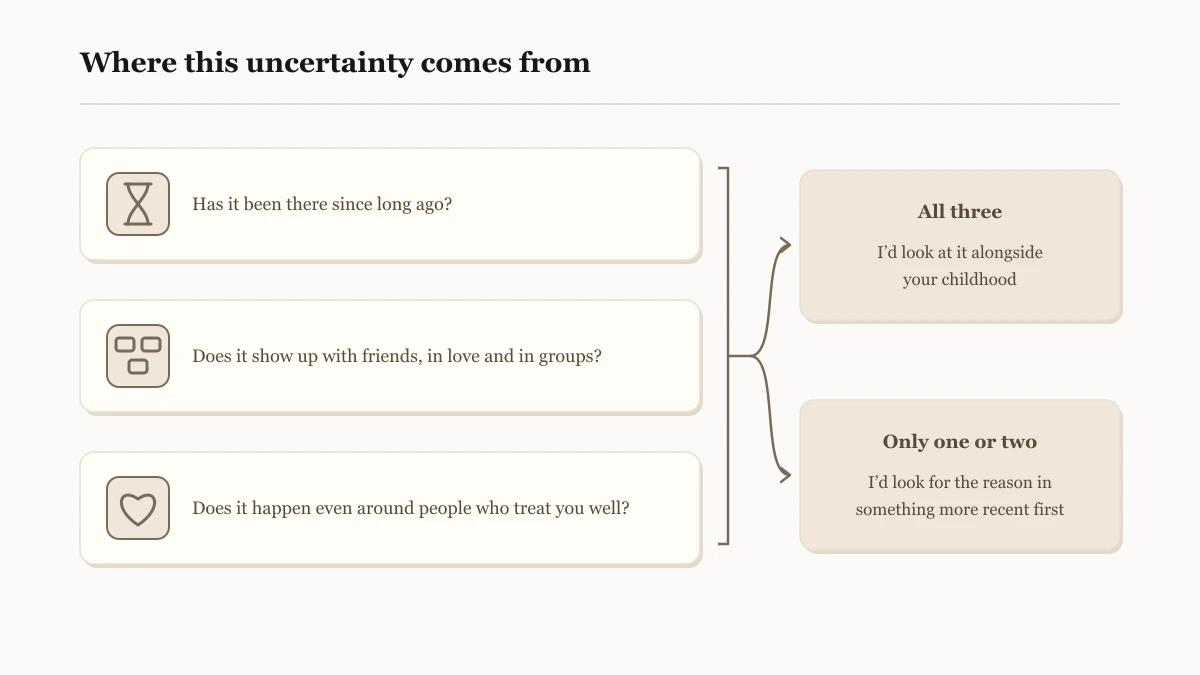
I’d use three questions to tell the difference. Has it been there since long ago, rather than starting in the last year or two? Does it show up with friends, in love and in groups alike, rather than in just one relationship? And does it happen even around people who treat you well, so that you still put your needs away with someone who has never let you down? If all three fit, I think it makes sense to look at it alongside your childhood. If only one or two fit, the uncertainty may come from something more recent. The phrase “growing up without enough love” is there to help you understand where you came from, not to let you say, “This is just who I am, and I can’t change.” Once you can see where it came from, it’s easier to know where to start changing it.
Start with one small need
These strategies have been with you for many years, and you don’t have to replace them all at once. None of the three practices below is big, and when you start is up to you.
Each week, tell one person about one small need
Pick someone who’s usually good to you, whether a friend, a partner or a coworker you get along with, and each week tell them about one small need. Start with the smallest: “Could you save me a seat?” Once that feels familiar, try “Want to grab dinner after work today?” Only then move on to “I haven’t been in a good mood lately, and I’d like to talk with you.” The point is to give your need a chance to be answered at least once, instead of leaving it inside you while you guess, alone, whether it would be turned down.
Once you’ve asked, you’ll usually run into one of three things. If they say yes, accept it and say “thank you,” without rushing to add “it’s fine if you can’t.” If they can’t this time but suggest another time, show up at the new time; as I see it, that means they want to, and that day just didn’t work. If they forget, or never reply, don’t take it as proof that asking is pointless. A few days later, try again with a different person and an even smaller need. One unanswered request doesn’t mean every request will go the same way.
When someone is kind to you, say thank you and don’t rush to repay
When you get a gift or someone buys you a meal, just say “Thank you, I really like it,” and give yourself one rule: for this week, don’t give anything back. You’re not refusing to repay it, only refusing to rush. The point is to practice being given to, letting that kindness stay in your hands a little longer and seeing whether it really gets taken back.
In an argument, don’t rush to apologize
The next time you disagree and “I’m sorry, it’s my fault” is on the tip of your tongue, try this instead: “I want to figure out what I care about first, and I’ll tell you once I’ve thought it through.” The point is to save apologies for what you actually did wrong. Once you’ve thought it through, if the mistake really was yours, apologize properly. If what you care about is something else, say that, because in any relationship, your feelings count too.
For you, who keeps putting your needs away
These signs stay with you because they once really worked. As a child, putting your needs away meant one less disappointment, and getting everything done first meant a little more chance of being noticed. When you’ve used a strategy for years, you keep reaching for it first even after the people around you have changed, and every “see, nobody pays attention to me” makes you believe in it a little more.
Wanting someone to ask about you when you’re sad, wanting to be relaxed and yourself in a relationship, wanting someone to really keep you company: everyone should have these things. They’ve been yours since you were small. It’s just that back then, nobody gave them to you.
For now, you could note on your phone each time someone keeps you company, even if all they said was “I’m here.” On a sad night, you could start by telling yourself, “You worked hard today.” You’ve been putting your needs away for many years, so it’s fine if changing that takes time. Tonight, put the phone down, play a song you love, and go to bed a little early.
Sources
Research and sources this essay draws on.
- Romantic love conceptualized as an attachment processJournal of Personality and Social Psychology, 52(3), 511–524
- Interpersonal and genetic origins of adult attachment styles: A longitudinal study from infancy to early adulthoodJournal of Personality and Social Psychology, 104(5), 817–838