Always Afraid of Losing Them? What Makes You Anxious May Not Be Love

Your partner has done nothing wrong tonight. It is Friday, they are out to dinner with friends, and you are home on your own. A little after ten they send a group photo and say it has been a fun night. In the picture they are laughing so hard their eyes have almost closed.
You type back, “Looks like so much fun.” Then you zoom in on the photo and keep looking, trying to remember whether they ever laugh like that when they are with you. The rest of the evening you cannot settle, until one question finally takes shape: Do I just love them too much? You ask because this relationship matters a great deal to you, and because you are afraid of losing it one day. Caring that much is not the problem. It has simply been wearing you out lately.
The things you have not said out loud
“They haven’t done anything wrong. So why do I still feel uneasy?”
Unease does not wait for someone to make a mistake. The more a relationship means to you, the less you want to lose it, and the more closely you watch for anything that looks like a sign of losing it. That you can tell they did nothing wrong matters a lot: it means you can still see clearly what they actually did.
“The better they treat me, the more I worry it will stop someday.”
When you have something you treasure, being afraid it will disappear is a natural reaction. Their kindness is real. In that moment you can let yourself be happy first, without immediately working out how long it will last.
“I don’t dare let them see how much I care. I’m afraid they’ll find me annoying.”
Caring about someone is not a burden. My guess is that what worries you is the kind of caring that keeps asking for a response, like sending lots of messages a day and then waiting for replies. Care can also go into places that need no reply at all. If they mentioned a job interview a few days ago, ask how it went the next time you talk. When they are talking, put your phone down and really listen. I believe they will feel those things, and none of them adds one more thing to their list.
“If they saw all of me, would they still like me?”
Before anything else, I would suggest looking back at one thing: what made them start liking you, and what have they complimented you on since? From what I have seen, the parts of you a person remembers are often not the ones you work hardest to show. They are the parts you already have, like the way you laugh, the small things you remember from what they said in passing, or the way you talk. The next time the worry comes, find the one or two things they have said they like about you and read them. Those are their own words, not your guesses.
What are those uneasy thoughts really worried about?
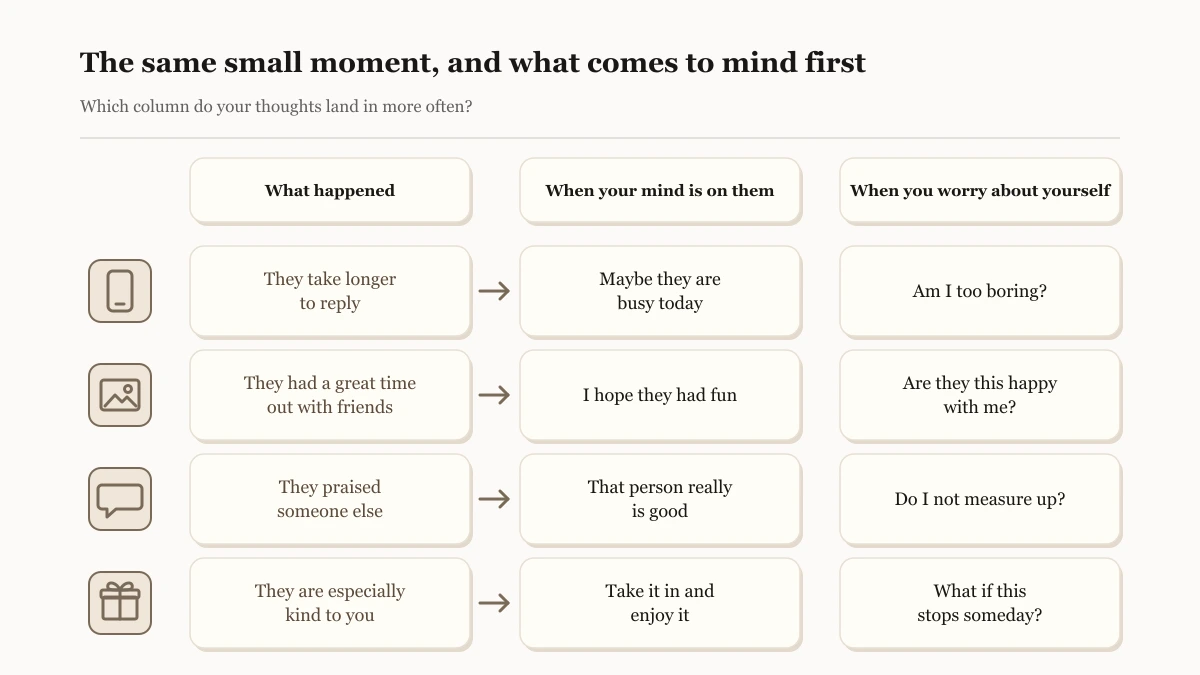
They take a little longer to reply, they mention a coworker you have never heard of, or they are quieter than usual today. These are all small things. In your mind, though, each one quickly gets attached to a reason, and the reason is almost always about you. You start guessing: Am I too boring? Have I not looked good enough lately? Is someone else more interesting than me? Did the way I said something yesterday upset them? You have thought of it too: maybe they are just tired, maybe the coworker simply happened to be part of their day. Those thoughts just do not convince you, and “Am I not good enough?” drowns them out fast.
As I see it, this is the most exhausting part of being anxious in love. On the surface you are watching them all the time. Underneath, the person being checked over and over is you.
Is this anxiety a sign that you love them too much?
I do not think so. Love makes you care about them. What keeps you anxious is something else: you are not sure you are someone who gets to stay. I would look at three places to tell where your unease is coming from.
First, look at who you are thinking about. When you love someone, your attention mostly rests on them: whether they are tired today, whether work went well, whether they enjoyed dinner. But when you are anxious, your attention keeps swinging back to yourself: Did I come across well just now? Did I let them down? Am I still enough for them to like?
Second, look at whether their kindness settles you. Love lets you take their kindness in and feel steadier. But once the unease sets in, it works the other way. They remember your birthday and come to pick you up when it rains, you feel happy for a moment, and then the thought arrives: they like the version of me that is doing well, and once they see all of me, this will end. So the kinder they are, the more tense you get, and the more proof you want.
Third, look at whether you can be yourself around them. Love lets you relax with them, so you say you are tired when you are tired and say you are upset when you are upset. But when you are afraid of losing them, you choose your words and hide the tiredness and the moods first, as if any side of you they noticed might be the one that makes them stop liking you.
If most of your answers land on the second half of each, this is how I see it: it is not loving too much that keeps you anxious. It is the fear that you are not good enough, not good enough to make them stay.
That fear often shows up earlier than this relationship. My guess is that it may come from a childhood where doing well was what earned praise, from being compared with other people again and again, or from a past relationship that ended without a real explanation. Experiences like these teach a lesson: you have to be good enough to be kept. So in this relationship, too, you have learned to check yourself first. That also means you do not have to pull back your love for them to feel less anxious. What needs attention is how you see yourself.
Ask yourself this: “When you worry that they will leave, is the reason you come up with something they did, or something wrong with you?” If it is something they have really done lately, for example they have not reached out on their own in a long time, then the unease has a reason behind it. If every reason is about you, too boring, not attractive enough, not as good as someone else, then I suspect the unease is coming from how you see yourself, and that is something you can start loosening, slowly, from today.
Three things to do when you are afraid you are not good enough
Being willing to stop and look at what you are really afraid of is already a step that is not easy to take. These three steps are small. You can start on them tonight.
Finish the sentence
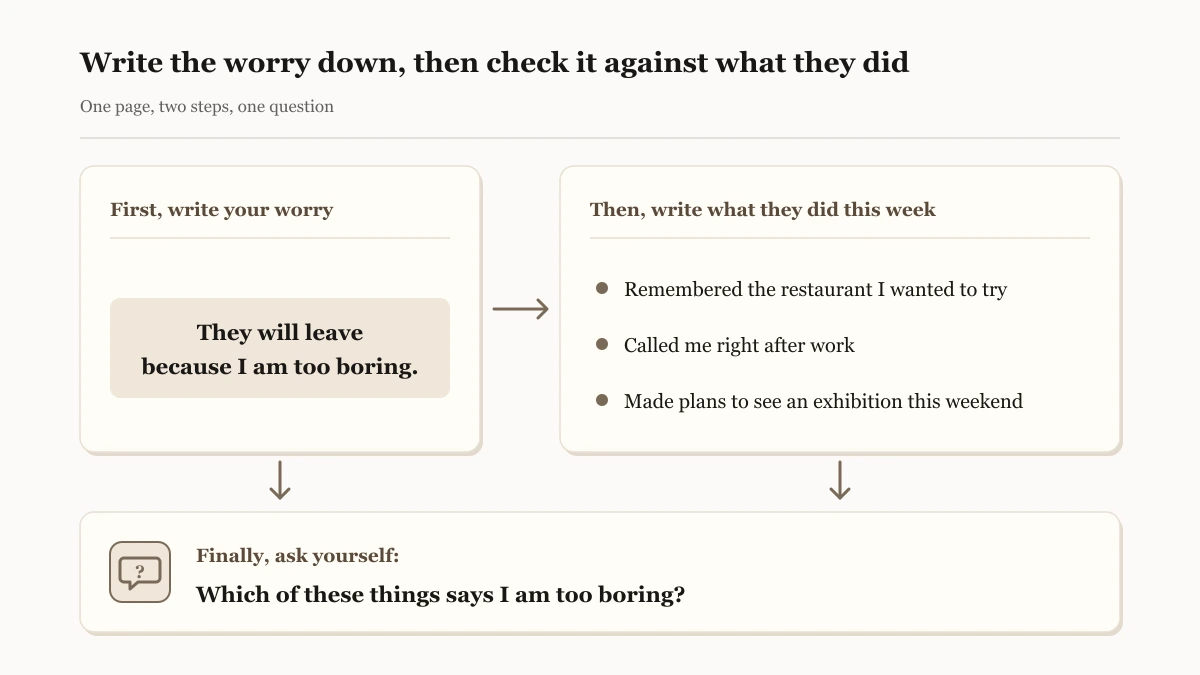
Each time the unease starts again, open the notes app on your phone or take a piece of paper and turn the thought in your head into one complete sentence: “They will leave because I am ___.” Fill the blank with the reason you actually believe, such as “too boring,” “not attractive enough,” or “often in a bad mood.” It does not have to be well written, and you do not have to argue with it yet.
While the thought stays in your head, it is often just a rush of panic you cannot name. Once it is a sentence, you can see what it is actually saying. I would suggest writing it down every time you feel uneasy, whenever it happens, and then going back to whatever you were doing.
Underneath, write what they actually did this week
Below that sentence, list three things they really did this week. Write only what they did, without adding any meaning to it. For example: they remembered the restaurant you said you wanted to try, they called you right after work, they made plans with you to see an exhibition this weekend.
Then put the two side by side and ask yourself: which of these things says you are “too boring”? My judgment is that someone who finds you boring is not likely to remember which restaurant you wanted to try, or to call you as the first thing after work. The two do not match because the first line is how you see yourself, and the list below it is how they actually treated you this week.
Tell them once
Pick an ordinary moment when neither of you is in a hurry, after dinner or before bed, and tell them about the unease once. Talk only about how you feel. Do not ask them to promise anything or to change anything. You could say: “Sometimes I suddenly feel really uneasy. It isn’t because of anything you did. I worry that I’m not good enough, and I wanted you to know.” If the two of you usually live apart, a message or a phone call works the same way.
What matters is that you said it out loud, and from that day on, the worry is no longer something you keep hidden on your own.
Four questions that may come up once you start
What if the reason I wrote down really is something I do badly?
Then treat it as something you can change, not as the reason they would leave you. Say you wrote “because I am always late.” That is a specific thing. Next time you can leave a little earlier, or you can ask them directly: “I’m late a lot. Does it really bother you?” In my view, one thing you do badly is very far from “I am not good enough as a person.” You can change the first one. The second is a verdict you have handed yourself.
If I tell them I feel uneasy, will they think I’m too much work?
I do not believe saying it once makes you too much work. The way I see it, what tires a partner out is usually not hearing that you feel uneasy. It is being asked to prove things over and over: being asked every day whether they still love you, or having to explain where they were whenever they reply a little late. What you would say is different. It only lets them know how you are doing, and it asks nothing of them.
In my view, being willing to say plainly how you are doing actually makes things easier for the other person, because they no longer have to guess why you suddenly went quiet or seem unhappy. To help them feel at ease, you can add one more line: “I’m not telling you this so you’ll have to comfort me every time. I’m working on it myself. I just don’t want you to have to guess.” Once is enough. The next time the unease comes, write it down in your own way first instead of going to them to check every time.
What if they really did do something that made me uneasy?
Then what needs to be dealt with is what they did, and you do not have to start by doubting yourself. Suppose they have cancelled plans at the last minute several times recently. You can say it plainly: “We’ve made plans and then cancelled several times lately, and I feel a bit sad. I’d like to hear what’s been going on for you.” Stick to what happened and how you feel, and hold off on drawing conclusions about them.
I have always been like this. Will I feel the same with someone else?
Possibly. I think this worry follows how you see yourself, not any particular person. So you do not have to wait until you meet someone better before you let yourself feel a little safer; you can practice in the relationship you are in now. The worry may not vanish all at once, either, and you do not need to expect yourself to stop worrying after trying a few times.
Wanting to be loved well is not too much to ask
The way I see it, you keep fearing you will lose them because this relationship matters so much to you, while part of you still does not quite believe you are good enough. Put those two together and every small thing they do gets checked against you, so of course you are tired. Wanting to be loved well, and hoping they will stay by your side, is a very natural wish in a relationship. You do not need to love less or ask for less just because that wish makes you uneasy.
From now on, when they compliment you, try saying thank you first instead of arguing with it in your head. On days when you feel you did well, you can make a note of that for yourself too. The unease will still come, and you do not have to drive it away in one go.
Everything they have done for you is still there, and so is your care for them. The next time the unease comes, try not to rush to blame yourself. Take it slowly.
Sources
Research and sources this essay draws on.
- Self-esteem and the quest for felt security: How perceived regard regulates attachment processesJournal of Personality and Social Psychology, 78(3), 478–498
- The Mismeasure of Love: How Self-Doubt Contaminates Relationship BeliefsPersonality and Social Psychology Bulletin, 27(4), 423–436