Should You Tell Them? First, Ask If You Can Bear to Lose Them

You’ve typed it out again.
It’s a little longer than last time. It starts with “I’ve been meaning to tell you something.” You read it three times, delete “been meaning to,” put it back, and then hold down the delete key and watch the whole thing disappear one letter at a time. The screen goes dark. The only sound left in the room is the air conditioner.
This isn’t the first time. Maybe it was the end of a night out — you walked to the corner together, they said “I’m this way,” you said “okay, see you,” and then you stood alone on the platform thinking: those thirty seconds, I could have said it. Maybe they posted a photo late at night and you stayed on it far too long, and all you sent back was a sticker. Whether you see each other every day or live a time zone apart, you know this moment.
And you know the question. You’ve had it for a while —
Should I tell them? And if I do, will I lose even what we have now?
If that question brought you here, let me say one thing first. You keep running the numbers on “what happens if I say it” because you care about what you have — enough that you can’t bring yourself to bet it. The daily conversations, being the first to know when they’re having a bad week, the jokes only the two of you get: those are real. Not wanting to lose real things is about the most reasonable position a person can hold.
So this piece won’t push you to confess, and it won’t tell you to let go. What it will do is take the question in the title apart. “Can I bear to lose them?” — first, let’s get clear on what exactly you’re afraid of losing. Then let’s look at whether that loss is really as big as it looks at two in the morning.
Their silence probably isn’t an answer
Let me start with the thing I most want you to know.
You’ve probably thought something like this: “I’ve been so good to them. They must have noticed by now. If they haven’t responded, that’s their polite way of saying no.” It’s a smooth line of reasoning — so smooth you may have already accepted it as the verdict and skipped the part where you actually ask.
One study changed my mind about that reasoning. It compared two things: how much interest a person believes their gestures have communicated, and how much the other person actually picked up. The result: the more someone fears rejection, the wider that gap. The feelings you’re sure are written all over your face? The other person receives less of them than you think.
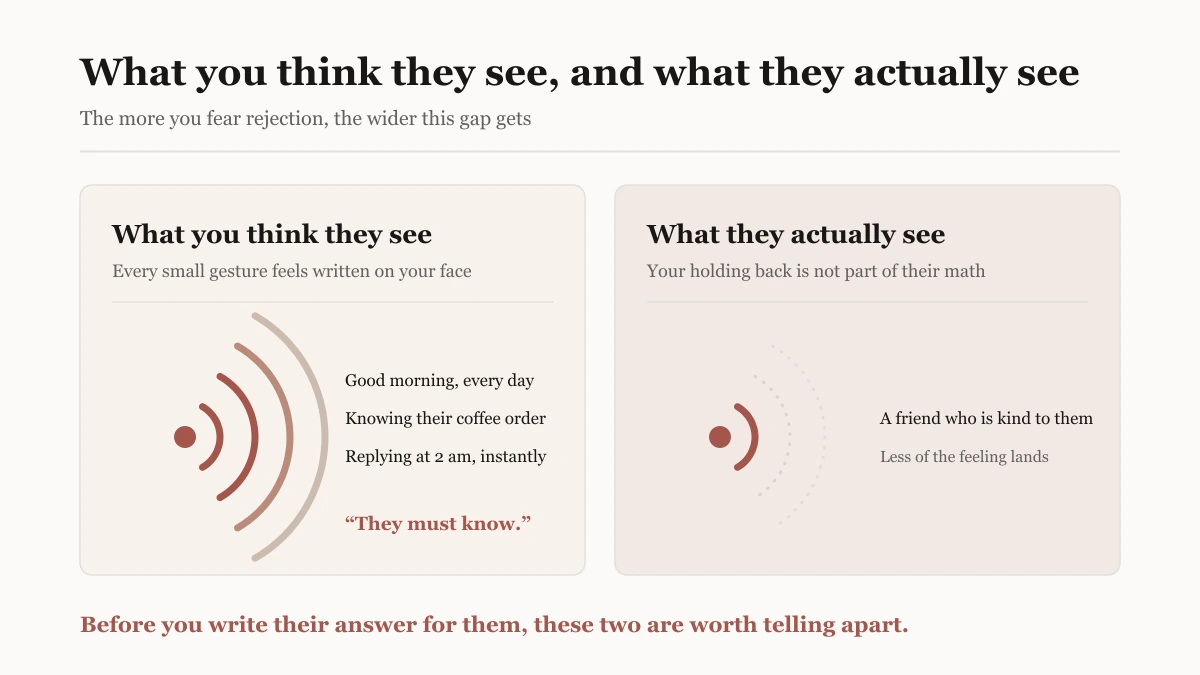
The gap has a very human source. People who fear rejection assume the other person can see their holding back — “they know how shy I am, and I still saved them a seat; surely they get it.” But the other person doesn’t factor your holding back into the math. They see the gesture itself, and only that: a friend saved them a seat.
So the answer “they already know, and their silence is a no” may well be one you wrote on their behalf. I can’t tell you whether they like you. What I can tell you is this: what you’re facing is most likely not a rejection that has already happened, but a question that hasn’t been asked yet. Those two things weigh very differently.
What exactly are you afraid of losing?
“If I say it, I’ll lose them.” The word “lose” in that sentence is carrying at least three different things. Pull them apart and the picture gets much clearer.
The first is the relationship as it is right now. Good mornings and goodnights, lunches together or late-night voice messages across a screen, the jokes only the two of you get. This is the most concrete piece, and the one you’re least willing to give up.
The second is the possibility that they might like you too. As long as you don’t say anything, that possibility stays alive — and it gives you a lot: a reason to get up, the flutter when they reply, an imaginary next trip. I’ve written about this in “Do I Like Him, or the Possibility That He Might Choose Me?” — sometimes what we can’t let go of is the possibility itself.
The third is the you from before you said it. The version of you who never has to face an answer and gets to stay “a really good friend” indefinitely. Once the words are out, you become someone who has said them, and whatever happens next, you can’t go back to that old spot.
These three usually get bundled into a single sentence — “I’d lose them” — which is why it feels so heavy. Separate them, and you’ll notice that very different things happen to each. The first isn’t necessarily lost at all. The second doesn’t disappear; it turns into an answer. And the third — honestly — you’re already losing it. You think that by staying quiet you’re keeping everything safe, but every night you spend guessing costs you something: the hour before sleep, the mood that sinks over one short reply, the days you didn’t really live because you were waiting on them.
“Can I bear it?” — how to ask so you actually get an answer
Throw “can I bear to lose them?” straight at yourself and what comes back is usually an emotion, not an answer: no, absolutely not. That’s not a verdict. That’s fear grabbing the microphone first.
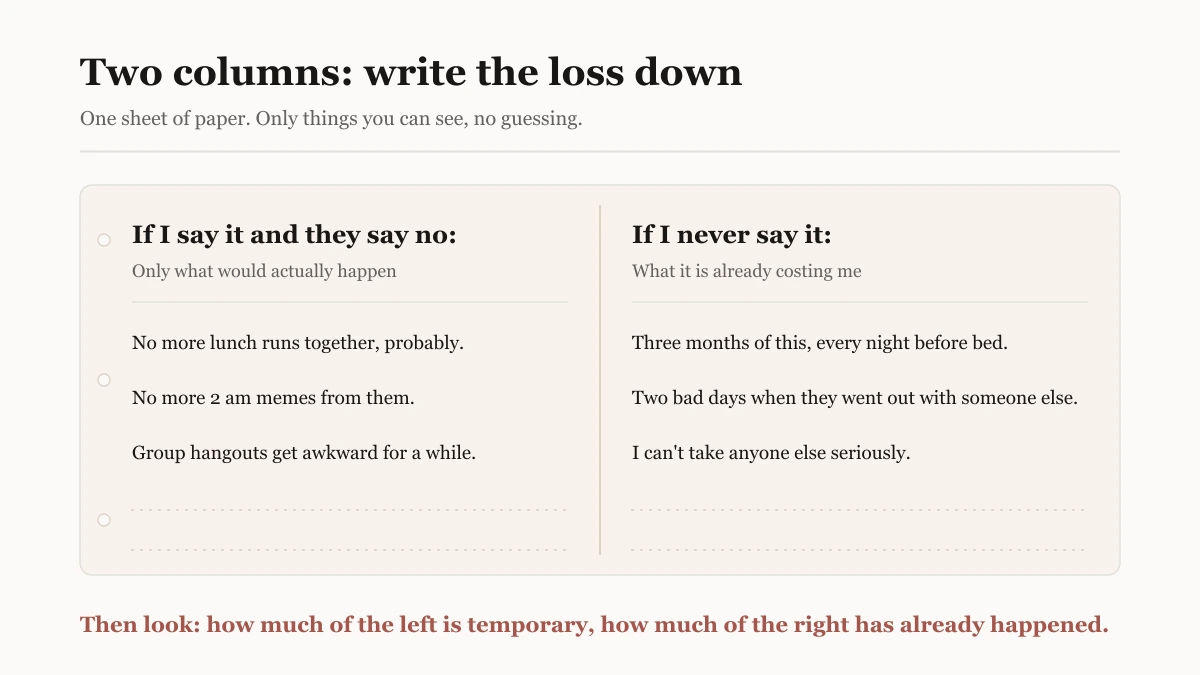
I’d suggest asking it a different way — on paper, not on your phone. One sheet, two columns.
The left column is headed “If I say it and they say no, I lose…” The right: “If I never say it, I’m already losing…” Both columns get only things you can see, no guesses. The left can hold “probably no more lunch runs together,” “no more 2 am memes,” “group hangouts get awkward for a while.” It can’t hold “they’ll think I’m annoying” — that’s a guess. The right can hold “three months of thinking about this every night,” “two bad days when they went out with someone else last week,” “I can’t take anyone else seriously.”
When you’re done, look at three things.
First, look at the left column. Sort each line into one of two kinds: things that would recover after a while, and things that truly wouldn’t come back. In my experience, the second kind is rarer than you’d expect — most of what’s there is the first.
Second: is the right column longer than you predicted? From what I’ve seen, a lot of people stop at this point, because it’s the first time they see that the stretch they’d filed under “I haven’t lost anything” has already cost them plenty.
Third, ask yourself one more question: do I want them to know, or do I want to stop living in a guessing game? Those aren’t the same wish. If you want them to know, there’s only one road: say it. If what you want is to stop guessing, there’s more than one: you can say it, or you can give yourself a deadline — “if I still haven’t said it by the end of the year, I’m allowed to take my heart back.” Get clear on which one you want, and the decisions after it get a lot easier.
If they really do say no
“Bearing the loss” shouldn’t be a slogan, so let me get specific about what it actually involves.
Start with the hurt. Rejection hurts; there’s no point dressing that up. But in “Why Does Loving Someone Feel This Exhausting?” I mentioned a piece of data worth bringing back here: people’s predictions of how much a loss will hurt tend to run heavier than what actually happens. That data looked at people going through breakups, not people whose confessions were turned down — but I think one part transfers. The version you’re picturing right now — devastated, never able to see them again, your whole friend group in ruins — is mostly fear’s drawing, not the shape of the future.
Then the other person. You might assume that saying “no” is the easy part — that they turn you down and walk away untouched. A set of accounts that listened to both sides of unrequited love says the opposite: the people on the receiving end mostly remember it as unpleasant — they don’t think they did anything wrong, yet they still feel guilty for making someone sad. It’s the people who loved who look back with both the bitter and the sweet.
That means two things for you. First, if they say no, it doesn’t mean you did something wrong, and it doesn’t mean you were a burden to them; that moment is hard on both of you, and you’re not the only one hurting. Second — and this is my reading — precisely because saying no is this hard, a lot of people never manage to say it. In those same accounts, the most common line from the people who loved was: “they never clearly turned me down.” If you’ve been waiting for them to give you an answer, that may be exactly why it hasn’t come: they don’t want to be the one who closes the door. So if what you want is an answer, it probably won’t arrive on its own. You’ll have to ask.
Finally, the friendship. Whether it survives is not decided on the day you confess. From what I’ve seen, it comes down mostly to how you treat yourself after you hear “no.” You don’t have to pretend you’re fine, and you don’t have to immediately prove “we’re still friends.” Give yourself a stretch where you’re not forcing it — seeing each other less, being online less, not replying so fast, whatever you need. Friendships that come back tend to grow back during that stretch; they aren’t secured on the spot by a quick “we’re still friends, right?”
How do you say it? And when?
If you finish the two columns and decide to say it, I have three suggestions. They’re methods, not guarantees.
First, when you say it, give them room not to answer on the spot. “I like you. I wanted to say it myself instead of letting you guess. You don’t have to answer now.” The important half of that sentence is the second half. It lifts the pressure off the moment so they can actually think — and it keeps you from filling in their answer as “no” in the few seconds before they reply.
Second, pick a moment when the two of you would be talking properly anyway: in person if you can see each other; if you mostly text or call, then through whichever way the two of you talk most easily. What matters is that neither of you is rushed, and that afterward you each have something else to do. Not their birthday. Not right after their boss chewed them out. Not late at night when you’re both too tired to think. In those moments, whatever they give you isn’t their usual self.
Third, after you’ve said it, keep the next few days for yourself, not for your phone. Whatever the answer, you’ll need some time — and rereading the conversation only makes those days longer.
You’ve probably heard the line: “If you don’t say it, you’ll regret it for the rest of your life.” I’m not going to use it on you. It isn’t as reliable as it sounds: some people look back and most regret what they didn’t do, but some most regret what they did. Regret doesn’t take only one side. So this decision deserves to be made by you — not by a proverb.
You don’t have to decide tonight
Back to the question in the title: can you bear to lose them?
By now you’ve probably noticed that this question can’t be answered with a yes or a no. The three things you’re afraid of losing each go a different way: the shape of the relationship isn’t necessarily lost; the possibility that they might like you too turns into an answer; and the version of you that keeps not facing it is already being lost, a little every day. As for “bearing it” — that isn’t lifting a mountain in one go, either. It’s the few days after a no when you still remember to eat. It’s not having to pretend you’re fine right away. It’s looking back a few months later and finding that it most likely hurt less than you’re picturing now — that’s what the data I mentioned earlier is about. I believe you can bear it, because bearing something is never done all at once. It’s done one day at a time.
I can’t decide for you whether to say it, and I can’t tell you how they’ll answer. The two-column page is in your hands, and so is the answer. But whether you end up saying it or not, you’ve already done something many people never manage: you didn’t let “they must already know” close the case for you.
And here’s something you may not be able to see yet. One day, looking back, what you’ll remember probably won’t be what they said. You’ll remember whether, during this stretch of your life, you took your own feelings seriously — whether you honestly asked yourself what you could bear, and then made a decision that was yours. The way I see it, what wears a person down was never the answer. It’s never choosing.
So you don’t have to decide tonight. Finish the page, then go to sleep. What you’ve already done for this feeling is more than you give yourself credit for — and what you still have time to do is more than you think.