Does Your Partner Punish You by Not Talking to You? Watch What That Silence Is Teaching You

Your last few messages are marked as read. Nothing has come back. You have scrolled up and reread them three times, looking for the line that did it, and you cannot find one. Or maybe there is no screen between you at all: you asked if they wanted dinner, they did not answer, and they walked past you as if they had not seen you. The food sat on the table for an hour before you put it in the fridge, closing the door as softly as you could, because you did not want even that sound to turn into a thing.
They have stopped talking again, and you already know how this goes. You do not know how long it will last, but you know how it ends, because the last one ended this way and so did the one before that: you go first. You ask if they are angry, you say sorry, you quietly put away whatever you had wanted to say, and slowly they come back. By now the question is one you know by heart, what did I do wrong this time, with a smaller one underneath it, what do I have to do to get them to talk to me.
I am not going to try to work out why they went quiet this time. What I want to look at with you is how it ends, every single time, because that is where the answer is.
Wanting it to end is caring
Let me say first what this essay is and is not. Whether they love you, and whether they are doing this on purpose, are two things I will not judge for you, and I will not decide for you whether this relationship should continue. What I will talk about is those few days when they are not speaking, and where you can look during them, because during those days you do not have to wait for them, and there are things you can start on your own.
Now the part that matters more. You want the silence over quickly because you care about this person and about the life the two of you share, and every day it goes on is a day that life is on hold. You speak first and apologize first because silence is harder to sit in than an argument; an argument at least makes noise, and silence gives you nothing, so you go and fetch the person back yourself. Both of those things have the same name, and the name is caring. And when you go first, it is usually not because you have thought it through and decided the thing was your fault. It is because you want the quiet to stop. Those are very different reasons, and you know better than anyone which one it was.
You are not remembering the same thing
Here is how I see it. The two of you go through the same silence and come away remembering two different events. What they remember, most of the time, is that it passed and you were fine again, which is why they can later say, with a straight face, “But we were okay after that, weren’t we?” They are not lying. That is the version they have. Your version is the days in between, guessing which sentence it was, which thing you did, guessing until you could no longer remember what you had wanted to say in the first place. And I have always thought the most painful part of those days is not the quiet itself but not knowing why. Someone who knows what their partner is angry about at least has one thing to deal with. Someone who does not know has nothing to hold, so they take themselves apart and inspect every piece, from what they said last night back to something from a month ago. If you are exhausted after a few days of this, I think the reason is simple: you have been doing a job that cannot be finished.
The things you have not said out loud
You have probably not said these to anyone. I am writing them down here. Read the ones you recognize.
“Maybe I’m too sensitive. Maybe they just need to cool off.”
The way I read it, it may well be true that they need to cool off, and it is also true that you need to know they are still there. Both can hold at once. Neither has to step aside for the other. A person needing some quiet and a person leaving you to guess for three days are two separate things, and they always were.
“I’ll just apologize. It won’t kill me.”
My answer is that apologizing is fine, but an apology needs something behind it. What, exactly, are you apologizing for? If you can name it, that is an apology. If you cannot, then the sorry is not really a sorry. It is the only button you have found that makes the silence stop.
“When they’re not talking, I can’t get anything done.”
What I think is happening is that you have handed those days over to them completely. They stay quiet, you wait, and a person who is waiting cannot do much else, which is not strange at all. What you can look at instead is something different: those days do not have to be handed over in full.
“Now I think about every sentence before I say it, in case it sets them off again.”
Of these, this is the one worth stopping on, because it is no longer about the days they are not speaking. It is about the days they are. You have started to hold back on the days they are talking to you, and that deserves more of your attention than the silence does. Put these side by side and they are doing the same job: each one is looking for something you can do about their silence. But the silence is theirs. What you can do about it is much smaller than you think, and much simpler.
Two kinds of silence, and the only difference is how they end
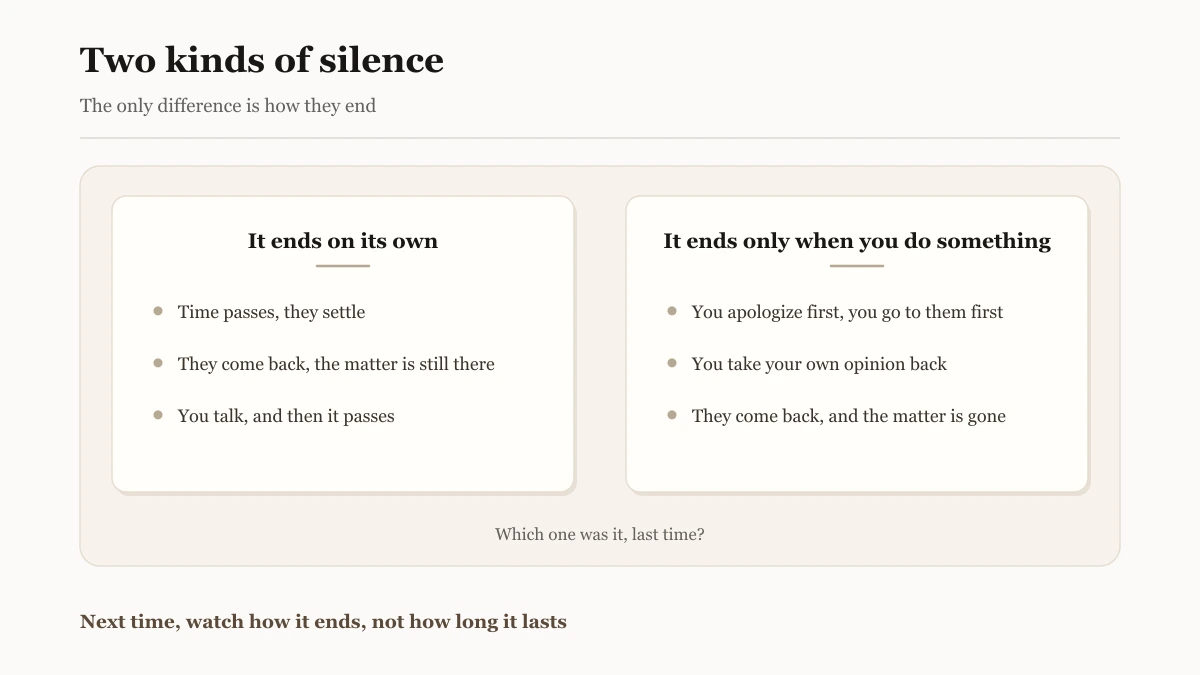
People who are angry sometimes need quiet. That is normal, and a person not wanting to talk is not the same as a person punishing you. I have hours like that myself, when I simply cannot get words out, and it has nothing to do with what the other person did. But there are two kinds of silence, and from the outside you cannot tell them apart. In both, the messages are read and not answered. In both, the food sits on the table and they walk past you. The difference is not how quiet it is or how long it lasts. The difference is how it ends.
One kind ends on its own. Time passes, they settle, and they come over and say, “About last night, can we talk,” or they say nothing and just start doing the dishes. The important part is that when they come back, the matter is still there. You can talk about it, and only after you have talked does it go away.
The other kind ends only when you do something. You apologize first, you go to them first, you take back the opinion you had, and then it stops. I want you to notice one thing about it. When it stops, the matter is usually gone. You apologized, they are talking to you again, and nobody ever discussed the thing itself, because that silence was never after a conversation. It was after your giving way, and once you gave way, its work was done. So here is one question, and only one: the last time they ignored you, did it end on its own, or did it end because you did something?
The punishment in the title is the kind that ends only when you do something, a silence with a condition for ending, and the condition is on you. A silence that will only end once you back down is already controlling you, whether or not the person doing it has thought about what they are doing.
What to watch for: their silence becoming yours
You go quiet before they do. That is what this does to you, and it is the thing the title is asking you to watch for. Before I say what it is called, I want to stay on what it does.
You run each sentence through your head first, checking whether it might set them off, and most of the time you decide not to say it. Your opinions get shorter, and “I’d like to go to that place” turns into “whatever you want.” Your decisions get smaller: where to go on the weekend, how to spend money, whether to visit your family, all of it now waits for a read of their mood before you open your mouth. You start arranging your day around how they seem, rushing to get everything said on a good day and bringing up nothing on an off day. By the end they do not have to say a word. You have already gone quiet for them.
That is why I call it manipulation. It does not require them to do anything each time; after it has happened a few times, you take over the job yourself. A lot of people call this PUA, and I am not going to explain that word again. Whoever is doing it may not know they are doing it every time, but the way it lands on you is the same: that one second before you speak, when you check. This change happened between the two of you, it grew out of repetition, and it has nothing to do with your personality. You are like this because you have been learning how to avoid those days, and people avoid what hurts.
Next time: say “I’m here,” then finish your day
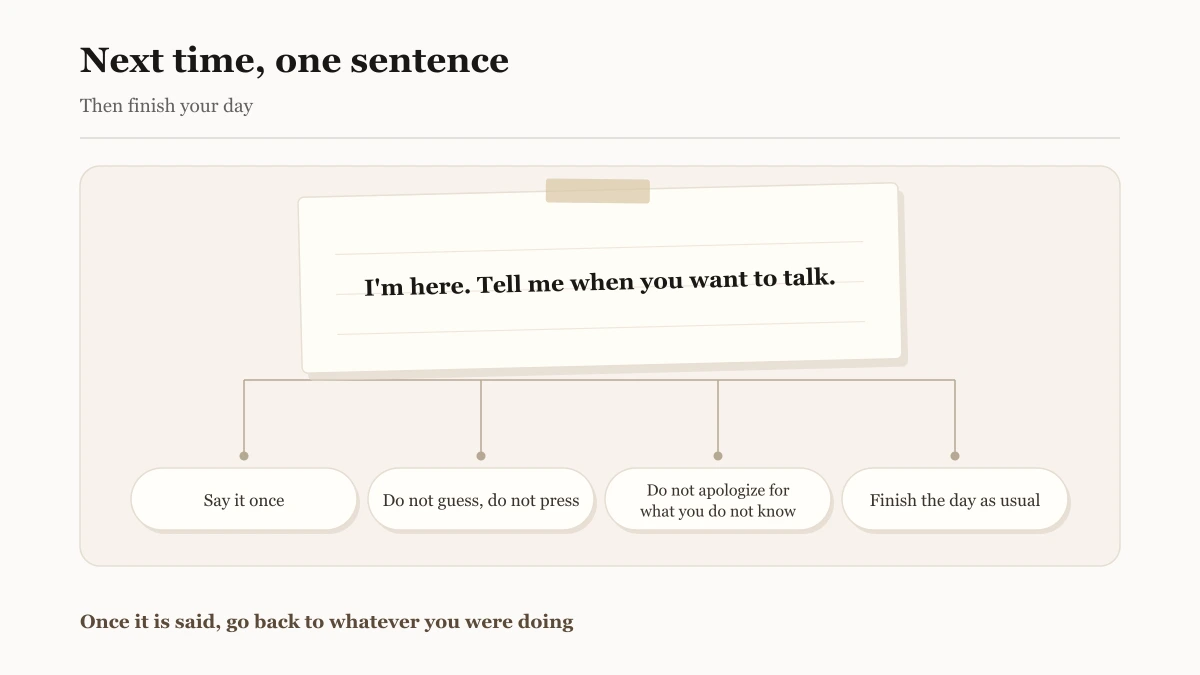
Next time, I would suggest one small thing. When they go quiet again, say one sentence, “I’m here. Tell me when you want to talk,” and then do not do any of the things you usually do. Do not guess what they are angry about. Do not ask “what is wrong with you.” Do not apologize for something you do not know. Do not turn the whole house down to match their volume; their not talking does not mean you have to tiptoe. Eat as usual, sleep as usual, go out as usual, and finish the day.
That sentence is not a test, and it is not a contest to see who can hold out longer. It does exactly one job: it hands “ending this” back to the person who was holding it all along. They started the silence, and when it ends is theirs too. What you have been doing all this time is taking that job off them and ending it on their behalf. This time, I would suggest, do not take it. And the sentence works for both kinds of silence. Someone who truly needs space gets it, settles, and comes back, and you will notice that when they do, the matter is still there and the two of you can talk. A silence that was waiting for you to back down does not get what it was waiting for this time, and you get to see how it ends instead. You do not have to judge in advance. The answer shows up on its own.
A few small things to keep in mind. Say the sentence once, and do not repeat it every day. Once it is said, go and do whatever you were going to do instead of standing there waiting for a reaction. When they come back, do not keep score and do not say “you ignored me for four days this time”; if the matter is still there, talk about the matter, and do not lead with an apology. If you live together, say it to their face or leave it on a note on the table, and then cook what you were going to cook, switch off the lights when you usually do, watch what you usually watch. If your relationship runs on text, or across a time zone, one message is enough: “I’m here, tell me when you want to talk.” Send it, put the phone down, do not send a second one, do not check whether it has been read, and the next day send whatever you would normally send at your normal pace.
If you feel you cannot do this yet, that you would not get through those days, then do not do it yet. There is no deadline. Start with the smallest piece: not apologizing for something you do not know. Leave the rest for a day when you feel like trying.
Four things you are going to ask next
“But what if they genuinely just need space?”
Then “I’m here, tell me when you want to talk” is exactly what gives it to them. A person who needs space gets space, settles, and comes back with the matter still there, and the two of you can talk. If what you are really trying to work out is whether tonight’s argument should be finished or paused, that is a different question, and I have written a separate piece about it: Should We Finish This Fight Tonight, or Is Going Quiet Sometimes the Better Call?.
“What if I don’t go first and they just keep ignoring me?”
Then you have an answer you could never get before: this is not the kind that ends on its own. It is not a pleasant answer, but it is more reliable than anything you could have guessed in three days of guessing. Waiting can have a limit, and you set it. Three days, say. When that day comes you can go to them, but the sentence you bring is “let’s talk about that thing,” not “I’m sorry.” That is the one difference from every other time you went first: you are not going to press the stop button on the silence. You are going to bring the matter itself back up.
“Should I tell them how much this hurts me?”
Yes. I would suggest saying it on a day they are talking to you, not in the middle of the silence, because anything said inside the silence will be heard as chasing. One sentence is enough: “You can be angry, and you can not want to talk, but I need to know you’re still here.” Say it and leave it. How they take it is the next thing, not this one.
“Is this the point where I should leave?”
This essay will not make that decision for you, and I do not think the decision belongs in the days they are not speaking. I would suggest saying “I’m here” and finishing your days as usual first, and then start counting. Every time a silence ends, you learn one more time which kind it was. How many times a thing can repeat before you stop staying is yours alone to decide, and a decision made after counting will be steadier than one made after guessing.
They can stay quiet. Your days can go on.
Whether they are punishing you with silence comes down to how it ends, not how quiet it gets. Whether it has become manipulation comes down to whether you have started going silent before they do. You can begin watching both today, without their cooperation, without a conversation, and without deciding where this relationship is headed. I cannot tell you whether they will change. What I can tell you is that those days do not have to be handed over in full. They can stay quiet; that part is theirs. The waiting does not have to be yours. While they are silent you can eat a whole meal, sleep a whole night, and keep the things you wanted to say, keeping them until they are back rather than until they disappear.
There is one more thing you probably have not had room to think about these past few days. Minding that they are not talking, feeling bad about a plate of food nobody touched, wanting to know they are still there: none of that is bad news. It means you still see them as someone you are building a life with. Here is how I see it: every silence you have ended on their behalf is proof of how much you care, not of anything you did wrong. From the next one on, some of that care is worth keeping for yourself. While they are quiet, you are still you.