Should We Finish This Fight Tonight, or Is Going Quiet Sometimes the Better Call?
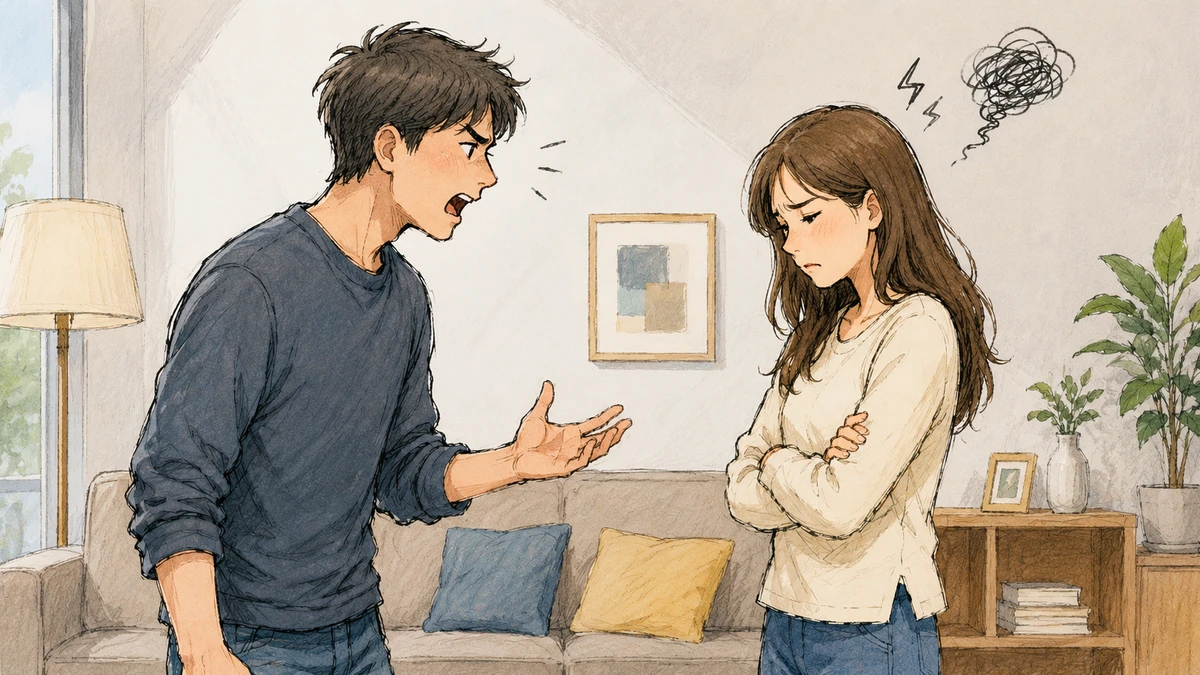
It is twenty to one in the morning and the two of you have circled the same sentence more times than either of you can count.
Nobody is shouting. The volume has not gone up. Every line is just a little shorter than the one before it. You still want to finish, because you are afraid that if tonight ends without an ending, the whole thing will sink somewhere underneath and come back as fuel for the next fight. The other person is on the far end of the sofa now, looking at the floor, answering, after a long gap, with a sound rather than a sentence.
Or maybe you are not even in the same room. Maybe your last message is sitting there marked as read, and nothing has come in since.
And there is only one sentence left in your head.
Do we have to finish this before we sleep, or should we stop right now?
If that is the sentence that brought you here, let me say what this piece is going to do. It is not going to decide which of you is right, and it is not going to teach you how to talk. There are two things here that have been folded into one, and I want to pull them apart. The first is how big the thing you are fighting about actually is, because that turns out to decide whether saying it straight helps you or costs you. The second is that “I’m done talking” is really three different things wearing the same face, and only one of them is a pause.
Everyone Awake at This Hour Is Awake Because They Care
The one who wants to finish tonight is afraid of tomorrow morning. Afraid of waking up to a house where this never happened, where they are the only one still carrying it, so that the next argument arrives with this one stapled to the back of it.
The one who cannot keep talking has, I think, usually lost track of what will come out if they open their mouth again, and what they are afraid of is a sentence they cannot take back. For that person, stopping is the only move they can think of that leaves everything else intact.
Both people want the same thing: to know that tomorrow morning is still intact. The only difference is that one of them believes they have to finish in order to know it, and the other believes that continuing is what will destroy it. The fact that you are awake at this hour looking for an answer says something to me: this relationship matters to you more than the outcome of tonight’s fight does.
Why Some Fights Really Do Get Worse the More You Talk
There is research that asked something very simple: when you say the harsh thing out loud during a fight, is that good or bad for the relationship?
First, what “the harsh thing” means here, because it is not the polite version of being direct. It is not “I did not love the way you handled that.” It is “you never listen to me.” It is “don’t do that anymore.” It is “you’re so immature,” “I don’t care what you think.” It is the kind of line you know is too much the moment it leaves your mouth, and still regret the next morning.
The answer was that there is no single answer. It depends on what you are fighting about.
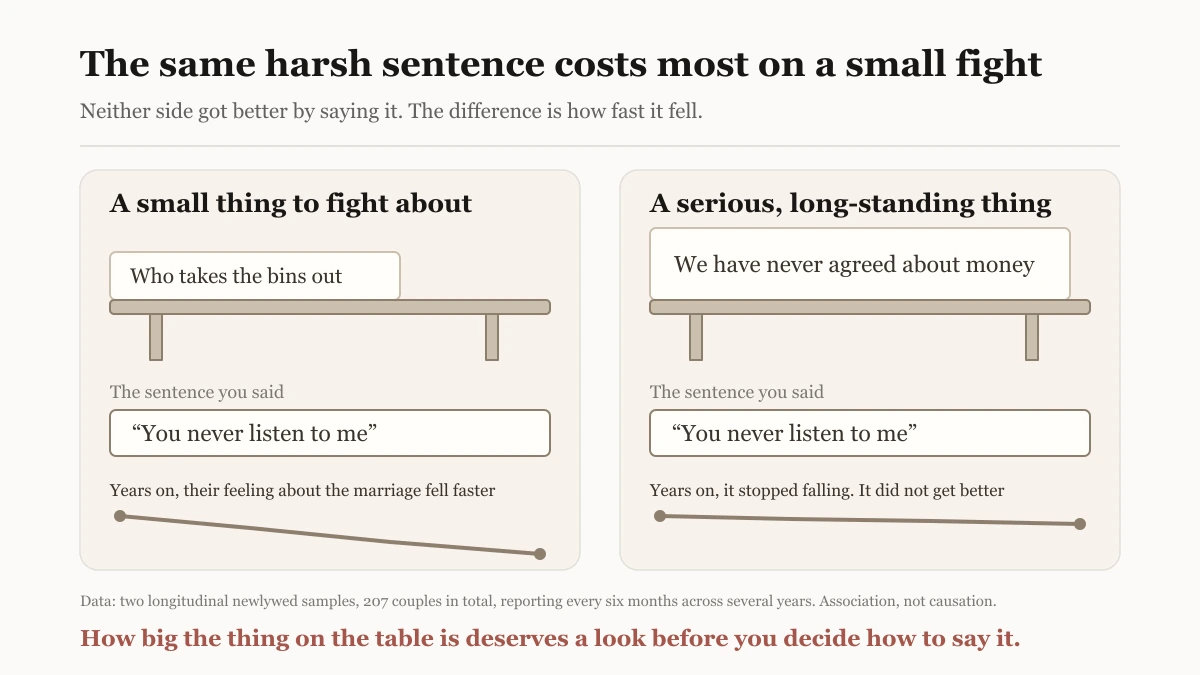
Among the couples whose fights were about small things, the more often someone spoke that way, the faster their feeling about the marriage dropped over the following years.
Among the couples carrying something genuinely serious, something that had been sitting there for a long time, the same harsh way of speaking went with a feeling that stopped falling.
Let me close off a reading of that before it starts. This is not saying that a big enough problem earns anyone the right to be cruel. Nobody in either group got better by speaking harshly. The best result available was that things stopped getting worse. Harsh words never once added anything.
The real message is on the small side. The same hard sentence costs the most when it lands on something that was never that serious, because what it damages is the part of you two that was fine. So when a fight really does get worse the more you talk, here is how I read it: the trouble is not in how the sentence was phrased, it is that the subject could not hold that much firepower.
As for the serious thing that has been sitting there, the one line I take from the data is this: it will not repair itself while you both keep walking around it, so somebody has to put it on the table. Putting it on the table and being cruel about it are two different acts, and being cruel about it made nobody better off.
So the question was never really whether to solve it now. It is how big the thing is that you are trying to solve tonight.
“I’m Done Talking” Comes in Three Versions, and Only One Is a Pause
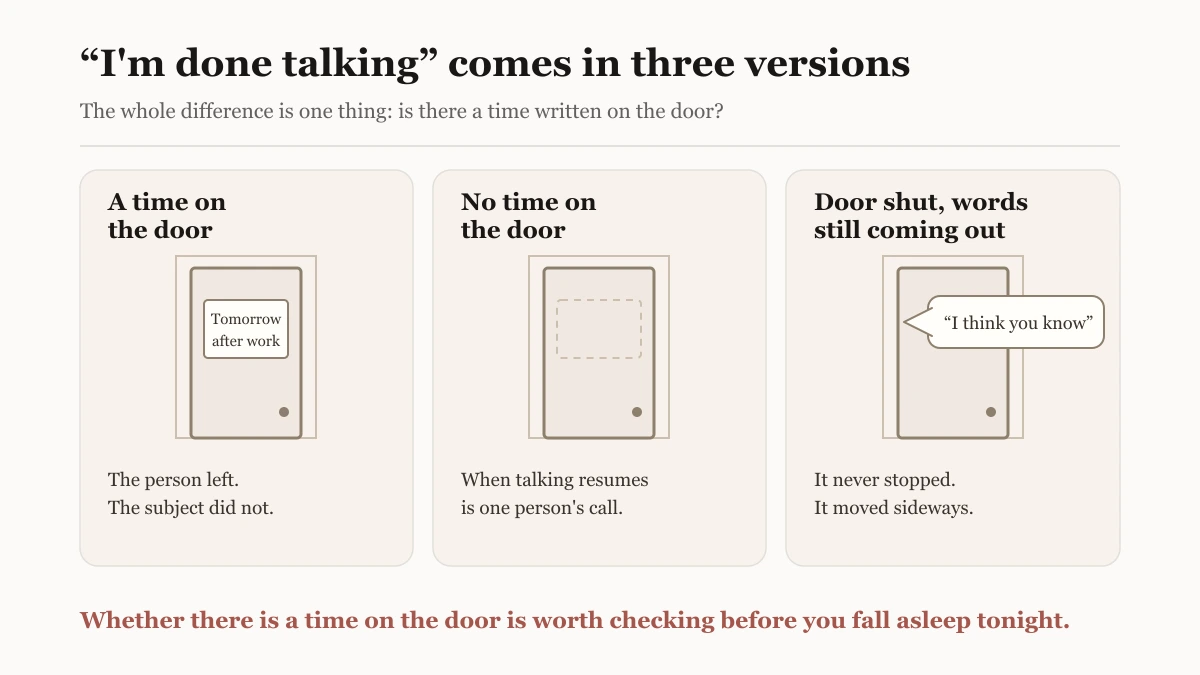
If you decide tonight that you are done talking, that decision can grow into three quite different things. Here is how I separate them.
The first is a pause with a return ticket. The person leaves, but the time stays: “I can’t do this well right now. Tomorrow after work, we talk about this.” Both people know the thing has not vanished. It has been moved to an hour when there is something left in the tank.
The second is a stop with no return ticket. You walk out and then you are gone. Messages unanswered, eye contact gone, and when talking becomes possible again is something only one of you gets to decide. From the outside it looks almost identical to the first one. The difference is that the other person has no idea how long the wait is, and someone who does not know how long the wait is has nothing to do but replay that last stretch of it and reread every line.
The third one is the one that gets mistaken for quiet, because it announces that it has stopped fighting. The talking is still happening. It has just moved sideways: “I think you know exactly why.” “What did I tell you?” “Fine, it’s all my fault.” “I can’t help it, so what do you want me to do.”
That same set of data also looked at the third kind. This time there was no split between small fights and serious ones. Whatever the couple was arguing about, the people who talked sideways felt worse about the marriage than other people did, and it stayed that way as the years went by.
Saying the harsh thing straight out still depends on how big the subject is. The sideways version does not depend on anything. It runs the same direction every time.
So here is my answer to the second half of the title. One kind of going quiet is good for you. The other two are not. The second one only pushes the conversation into the future, and the future it pushes it into, I would say, is usually harder to speak in than tonight was. The third one has not stopped at all, it has only changed the direction the words come out of.
To tell tonight apart, ask yourself one thing: when you stop, did you say when you would start again? If you did, that is a pause. If you did not, then however quiet it is where you are right now, this fight has not ended.
One more thing deserves its own sentence. If the quiet is not there so that two people can catch their breath, but is there until you go first, then the thing to look at is not how either of you phrases things. It is who currently decides when speaking is allowed again. If that is the distinction you actually came here for, I have written about it separately in Why Does Loving Someone Feel This Exhausting?
One of You Wants to Talk More, One Wants to Talk Less, and Neither Is the Problem
By now you have probably recognised which side you are on: the one who wants to finish, or the one who cannot keep going.
This forward-and-back pairing turns up across a great deal of relationship data, and it keeps showing up alongside how well a relationship is going. One detail is worth saying first: whether the one moving forward is you and the one moving back is them, or the other way round, it comes out about the same. Which means this is not one of you being harder to talk to. It is the two of you walking into the same shape together.
The way I understand it is this. The person moving forward is afraid of being left. The person moving back is afraid of saying the wrong thing. On the same night, both of those fears are real.
So how do you get out of it? My answer is the time written on the door.
An agreed time works because it happens to catch both fears at once. The one moving forward hears “this has not been dropped, tomorrow still counts.” The one moving back hears “I can stop for now, and this silence will not be counted as my answer.” Why the two of you are stuck tonight is simple: in that moment, the move that calms one person down is exactly the move that panics the other. An agreed time is one of the few things that works for both of you at once.
So if there is only one thing you do tonight, say the time out loud, and then actually turn up for it.
“Solve It Now” Is Actually Two Different Jobs
I think the question you are asking at this hour is the wrong question.
“Solve it now” contains two separate jobs. One is solving the problem. The other is getting the person back. What your mouths are arguing about is the problem, but my judgement is that at this hour what neither of you can carry any longer is the person. You do not urgently need tonight to produce a rule about who takes the bins out. You need to know they are still there.
So my suggestion is to pull the two apart and do them in order: person first, problem second. This is the order I would follow, and every step in it is something you can do alone tonight. None of it needs the other person to cooperate first, and none of it needs you to be in the same place.
Step one, let them know which of the two you are after. Until you say it, there is a good chance they have been hearing a demand for a verdict, and have spent the whole evening assembling a defence. Once they realise you want reassurance rather than a verdict, half of what they were defending stops needing defending. My judgement is that this is the step that changes the direction of the night most.
Step two, if you stop, attach a time to it. “I don’t want to talk about this” and “I can’t do this well right now, tomorrow after dinner we talk about it” do not differ in tone. They differ in whether “tomorrow after dinner” is in there, giving the other person something to wait for. And whether you actually turn up when that time comes matters more, I would say, than how gracefully you announced it.
Step three, if they are the one who stopped first, do not write the answer onto that closed door tonight. What they walked out of is this conversation, not necessarily you. Whatever meaning you are reading into it at the hour when you have the least strength, I would say most of it is yours rather than theirs.
Step four is only for the fights that live in a message thread: separate “left on read” from “thinking”. They cannot see you thinking. They can only see that you have not replied. Send one line, “I’ve seen it, I need to think, I’ll reply before ten,” and I think it turns their night from “am I being dropped” into “ten o’clock.”
Step five, decide in advance what your first sentence tomorrow will be. I think that sentence sets the direction of everything that follows it. If it requires a confession before anything else can happen, last night’s stop was wasted. If it starts from your side, say, which part last night got you most stuck, it is something they can pick up.
Two Questions You Might Be Asking Right Now
Isn’t stopping just avoidance?
What matters is not whether you stopped. It is whether you came back. Stop tonight, walk back into it tomorrow and finish, and that was a pause. Stop tonight and let nothing follow, and that was avoidance.
So if “some other time” is a thing you have said many times and some other time keeps not arriving, that is no longer a pause.
That line is for you to use on yourself, not to hold over anyone else. Next time you hear yourself say “some other time,” stop for half a second and ask: can I name the day?
Some things we can never seem to finish. Doesn’t that mean we don’t fit?
Not necessarily. Some subjects are not really subjects. They are the places where two people are simply built differently: one recovers by being alone and one recovers by having someone nearby; one believes money should be saved first and one believes life should be liveable first.
Getting a subject like that to a conclusion is unlikely. Getting it to a place where either of you can raise it without it turning straight into a fight is not. You do not have to solve it. You only have to make it a topic you are allowed to bring up again. Those two things are very different in difficulty, and being allowed to raise it is the one you actually need.
I am also not going to promise you that every silence is only tiredness. Some silences, in my judgement, are not pauses at all. They are one person already on their way out. If that is the question underneath your question, the thing to look at is not tonight. It is whether, over these past few months, they are still willing to work something out with you at all.
You Don’t Have to Solve It Tonight, But You Do Have to Name When
Do you have to solve it tonight? My answer is no. But there is one thing tonight does have to produce: the time you will pick it up again, and a time you honestly believe will arrive.
Is going quiet sometimes the better call? One version of it is. That version has a time written on the door, and it spares two people from making decisions at the hour when they have the least left. The other two are not: one pushes the words into a harder tomorrow, and one has not stopped at all.
You are probably never going to become a couple who does not fight, and I do not think that has to be the goal. What actually accumulates is something else: one “let’s stop here, we’ll talk tomorrow” after another, and somebody genuinely opening their mouth the next day. Once you have enough of those nights behind you, you both come to know something steadier than any argument you could win. You can come back from a fight.
The “forget it, I’m not doing this” you were about to say tonight can still become “I can’t do this well right now, tomorrow we talk.” That extra half sentence is not you stalling. It is you keeping a chair out for the two of you tomorrow.
You are awake at this hour looking for an answer, and that says one thing: you care. Tonight’s fight does not use that up. It will still be there in the morning. Go to sleep. The rest of it can wait for the time you agreed on.