Your Partner Keeps Getting More Impatient: Is the Love Fading, or Are You Two Still Adjusting?

There was a time when you could ask the same thing twice, even three times, and they would smile and answer again. So when you asked, phone in hand, what time you were heading out on Saturday and your partner said, without looking up, “Didn’t I already tell you?”, their tone was much sharper than it used to be. It has been happening more and more these past few months. There was no fight, and you cannot point to the day it started. You put your phone down, and one question keeps going around in your head:
“Is the love fading, or have we just reached the stage where we are still adjusting to each other?”
Taken one at a time, a sharp reply hardly seems like something to make a fuss about. What stays with you is not any single sentence but how many times it has come up these past few months. From what I have seen, many couples reach this point after being together for a while, and stopping to think about it now means you are taking this relationship seriously.
Is the love fading, or are you two still adjusting?
Here is my view. Growing impatience does not, on its own, mean the love is fading, and I would start by treating it as part of adjusting to each other. But one kind of impatience deserves a separate look: when you are only talking to them, with nothing for them to deal with, and they are still impatient.
Adjusting is the stretch of time when two people’s habits, pace and ways of doing things start to run into each other. Maybe one of you likes to leave early while the other gets ready at the last minute; maybe one of you wants to say everything at once while the other needs a quiet moment first. Early on, when these differences come up, one person often just goes along with the other without saying anything. The longer you are together, the more they surface one by one, which is why impatience during this stretch is aimed at how a particular thing gets done. When love fades, on the other hand, your partner slowly loses interest in you as a person and in what happens between you. That kind of impatience does not need anything to set it off. You simply start speaking, and they already do not really want to listen.
There is also a chance that growing impatience has nothing to do with your relationship at all. They might be under a lot of pressure at work, sleeping badly, feeling unwell, dealing with something at home, or carrying a worry they have not put into words yet. My sense is that patience is often the first thing to go when a person is worn out, and the people who are around them every day see that side the most. That can explain why they have become sharper. It does not mean you have to keep living with that tone.
This time: how to respond when they get impatient
At the moment their voice turned sharp, you held back from snapping in return, and you did not pretend nothing had happened. Stopping to think about what to do is already a way of looking after your relationship. What helps right then is not hiding the hurt and not answering in the same tone. Say only what you heard and how it felt, and then let them choose what happens next:
“That came out a bit sharp, and it made me a little sad. Do you want to take a break for a while, or should we keep talking now?”
This sentence has no “Why are you being so harsh with me?” and no guess about the reason. It holds only their tone and your feeling. I suggest letting them choose because they may genuinely be tired, and offering a way to catch their breath is easier to respond to than being asked to explain themselves on the spot. After you say it, they will probably answer in one of three ways.
They say, “I’m a bit tired.” Let them rest: “Okay, go ahead and rest, and tell me when you feel like talking.” Then go back to whatever you were doing, without keeping an eye out for when they might come find you. If bedtime comes and they still have not brought it up, find another chance the next day and simply ask your question again.
They say this particular thing is what is bothering them. For example: “That’s the third time you’ve asked about the weekend.” Before you rush to explain why you kept asking, you could reply, “So how do you think we should handle this?” and make a note of what they say. If what bothers them is how something gets done, that is the very thing the two of you can work on together over the next month.
They say “Nothing,” or their tone gets worse. Stop asking for now, and there is no need to hurry into an apology either. You can say, “Okay, I’m going to do something else for a bit,” and get on with what you were doing. A harsh tone is something they need to adjust on their side. You have already said how you feel, and the rest is not yours to carry alone in that moment.
These past few months: what were you doing when they got impatient?
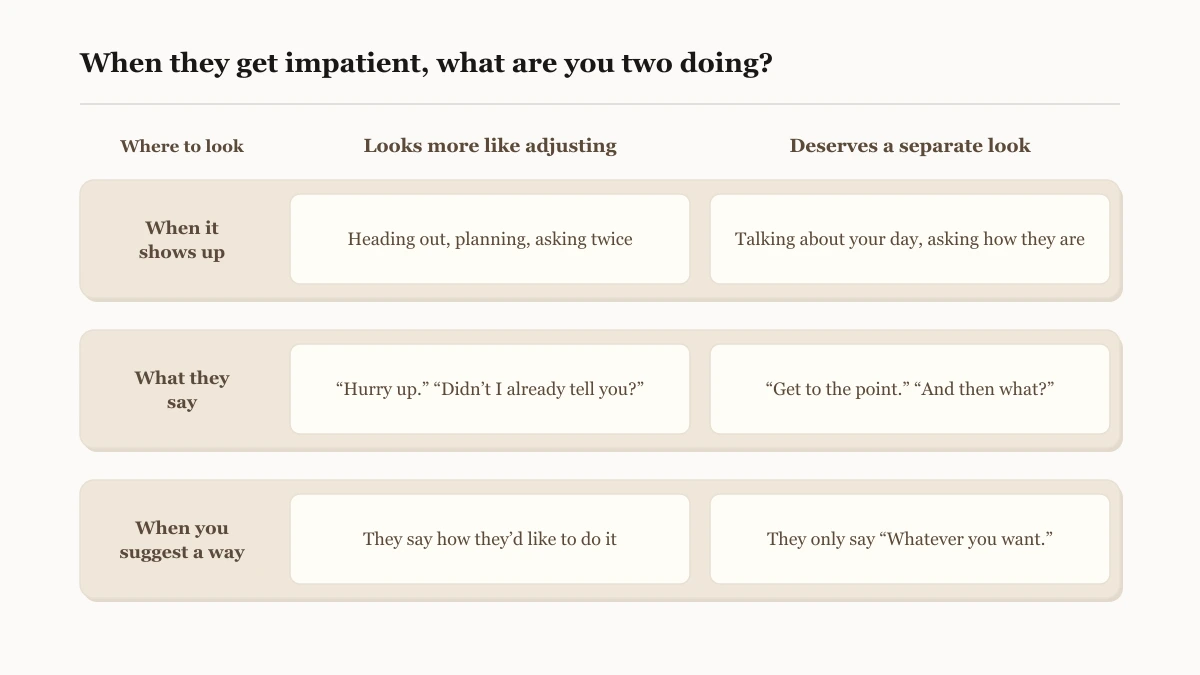
One moment on its own rarely tells you whether you are adjusting or the love is fading, because their voice can sound equally sharp either way. The difference shows up when you put the past few months side by side. As you look back, ask yourself just one thing: these past few months, when they got impatient, were the two of you dealing with something, or were you only talking to them?
Dealing with something might mean the time you agreed to leave is almost here and you still cannot find your things, or you are deciding together where to go for the weekend, or you are asking about something for the second time. It might also mean reminding them of something they promised to do. In moments like these, what they say tends to be about the task in front of you: “Hurry up,” or “Didn’t I already tell you?” Only talking is different. You might be telling them about something that happened while you were out today, asking how their day went, or sharing a funny video you just watched. And the reply you get is “Get to the point,” or “And then what?”
As I see it, if most of the impatience over these months showed up while you were dealing with things, it looks more like adjusting: the two of you have not yet found ways of doing things that work for both. If they are often impatient even when you are only talking and they do not have to do anything, I would treat that separately. My guess is that it looks more like they are slowly losing interest in what happens between you. That could mean the love is fading, or it could mean something on their mind is taking up all their attention.
One more moment can be looked at alongside these: when you suggest a way of doing something and ask, “Does this work for you?” From what I have seen, while you are still adjusting, they will usually tell you how they would like to do it, even if their tone is not great, while in the other case the answer is often just “Whatever you want.” All of this only shows which way things lean, but once you know which way they lean, you know whether your next step is to adjust together, or to first have a proper talk about what is happening between you.
The next month: pick one thing and adjust together
Adjusting to each other is, by its nature, something two people do together. So I suggest the most direct way to find out where you stand: actually pick one thing and work on it together, once.
Choose the thing they are most often impatient about
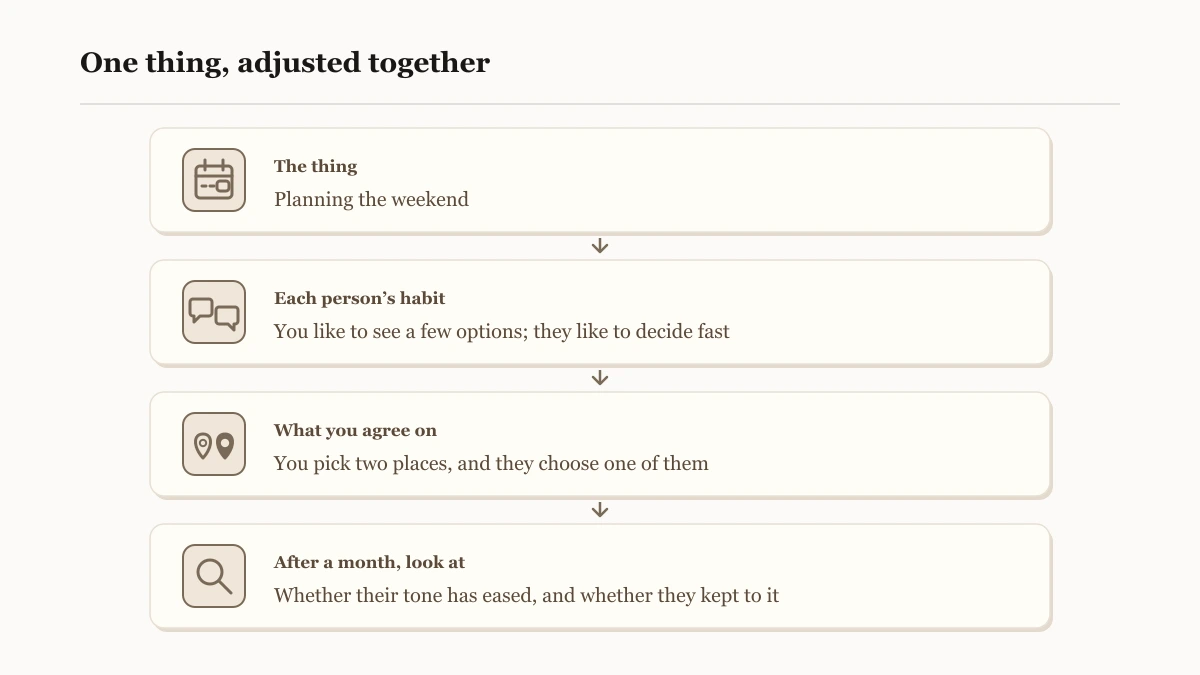
Think back over these months and find the one thing that most often makes them impatient, for example planning your weekends. Choose just one, the one that comes up most often and is also the smallest, because a small thing is easier to talk about and easier to stick to afterward.
Then find a time when neither of you is tired or in a hurry to decide anything, such as a walk after dinner, and say:
“Every time we plan the weekend, we seem to end up talking a bit impatiently. I’d like to hear how you usually like to plan it, and tell you how I do.”
Then each of you takes a turn. Maybe they want to decide quickly and do not like comparing option after option. Maybe you like to look at a few choices first, because you worry that picking the wrong one will mean neither of you enjoys the day. Both habits make sense, and neither of you is more right. What you are looking for is a way that both of you can actually manage, such as: you pick two places, and they choose one of them. Once you agree, try it for a month.
After a month, look at two things
The first is whether their tone has eased when you plan the weekend. The second is whether they have kept to the way you agreed on. I believe that if both have shifted even a little, you are adjusting, and it is just that no one had said so out loud before. If you have kept to it and they are still just as sharp, you can talk with them again, and this time say it plainly: “It seems like you haven’t been doing what we agreed on yet. I’d like to know what’s making it hard.”
If the past few months look more like the love is fading
If most of their impatience showed up while you were only talking to them, working on one task together may not help, because what bothers them is not how things get done. What needs talking about then is how they have been lately, and what is going on between the two of you. Choose an evening when you both have time, and say:
“Lately, when I talk to you, I often feel like you’re really impatient with me. I’d like to know how you’ve been doing, and I’d also like to know how you feel about us.”
This asks about two things, them and the two of you, so they can start with whichever is easier to talk about. You will probably hear one of three kinds of answer.
They talk about something in their own life, for example that work has been very busy, or that they have been feeling low for a while. Start with something like, “So you’ve been this worn out lately.” Then listen to as much as they want to share, without pressing for details or trying to settle anything that night. A few days later, when they are in a better mood, tell them one thing you would like: “Next time you’re tired, just tell me, ‘I don’t have the energy to talk right now,’ and I’ll know it isn’t about me.”
They talk about something between the two of you, for example that they feel you have less and less to say to each other, or that something has been weighing on them. Hear them out without rushing to argue, and when they finish, say, “Thank you for telling me.” What to do about it does not have to be decided that same night.
They say “It’s nothing” and do not want to talk. My suggestion is to accept that answer for now, then spend the next two weeks noticing whether the way they talk to you changes. If nothing changes, say it once more, and this time name what you need: “When we talk, I’d like you to really listen to me until I finish.”
For anyone who cares about the way they speak to you
Here is how I see it. The longer two people are together, the easier it becomes to lose patience, because you know each other so well that explaining starts to feel unnecessary, and so well that a whole day’s tiredness gets carried straight to the other person. When you first met, you would both think for a moment before speaking. Later, that second often gets skipped, and the sharp tone comes straight out.
You care about how they talk to you, and you want them to really listen until you finish. That is a very reasonable thing to expect in a relationship. Wanting to know whether you are adjusting or the love is fading comes from how much this relationship means to you, and two people who are together deserve to be treated well by each other.
In the meantime, when they do listen to you all the way through, you could tell them, “Thanks for hearing me out just now,” so they know you noticed. If there are things you cannot quite say yet, you can write them in your phone’s notes and bring them up once you have found the words. Whether this is adjusting or fading does not need an answer today. Tonight, take a hot shower and get some rest a little earlier than usual, and when you wake up tomorrow, get through the day at your own pace.
Sources
Research and sources this essay draws on.
- Stress spillover in early marriage: The role of self-regulatory depletionJournal of Family Psychology, 26(5), 698–708