Is It Normal for Your Partner to Disappear on Purpose After a Fight? How to Tell Cooling Off From the Silent Treatment

Maybe they grabbed their keys and the door closed behind them, leaving you alone in a quiet room. Maybe the chat just stops at your last message, marked as read, with nothing after it. Either way it happened halfway through the fight, right after they said “Whatever.” You keep picking up your phone and turning it face down again, and every time you check, it says they were online a few minutes ago. One question keeps coming back: are they cooling off, or is this the silent treatment?
You keep checking because this relationship matters to you
You have probably heard “give them some space,” and you did. You did not chase them out the door or call over and over. You just cannot stop looking at your phone, because you want to know whether they are okay, where they went, and whether they are coming back tonight. That is a reasonable thing to care about. In my view, the hardest part after a fight is often not the words you traded but the waiting afterward, when you have no idea how long it will last. You are waiting for a reply with no idea when it will come, so your mind keeps hanging there, and that is a very human reaction.
The things you have not said out loud
“They left without saying anything. Are they not coming back?”
Leaving a fight and leaving a relationship are very different things. My read is that walking out mid-argument, or going quiet on a chat, usually means stepping away from that one fight; it does not yet tell you they are leaving you. Your mind goes to the worst place because they did not leave a single sentence behind to reassure you.
“They never used to do this. Do they not love me anymore?”
One disappearance tells you how they handled this particular fight. It is not enough to tell you whether they love you, and you do not have to answer that bigger question tonight from one unanswered message.
“I keep checking my phone, and even I’m tired of it.”
You cannot stop checking because this wait has no agreed ending. As I understand it, when something has no set end, it is very hard for the mind to let go of it, and anyone in your place would keep looking too.
“It’s like this every time we fight. How much longer do I wait?”
You are asking because you have noticed this is not the first time. How long you wait does not have to be entirely up to them. You can wait and still get on with your evening: eat, shower, watch the show you had planned to watch. Waiting and living your life can happen at the same time.
To answer any of these, you first need to know one thing: is their silence this time cooling off, or the silent treatment?
What cooling off is, and what the silent treatment is
From the outside, the two terms in the title look the same: no talking, no replies. What they are doing is not the same.
Cooling off: stepping out of one fight in order to come back and finish it
Wanting to leave the room and be alone for a while after a fight is normal in itself. Some people get sharper the longer they argue, so walking away keeps them from saying something even more hurtful. Other people need a night to sort out the mess in their head before they can say what actually matters to them. Here is how I would put it: cooling off means taking yourself out of the fight until the anger settles and your thoughts are clear, so you can come back and finish the conversation. That is why cooling off has an end, maybe one night, maybe a day or two. It stays inside this one fight, and outside it they still answer you and still care how you are.
The silent treatment: long-term coldness that makes you feel you don’t matter
The silent treatment means using ongoing non-response, coldness, or brush-offs to wear down another person’s sense of their own worth. There is no shouting involved. It works by leaving you without an answer, over and over, which makes it a quiet way of controlling someone. The person doing it deliberately withholds any response so that you lose your sense of safety. I see that as an attack, just a silent one.
That is what the words “on purpose” in the title point to. The silence is no longer for calming down; it has become something used against you. You ask what is wrong, they say “nothing,” and then they ignore you for days. The fight is long over, the coldness is still there, and each round lasts longer than the one before.
Why the silent treatment hurts so much
Being frozen out by someone you care about hurts. When people are left out and ignored, the brain regions that respond overlap partly with the ones that respond to physical pain, so what you feel is real pain.
It also turns your doubt inward. Nobody tells you what happened, so you go looking for the reason yourself, and more often than not you land on “did I do something wrong?” After enough rounds of this, you speak up less and less, and your mood starts rising and falling with their coldness.
And it is hard for anyone else to see. There are no marks, and there was no loud fight. If you tell someone, you may hear “they’re just being quiet.” Because the damage is invisible, it tends to be underestimated, which leaves the person living with it even more alone.
Both terms describe what this particular silence is doing. They are not a verdict on who your partner is. The same person might genuinely need to cool off this time, but when the coldness never stops and keeps getting longer, you are looking at more than one fight.
Is disappearing on purpose normal? Wanting to cool off is; using coldness to make you feel you don’t matter is not
Wanting some time alone to cool off after a fight is normal. Using ongoing non-response, coldness, or brush-offs to make you feel you don’t matter is not cooling off; it is the silent treatment.
To tell which one you are dealing with, check one thing: is their silence a pause in this one fight, or has it become the way they treat you?
From what I have seen, cooling off usually looks like this: it has an end, they come back and talk the fight through with you, and outside the fight they still answer you and still care. The silent treatment leaves a different pattern. The coldness comes back again and again and drags on with no end in sight. When they return, they act as if nothing happened or keep brushing you off, and even on ordinary days, all you get when you talk to them is “mm” or “whatever.”
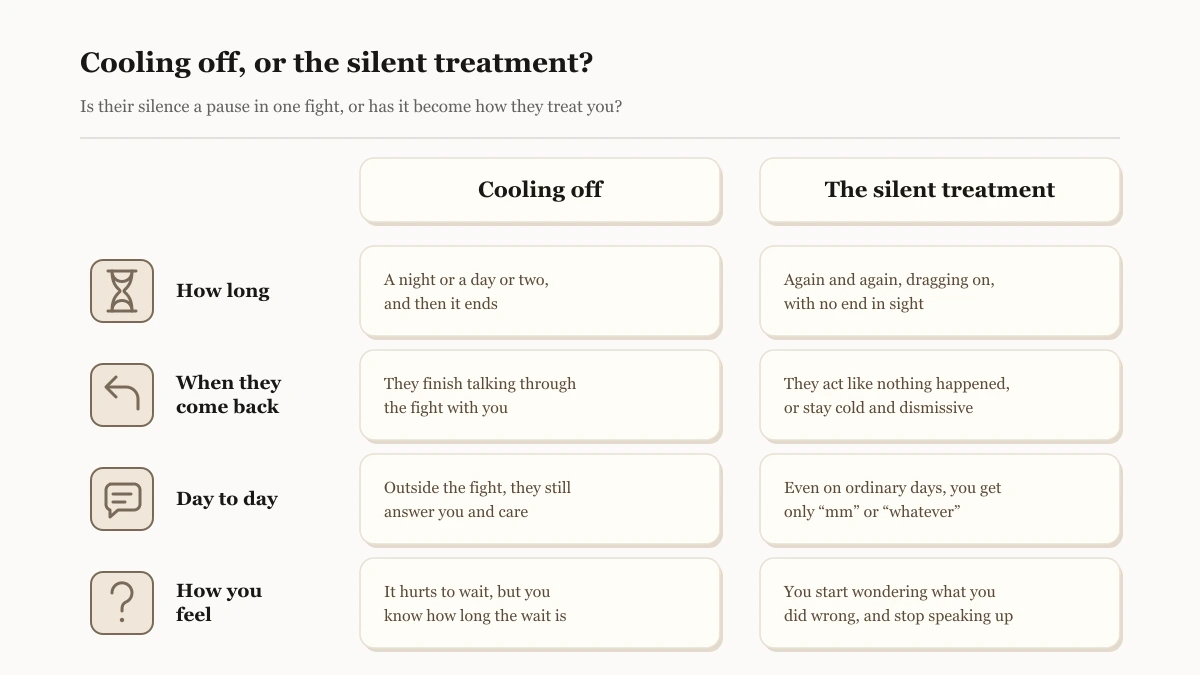
Any one of these on its own does not say much; they may just have been worn out lately. What I would look at is whether they show up together and keep repeating. If they do, what you are facing is no longer one fight. It is a way of relating to you that slowly takes away your sense of safety.
While they are gone, ask once how long they need
You do not need to figure out first whether they love you, and you do not need to wait for them to speak first. There is one thing you can do right now. Send them this, once: “How long do you need? Give me a time, and I won’t bother you until then.”
It is not an apology, and it is not begging them to come back. It asks about one thing only: time. In my judgment, someone who is truly cooling off can name a time, maybe “tomorrow morning,” “after I shower,” or “before bed tonight.” For them the message is a way back that does not require their anger to be gone first; they only have to give you a time. For you, it puts an end on the wait. Once you know how long you are waiting, you no longer need to check your phone every few minutes.
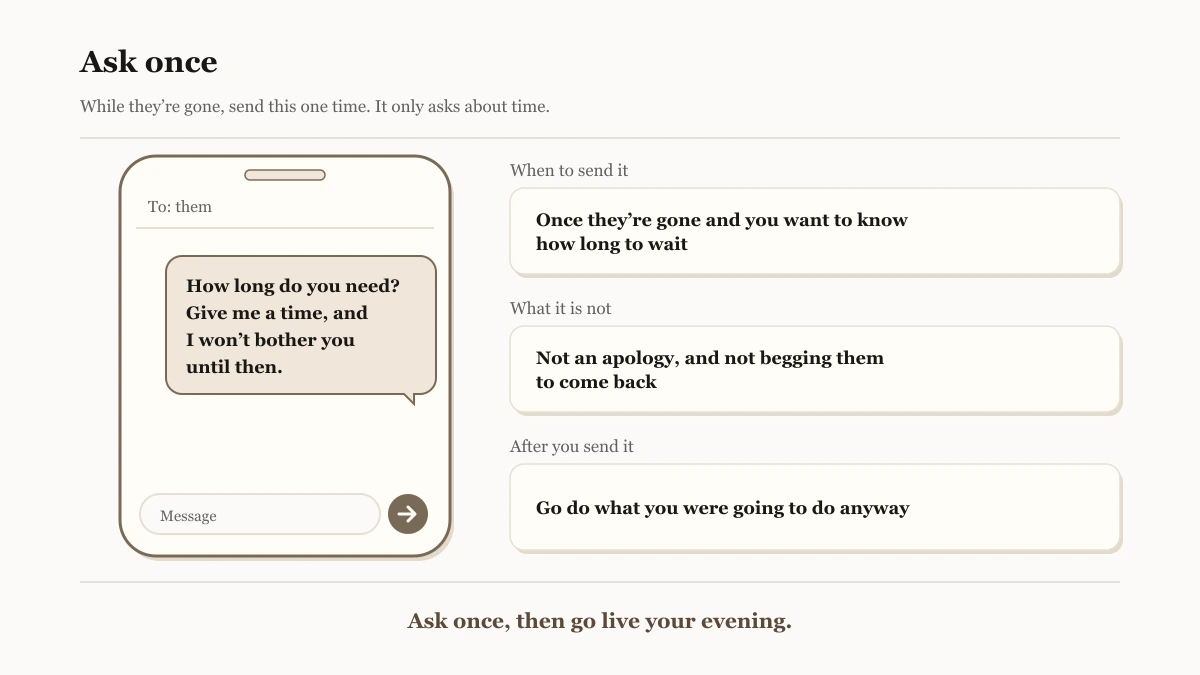
One message is enough. Afterward, go eat, take a shower, watch what you meant to watch, and let your evening run the way it would have. If you do not live together, or you are in different time zones and text is all you have, you send it the same way. The first time, you may type it and delete it several times, or send it and still glance at the screen once or twice. That is completely normal. Whatever they reply, you have asked the thing you actually wanted to know, and the rest of your evening can be yours again.
The four things you will probably ask next
They have been gone for days. Should I keep texting?
No. Once that one message has gone out, there is no need for a second. Here is my thinking: if they are cooling off, a second message will not help them settle any faster, and if it is the silent treatment, the more you send, the more you put yourself in the position of begging for a reply. When the urge to text hits, type what you want to say into your own notes app and leave it there, unsent. If several days go by and they still cannot give you any time at all, I would take that as an answer too, and keep it in mind.
Did I say something too harsh, and that is why they left?
If you said something too harsh, you can apologize for it, but their choice to disappear in response is a separate matter. Apologizing for what you said, and telling them that their sudden disappearance worried you: I would save both of those for when they are back and the two of you are talking again; while they are gone, the one message asking how long they need is enough. Once they are back, you could say: “What I said during the fight was too harsh, and I’m sorry. But you just vanished, and I was really worried.” The first half apologizes for your words. The second half lets them know their disappearing affected you. When you say both, they understand what you care about, instead of hearing only that you admit you were wrong.
They say they just need to cool off. Am I being too clingy?
Wanting to know where they are and when they will be back comes from caring about them, and it is a perfectly normal thing to want. Here is the concrete picture I would use for clingy: after they say they need to cool off, you keep texting and calling and never give them any time alone, so they end up feeling chased. If you ask once how long they need and then let them go, you have already given them that time alone. To me, that respects the space they asked for and still looks after your need to know when they will be back.
While they are gone, can I ignore them too?
You can stop texting; that is you taking care of yourself. Paying them back with the same coldness is a step I would hold off on. When both of you use silence to show you are upset, nobody brings up what you were fighting about, and the sense of safety between you shrinks on both sides. When they reach out again, answer the way you normally would, and then say: “Can we finish talking about what we were fighting about?”
Once you can tell them apart, you know what you are waiting for
You keep checking your phone because you do not know whether this silence is cooling off or the silent treatment. As long as that question has no answer, all you can do is keep waiting, without even being able to say what for. Once you can tell, things change. If they are cooling off, you can let them go without worry and leave that time to them to pull themselves together. If it has already become the silent treatment, I would say the problem is not something you did wrong. You have already asked how long they need, the evening ahead belongs to you, and you can also start thinking about whether this is a way of being treated you want to keep living with.
Either outcome is better than where you are now, because right now all you can do is sit with a chat that will not move. What you want was never a partner who never gets angry. It is not having to hang there alone when they do, guessing how long you will be waiting.
Sources
Research and sources this essay draws on.
- Does Rejection Hurt? An fMRI Study of Social ExclusionScience, 302(5643), 290–292
- Ghosting and orbiting: An analysis of victims’ experiencesJournal of Social and Personal Relationships, 38(7), 1987–2007