Your Friend Having More Fun With Someone Else Doesn't Mean You've Been Replaced

The photo shows up in your feed from a night you missed. Your friend is right in the middle of it, head thrown back, eyes screwed shut, laughing harder than you have ever seen them laugh. Somebody’s arm is slung over their shoulder. You pinch to zoom. You look, you put the phone face down, and a minute later you are looking again.
It does not have to be a photo. Maybe you were actually there, wedged in at the end of the table while your friend and someone new talked over each other for two hours, and every joke reached you half a beat late. Or maybe it is subtler than that: the way your friend talks now, the references, the running bits, the little phrases, all of it picked up from that other person. You can follow every word. You just were not there when any of it was made.
And then the thought lands, fast and whole: they are happier with that person than they are with me.
If that thought is what brought you here, here is the one thing I want to do with you. Two ideas have fused together in your chest: “my friend has more fun with someone else” and “I have been replaced.” Fused, they hurt like one wound. Pried apart, you will usually find that only the first one is actually true.
It stings because you want a place in their life
Start with the obvious thing, because it is worth saying out loud. That photo stings because you want a place in your friend’s life, and not just any place, a good one. There is nothing wrong with wanting that. When someone matters to us, we want to know where we stand with them. That is what caring looks like from the inside.
Notice, too, what you were actually looking at when you zoomed in. Not the restaurant, not the group. Them. The thing you care about is how much this person weighs in your life, not the like count on somebody else’s post. I am putting that up front because everything that follows rests on it.
One boundary before we go on. I am not going to tell you whether your friend has changed. That is a different question. What I can help with is where to point your eyes after you have seen a picture like that, because if you point them at the wrong thing, you can spend a long time grieving something that never happened.
The things you have not said out loud
Let me try saying a few of them for you. Not all of these will be yours. I would bet some of them are.
“I have never seen them laugh like that.” The sharpest one, because it is simply true. You have known this person for years, you thought you had the full catalogue of their faces, and here is one you have never seen. My read: that face belongs to that room. It needed those particular people, that particular night, the joke that had just landed. You were not in the room, so you have not seen it. It says nothing about where you stand with them.
“Have they ever been that happy with me?” Now you are scrolling back through your own history together, hunting for a picture where they laughed that hard, and your stomach drops when you cannot find one. My read: most of the time you have spent together, nobody was holding up a phone. And the laugh you are hunting for was never the main event between you anyway. What you two have is quieter than that, and quiet does not photograph.
“I can’t ask. It would sound jealous.” So you said nothing, hit like, and immediately felt like a fraud for hitting like. My read: not asking is a kindness. You do not want them to feel watched. The trouble is that a question you swallow does not dissolve. It stays in you and becomes a long night of turning it over by yourself.
“That person is just more fun than me. I know it.” Maybe. Maybe they are a natural talker, the one everybody drifts toward at a party. My read: fun is a property of rooms, not of friendships. In a crowd, the fun person glows. But what holds you and your friend together was never fun. It is the fact that you can tell them something dull, lose the thread halfway, sit through an entire evening with nothing much to say, and they are still there. That is the load-bearing part.
“So what does that make me?” The quietest one, and the one with the most weight. My read: you are the one they do not have to try with. Around that other person they are switched on. Around you they can switch off. They can tell you something ugly without dressing it up first. They can change the subject mid-sentence and you will not chase it. Nobody is fighting you for that spot, because you do not win it by being the brightest thing in the room.
What all five have in common: each one takes your friend’s happiness with someone else and turns it into a grade for you. And it was never a report card.
Fun is not a ranking
Here is something I am sure of. A person is a different version of themselves depending on who is sitting next to them. Your friend has a work self, a family self, a self that only shows up around this new person, and a self that only shows up around you. None of those is ranked above the others. They are sides of one person, and the company decides which side comes out.
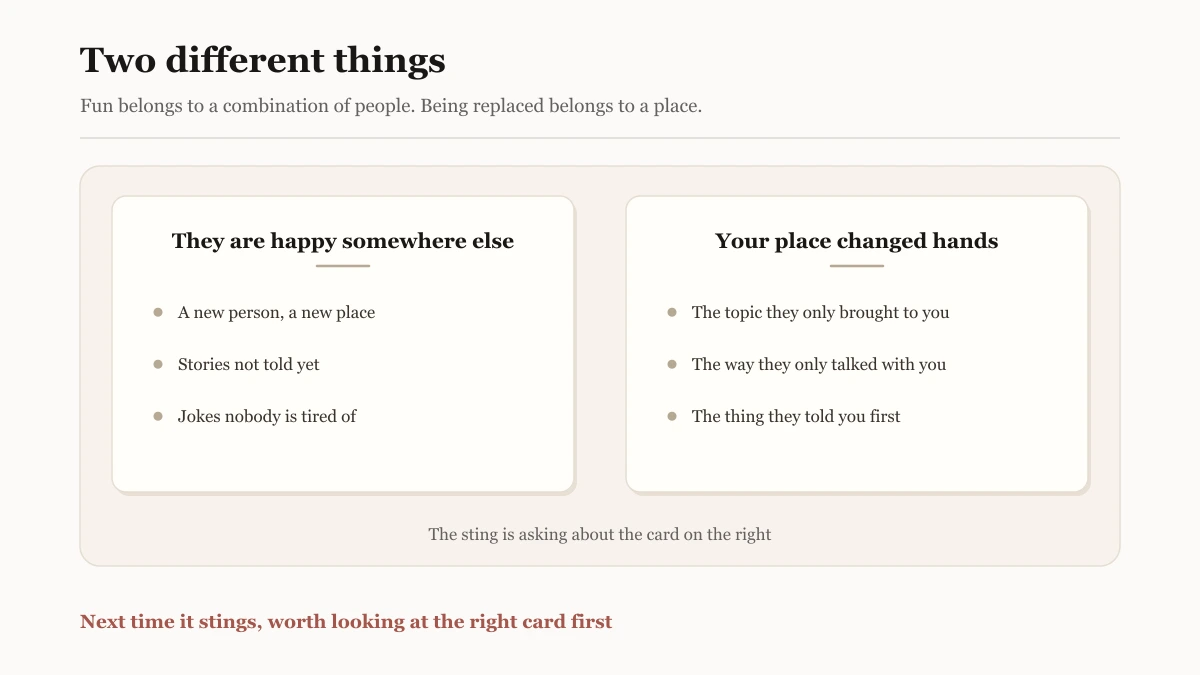
The fun in that photo grew out of that specific combination: a new face, a new place, stories that have not been told yet, jokes nobody has heard enough times to be tired of. Put those ingredients together and anyone laughs louder. My read: none of that was taken from your side of the ledger. It grew where it grew. One more laugh over there does not mean one less over here. Happiness is not a tank that runs low.
And there is something that only happens between the two of you, and most of it is quiet. Long silences that do not need filling. Subjects dropped halfway with no explanation. The worst version of yourself brought out and never put away. That kind of happiness does not photograph well. Nobody frames it, nobody posts it, it is not loud. So of course you will never spot your own kind of happiness in someone else’s photo. It does not look like the things in photos. That is not the same as not existing.
Which answers the first half of the title. Your friend having more fun with someone else means that is who they are in that combination. It does not mean they are settling for you. Settling is staying when somewhere better is on offer, and when they are with you, the thing they are after was never the laugh-until-you-cannot-breathe night. It is the kind of company where they are allowed to go quiet.
What “replaced” actually means
Being replaced is a different thing entirely, so let me be precise about it.
Being replaced does not mean your friend is happy somewhere else. It means the place you held in their life is now held by someone else. Every friendship has one thing that happens only between those two people. A topic they bring to you and no one else. A register of talking they use with you and no one else. The thing that happens to them at eleven at night and you are the first person they want to tell. That thing is the place. It is not a slot in their calendar, and it is not a rank on some list of friends.
So here is the only question worth asking: the thing that happens only between the two of you, has it still been happening?
If it has, you have not been replaced. You have seen a side of your friend you had not seen before. However much fun they have with that person, it cannot touch that thing, because that thing does not live in that room and that person has no way to reach it. What you are actually watching for is whether they have stopped coming to you. Not whether they have gone to someone else. The two feel identical from the inside, and only the first one has anything to do with your place.
Next time, ask them if it was fun
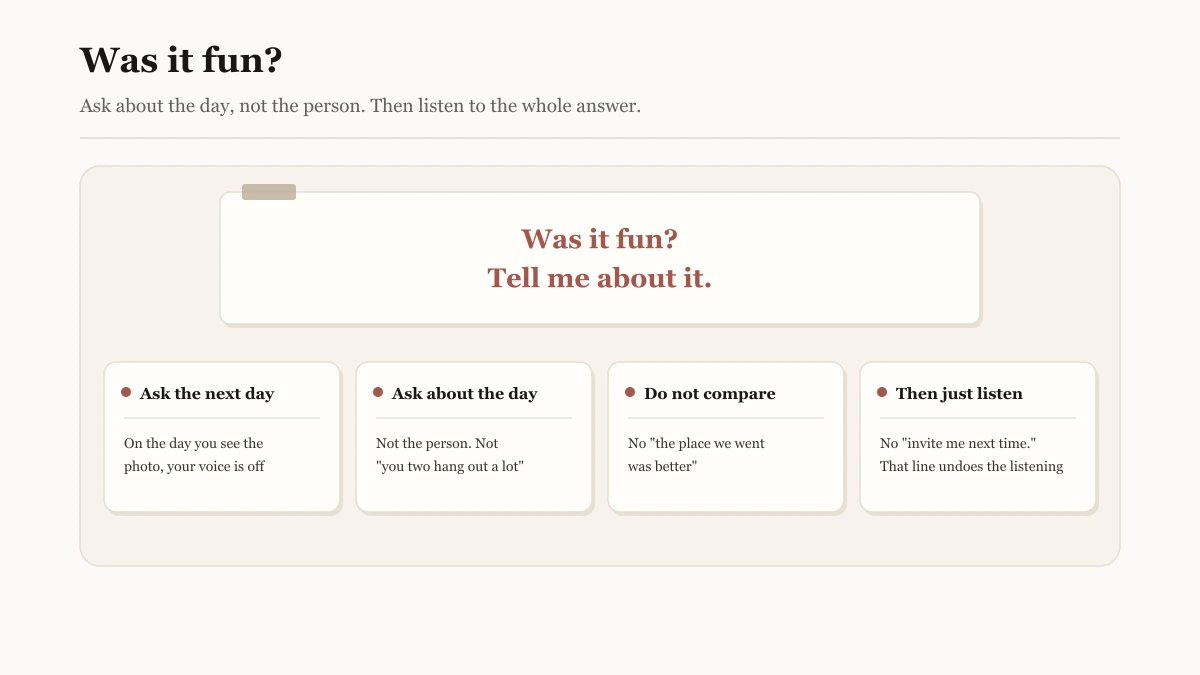
Here is what I would try. The next time you talk to them, ask one thing: “Was it fun? Tell me about it.” And then let them tell you the whole thing.
It cuts against every instinct you have right now. You want to zoom in on the photo. This asks you to hear the story instead. You want to go through that person’s profile. This asks you to hear about them from your friend. You want to go a little cold so they notice something is off. This asks you to walk toward them. You want to drop a “you two are close these days.” This asks you to swallow it. You want to be a bit more interesting than usual. This asks you to be the listener for once. It does exactly one job: it takes the fun they had with someone else and puts you inside it. It is not a check. It is not a test. It is one friend wanting to hear another friend tell a good story.
A few ground rules, the way I would do it. Do not ask on the day you saw the photo. Wait until tomorrow. Today your voice will give you away, and they will hear it. Ask about the day, not the person. “Was it fun?” and “you two have been hanging out a lot” are not the same question and do not get the same answer. While they tell it, do not compare. Not “the place we went was better,” not “I have been there.” When they finish, do not tack on “invite me next time.” The second that line is out, everything you just listened to becomes a setup for it. If they are enjoying telling you, let them run. Whatever stings while you listen does not need handling right then. It will pass or it will not, and either way you can still hear them out.
If you genuinely do not want to hear about that person yet, do not ask yet. Ask on a day you do want to hear it. There is no deadline on this. If you only ever talk over text, a time zone apart, one message does the job: “Was it fun? Tell me about it.” When they reply, take your time. Read it, then send back one thing you actually thought while reading. Not a sticker.
The four questions you will actually ask next
“What if that thing really hasn’t happened in a long time?”
That is still not being replaced. Replaced means somebody sat down in your seat. When most friendships fade, nobody sits down anywhere. The two people just stop bringing the thing out, life fills up, and the thing stays wherever it stopped. My read: anything that has stopped can be restarted by either person, and either person includes you, today. You do not need to check first whether they still want it. You do the thing that only the two of you do, one more time, and see whether they pick it up.
“Can I tell them I’m a bit jealous?”
Yes, and I would encourage it. Just do not lead with that word. The moment “jealous” is on the table, what your friend has to deal with is your feelings. They will hurry to tell you the night was nothing, you will both be embarrassed, and the conversation will die right there. Turn it into something you want instead: “Saw the pictures from that night. I want to go somewhere like that with you too. Pick a day?” That sentence contains the thing you want and a question they can answer on the spot. They say “sure” or “next month,” and the place you were after is yours again, with nobody having to explain anything.
If you are a time zone apart and see each other once a year, swap “pick a day” for something that does not need a shared city: “Next time we call, tell me about that place. I want to find one like it here.” You are still asking for a place. The place just does not have to be in the same town.
And if you really do want them to know the photo got to you a little, you can say that too. Say it after, once the plan is set: “Honestly, those pictures stung a bit. I am fine now that we have a date.” Ask for the thing first, then mention the feeling. The other way round, they end up busy managing the feeling and the thing you asked for gets lost.
“But I’m like this every time, not just this once.”
If it is not this photo, if every unanswered message and every time they do not reach out first lands the same way, then the thing that needs practice is not this one judgment call. It is the part of you that gets set off so easily. That is its own subject, and I have written about it separately in Can You Practice Your Way Into Feeling Safe With Friends?, which goes into it properly.
“Am I being petty?”
Here is where I would draw the line: not at what you feel, but at what you do with it. A sting when the photo appears, a second look, a flat evening afterward. Those are feelings, and feelings hurt no one. What hurts people is the next step. Going cold and making them guess why. Running the new person down in front of other people. Dropping a “you two are close these days” just to watch the reaction. Leaving their messages on read on purpose. That list is what you are afraid of. Look at it again. You have not done a single item on it. What you did was open an article.
So what you are doing right now has a name, and the name is caring. The next time the sting comes back, you do not have to chase it off, and you do not have to do anything to your friend. Let it sit. It is usually mostly gone by the time you wake up. A sting hurts nobody, and that is your answer.
A louder laugh is not a changed seat
Your friend having more fun with someone else does not mean you have been replaced. That is who they are in that combination, and the combination grew out of those people and that night, not out of anything subtracted from you. Whether you have been replaced comes down to the one thing that only happens between the two of you, and that thing is still in your hands today. You can bring it out whenever you like.
I cannot tell you how they will respond. What I can tell you is that “replaced” means the seat changed hands, not that the laughing got louder. Once you can hold those two apart, the photo turns back into a photo: someone you care about, having a good night, somewhere you were not.
One more thing you may not have considered. You thought the photo showed you a gap. I would say it showed you that your friend is bigger than you knew. There is a side of them you had not met, and for a friend that is good news, because a person who is still growing new sides has new things in hand to talk about, and your “was it fun?” is the door you leave open for them.
The way I see it, you do not need to be the person who makes them laugh the hardest. What the two of you have was always smaller than that, and always meant to last longer. So the next time they come back from wherever that was, ask them if it was fun. The person asking is not checking whether they still belong. They are letting their friend’s other side into their own life too.