Can a Broken Friendship Be Saved? The Signs It's Worth Repairing, and the Signs It's Time to Let Go

The last message in the thread is from the day before it happened.
You know the one. Maybe it was something they said. Maybe they were not there on the day you needed them most. Maybe they repeated something you had told them in confidence, or promised something and did not do it. Since then there has been no fight and no formal ending. You simply stopped talking. At the last gathering you were both there, two people apart, and neither of you walked over. On the way home you opened the thread, saw that last message, and put the phone away.
Two questions come with it. The first one you can say out loud: “Can this still be saved?” The second one you barely admit to yourself: “And why should I be the one to go first?”
Here is what I want to give you: three signs you can check by yourself, and one message you could actually send. It is not an apology, and it is not forgiveness.
You are stuck because two things are true at once
What they did really hurt you, and this person really matters to you. You have been stuck this long because both of those are true.
I do not think you opened this looking for a reason to forgive them, and I do not think you are looking for permission to give up. You want this to end, one way or the other, so that it stops being the thing you think about every day.
A lot of people stop right here. My reading is that it is not because they do not care. It is because they cannot see what happens after they speak. Bring it up, and the friend might say it was not that serious. Leave it, and is that even making up? The three signs are there to answer that.
The things you say to yourself when nobody is around
You have probably only ever asked these inside your own head. I will take them one at a time.
“Why should I be the one to go first?” Because going first does not mean the fault is yours. They have not come to you, and there are three possible reasons: they are waiting for you too, they have no idea how heavy this was for you, or they genuinely stopped caring. As long as neither of you speaks, you cannot tell those three apart. Once you speak, you at least get the chance to find out which one it is.
“If I speak first, does that mean I’m letting it go?” No. Letting it go means never mentioning it again: you eat together, you chat as usual, and the thing stays swallowed. Speaking means saying it out loud so that they know you were hurt. What you would be doing is the second, which is the opposite of letting it go.
“Won’t they think I’m making too much of it?” They might. But how heavy it is was decided by the hurt you took, not by their reaction. If they think it was nothing, your hurt does not get lighter. What you have to tell them is exactly how heavy it was for you. Until you say it, they have no way of knowing.
“After all these years, is that really it?” What is gone is not the years. What is gone is now: when something happens, you cannot tell them. The things they did for you and the places you went together are not erased by this. What hurts is that today there is one fewer person to tell, not that the past has been wiped out.
Every one of these questions is about what they will do. The three things you most need to know right now do not require asking them.
Three signs you can check by yourself
Whether to repair this is not decided by what they did. You already know that part. It is decided by three other things: how the two of you got along before it happened, what you are missing now, and where the thing ends up when you picture making up. All three are questions you can answer on your own.
When it happened, was your first reaction “how could they” or “of course”
If your first reaction was “how could they,” then what they did does not match the person you know. The person you know does not do this, which is why you are still wondering whether something happened that day that you were never told. In that case my judgement is that the friendship is still there: the person you trusted really existed, and this was the exception.
If your first reaction was “of course,” you had been waiting for this. It was not the first time they were missing when you needed them, or the first time something you said got repeated. You had been making excuses for them, and this time you ran out. In that case the thing was not what broke the friendship. It was the last straw, and the break had started long before.
Ask yourself: before it happened, had you ever imagined it happening?
In all this time, has something happened that you wanted to tell them first, and then remembered you couldn’t
Your life kept going while the thread stayed silent. Maybe a new job, maybe something at home, maybe a film that made you laugh out loud. Think back to the moment each of those happened: who was the first person you wanted to tell?
If it was them, and what you wanted to tell them is the kind of thing only they would get without a paragraph of background, then what you are missing is this specific person. That kind of missing has a name attached to it.
If what you thought was “anyone will do,” and telling a colleague or another friend satisfied you just as well, then what you are missing is a listener, not them. That does not mean the friendship was fake. It means the person who used to hear these things was them, and now someone else hearing them works just as well, so what you would be letting go of is smaller than you feared.
If you made up tomorrow, would the thing get talked through, or skipped over
Of the three, I think this one is the most accurate. Picture the two of you after making up. Skip how it happens and go straight to the afternoon when you are sitting together again. Picture one: you say how badly that day hurt you, they listen, they tell you what it looked like from their side, and then you carry on with lunch. It can be as awkward as you like. What matters is that the thing was said and they were listening. If you can picture that, the thing is speakable between you, and I believe a thing that can be spoken has a chance of passing.
Picture two: you go back to how it was, eating together, laughing together, and neither of you ever mentions it. You swallow it and act as though it never happened. If that is the only version of making up you can picture, the price is treating your own hurt as though it never happened. My judgement is that this version does not hold, because the thing was never dealt with. It was only put away, by you, alone.
Ask yourself: would making up require you to pretend something never happened?
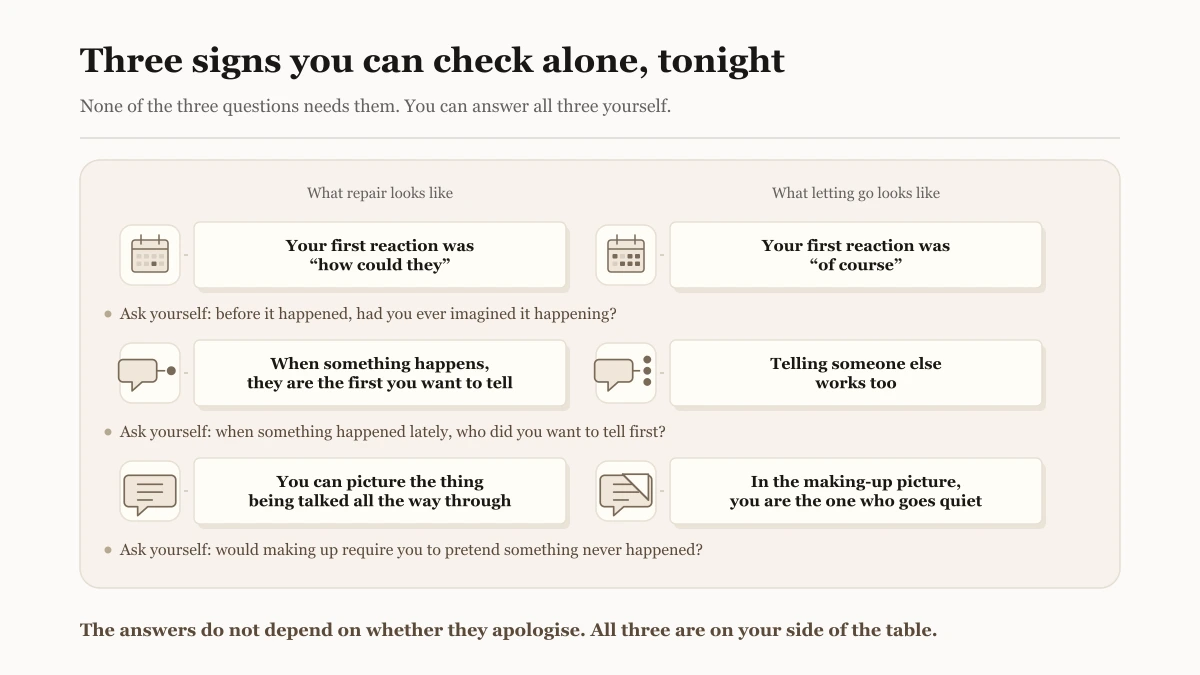
None of these three questions needs them, and none of the answers depends on whether they apologise. Whether they say sorry is theirs. How you used to get along, what you are missing now, and which kind of making up you can picture are all on your side.
Can it be saved? Yes, but not the version you had
My answer: if all three signs point to repair, speak first, once. If all three point to letting go, let go, and letting go is not losing. If they are mixed, say the thing once, not to rescue the friendship, but because once it has been said the three signs become clear and you will know which side you are on.
I want to be exact about what “saved” means. The friendship from before the break is not coming back, because those two people had never been through this and now they have. What can be saved is the friendship after the thing has been talked through: they know how much it hurt, you know what it looked like from their side, and there is now one thing between you that has been said out loud. I would say that kind of friendship holds up better than one that has never been through anything, because it has already been tested once.
So, can it be saved? Yes. What comes back is the new one, not the old one.
What to do: speak, which is not apologising and not forgiving
Speaking means saying the thing to them. That is all.
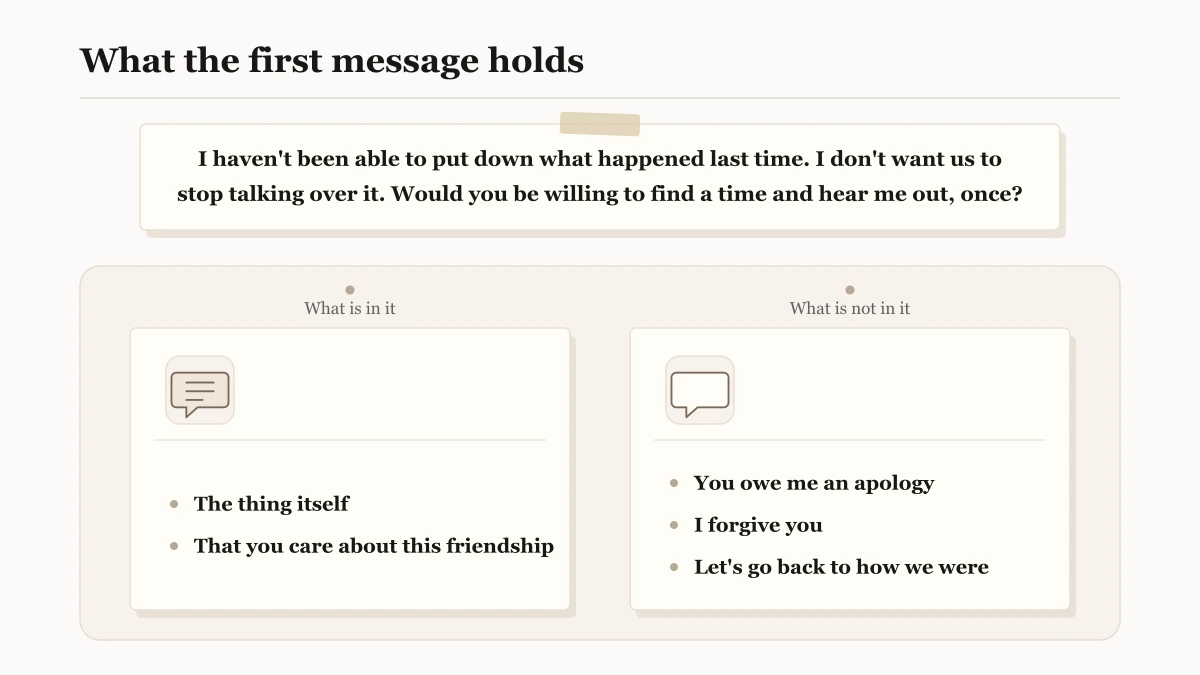
A message you could send as it stands: “I haven’t been able to put down what happened last time. I don’t want us to stop talking over it. Would you be willing to find a time and hear me out, once?” There are two things in that message: the thing, and the fact that you care about this friendship. There is no “you owe me an apology,” no “I forgive you,” no “let’s go back to how we were,” because none of those three is yours to decide right now.
Going first does not make you the one who lost. It makes you the one who decided this friendship gets one more conversation. It feels like lowering your head only because you have put “who speaks first” and “whose fault it was” in the same box. The fault is theirs, and your speaking first does not change that. It only gives that fault a chance to be said out loud.
Forgiveness is not something you need ready before you speak. Being angry right now does not stop you from speaking, because what you are going to tell them is precisely how much the thing hurt. Once they have heard you out and told you their side, that is when you decide whether to forgive.
Talk about this one thing only, and leave the rest of the ledger closed. The times they were late, the birthday they forgot: if those matter, give them their own conversation. This one is for the thing that stopped you talking: where you were when it happened, what it felt like at the time, and how you have carried it since.
When you have said it, listen to what it looked like from their side, without deciding their answer for them. Their version may not match yours, and when they have finished you will have something you did not have before: their reaction to knowing you were hurt. If they care that you were hurt and are willing to change, the friendship can go on from there. If they think it was nothing and have no intention of changing, you have your answer too, and letting go will be easier than it is now.
If the signs pointed you to letting go, there is something to do as well. Letting go needs no announcement, no blocking, no formal ending. Letting go is saying the thing once, to yourself: “That day they did that, it hurt, and I am no longer waiting for them to say anything.” Then, to the friends you share, one sentence: “We’re not in touch right now, so no need to invite us together.” What you are putting down is the waiting for them to speak. The years are not part of it. Those stay yours.
The four things you will ask next
“Should I do this by message, or face to face?”
Use the message to set it up, and say the rest in person. Send that one message and nothing more. Do not type the whole thing out in a text, because in text you cannot see their reaction, and you cannot tell whether they are actually listening. Meet somewhere you used to go, or on a video call. What matters is that you can both see each other. Once you are there, start with where you were when it happened, then what it felt like at the time, then how you have been carrying it since.
“What if they read it and don’t reply?”
Give them a week. During that week, do not send a second message, and do not ask the friends you share whether they have seen it. If they reply within the week, whatever the reply says, go and have the conversation at the time you agreed. If the week passes with nothing, that is their answer, and you can do what the letting-go section says: say the thing once to yourself, and stop waiting. Decide the deadline with yourself in advance: “I’ll wait until next Wednesday. If there’s nothing by then, I stop waiting.”
“Should I wait until I’m not angry anymore?”
No. The condition for speaking is that you want the thing said through, not that the anger has gone. By the day the anger is gone, you will mostly have lost the wish to talk, and then all that is left is two people who stopped speaking. Anger is not the problem, as long as you are talking about the thing and not attacking who they are. Something you could say: “I’m still a bit angry, but I want to get it said.”
“If I suddenly want to reach out years from now, is it too late?”
No. The three signs check the same way years later. What changes is the detail: you may no longer remember the exact words they used. So years later you do not reopen the details. You say that you thought of them, and how you have come to see what happened. Something you could say: “It’s been a long time. I thought of you the other day. I’ve thought a lot about what happened between us, and if you’re willing, I’d like to tell you about it once.”
Let it end inside one conversation
Can it still be saved? What can be saved is not the friendship from before the break. It is the one on the other side of the conversation. Whichever way the three signs point you, you do not have to stay in the middle.
You ask why it has to be you, and the question is fair: you were the one hurt, so they are the one who should come. They should have, and they did not. That is on them. But the thing is now stuck in you, not in them, and letting it end inside one conversation instead of inside a thread frozen on the day before is something only you can do.
Right now you are the only one who knows how much that thing weighs. Tell them. If they care, the two of you go on from there. If they do not, you stop waiting. Either of those beats what you have now, which is opening the thread every day, taking one look, and closing it again.