Can You Practice Your Way Into Feeling Safe With Friends?

Eleven at night. The message still says “read.”
You scroll up and reread what you sent. Once. Twice. Was that word too much? Did the emoji land wrong? Should the whole thing never have been sent? You open the keyboard to add “no worries, you’re busy!” — then delete it halfway, because sending it might look like what it is: asking for a reply.
Maybe it isn’t a message at all. Maybe it’s the group chat moving fast, and the one thing you said slid past without a single reaction. Maybe you’ve counted how many times in a row you were the one who suggested meeting up. Maybe “are you free this weekend?” has been rewritten three times and now lives in your drafts.
And then the question surfaces —
Why am I still this tense around my own friends? Can I practice my way out of this, or is this just who I am?
If that question is what brought you here, let me say this first: I’m not going to tell you to “just be yourself,” and I’m not going to audit your friends. What I want to do is take the word “insecure” apart. It’s several different things stacked on top of each other. Some of those things can genuinely be trained — and what “trained” looks like is probably not what you imagine.
Rereading the message means the friendship is real
Start with something I believe outright: you reread that message a third time because this friendship matters to you. That caring is the real thing — you don’t proofread your texts for someone you don’t care about.
My guess is the tenseness has a history, too. Maybe a best friend once faded on you — no fight, no ending, the friendship just quietly stopped. Maybe you’ve moved schools or cities enough times that “knowing people” had to be rebuilt from zero again and again. Maybe it was recent and specific: the group photo everyone was in except you, the event chat you weren’t added to. That sharp, immediate kind of hurt is its own injury — I wrote about how to hold it in “What to Do When You Are Left Out of a Group Chat or Activity.” This piece is about the longer line: what to practice between those moments.
If any of that is your history, here is my read: the alarm inside you isn’t broken. It was tuned too sensitive by those years, and now it goes off whenever a friend goes a little quiet.
The good news: you don’t have to finish understanding your past before you start practicing.
The way you get close to people is not a factory setting
“This is just who I am.” The heaviest word in that sentence is “just.” It assumes the way you get close to people is a factory setting: whatever you were as a child, you’ll be forever.
But here’s what I think: how easily you tense up describes how you connect right now. It is not a verdict on who you are. And I keep coming back to one belief — whatever can change can be trained. The only open question is whether you get a hand on the wheel.
So the question is worth rephrasing. Not “was I born insecure?” but: “is this alarm’s sensitivity still right for the life I have now?”
“Insecure” is actually three different things
On a read-and-no-reply night, three separate things are happening in you. They move so fast they fuse into one wave of dread. They deserve to be pulled apart.
First, the body’s alarm: the heartbeat that skips, the stomach that tightens, the thumb already sliding back to that message. This is a physical reflex. It going off does not mean something happened — it reflects your tension, not what is true on their side.
Second, the mind’s captions: “they’re getting tired of me,” “I must have said something wrong last time,” “there’s probably a group chat without me.” These are interpretations, not facts. They arrive so fast and so smoothly that they feel like something you saw with your own eyes.
Third, the friendship’s actual track record: how they usually treat you, what the two of you have been through, whether they always go quiet when work floods in. This one can only be answered with facts that contain no guessing — and answering it takes time, not panicked guesses.
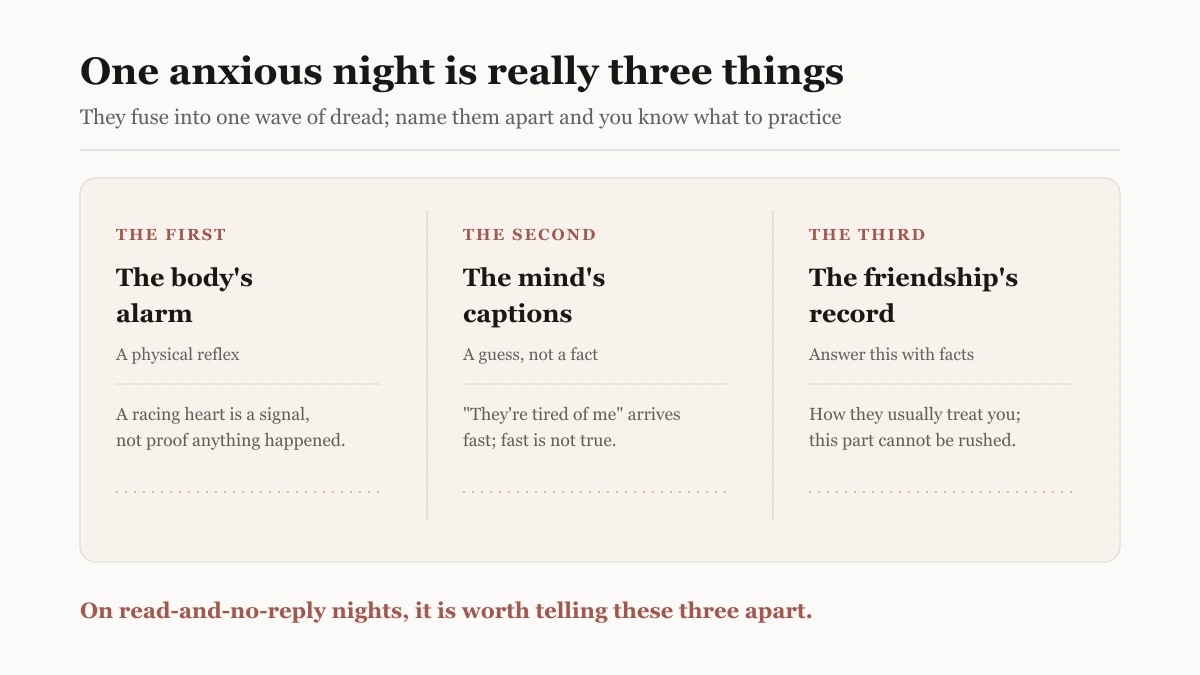
Here is why the pulling-apart matters. Of the three, the alarm obeys you least — it is your body, not a thought. The track record isn’t yours to control alone, either. But the middle one — the captions — is the most trainable of the three. In a neighboring field, loneliness, the different approaches have been compared head-to-head: social-skills training, more chances to meet people, more support. The type that moved the needle most was helping a person replace their automatic negative reading of social signals. The doorway to practice is the captions.
So “practicing security” is not practicing until the alarm never rings. It’s practicing until, when it rings, you can tell the three apart: this is the alarm, this is a caption, this is the record. Three things — not one.
Three small things you can start tonight, alone
These three share one feature: they need no cooperation from anyone, no perfect timing, and they can start tonight.
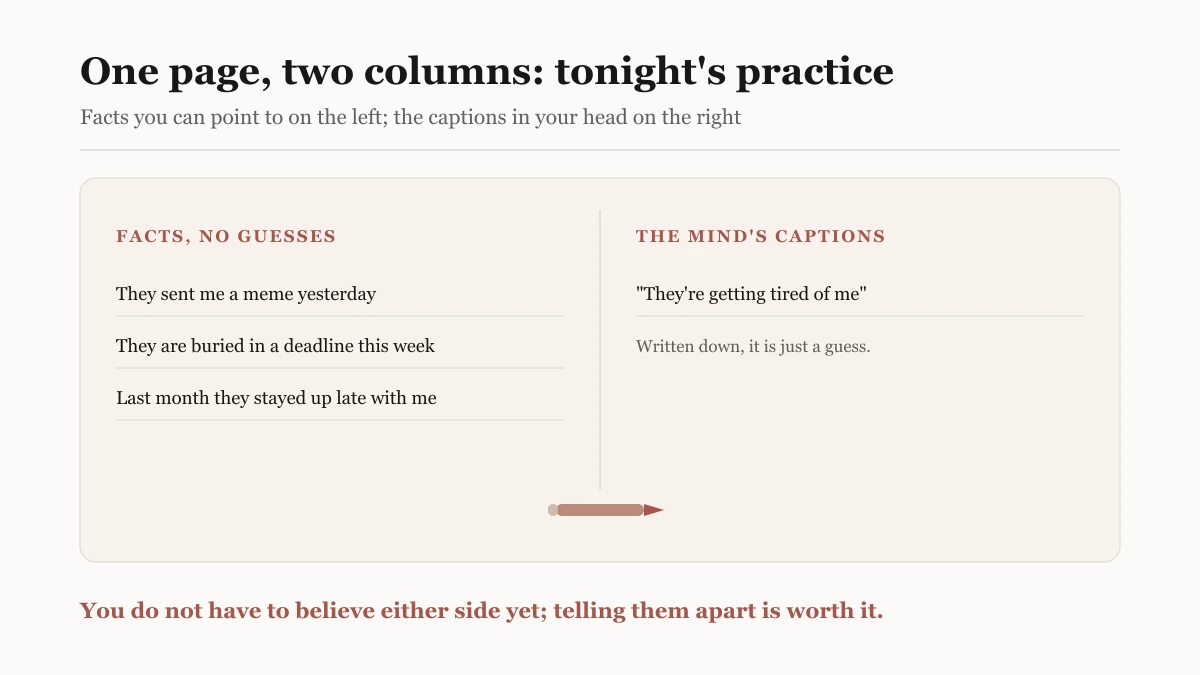
First: one page, two columns. On a read-and-no-reply night, the left column holds facts with no guesses in them: they sent me a meme yesterday; they’re buried in a deadline this week; last month, when I fell apart, they stayed up talking with me. The right column holds the captions: they’re getting tired of me. Once both are written, you don’t have to force yourself to believe either side. My judgment is that a caption, once written down and seen for what it is — a guess — usually gets quieter. That claim you can test yourself, tonight.
Second: take one friendship you want to keep, and make it small and steady. No summoning courage for a big reunion, no composing long heartfelt paragraphs every time. See something that reminds you of them — send it over. Keep one low, steady rhythm of small updates. I’ve come to believe security grows on “repeated and predictable,” not on “grand.” And this works across time zones and text-only friendships just as well — repetition doesn’t care about distance.
Third: next time the alarm rings, keep your normal rhythm. Don’t retreat — “I’ll just talk less from now on” is not tonight’s conclusion to draw. Don’t double down either — three follow-up messages chasing one unanswered one. The goal of this round isn’t to get warmer. It’s only this: when the alarm finishes ringing, the friendship is still standing where it was. My judgment is that as the “it rang, and nothing happened” nights add up, the alarm starts ringing softer on its own.
All three are small. But practice was never fed by size. It’s fed by repetitions.
Should you just tell them you feel insecure?
At some point in the practicing, you’ll wonder: should I just say it out loud?
Here’s what I’d suggest: say it — but hand them the specific thing, not the diagnosis. “I’m just an insecure person, please bear with me” presses a label onto you first, then hands the other person homework with no instructions. The specific version sounds like: “Last time you took two days to reply, I spun a whole story in my head, and then it turned out you were just busy. Telling you because next time, I’m practicing not scaring myself like that.” To my ear, the first version demands a guarantee. The second lets a friend know you better.
The way I see it, what draws two people in is gradual, back-and-forth disclosure — not emptying everything out at once. As for “telling a long-time friend the specific thing brings you closer” — that step is my own judgment. I’ll stand by it anyway, because I honestly think most friendships don’t end in a fight. They drift apart inside “neither of us ever said anything.”
Who to tell is worth a thought too. I’d start with the friend who has caught your serious topics before. The one currently drowning in their own life? Don’t rush them. Practice on your own with the tools above, and wait until their busy season passes.
How long until it counts?
First, recalibrate your clock. Closeness between friends is built up little by little. One set of data looked at exactly this: among friends, the role of “the first person you turn to” shifts over gradually, alongside how long the relationship has lasted. So still feeling tense a few months in doesn’t mean you’re practicing badly. The road was always this long; slow is its normal speed.
Then recalibrate what “trained” looks like. It is not “never anxious again.” It’s the same “read” receipt — you still glance twice, but you no longer cancel your own evening over it. The alarm still rings — but when it stops, you send the meme anyway, on schedule. It’s the day you notice you haven’t proofread a single sent message all week. Security isn’t the alarm going silent. It’s the alarm no longer having the full final say.
And one question I won’t step around: what if I keep practicing and they never quite catch me?
That is not your practice failing. What a friendship can hold right now may simply be this much — their life may be full of something you can’t see, which isn’t necessarily about you, and doesn’t need a verdict stamped on it tonight. But one thing I’m sure of: what you’ve trained goes with you, not with them. The eye that tells alarms from captions, the habit of saying the specific thing, the small steady rhythm — you carry the whole kit into the next friendship. Practice is never wasted on any particular person, because it was never stored in them. It lives in you.
Slow is the native speed
Back to the question in the title — can you practice your way into feeling safe with friends?
Yes. And I want the emphasis on practice, slowly: slow isn’t this road’s flaw, it’s this road’s speed. The ease you assemble one square at a time doesn’t zero out over a single unanswered message.
One day you’ll look back and notice that what changed wasn’t how fast your friends reply. It’s that the same “read” receipt now triggers a different first sentence in your head — from “are they sick of me?” to “probably busy. I’ll go shower.” That moment comes with no fireworks. It’s quiet enough to miss. It is also exactly what practice looks like when it’s working.
You’re already doing more than you think — caring this much, wanting to say things right, reading this far: it’s all the same seriousness. And starting from tonight’s two-column page, what you still have time to practice is more than you think, too.