Signs of a One-Sided Friendship: Are You Always the One Reaching Out?

The last time you two got together, you were the one who asked. The time before that, too. Now it is Friday night, and you have their chat open with a message half typed: “Want to try that place we talked about this weekend?” You don’t delete it. You don’t send it either. You just look at it, and a question surfaces: Am I always the one reaching out?
You are asking because you take this friendship seriously. You remember what they like to eat and what has been keeping them busy, and every time, you clear space in your schedule for them first.
The things you keep asking yourself
“Maybe they’re just busy lately?”
That could be true. Everyone goes through stretches where friends get pushed aside, and I am not asking you to treat their busyness as an excuse. Here is how I see it, though: busy periods usually begin and end. If you have been the one making plans for as long as you have known each other, this is about more than one busy stretch.
“If it’s always me asking, am I annoying them?”
From what you have seen, I would say it doesn’t look that way. As far as I can tell, when someone finds you annoying, it usually shows: they keep finding reasons to say no, their replies are short and half-hearted, and when you meet they keep checking the time as if they want to leave. But your friend said yes, showed up on time, and had a good time with you, and none of that looks like someone who finds you annoying. I think what really bothers you is why getting together always has to start with you, and that is a separate question from whether they find you annoying.
“Do I need them too much?”
Hoping a friend will sometimes think of you first is something anyone could say out loud in any friendship. You aren’t asking to hear from them every day. You want one time, just one, when they think of you first.
“If I bring it up, will I look petty?”
Telling someone how you feel and counting who asked whom how many times are two completely different things. What you want to say is that you would like to see them, and that you would like them to think of you. That is a gentle thing to say.
“Should I just care less?”
Caring about a friend naturally means noticing whether they think of you. From what I have seen, you don’t need to put that care away. It is what showed you how this friendship looks right now.
Six common signs of a one-sided friendship
You set up almost every meetup
Nearly every time you see each other, it is because you asked. They say yes, arrive on time, and enjoy themselves. But “let’s do this again” has never once started on their side. So you have started deciding the time and place in advance, even looking up where to eat, so all they have to do is reply “sure.”
You know all about their life, and they rarely ask about yours
You know they recently moved, had a fight with their family and which show they are into, because you ask every time you meet. When it is your turn to talk, they nod along, and then the conversation stops there or drifts back to them.
Bit by bit, the stories you tell about yourself get shorter. Sometimes you skip them altogether.
When they need someone, they think of you
When they are feeling low, need a hand moving things, or suddenly need someone to come along on an errand, you are often the first one they message. Once it is over, the chat goes quiet again until the next thing comes up. These days, when their name shows up on your screen, part of you starts guessing what has happened this time.
When you need someone, they are not the first person you think of
Something is weighing on you. As you scroll through your contacts, you pass their name and keep going. You know that if you message them, they might take a long time to answer, and the answer might be short. Over time, you have started carrying your own problems alone.
They are usually the one who cancels, and you are the one who reschedules
On the day you had planned, they tell you at the last minute that something has come up. They end with “let’s do it another time.” That other time never arrives on its own. It only gets a date when you ask again. That is why, when you plan your week now, you quietly leave a gap for the chance that they won’t make it.
You are the one who remembers the important days
Their birthday, the interview or exam they mentioned: you keep track, and when the day comes you send them a message. On your birthday, they often remember a day late, and sometimes they don’t remember at all. Eventually you hardly mention your own dates anymore, because if you don’t mention them, there is nothing to be let down by.
If you always reach out first, does that make the friendship one-sided?
Not necessarily. What I look at is not who speaks first, but whether the friendship is still there after you stop.
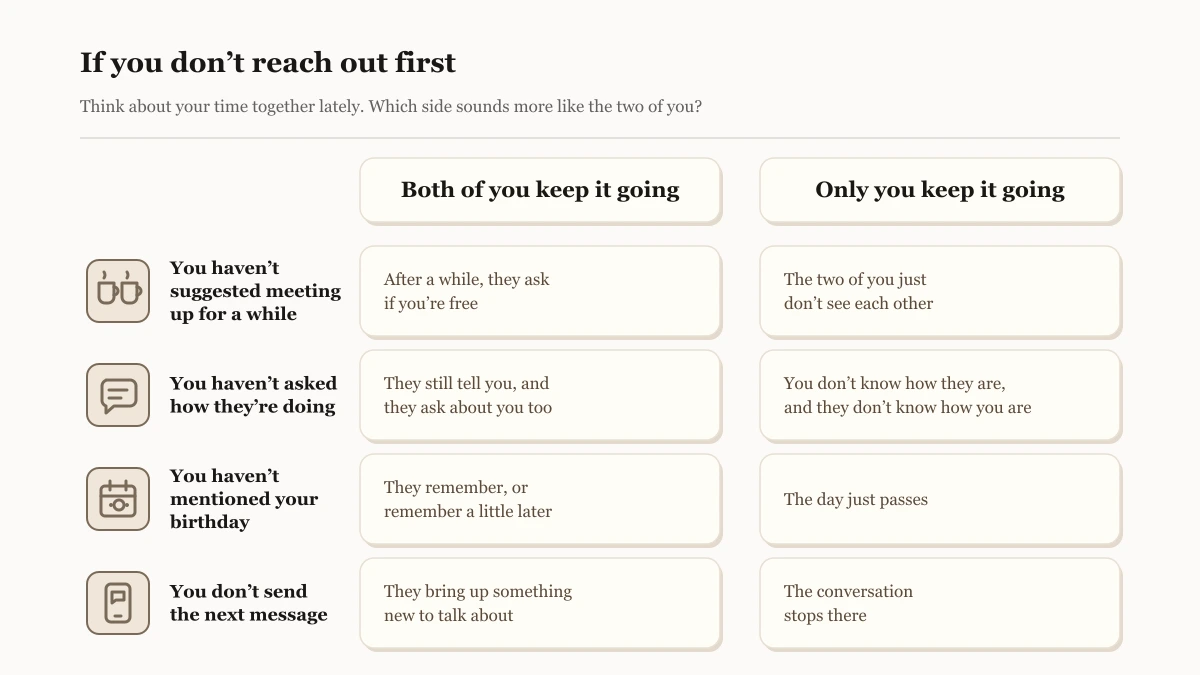
By a one-sided friendship, I mean one that only you are keeping alive. If you don’t ask, you don’t meet. If you don’t check in, you don’t know how they are doing, and they don’t know how you are doing either. If you don’t remember the important days, those days simply pass. They are not a bad person, and when you are together it is still fun. But every step this friendship takes forward, you have to take first. To put it more plainly: when you stop, the friendship stops.
Some people care deeply about their friends and are simply bad at reaching out. Some have had very full lives these past few years, and just answering messages takes a lot out of them. Others have always been the one who gets invited and have never thought about doing the inviting. In my view, any of these could be why they rarely reach out first, which is why I would not call a friendship one-sided just because of who speaks first.
So here is a question I would like you to ask yourself: “If you didn’t reach out first, when would the two of you talk next, and why?”
You don’t need to stop and run a test. Just look back. You may have had a stretch when you were too busy to reach out. Think about whether the two of you talked during that time. If you did, and they were the one who sent an update or asked whether you were free, then they are keeping this friendship going too, just at a slower pace than you. If you only talked once you were less busy and messaged them first, then right now this friendship is being kept alive by you alone. And if the one time they reached out during that stretch was because they needed your help, I would see it the same way.
What to do: say it once, then match their effort
You have already done a lot for this friendship. These next three steps are for you.
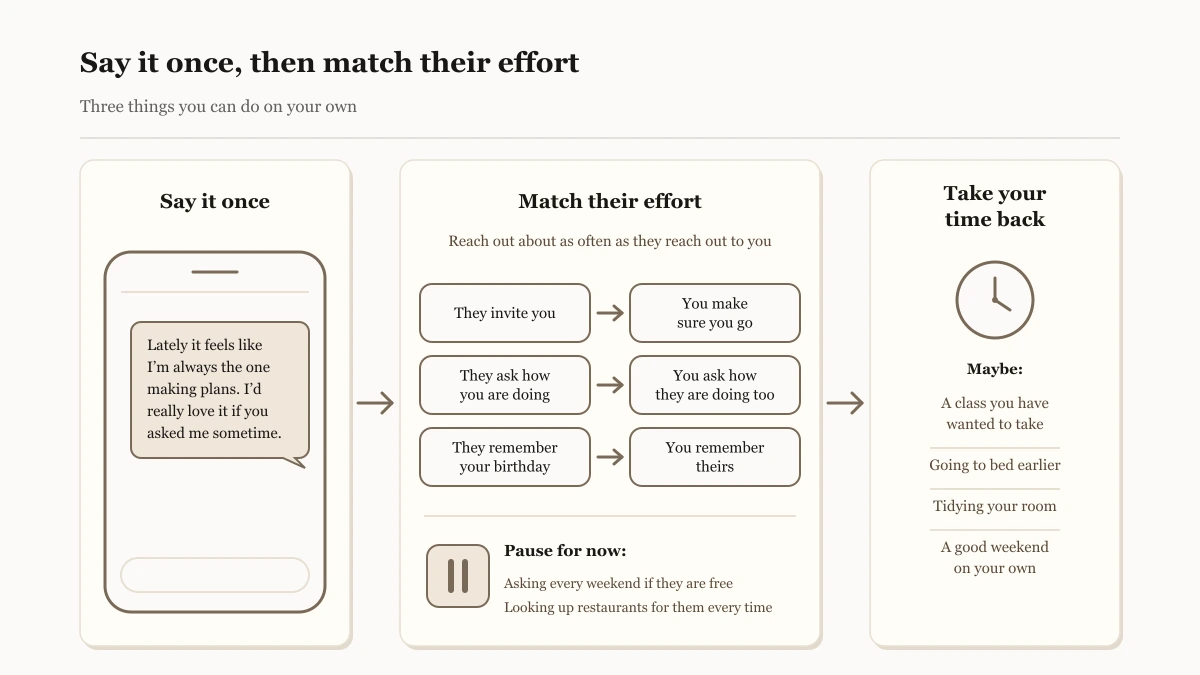
Say it once. Pick an ordinary moment, not the day they just canceled on you and you are still hurting, and tell them in one sentence about your own feelings, saying only how you feel and what you would like, not what they have done wrong: “Lately it feels like I’m always the one making plans. I’d really love it if you asked me sometime.” You can text it or say it in person; it is just as clear in writing. After that one sentence, you are done. You don’t need to tally up who asked how many times, and you don’t need to ask why they never invite you.
In my view, they may never have noticed that you are always the one making plans. Saying it once is what gives them a chance to know how you feel.
Then match their effort. Once you have said it, you no longer have to be the one who reaches out every time. Reach out to them about as often as they reach out to you. If they invite you, make sure you go. If they ask how you are doing, ask about them too. If they remember your birthday, remember theirs. The things only you have been doing, like asking every weekend whether they are free or looking up the restaurant for them every time, you can stop for now.
You might be afraid that if you reach out less, the friendship will end. Here is how I see it: you have already told them how you feel, and whether this friendship lasts depends on both of you, not on whether you asked often enough. If every meetup only happens because you keep doing more, the kind of friendship you actually want, one where they think of you too, still hasn’t arrived. Matching their effort is not giving them the cold shoulder. You are still friends, and you are still glad when they reach out. You are just no longer doing the work of two people on your own.
Finally, give the extra time back to your own life. All the time you used to spend figuring out where to invite them, waiting for a reply, or wondering whether they were busy is free now. You might use it for a class you have wanted to take, going to bed earlier, finally tidying your room, or simply a good weekend on your own. That time was always yours. I hope you spend it on yourself, so your days don’t revolve only around waiting to hear back from them.
Four more questions you might have
I told them, they said they’ve been busy, and nothing changed. Now what?
You don’t need to say it a second time. They have already heard how you feel, and saying it again can easily start to sound like pressure. My suggestion is to reply with something like “Okay, let’s talk when things calm down for you.” After that, there is no need to keep waiting for them to change. Spend the rest of your time on your own life. The things on your plate, the other people you care about, and the things you have been wanting to do are all still there waiting for you.
I reached out less, and now we haven’t talked in a long time. Should I message them?
When you miss them, you can, and reaching out first once in a while is fine. What I think matters is the reason. If you genuinely want to know how they are, send it. If it is fear that the friendship will end, pulling you back toward starting everything yourself again, hold off for now. When you do miss them, a simple message asking how they are is enough, with no mention of who has been reaching out more, for example: “I just walked past that place we used to go, and you came to mind. How have you been?”
How should I act the next time we see each other?
Just as you normally would. You already enjoy your time together, so there is no need to be deliberately cool with them because you have been thinking a lot lately, and no need to act as if nothing is on your mind. If they ask how you have been, tell them properly. If they don’t ask, you can bring it up yourself. A line like “Honestly, I’ve been pretty tired lately” is enough to bring your own life into the conversation.
We’ve been friends for so many years. Isn’t it a shame to let it fade?
It is a shame, because the things you went through together were real. I believe that even if a friendship fades, those experiences don’t disappear with it. What fades is how often you see each other now, not the times you laughed together back then. Here is one small thing you can do today: think of your best memory of the two of you, write it down, and keep it somewhere you can find it. Whether this friendship grows closer or fades from here, that memory is yours.
A friendship where both of you move closer
Here is how I would put it. You keep reaching out first because you treasure this friend. But when a friendship rests on you alone, every extra invitation and every extra check-in comes with another quiet question to yourself: where do I actually stand with them? After a while, you hesitate even before sending a single message.
What you want is a friendship where both of you move closer, where sometimes you reach out and sometimes they think of you first. That is simply what a friendship is supposed to look like.
From here, this friendship might grow closer, with them sometimes asking you first. Or it might slowly fade, and you will see each other less. Either way, I believe you will carry much less than you do now. You won’t be holding it up by yourself, you won’t spend the time after every message guessing, and you won’t keep putting yourself second just to hold on to it.
You have always been good at keeping other people in mind. Starting today, you can keep yourself in mind too.
Sources
Research and sources this essay draws on.
- Are You Your Friends’ Friend? Poor Perception of Friendship Ties Limits the Ability to Promote Behavioral ChangePLOS ONE, 11(3), e0151588
- The surprise of reaching out: Appreciated more than we thinkJournal of Personality and Social Psychology, 124(4), 754–771