How many hours does a friendship take?
Somewhere in your thirties, a suspicion sets in: making friends has become harder than it used to be. Not impossible — you still meet people you like, still have the conversation where you both say we should do this more often. But the conversion rate has collapsed. You meet a dozen people you genuinely enjoy, and a year later none of them is a friend.
The usual explanations are moral ones. You’ve become closed off. You don’t make the effort. Everyone is too busy staring at their phones.
There is a less flattering and more useful explanation, and it is arithmetic.
The number is about 200
Jeffrey Hall, a communication studies researcher at the University of Kansas, ran two studies to find out how much time it actually takes for one person to become another person’s friend. The first followed 355 adults who had moved to a new city within the previous six months. The second tracked 112 first-year university students, checking back at week four and week seven as their new social worlds formed.
Both groups were doing the same thing from scratch: building friendships out of strangers, with a clock running.
The thresholds Hall found are specific enough to be uncomfortable:
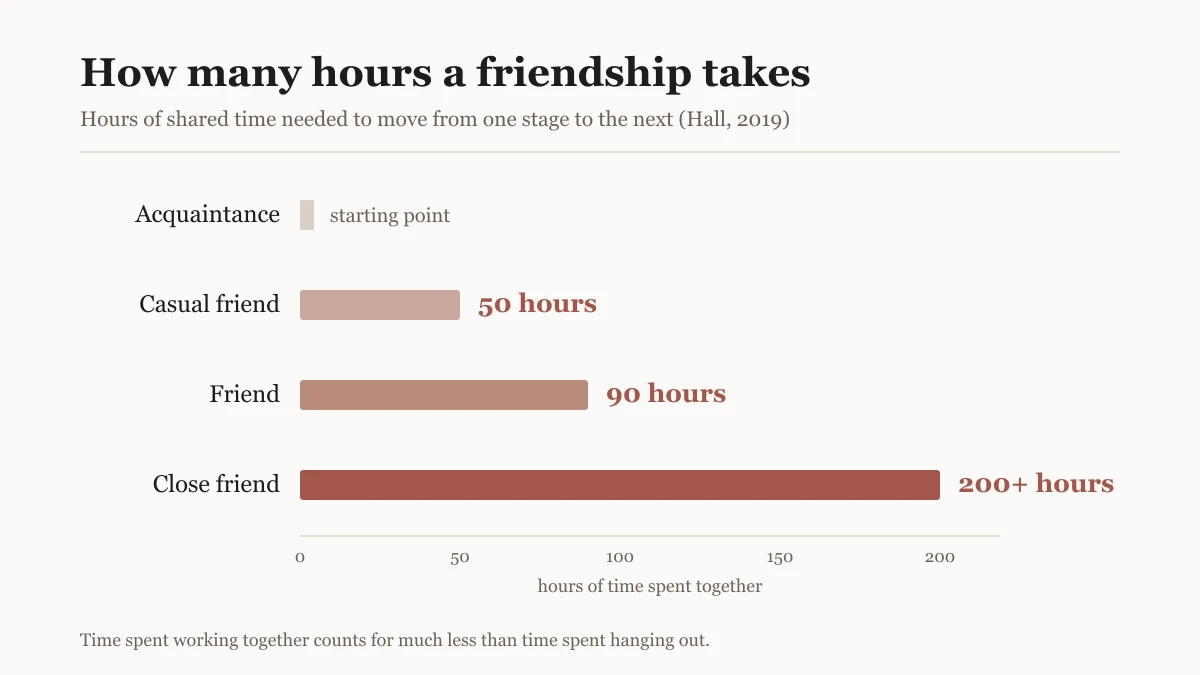
- Roughly 50 hours of time together to move from acquaintance to casual friend
- Roughly 90 hours to go from casual friend to friend
- More than 200 hours before someone becomes a close friend
Combining both studies, he gave ranges rather than points: 40 to 60 hours for a casual friendship, 80 to 100 to become a friend, and upwards of 200 hours for a good one.
These are not thresholds you cross by intending to. They are thresholds you cross by showing up, repeatedly, for a long time.
Not all hours are equal
One detail in Hall’s findings does more work than any other, and it is the one most people skip past: time spent working together doesn’t count for much.
Hanging out counts. Joking around counts. Playing games, eating, wandering, doing nothing in particular together — those count. Sitting in the same meeting for the fourth time this week does not, or at least not at anything like the same rate.
It isn’t hard to see why. Time at work is time in which the relationship is not the point. You are both oriented toward a task, the conversation is constrained by who else is listening, and neither of you chose the other — you were assigned. The hours that build friendship seem to be the ones where the other person is the activity: where the only reason either of you is there is the other, and where the conversation can go wherever it wants, including nowhere.
That distinction matters more than the raw totals, because it means you cannot fix a friendship deficit by simply being around more people.
This is quietly devastating for adult friendship, because work is where adults spend most of their waking hours around other people. If you tally up the time you spend physically near other humans in a given week, the majority of it is structurally the kind that doesn’t build friendship. You can be surrounded by people for fifty hours a week and accumulate almost nothing toward the 200.
It also explains why university friendships are so disproportionately durable. University is an environment engineered — accidentally — to generate exactly the kind of hours that count. Unstructured time, shared physical space, no supervision, low stakes, and a great deal of doing nothing in particular. Nobody designs adult life that way.
You only have so many slots
The second piece of arithmetic comes from Robin Dunbar’s work on the structure of human social networks. His finding, replicated across mobile phone records, online games and social platforms, is that our relationships aren’t a smooth gradient. They cluster into layers, and each layer holds roughly three times as many people as the one inside it.
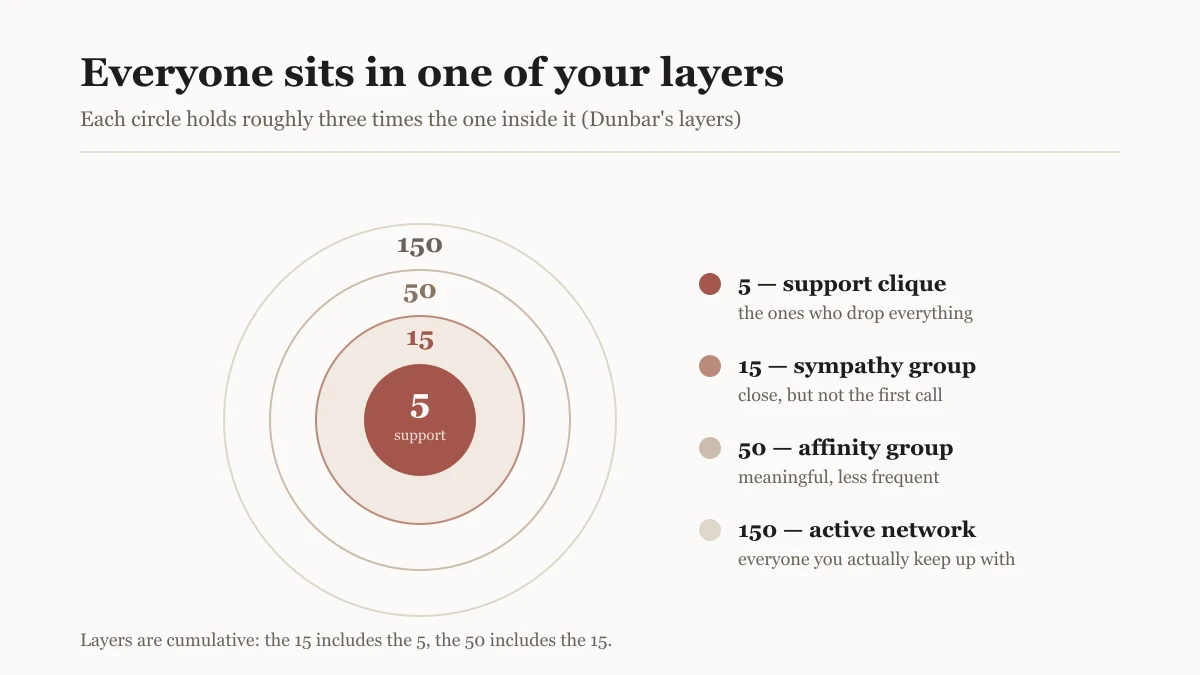
The innermost layer holds about five people — the ones who would drop everything. Then about fifteen, close but not the first call. Then about fifty, real relationships maintained at lower frequency. Then about 150, the full set of people you actually keep up with rather than merely know.
The layers are cumulative — the fifteen includes the five — and they are strikingly stable across cultures and communication technologies. What changes when your life changes is not the size of the layers but who occupies them.
That last point is the one worth sitting with. The layers don’t expand when you meet someone wonderful. Someone else moves outward.
The arithmetic nobody does
Now put the two findings side by side. Hall tells you what one relationship costs in hours. Dunbar tells you how many relationships you can hold.
Two hundred hours is the price of admission to the innermost circle. What does that look like on a calendar?
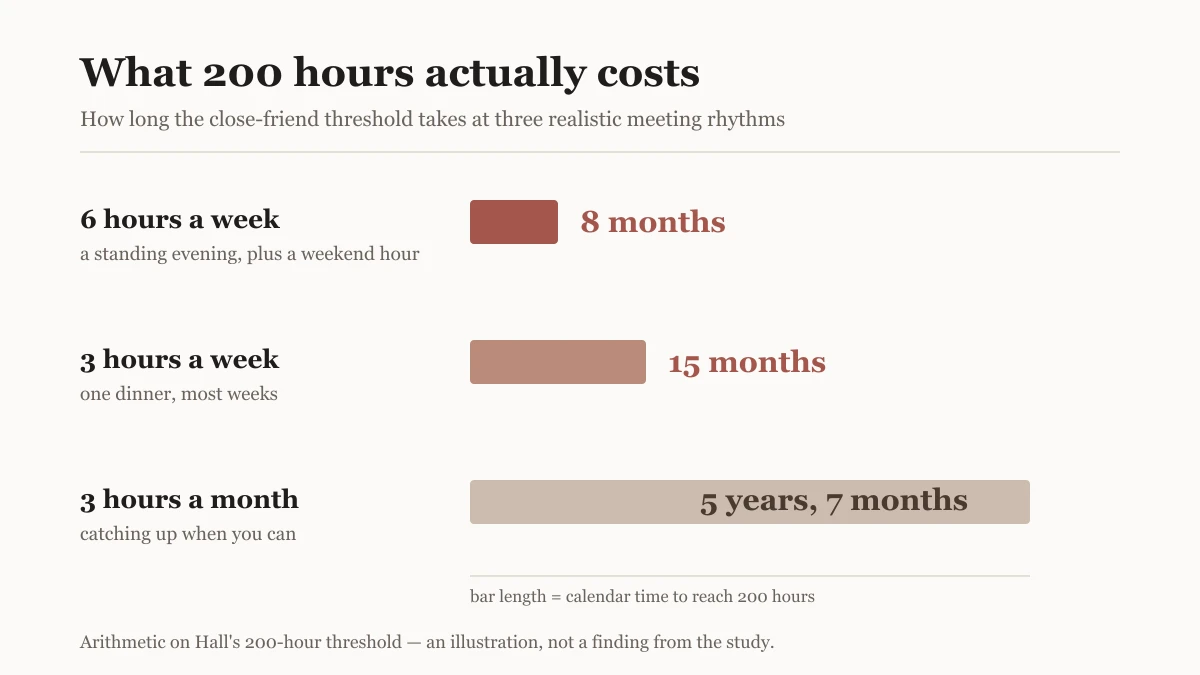
At six hours a week — a standing evening plus an hour at the weekend, which is more than most adults give to anyone outside their household — you reach 200 hours in about eight months.
At three hours a week, one dinner most weeks, it takes about fifteen months.
And at three hours a month, which is what “we should catch up more” usually amounts to in practice, it takes five years and seven months.
That last figure is the one that reframes everything. The friendship you have been meaning to deepen, at the rate you are actually meeting, is on a six-year trajectory. Not because either of you is failing. Because that is what the numbers do.
(That calendar conversion is my arithmetic on Hall’s threshold, not a finding from his study. The 200 hours is his; the months are just division.)
What this actually explains
Three things fall out of this, and none of them is a character flaw.
Adult friendship isn’t declining because people got worse. It’s declining because the hours got scarcer and the kind of hours that count got scarcer faster. Full-time work, commuting, caregiving, and the domestic load of running a household consume the unstructured time that friendship is built from. What’s left is fragmented into pieces too small to accumulate.
Friendships fade without anyone deciding to end them. If maintaining a place in someone’s inner layer requires ongoing hours, and your hours get reallocated — a new job, a move, a baby, an illness in the family — the friendship drifts outward without a single moment of conflict. This is why so many lost friendships have no story attached. There was nothing to fall out about. The hours simply stopped.
Intensity is a poor substitute for frequency. A weekend away is fifteen hours. It feels like a great deal of friendship, and it is genuinely valuable, but against a 200-hour threshold it is a down payment. The relationships that reach the inner layers are almost always the ones with a rhythm — the weekly thing, the standing call, the walk every Sunday — rather than the ones with occasional peaks.
Where the finding stops
It is worth being precise about what these numbers do and don’t cover, because this is exactly the sort of research that gets stretched past its evidence.
Hall studied friendship, and specifically friendship being built from scratch by people in transition — new city, new campus. The thresholds describe how strangers become friends. They are not a general law of human attachment, and there are kinds of love they clearly don’t govern.
Family is the obvious counterexample. Nobody accumulates 200 hours before a parent counts as close; the relationship starts inside the inner layer and the hours arrive afterward, if they arrive at all. Romantic relationships appear to run on a different clock too — they can reach extraordinary intimacy in weeks, at a pace no friendship matches, partly because they come with a social script that licenses disclosure early.
What friendship lacks is any of that scaffolding. No ceremony, no contract, no shared surname, no moment where you formally become friends. There is nothing holding it in place except the hours themselves — which is precisely why the hours are so decisive here and so much less decisive elsewhere.
So the honest version of the claim is narrow: for the one kind of love with no structure to hold it up, time is the whole structure.
The uncomfortable implication
If friendship runs on hours, then wanting a friendship is nearly worthless on its own. Affection is not the input. Time is.
This is unwelcome because it removes a comfortable story. Most of us prefer to believe our close relationships reflect the quality of our feeling — that we love the people we love, and that this is the substance of it. The hours suggest something more mechanical and less flattering: the people who ended up close to you are, to a first approximation, the people you happened to spend enough time near.
But there is something freeing in it too. If friendship is a function of hours rather than chemistry, then it is buildable. You don’t have to wait to meet the right person. You have to find a rhythm with a plausible one and hold it long enough for the arithmetic to work.
Which means the useful question isn’t who do I click with? It is a much more boring one: what is already recurring in my week, and who could be in it?
The friendships that survive adulthood are rarely the ones built on the strongest initial spark. They’re the ones that got attached to something structural — a commute, a standing dinner, a sport, a shared school run. Something that generates hours whether or not either party is feeling particularly warm that month.
Love of this kind is not a feeling that produces time. It’s time that produces a feeling.