After a Fight With a Friend, Should You Apologize or Stand Your Ground?

There’s a “sorry” you’ve typed out and deleted more than once now. It would go right under the last thing your friend sent you, a few nights ago: “It was just a joke. Was that really necessary?” Nothing has been said on either side since.
Every time your thumb hovers over send, the same thought stops it. The joke was about you, after all. Sending “sorry” feels like signing off on the whole evening as your fault, including the part you still care about. Not sending it feels like telling them you’re done with the friendship.
So the question keeps going around: should I apologize first, or stand by the fact that I wasn’t wrong?
Apologize or stand your ground?
My suggestion is that you don’t have to choose. Apologize for what you said wrong, and keep standing by what you still believe. From what I’ve seen, most fights carry two things at once: the way you said something in the moment, and what you were trying to get across. An apology is for the first. Standing your ground is about the second. Those two don’t cancel each other out.
Here is the evening in question. You’ve recently started learning to draw. Over dinner, just the two of you, your friend joked about it again: “What’s the point of learning that? It’s not like it’s useful for anything.” It was the third time they’d said something like it, and this time you snapped back, “You’ve never stuck with anything in your life, so who are you to talk?” Then you got up and left before the conversation was over, throwing one last line over your shoulder: “I’m never telling you anything again.”
Look back at that night and you’ll find a few lines you’d take back, along with a few points you still hold. My guess is that once you sort them into two piles, the part that needs an apology turns out smaller than you thought, and the part you care about doesn’t have to go in the bin with it.
The lines I’d apologize for
Start with “You’ve never stuck with anything in your life.” That line had stopped being about the joke. It went after who your friend is, holding up their whole past and dismissing it. In my view, it’s the line from that night that most needs an apology, because the place it hurt them has nothing to do with the joke they made.
Next is getting up and walking out mid-conversation. You may honestly not have been able to sit there any longer. From your friend’s side of the table, though, the person across from them left halfway through dinner, and they never got the chance to ask what was wrong. Last is “I’m never telling you anything again.” What upset you that evening was one joke, but that line turned one bad moment into forever. I think it was something said in anger rather than what you actually want, which makes it a line you can take back too.
Other fights are built the same way. In the ones I’ve seen, the parts that most often need an apology look like this: attacking who the person is, dragging up old history that has nothing to do with today, turning one time into every time, and walking off in the middle of things. Each of those is about how something was said. None of them means the point behind it was wrong.
The points you can keep standing by
That night also left you with things you don’t need to take back.
Learning to draw matters to you. You don’t need your friend’s permission to care about it. Being teased about the same thing over and over made you uncomfortable, and that discomfort is simply how you felt; feelings on their own don’t call for an apology. And you’d like your friend, when they’re curious about what you’re doing, to just ask you instead of brushing it off with a joke.
In other arguments, the points worth holding onto tend to be the things you care about, how you felt, where your limits are, and what you saw with your own eyes. As I see it, in the heat of a fight these often come out wrapped in the harsh words, so the harsh words are what the other person hears first and the real point gets buried. Standing your ground doesn’t mean saying it all again, louder. You can soften how you say it and keep your position. Your position also counts whether or not your friend agrees with it right away.
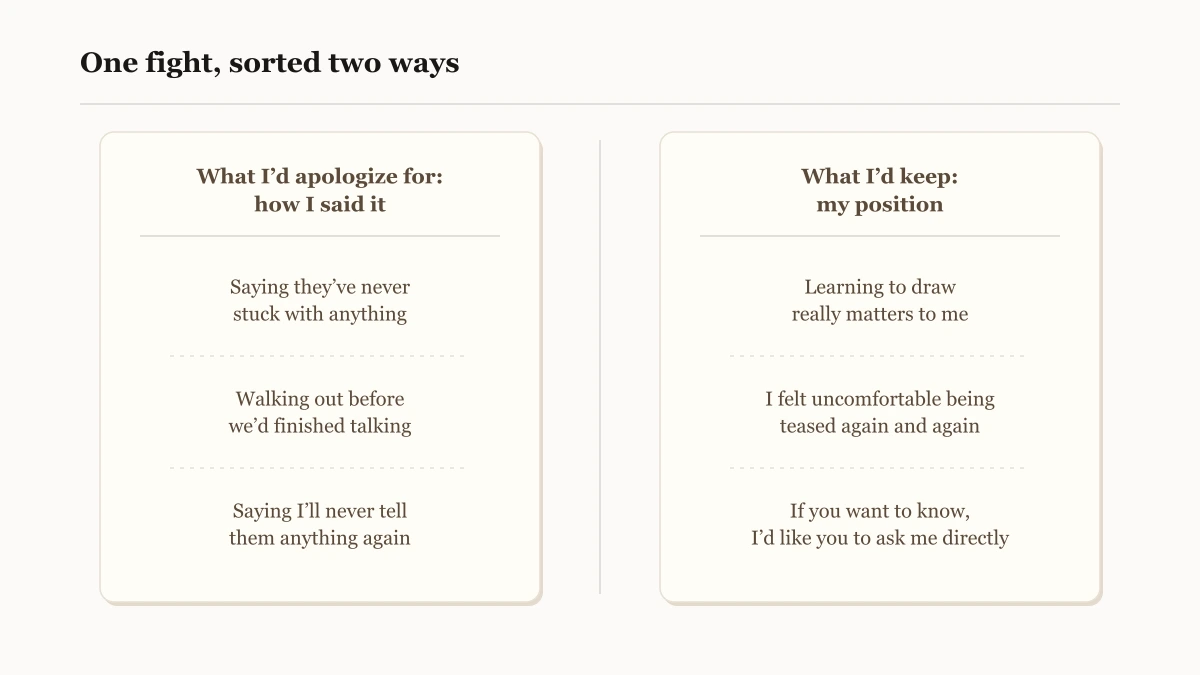
How to tell: if that day happened again
If your own argument won’t separate so neatly, try asking yourself this: if that day happened again, which words would you leave unsaid, and which points would you still make?
The words you’d leave unsaid are the part to apologize for, and to me the apology should cover only those. If you wouldn’t say “You’ve never stuck with anything” a second time, that line goes on the apology side.
In my eyes, the points you’d still make are the ones to stand by, just in different words. If you’d still want your friend to know “I don’t like being teased about this,” only not the way it came out that night, it belongs on the other side.
Take a piece of paper or open your phone, and write each side as a single line: the words you’re taking back on the left, the position you’re keeping on the right. Those two lines are the message you’re about to send. They don’t have to sound polished; write them the way you’d normally talk to your friend.
Two moments when I’d hold off
There are two moments when your sorting can get pulled off course by how you feel right then, and in both it pays to hold the message back for a little while.
The first is wanting to apologize because you can’t stand the silence and you’re afraid of losing them. That’s when it’s easy to give everything up, including “learning to draw matters to me,” and fold it all into “it was all my fault.”
If that’s where you are, my suggestion is to wait one night before sending anything. Write the full apology tonight, then read it again in the morning. Cross out anything like “it was all my fault” or “I got everything wrong,” the kind of line that gives away what you care about along with the rest, and keep only the three specific things: saying they’d never stuck with anything, walking out before you’d finished talking, and saying you’d never tell them anything again. If you don’t want to leave them waiting all night with no word, you can send this in the meantime: “I’m still thinking about the other night. I’ll get back to you once I’ve sorted it out.” It isn’t an apology. It just lets them know you haven’t walked away.
The second is wanting to stand your ground because you don’t want to be the one who backs down first, so you keep waiting for them to apologize.
Here it helps to see that each side has something to apologize for. On their side, it’s the third joke about your drawing. On yours, it’s the two harsh lines and walking out mid-conversation. Whether they apologize is out of your hands, but the two things you said were said either way. If you ask me, give it three days. Don’t push them during that time, and don’t go looking elsewhere for signs of how they’re doing. If three days pass and they still haven’t said anything, send yours first, and apologize only for your side. Their joke belongs in your second line, the one about your position. Being the one who writes first doesn’t mean the whole night was your fault.
Say the apology and your position as two separate lines
The hardest step, pulling the two apart, is already behind you. What’s left is saying them.
The apology could go like this: “That night I said you’ve never stuck with anything, I walked out before we’d finished, and I said I’d never tell you anything again. I was wrong to do all of that, and I’m sorry.” End it there, with a period. Don’t add “but.” My guess is that the moment “but you also…” shows up, the second half is all your friend hears, and the apology turns into one more round of the argument.
Say your position as its own line: “Learning to draw really matters to me. If you want to know about it, I’d like you to just ask me.” That line holds two things only, what you care about and what you’d like them to do next time. There’s no need to retell the whole evening.
Both lines can go in one message with a line break between them. If two things at once feels like too much, send the apology first and save the other line for after they reply.
Once it’s sent, their answer might be one of these. If they apologize too, or say they won’t joke about it like that again, just make plans for your next dinner. You don’t have to go back over that night from the start. If they accept your apology but still say “I was only joking,” you’ve stated your position once and don’t need to push them into agreeing. The next time the same joke comes up, say “I really don’t like that” right then.
If they want you to take back “learning to draw matters” as well, and say you shouldn’t have gotten upset over something like this, my own take is that the apology stays as it is, and so does your position. You could reply: “We see this differently, but I still want to be friends with you.”
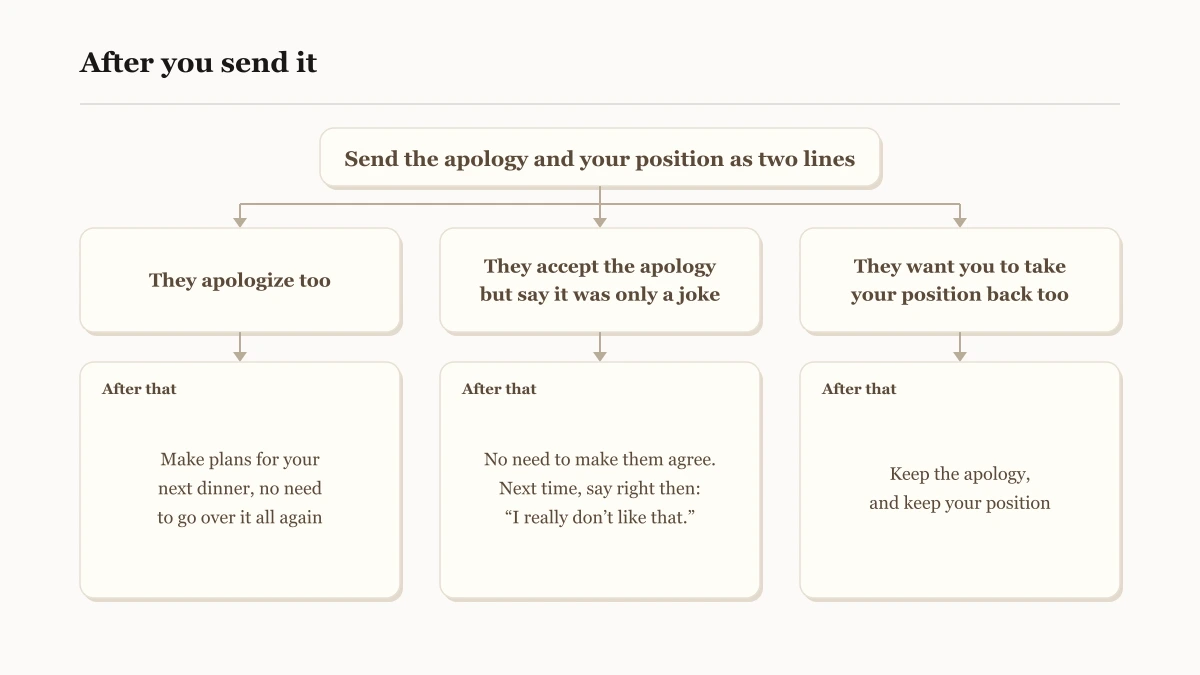
And if they don’t reply at all, my thinking is that a week is enough. During that week, don’t chase them for an answer or send anything else. If a week passes and there’s still nothing, go back to your own days, and decide whether to reach out again once you actually feel like it. You don’t need to come up with reasons for their silence on their behalf.
Keeping the friend and keeping what matters to you
From what I’ve seen, a decision like this is often so hard because the friend matters a lot to you. That’s why their joke stung as much as it did, and why your answer came out as harsh as it did. So when it’s time to clean up, you’re afraid of saying the wrong thing.
Wanting to mend this friendship is right. Wanting to hold on to what matters to you is right too. You can keep both in mind without trading one away for the other.
Keep doing the thing you care about over these next few days. If it’s drawing, go to your next class as usual and put away what you finish somewhere safe; whatever it is for you, the same goes. One fight doesn’t make it matter any less, and whether or not your friend writes back, it stays yours to keep doing.
Sources
Research and sources this essay draws on.
- Is Apology Worth the Risk? Predictors, Outcomes, and Ways to Avoid RegretJournal of Social and Clinical Psychology, 26(4), 479–504
- The Psychology of Offering an Apology: Understanding the Barriers to Apologizing and How to Overcome ThemCurrent Directions in Psychological Science, 27(2), 74–78
- Refusing to apologize can have psychological benefits (and we issue no mea culpa for this research finding)European Journal of Social Psychology, 43(1), 22–31