A Friend of Many Years Is Suddenly Drifting Away: Should You Ask, or Quietly Step Back?

“Busy lately. Maybe another time.”
The reply came a full day after you sent your message. You had walked past a new bookstore, thought of them before anyone else, and snapped a photo: “You’d love this place. Want to come with me sometime?” Last month, when you suggested dinner, you got the same answer.
You have known each other for years. You used to talk several times a week, and good news or bad, you told each other first. Over the past few months, though, they seem to have suddenly turned into someone else. There was no fight, and you can’t think of anything you did wrong. Now, looking at “maybe another time,” you are left with one question: should you ask them, or just let it go? You keep turning it over because this friend matters to you. When someone you have known this long suddenly feels far away, it is natural to feel hurt and to want to know why.
So let’s look at what might be going on with them first, and then walk through both choices, asking and quietly stepping back, from beginning to end.
What Might Be Happening When an Old Friend Suddenly Pulls Away?
A sudden pullback is a little different from slowly drifting. When a friendship drifts, you both reach out less and less, and neither of you could name the day it began. A sudden pullback starts at a particular point: something changes on their side while you are still the same as before.
A lot could be going on with them. They may have changed jobs, have someone sick in the family, be unwell themselves, have started a new relationship, or have been feeling low for a while. It is also possible that something between the two of you bothered them and they have never said so. From where you stand, all of these look alike: shorter messages, “busy” whenever you suggest meeting, the old routines no longer mentioned. That is why I think it is hard to tell which one it is just by guessing in your head.
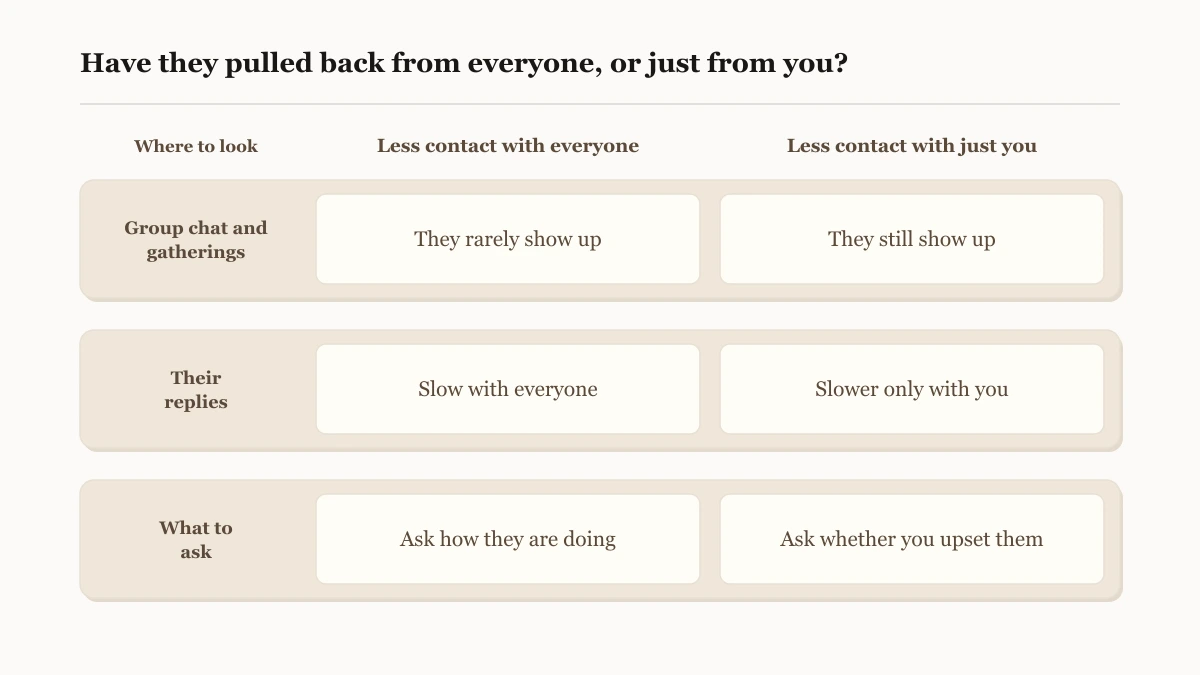
There is one question you can answer on your own, right now: have they pulled back from everyone, or just from you? You can see the answer in everyday places. Check the group chat you share, and notice whether they still speak up there. Look at the get-togethers your mutual friends plan, and whether they still come. When their replies slow down, ask yourself if that is true for everyone or only when they are replying to you. Then think about your old habits, like celebrating birthdays together every year or having dinner once a month, and whether they have dropped those with everyone or only with you.
From what I’ve seen, if they are quiet in the group chat too, rarely come to gatherings, and have gone silent with nearly everyone, it is more likely that something happened in their own life and they don’t have the energy for friends right now. If they still joke around in the group and still show up, and only their contact with you has dropped, my guess is that something is stuck between the two of you that they haven’t found the moment to say. Both are only possibilities, not answers. Still, working out which one it looks more like decides which question you ask when you reach out.
A Friend of Many Years Is Suddenly Pulling Away: Should You Ask, or Quietly Step Back?
My advice: ask once first, and then decide whether to quietly step back.
I suggest this for three reasons, starting with you. If you leave without asking, the question “Did I do something wrong?” will keep following you around. You think of them on the street or pass a place you both used to go, and there it is again. Once you have asked, even if they never answer, you know you did what you could, and that question becomes easier to set down.
Then there is their side. Friends of many years have long been used to not needing to check whether the other person is still there. My guess is that when they pulled back, they may have assumed you hadn’t noticed, or they may have had something on their mind and not known how to bring it up. The way I see it, asking this once tells them that you noticed, and that you care about them. Finally, I think asking once is lighter than you imagine. Asking is not interrogating. It is one message, or one sentence the next time you see each other, and whether they reply, and how much they say, is still up to them.
Sometimes stepping back without asking is fine too. Maybe you have already asked, and their response told you they don’t want to say more. Maybe you have realized over these months that you no longer want to keep the friendship going yourself. In either case, quietly stepping back is a decision you have thought through and made for yourself.
If You Decide to Ask
Choosing to be the one who speaks up for a friendship this long is a precious thing in itself.
Ask a Different Question Depending on Who They Have Pulled Back From
If they have gone quiet with everyone, what you want to ask about is them and how they are doing: “I haven’t heard from you in ages. How are you doing? If there’s anything I can help with, just let me know.” There is no “why don’t you ever reach out” in it, because right now they may not have room for anyone, and it is enough for them to know that one person is thinking of them.
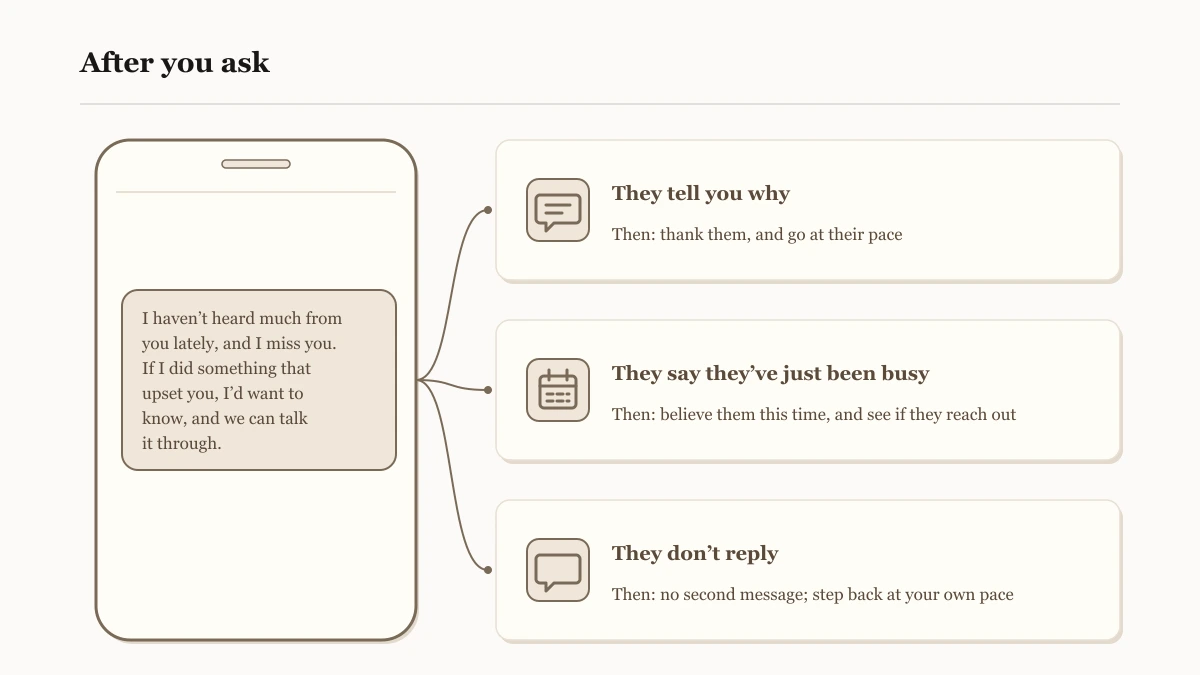
If it is only their contact with you that has dropped, ask about the two of you: “I haven’t heard much from you lately, and I miss you. If I did something that upset you, I’d want to know, and we can talk it through.” It only says what you feel and what you hope for. It doesn’t call them distant, and it doesn’t decide their reasons for them.
Ask just once. A message or in person both work, so use whatever way the two of you usually stay in touch, with no need to set up a formal time.
Three Ways They Might Respond
They tell you why. If it is something on their side, say work has been crushing them or someone in the family is in the hospital, you can reply: “Thank you for telling me. It’s been a hard stretch for you.” Don’t press for details, and don’t rush to get back to talking every day. Go at their pace, and when they have time to reach out, be there and really talk with them.
If it is something between you, for example something you once said that upset them, first thank them for telling you, then apologize for what you said that time: “What I said that day upset you. I’m sorry.” You may have had your reasons. I’d suggest not rushing to explain. Let them finish, and then slowly share what you were thinking at the time.
They say, “Oh, it’s nothing, I’ve just had a lot going on.” My advice is to believe them this time and send something with no pressure in it: “Got it. Take care of yourself, and let’s make plans when you’re free.” For the next month, you don’t need to go out of your way to contact them. Just see whether they reach out to you once. If they do, show up and catch up the way you used to. If a month passes with nothing, I would take that as their response, and you can begin to quietly step back.
They don’t reply. In my view, two weeks is enough to wait. During that time, don’t send a second message, and there is no need to keep opening the chat to see whether they have read it. If two weeks go by with no reply, you have already said out loud that you care about them, and from here you can quietly step back at your own pace.
If You Decide to Quietly Step Back
By quietly stepping back, I mean no more asking, no longer always being the first to reach out, and no need to announce “we’re not friends anymore” to them or to anyone else. The friendship doesn’t need a formal ending. You are simply taking the attention you were spending on waiting for them and slowly bringing it back into your own life.
What You Stop, and What You Keep
What you stop are the things that keep you waiting on them: asking why one more time, messaging every few days to find something to talk about, seeing them online and wondering whether they will reply. From what I’ve seen, do these for long enough and your whole mind starts circling around whether they will respond, which makes every day exhausting.
What you can keep is the warmth that belongs between old friends. On their birthday, if you want to say happy birthday, say it. If they message you out of the blue one day, reply the way you normally would. If you run into them at a mutual friend’s gathering, say hi naturally and catch up a little. Quietly stepping back is not pretending you don’t know them. It means you stop waiting for them to give you a response.
“Did I Do Something Wrong?”
Once things go quiet, this question often surfaces on its own, and you can answer it with two things. First, you asked. If you really did do something wrong, they had the chance to tell you, and you let them know you wanted to talk it through. Second, they chose not to say, so the answer is not in your hands. No amount of thinking on your own will tell you a reason they haven’t shared with you.
On nights when you can’t sleep, take a piece of paper and write down what you have done for this friendship over the years. Maybe you helped them move, stayed on the phone when they were having a hard time, or remembered their birthday every single year. Read it through once you’re done. I believe you will see that you have always taken being their friend seriously, and the silence now does not change that.
When They Show Up Again Months Later
If, after a few quiet months, a message pops up from them saying “Hey, how have you been?”, you get to decide again how to respond. You don’t have to act as if nothing happened, and you don’t have to settle the account for those months first either. I’d suggest replying the way an old friend would, then finding a moment to say: “We didn’t talk much for a while, and I was a little worried about you. Is everything okay now?” If they want to tell you what was happening during that time, listen well. If all they say is “I’m okay,” that’s fine too, and whether you start talking more often again can follow whatever pace feels comfortable for both of you now.
For a Friendship That Has Lasted This Many Years
I believe old friends find this especially hard to bring up because you stopped needing to ask a long time ago. When something happened, you told each other, and when you wanted to meet, you just made plans. You never had to check that the other person was still there. So the first time you have to ask “what’s going on with us?”, it can be harder to say to this person than to anyone else.
Wanting to know what has happened to a friendship this long comes from caring about this friend, and that care makes sense. Whether you end up asking or quietly stepping back, you are treating this friendship well, and you are treating yourself well too.
For now, you might put some of that energy into the other people around you, like having a meal with a friend you’ve been talking to a lot lately. When they come to mind, there’s no hurry to delete the old photos and messages; it’s fine to keep them. Whether to ask can wait until you feel steadier. The years you spent together still count, even with things quiet now, and for now, getting through today well is enough.
Sources
Research and sources this essay draws on.
- Keeping and Ending Casual, Close and Best FriendshipsJournal of Social and Personal Relationships, 3(3), 275–288
- Relationship dissolution in the friendships of emerging adults: How, when, and why?Journal of Social and Personal Relationships, 38(11), 3243–3264