How Do Introverts Make Friends? A Practical Way That Doesn’t Ask You to Become an Extrovert

The last time someone asked you to do something, just the two of you, was a long time ago. You worked that out when you woke up on a weekend morning with nothing planned for the whole day and opened your phone. The recent chats were notifications and big group threads, and as far down as you went there was no one you could ask, “Want to go for a walk today?”
You’ve never known where to start, and every time you stand next to a group, you can’t find a way in.
So the old question comes back:
“Is it just that introverts like me can’t make friends?”
You’ve been trying hard; those places just never left room for you
Reading this means you still want to get close to people, and that wish has been there all along. You’ve made the effort, too. You went along to a few events, replied a couple of times in a group chat, and stood beside people who were talking, waiting for a gap to say something. You were paying close attention the whole time, listening and working out what to say, but settings like that rarely leave room for you to speak. What you need is a way that works without turning yourself into a different kind of person, and that way exists.
The things you haven’t said out loud
“Everyone else seems to click right away. I’m the only one who can’t get in.”
Once a group gets to know each other, it has its own topics and its own jokes, and standing at the edge, there’s a lot to catch up on. My view is that a lot of people run into this in that kind of setting. You can certainly make friends in a group, but for an introvert, starting a conversation with one person in it is usually easier than trying to keep up with the whole group at once.
“Maybe I’m just boring, and that’s why nobody wants to be my friend.”
The way I see it, when a group is talking, the topic changes fast, and the people who talk less simply get heard less. You can only tell how interesting someone is when there’s time to stay on one subject, and group conversation rarely gives anyone that time.
“I don’t even know what to say first.”
The first thing you say doesn’t have to be interesting or memorable. All it has to do is let the other person know you’re open to talking. Where it goes after that is up to the two of you together; you don’t have to prepare the whole conversation alone.
“Should I force myself to go to more events and parties?”
If there’s an event you want to go to, go, and if you enjoy it, that’s great. My judgment, though, is that crowded settings make it easier to meet a lot of faces, while turning someone you’ve met into a friend takes one more step, and that step rarely happens around a crowded table. So when you don’t want to go, you don’t have to treat parties as the only road to friendship.
“Can I still make new friends now that I’m grown?”
Yes. I believe that once we’re grown, friends rarely just appear. Someone usually has to speak first, and that someone can be you, in a way that suits you.
What introversion is, and why group conversation is so tiring
What introversion is
Introversion is about where a person gets their energy back. Extroverts often feel more energized the longer they’re with people. Introverts, even after time with people that they enjoyed, need a stretch on their own before they feel like themselves again, and the more people and the faster the topics change, the longer that stretch.
Introversion, shyness, fear of people and not liking people are different things. Shyness is worry about how you come across. An introvert can talk to people with ease and can like someone very much; they just need rest afterward. I see introversion as a temperament, the way some people are early risers and others are night owls. Neither is better, and neither needs fixing. If you haven’t made friends yet, I don’t think the problem is this temperament. It’s that you’ve been trying to make friends in the middle of group conversations, which happen to be the setting that tires introverts out the most.
Why group conversation is so tiring
This is how I see it: in a group, the topic keeps moving, and every time it moves you have to catch up again: who are we talking about, where are we in the story, is there room for me to say something. Most of your attention goes into keeping up, and what you actually wanted to say never quite gets said. More people means more to track, like who just finished, who hasn’t spoken, whose joke you didn’t get, and each of those takes a little of you. When the talk stalls, you rush to find something to fill the silence. By the time everyone leaves you’ve spent a lot, yet you can barely remember what you really talked about, or with whom, and you haven’t grown any closer to anyone.
How introverts make friends: find one person, and invite them to do one thing with you
That’s the answer: find one person, and invite them to do one thing with you.
Before anything else, think back to this: “The last time you spent time with someone and didn’t come away drained, what was the setting?” It’s fine if it was a long time ago, or only lasted a short while. My guess is that the picture you have shares a few things: only one or two people, something to do with your hands, no pressure to keep talking. That picture is your way of making friends.
Time like that is less draining because the conversation follows what’s in front of you: the colors in this painting, how salty the noodles are, whether to turn down that street. You don’t have to come up with a topic, and quiet stretches aren’t awkward, since you’re both looking at the same painting or eating at the same place; the quiet is part of doing something, not a conversation that died.
From what I’ve seen, this is often when an introvert’s real thoughts come out. You’re walking along, and suddenly you’re talking about what’s been bothering you lately. You’ll still be tired afterward, but you’ll remember what you talked about, and you’ll feel a little closer to this person. The thing you do together is only a reason to meet. The one you want to know is, and always was, the person who came along.
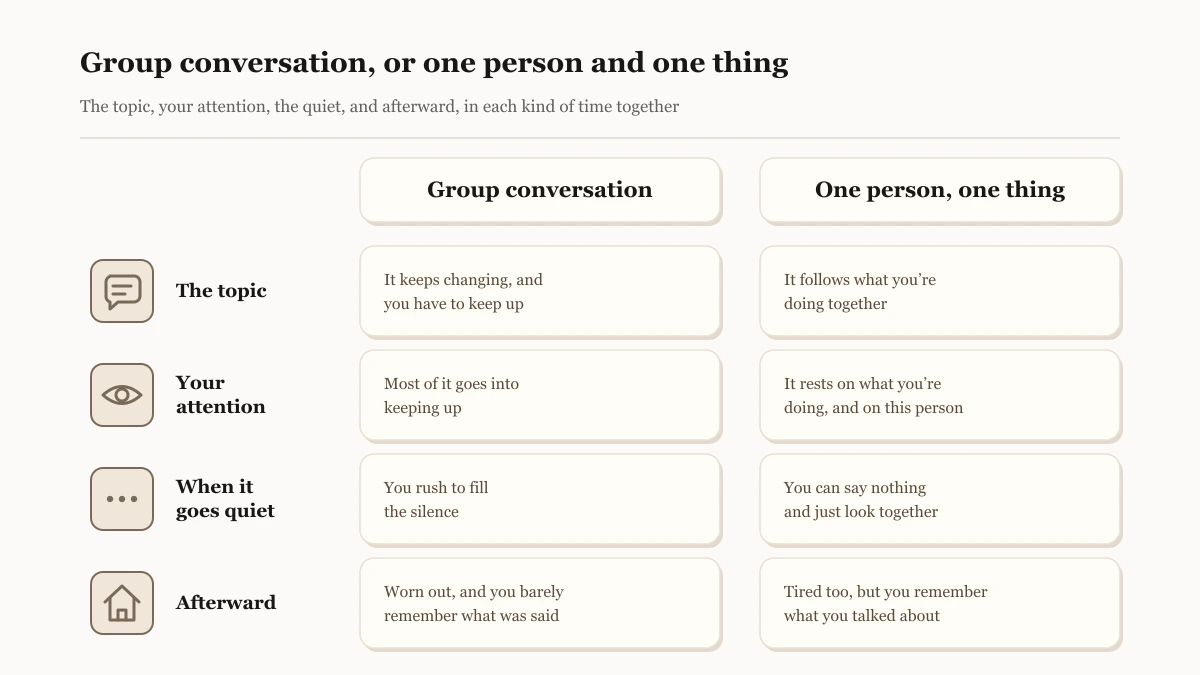
When the title says you don’t have to push yourself to become an extrovert, here is what I mean. There’s more than one way to make friends. A lively crowd is one way; two people doing one thing together is another, and you can simply choose the one that doesn’t drain you. If someday you feel like trying to say a bit more at a party, that’s good too. It just isn’t your only way in.
What to do: find that one person first, then invite them to do one thing
You don’t need to learn how to talk in a crowd first, or become good at small talk. Starting today, you can take it one step at a time.
Step one: find that one person. Look in places you already show up again and again: the same class every week, the same club or activity, the shop you keep going back to, an online community where you regularly post. In one of those places, is there someone you’ve seen many times, traded a sentence or two with, and don’t mind being around? They don’t have to be close. One person like that is enough. I’d start with people from places like these, because you’ll see them again, so you get more than one chance to speak.
Step two: open with what’s in front of you. Make the first thing you say about something you can both see. In a class, you might ask, “Did you find this session’s material hard?” In a shop, “Do you come here a lot too?” Then leave it there; you don’t have to force the conversation to keep going. Next time you see them, say one more thing. After a few times, the two of you have something to pick up from.
Step three: invite them to do one thing. Pick something with a clear start and finish, like an exhibit, a restaurant you’ve wanted to try for ages, or a walk. I’d go for something that ends at a set time, because you know when you can go home and rest, which makes saying yes easier. The same is true for them. Then send it: “I want to see that illustration exhibit Saturday afternoon. Want to come with me?” There’s a time, a place and one thing to do, so all they have to say is yes or no. You’re inviting this one person, not rounding up a group. If you live far apart, or mostly keep in touch by message, you can still plan one thing: watch the same movie at the same time in your own places and talk about it afterward, or play a game together.
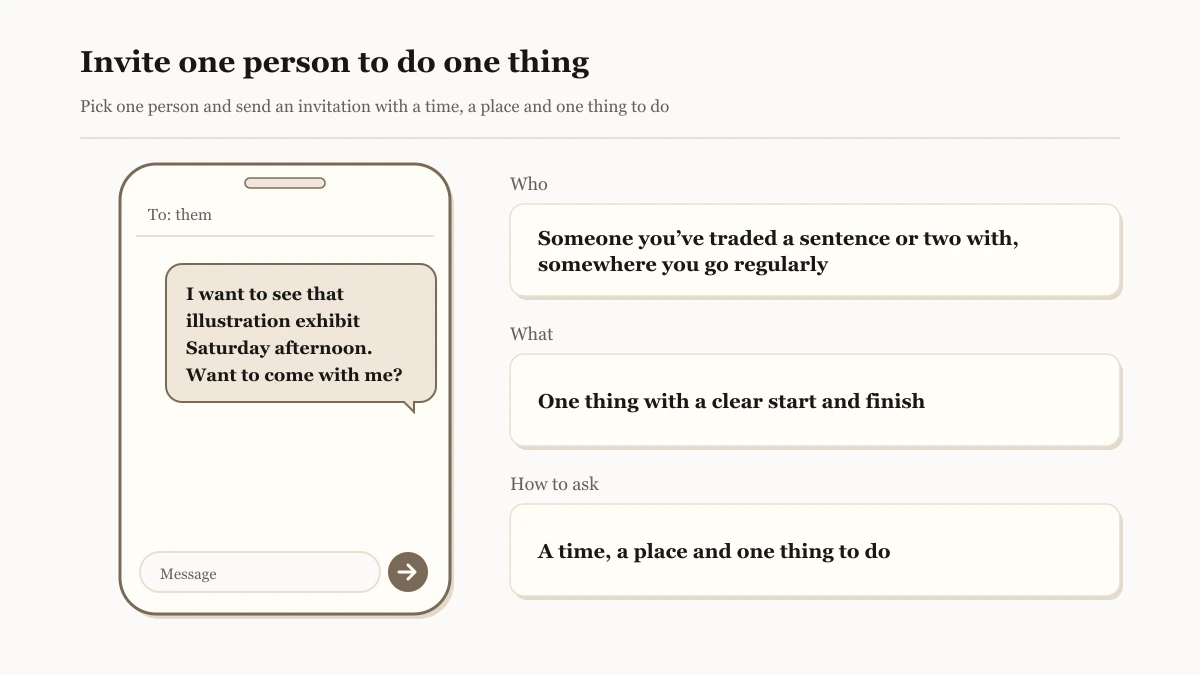
After you meet, keep some time for yourself, and don’t apologize for it. Wanting a quiet evening at home afterward is the rest your temperament needs. I’d suggest building that rest into the plan from the start, say, meet in the afternoon and keep the evening for yourself, so that once you’ve rested you have the energy to ask again.
The moment that message goes out, you’re already making friends your own way.
The four things you’ll really want to ask next
What if they say they’re busy?
Busy means the timing didn’t work this once. I’d wait a few days and ask again with a different time or a different plan, something like, “How about the weekend after next? And if there’s somewhere you’ve wanted to go, tell me and we’ll go together.” If two tries don’t work out and they don’t suggest another time, I’d put my energy toward someone else for now, without trying to guess why. As I see it, not every invitation lands, and one that falls through doesn’t have to prove anything.
What if we run out of things to say while we’re out?
In my judgment, having something to do makes quiet less awkward. When you do want to say something, talk about what’s right in front of you: “Which one did you like best?” or “What do you think of the soup here?” You don’t need a fresh topic. The few minutes you spent not talking, you still spent together.
We’ve met once. How does that turn into a friendship?
Ask again, and be the one to ask this time too. You can say it as you part, “Next time let’s try that place you mentioned,” or send a message once you’re home: “I had a really good time today. Want to go to the market next month?” To my mind, friends get closer one meeting at a time, just the two of you, and you don’t have to wait for one conversation that goes especially deep.
What if I don’t have a single person I could ask?
Then start by giving yourself a place you show up regularly. Choose something you’re already interested in that meets at the same time every week: a class, a reading group, a small sports or craft group, or an online community that gathers at a set time. I’d pick a smaller one, so that the same few faces keep turning up. You don’t need to rush to invite anyone. Just keep going, and each time say hello to the same person. Once you’ve talked a few times, you have the one person you can ask.
Making friends your way
You may think you can’t make friends because you’ve kept trying to squeeze into the middle of a group. That way wears you out and makes it hard to get close to anyone, so you assumed the problem was you. Wanting friends is a completely reasonable thing to want. Once you switch to one person and one thing, either the plan happens, and you have your first person you can be quiet with, or it doesn’t, and you’ve still gone from having no one to ask to knowing who to ask next and what to ask them to. Either way, you’re making friends as the person you already are, without having to swap yourself out first.
If you’re still on your own right now, there’s no rush, and it doesn’t mean you have any less to offer than anyone else. The way you listen in those settings and keep working out how to join in, that care has always been part of you, and it’s what you’ll bring into every friendship you have. Before you send that first message, you might rewrite it several times and hesitate for a long while. That’s okay; if you hesitate and still press send, that already takes courage. Going slowly is fine too. One person at a time, one thing at a time, and every step you take counts.
Friendships don’t only start in the loudest room. Some start on a very quiet walk, because you were the one who asked.
Sources
Research and sources this essay draws on.
- Happy Now, Tired Later? Extraverted and Conscientious Behavior Are Related to Immediate Mood Gains, but to Later FatigueJournal of Personality, 85(5), 603–615
- Would introverts be better off if they acted more like extraverts? Exploring emotional and cognitive consequences of counterdispositional behaviorEmotion, 12(2), 290–303
- Costs and benefits of acting extraverted: A randomized controlled trialJournal of Experimental Psychology: General, 148(9), 1538–1556