It Took Losing Someone to Learn How to Cherish

It is eleven at night when you remember the message they sent this afternoon. You open it. Underneath it there is no second message, no “what are you up to,” not a single question mark. Just one line: “No worries, you’re busy.”
It did not use to be like this. They used to send three, ask where you were, get a little annoyed, and then you would write “sorry, was busy” and they would be fine. You look at that “no worries” and first you feel relieved, and then some very small place inside you feels off, in a way you cannot quite name. You will probably file it under one sentence: do they finally need me a little less?
This piece is here to help you look at that small, off feeling. In my experience, it is often the last early warning a person gets.
Someone who is always there is the easiest person to turn into background
Let me say one thing first. You do not need to sentence yourself before reading on. You care about them. You just care quietly, so quietly that you have stopped noticing it yourself.
Nobody cherishes their own breathing every day, or the tap in their kitchen, or a person who has never once not been there. They have always been there, and always so reliably that they became the backdrop. Whether you replied or not, they were there. Whatever you forgot, they were still there. Give it enough time and you look at them the way you look at the clock on the wall: you glance up when you need it, and the rest of the time it just hangs there.
I would put it this way: the opposite of cherishing is not hurting someone. It is getting used to them. You did nothing to them. You only got used to their being there. And getting used to someone has one quiet problem: it stops you from seeing that they are changing, because you have not really looked at them in a long time.
Cherishing needs one thing first: knowing they could be gone
I have always thought that people only cherish what they know they can lose. You feel the last days of a holiday slipping away, and you hurry to use a ticket before it expires, because you know these things will run out. You do not cherish the tap in your kitchen, because it is there every day, and water comes out whenever you turn it. They are that tap. They have always been there, so it has never crossed your mind that one day they might not be.
Of the people I have known, most learned this only after the loss. The relationship ends, the other person leaves, and only then do they see how much this person was giving them, and that none of it is coming back. That is the most expensive way to learn it, so expensive that by the time you have learned it there is no longer anyone to use it on.
But you do not have to actually lose someone to learn that they could be gone. You can think it through right now: if they were not here tomorrow, what would drop out of your days? The more specific you get, the more clearly you see what they are giving you right now. You do not need to lose them before you can learn to cherish them. You only need to work out, now, what would be missing if they were gone.
The three things they are doing now, which you have probably read as good news
Back to that “no worries, you’re busy.” I want to walk you through three things. They usually do not happen on the same day. They grow over months, and every one of them is easy to read as good news.
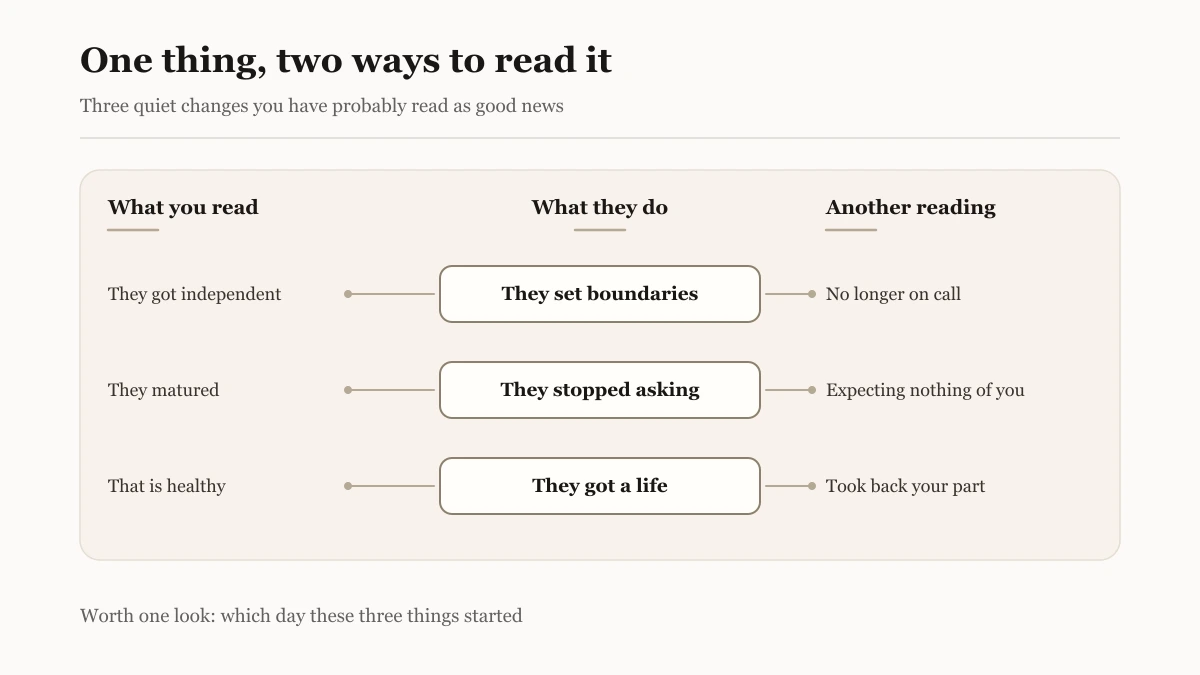
They have started having boundaries
Before, if you texted “still up?” at eleven, they always answered. If you said where you wanted to go this weekend, their plans moved around it. Now they say “let’s talk tomorrow,” or “I’ve got something on that day,” or “go to sleep, I still have things to do here.”
What you probably read is: they have finally become independent, they no longer orbit you. There is something nice about that reading, but I would ask you to look one layer further. It is not that they had no boundaries before. They kept their boundary on your side and trusted you not to overuse it. Now they have taken it back, because they waited for you too many times, and every wait moved them back half a step. One thing here is worth remembering, and it is my own judgement: a person who still says “let’s talk tomorrow” still intends to have a tomorrow with you. As I see it, someone who truly does not want to come does not need a boundary. They simply stop showing up.
They have stopped asking
Before, they would ask why you had not replied, remind you what day it was, and make sure you knew they minded when you forgot. Now, when you forget something, they say “no worries.” When you are late, they say “it’s fine.” When you do not do the thing you promised, they do not bring it up.
What you probably read is: they have finally matured, they have stopped keeping score. I read it differently. A person asks because they believe asking works. When they stop asking, it is usually because they have already written your answer for you, so there is no point. “No worries” sounds like they are letting you off. It is really them letting themselves off, taking their expectations back one at a time, until there is nothing left to be disappointed by. This is how I read it: the number of times they have said “no worries” is the number of times they have stopped expecting.
They have turned their attention back to their own life
Before, their weekends were kept empty for you. If you were free, they were free. Now they have signed up for a class, they have a standing time with friends, they have weekend plans you did not know about, and when you ask them out at the last minute they have to check.
What you probably read is: they finally have a life of their own, and you may even think that is healthy. Having a life of one’s own is a good thing. But “having a life of their own” comes in two kinds, and the difference is whether they bring it to you on their own. If it is a life they have newly added, they will want to share it: after the class they tell you what they learned, how funny the teacher was. If it is a life they have taken back from you, they do not mention it; where they went and who they were with, you only find out when you scroll past it in their posts. The kind they tell you about means their world got bigger. The kind they keep quiet about means they have taken away the part that used to be kept for you.
For these three things, look at one place
Taken one at a time, all three look like good news, and they really can be good news, if that is who they want to be. I would suggest you look at only one thing: when it started. If you can trace it back to a time you did not reply, a time you forgot, a time you made them wait until they gave up, then these three things are not growing up. They are packing up.
And I owe you one honest sentence, and it is my own reading: the fact that they are still doing these three things means they are still here. As I see it, someone who has truly left does not need to set boundaries or take back expectations. They are simply gone.
If they were gone tomorrow, what would be missing
This is the one thing I most want to ask you to do tonight. It takes ten minutes.
Do not think “I would be sad.” That is too vague to produce anything. Think in specifics. Tomorrow morning, who would send you a good-morning message? When you forget to bring something, who would remind you? When you work late, who would ask whether you have eaten? When you cannot sleep and send a message at two in the morning, who would answer? The thing you mentioned only once, who would remember it? Go through them one at a time. Whichever one makes you stop is the one you are currently overlooking.
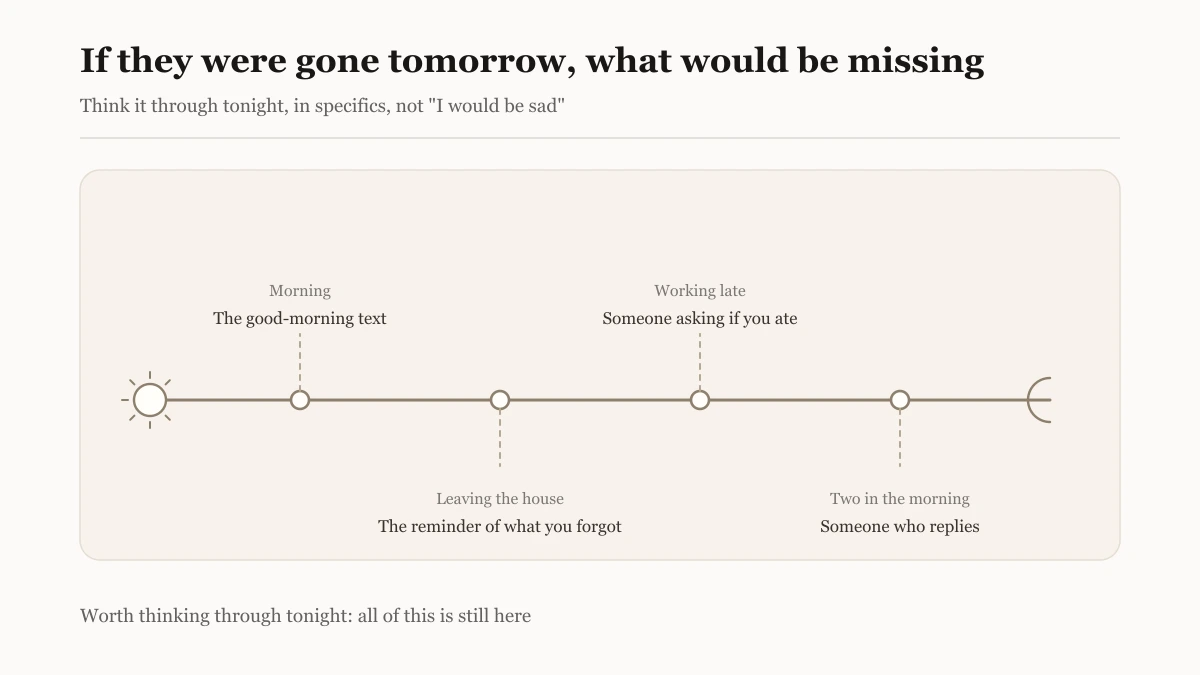
When you are done, keep the list. It is not there to make you sad. It is a map. Every item on it is something they are still doing for you right now, and every item is a place you can go back to today. They send good morning, you reply with what your day looks like. They remind you to take something, you tell them you have got it. They ask whether you have eaten, you tell them what you had. As I see it, cherishing has never needed a grand gesture. It is simply going back, once, to every item on that list.
The three things you will actually ask next
“They have already started pulling back. Is it too late?”
Look at whether they are still doing those three things. My judgement is that a person who is still setting boundaries, still saying “no worries,” still taking back their own life, is still on the road. They have not finished walking it, because as I see it, all three are things people only do for someone they still care about. What you have to catch up with is not their heart. It is their pace. For every step they take back, you put one thing back, and what you put back is not a gift. It is one of the small things you skipped.
“Does cherishing mean I have to text all day and be on call?”
Cherishing is not about frequency. It is about seeing. You do not need to text every hour. You only need to answer when they text, remember when they tell you something, and show up on the day they are sick. I believe what they want has never been you on call around the clock. It is you being present when you answer, and actually listening when you listen. Piling time onto someone and putting attention on them are two different things. They get confused all the time, and what they want is attention.
“What if I do all this and they leave anyway?”
That can happen, and I will not tell you that putting things back guarantees they stay. But if it does come to that, you will not be the person who learned to cherish only through loss. You will be the person who tried while there was still time, and those two people walk out of it looking completely different. What you learned will stay with you, and next time you will not have to pay such an expensive price for it.
Do not wait until you have lost them to learn to cherish them
“It took losing someone to learn how to cherish.” I have heard many people say it, and every one of them said it calmly, because by then they had no other option. I do not want you to become one of the people who say it, so I want to end with a few things you can do, all of them today.
Treat “no worries” as a reminder, not as a pardon. Every time they say it, there is a skipped thing underneath. Start with the most recent one: whatever they wanted to tell you this afternoon, reply tonight and ask how it turned out. You do not need to apologise. You need to go back to the thing itself.
When you reply, reply to the content. What they want is not a fast answer. It is an answer that shows you understood what they said. When they say they are exhausted, do not send a sticker. Ask why. When they share something small, ask one more question. This is tiny, so tiny you will think it does not count, but I believe it is exactly how they tell whether you are looking at them.
Once a week, fit yourself around their time. Until now they have fitted around yours: when you were free, they were free. This week, turn it around. Ask which day works for them, keep that day clear, and plan nothing else. They will probably pause for a second, because it has been a long time since anyone treated them that way.
And there is one sentence, if you can get it out, that I would suggest you say: “I know that when you say ‘no worries’ it is not really no worries. I’ll reply from now on.” It is not long, but it tells them the one thing they have been waiting a long time to hear, which is that you have seen it.
I believe cherishing is not something you do after the loss. It is something you do a little of every day while they are still here. You do not need to buy an expensive gift or turn into a different person. You only need to answer when they write, listen when they talk, and know, when they say “no worries,” that it is not really no worries.
They are still here. That sentence is still in the present tense. It is worth taking a good look while it still is.