What Loss Taught Me About Love, Regret, and Letting Go

One of the hardest parts of loss is not simply that someone is gone. It is what their absence seems to say about everything that came before it. If the relationship ended, what was the love worth? If I understand my mistakes only now, what can that understanding possibly change?
You may miss them and feel embarrassed for missing them. You may know that the ending has happened and still rehearse different versions of the past. You are not choosing to be stuck. You are trying to understand something that mattered, because you do not want it to collapse into one brutal word: failure.
In one study of people who had recently experienced a breakup, participants named an average of five kinds of personal growth that they believed could improve a future relationship. That result does not require you to call every loss a gift, and it does not mean pain automatically makes anyone wiser. It offers a smaller, kinder possibility: grief and learning can exist at the same time.
What loss teaches us is rarely a perfect sentence. More often, it becomes a choice we make differently later. You do not have to redeem the ending in order to carry that choice forward.
Love can have been real without being able to stay
After a relationship ends, the ending can begin rewriting the entire history. If it did not last, perhaps I misread everything. If they left, perhaps every loving word was false. If I am still hurting, perhaps the relationship only wasted part of my life.
But “it did not stay” and “it never existed” are not the same sentence.
Someone may truly have listened to you, reached for you when you were frightened, and imagined a future beside you. Those moments do not disappear because a later decision changed the relationship. The reverse matters too. Real love does not excuse later neglect, dishonesty, control, or incompatibility. The love can have been real. The harm can have been real. A memory can matter, and leaving can still be the right decision.
Loss did not teach me that love is useless. It taught me that love is more than intensity. It includes whether two people can name their needs, respect a no, preserve each other’s dignity in conflict, repair what they damage, and keep moving toward lives that can still meet.
Instead of asking only, “Why was it not forever?” you can ask questions that produce something you can keep:
- What did I give naturally and generously in this relationship?
- Which boundaries did I abandon because I was afraid of being left?
- When did I feel seen, and when did I repeatedly make myself smaller?
- What truth would I want to say sooner next time?
These questions are not a report card for the relationship. They simply make room for a translation of “I loved” that is larger than “I failed.”
Regret keeps returning when it believes something may still be changed
Regret has a favorite phrase: if only. If only I had not said that. If only I had noticed their disappointment sooner. If only I had asked one more question. If only I had stayed that night. The mind keeps reopening each turning point as though enough thought could locate a hidden path back into the scene.
A body of work comparing people’s major life regrets proposed an “opportunity principle”: regret tends to persist where people still perceive room for corrective action. When a door looks even slightly open, the mind keeps simulating what it could do differently.
That helps explain why regret is sticky. It does not mean regret is always telling you to return. It may point toward an apology that is still appropriate. It may instead be teaching you that, in a future relationship, fear cannot keep turning into silence or pressure. “I know how I could behave better” and “I should persuade this person to take me back” are different conclusions.
Before you act, I would ask a few quiet questions. Is repair genuinely available? Would contact care for the other person, or mainly relieve my guilt? If they have clearly asked for no contact, can respecting that boundary become part of what this loss teaches me about love?
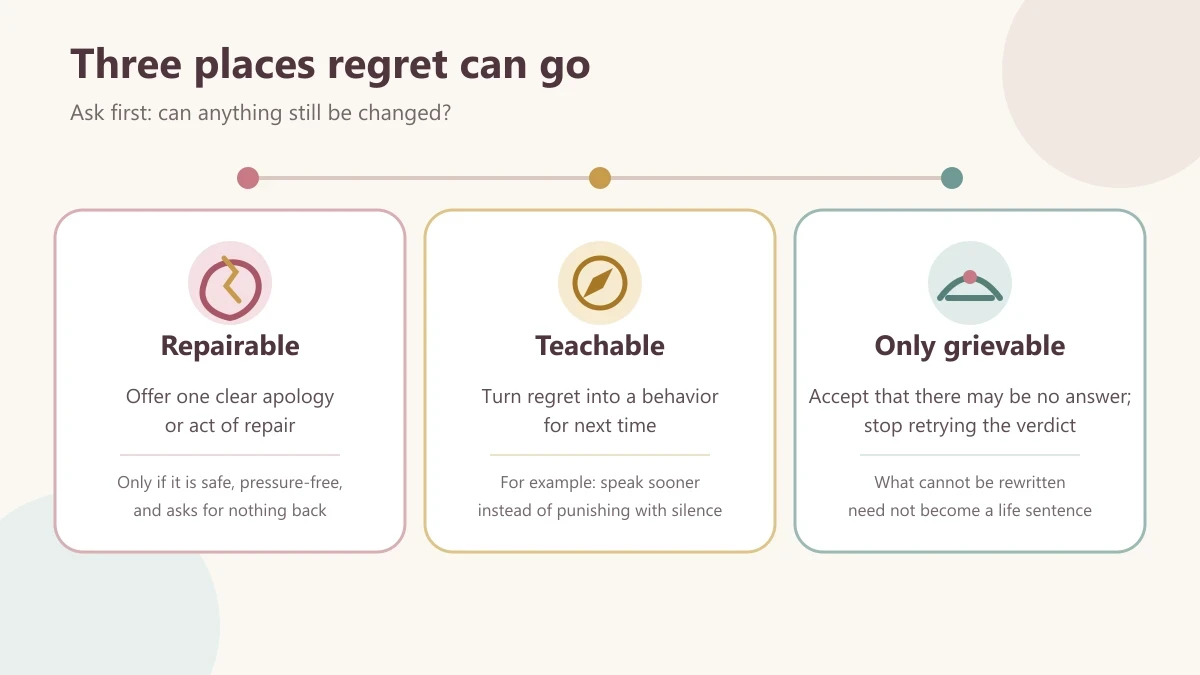
Regret needs more than one destination
I sort regret into different places, because not every regret should receive the same response.
When repair is possible, make one clean repair
If you harmed someone, contact is safe, and you would not violate a boundary by reaching out, you can offer one specific apology. Name what you did. Name the likely impact. Explain what will change. Do not hide a bargain in the final sentence, and do not require immediate forgiveness.
“I am sorry I hurt you, but I only did it because I loved you so much” returns the burden to the person who was hurt. A cleaner apology sounds more like this: “You asked for space, and I kept sending messages to pressure you, which did not respect your boundary. You do not need to respond. I will stop contacting you, and I am working on what I do when anxiety makes me chase reassurance.”
An apology can complete your responsibility. It cannot purchase a new ending. Whether the other person replies, forgives, or moves closer remains theirs.
Repair may also be impossible because the safest boundary is distance. If there was abuse, coercion, stalking, a request for no contact, or any reason communication would be unsafe, do not turn the language of closure into permission to enter someone’s life again. A letter you do not send can still clarify what you are taking responsibility for. Respecting a closed door may be the repair that is available now.
When repair is over but learning is available, convert regret into behavior
“I will never ruin anything again” is too large to guide you. It is also likely to vanish the next time you feel threatened. Rewrite it as an action another person could actually observe.
Do not stop at “I will communicate better.” Try: “When I notice that I am about to shut down, I will say: I am tense and afraid I will say something hurtful. Give me time to settle, and let us finish this conversation tonight.” Do not stop at “I will never lose myself again.” Try: “I will keep time with my friends and one interest that is mine even when I fall in love.” And do not merely say, “I will care more about your feelings.” Try: “When someone says that something I did hurt them, I will ask which part affected them most, listen to the answer, and only then explain my view instead of rushing to defend myself.”
What regret can usefully leave behind is not a harsher opinion of yourself. It is a clear answer to this question: when a similar difficult moment comes, what will I do differently?
When nothing can be repaired, allow the regret to be grief
Some losses have no entrance. The other person does not want another conversation. Time cannot reverse. You made a decision with what you knew then. Or the relationship reached a place where love could not create a shared direction. Repeatedly blaming yourself will not reveal information you did not have at the time, and it cannot rewrite what has already happened.
This kind of regret may need an acknowledgment rather than a solution: “I wish I had acted differently, and this can no longer be rewritten by the person I am today.” That is not evading responsibility. It is refusing to use indefinite suffering as proof that you finally understand.
Allowing regret to be grief means admitting that some pain has no next step to perform. You may still remember what was left unsaid, the timing you missed, or the future that will not happen. When the memory returns, you do not have to find another explanation or force it to teach you something. You can simply say, “I truly wish this had been different, and that is why I am sad.”
Grief is different from putting yourself on trial. Grief acknowledges that something important was lost. Self-prosecution drags you back into the past and demands that the person you were then make a choice available only to the person you are now. Grief rises and falls and can gradually loosen. A trial only keeps reopening the same case.
When this regret returns, I would not begin with, “What else can I do to fix it?” Ask instead, “Is there one action left that respects reality and cares for me?” If the answer is no, today’s task is not action. Let the sadness stay for a while, then shower, eat, sleep, and allow ordinary life to keep caring for you. Letting it be grief is not giving up on responsibility. It is recognizing that responsibility has reached its end, and what remains needs time rather than more punishment.
You do not have to turn pain into a perfect story
After loss, many people write and analyze relentlessly because they want one complete explanation. Writing can give edges to chaos. But not every form of writing leads away from rumination.
Pay attention to what your journal does next. If every entry makes you more likely to check their profile, more certain that you are unforgivable, or more determined to solve a question the other person has already answered, “going deeper” may not be the only path.
I would keep the page brief and give it a stopping point:
- Fact: Write what happened without guessing a motive.
- Regret: Name only the part that belongs to your responsibility.
- What I will do next time: Turn “if only I had…” into a concrete response, such as “Next time I am upset, I will speak before silence takes over.”
- Today: Name one task that returns you to your life, then close the notebook.
Closing the notebook matters. You are not required to discover the final meaning of an entire relationship tonight. You are giving this evening an exit.
Letting go is not forgetting; it is ending the past’s authority over today
Many people imagine letting go as memory deletion. You will no longer think of them, feel pain, or react to their name. Until then, you have not succeeded. That standard turns every memory into evidence that you have gone backward.
But a feeling can return without requiring you to return with it. You can miss someone and not reopen the conversation. You can admit that love remains without handing your worth to their next reply. You can mourn the future that never happened and still make plans for a day that no longer waits for it. If your question is less about regret and more about why your feelings remain after reason has accepted the ending, this essay on reason, attachment, and imagined futures may help.
Work on breakup and the self-concept helps explain why reducing reminders is only one part of letting go. Across several studies, relationship endings changed not only the participants’ sense of “us” but also the content and clarity of “me.” Lower self-concept clarity was linked with greater emotional distress.
The breakup may therefore remove more than a person. It can remove shared friends, the shape of a weekend, a familiar role, and the version of yourself who expected a particular future. Looking at their profile less may quiet an immediate trigger, but it cannot answer, “Who am I, and how do I live, without this relationship?” Those parts of life have to be rebuilt rather than merely avoided.
Part of letting go is making your life wider than the loss again. This is not a performance designed to prove that you are thriving. It is the gradual return of identities that do not require the other person’s approval: friend, sibling, worker, artist, teammate, reader, gardener, volunteer, or simply the person who can make dinner and keep a promise to tomorrow’s self.
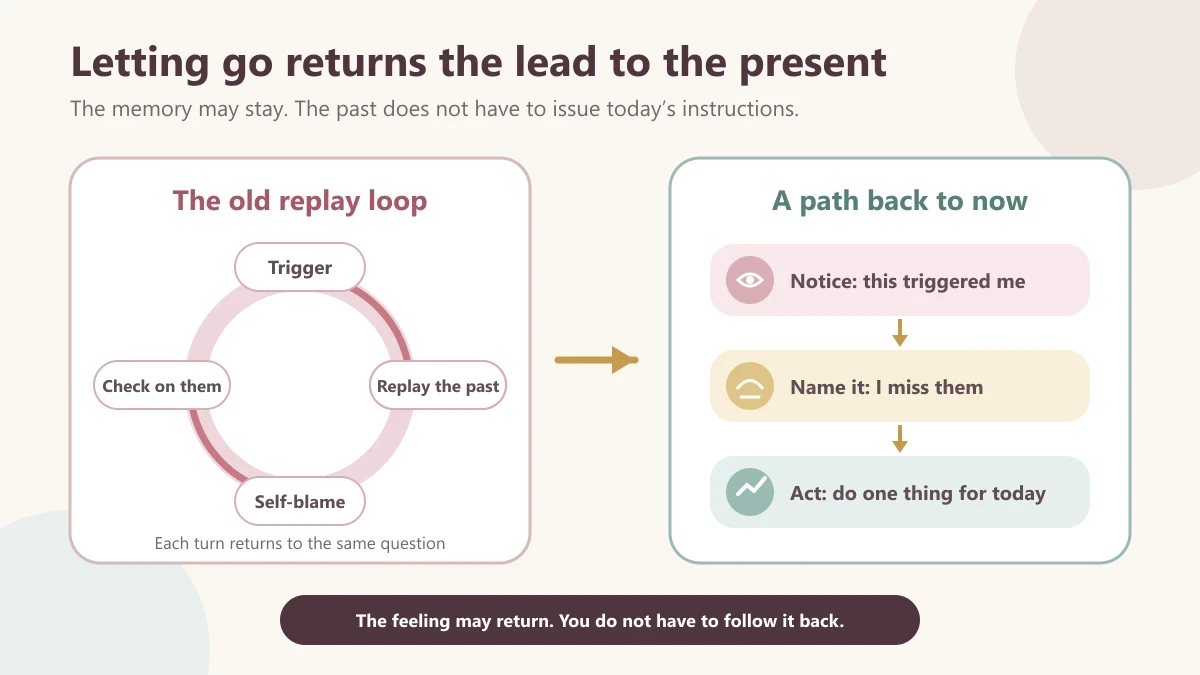
When a song, a street, or a notification triggers you, try not to begin with, “Does this mean I have not let go?” Say something more precise: “This image makes me miss them.” Then ask: “Do I need comfort, company, movement, food, sleep, or simply more distance from my phone right now?”
Name the feeling, then choose one present-tense action. Eat a normal meal. Reply to the friend who has kept checking in. Prepare what you need for the morning. Finish something unrelated to the relationship that helps you trust your own follow-through again.
None of these actions is dramatic. None guarantees that tomorrow will be painless. Their purpose is to return the next decision from memory to you.
What love leaves behind is larger than one person’s place
Loss may show you that you are capable of caring for someone with astonishing depth. It may also show you that you once confused endurance with loyalty, guessing with empathy, or hiding your needs with maturity.
You do not need to throw away your capacity to love deeply because one relationship ended. What needs to change are the habits that made you increasingly small, silent, or afraid to tell the truth. You can still give yourself wholeheartedly next time without using self-erasure as proof of love.
Love does not have to be declared false because it ended. Regret does not have to become a life sentence because it is real. Letting go does not have to be purchased with forgetting. Eventually, all three may become visible choices: tell the truth sooner, respect an answer you did not want, refuse to disappear in exchange for company, repair what you damage, and stop when repair is not yours to force.
You do not have to thank the loss. You only have to refuse to give it the rest of your life as well.
If tonight is still difficult, care for tonight. Leave the unsent message in drafts. Close the notebook. Do one thing that lets your body know, “I am still here.” Letting go is rarely an announcement that the work is complete. More often, it is the choice—made again and again—to return to your own side.
You do not have to believe tonight that the pain will disappear soon. Begin with smaller beliefs that you can act on: you can eat the next meal, tell the truth to one reliable person, pause before reaching back, and spare tomorrow’s self from carrying every impulse you feel tonight. Each completed act reminds you that this ending matters, but it does not make the final decision about your life.
Loving someone did not turn you into a person who can only wait. You still get to choose how you love, whom you move toward, which boundaries remain, and when to trust your own judgment again. Letting go is not deleting someone from your heart. It is gradually returning room in that heart to you, so that new days, new relationships, and new possibilities will have somewhere to enter when you are ready.