When Love Becomes a Memory: Learning to Live with Loss

They always said the salt goes in last.
So on a weekend afternoon, making that soup the way they used to, you stopped with your hand halfway to the salt. The radish was already in the pot. When the soup was done, you reached for your phone out of habit to snap a picture and send it to them, and only stopped once the chat was open. Sitting at the table, one question came up:
“They’re gone now. Where do I put all this love I have for them?”
You ask that because you still love them very much. The flavors they liked, the way they talked, the jokes only the two of you understood: you still remember all of it clearly.
The questions you have not said out loud
“It has been this long. Shouldn’t I be better by now?”
I believe missing someone has no set day when it is supposed to end. You can go to work, eat, and go out with people as usual, and still suddenly miss them very much at some point. That missing shows how much they have always mattered to you.
“Everyone thinks I’m fine now. Am I still allowed to be sad?”
Yes. Other people see how you are during the day. They do not see the moments when you think of them in the middle of the night. When you feel sad, and for how long, does not need anyone else’s approval.
“I can laugh again. Is that fair to them?”
Laughing and loving them can both be true at the same time. Here is how I see it: when you laugh, they do not weigh any less in your heart. Sometimes the thing that makes you laugh is remembering something funny they did.
“I think of them less often now. Does that mean I love them less?”
I do not think so. Right after you lost them, you thought of them almost constantly, because everything was still so new. Over time, you may think of them less often. But each time you do, you still remember their face and their voice, and how much you care has not shrunk at all.
When love becomes a memory, where does that love go?
While they were here, your love for them had plenty of concrete things to do. You shared meals with them, waited for their calls, listened to them talk about their day, remembered the foods they liked, and went with them to your usual places. All of that happened day after day. You did not have to think about it; the love simply had things to do.
After they died, those things stopped being possible, one by one. The love is still there, but everything that used to hold it has stopped. So it often turns into a sudden wave of missing them, or an evening when you want to send a message and do not know who to send it to.
In my view, when you still feel this sad after so long, it is often because the love is still there, and you do not know what to do with it.
What does it mean to live with loss?
My answer: the loss does not go away. Learning to live with it means letting it become part of your life, and carrying your love for them with you as you go on living your own days.
Right after they died, the loss was nearly your whole life. Your first thought on waking was that they were gone. You were sad while eating, while walking, before bed, and it was hard to do much else.
After a while, you went back to work, ate with other people, and even laughed at some small thing. But the missing did not leave. It started coming in waves instead. Sometimes you can see it coming, like on their birthday. Sometimes it arrives without warning, like when you spot the tea they loved on a supermarket shelf.
So living with loss does not mean waiting for the day you stop missing them. It means accepting that the missing will keep coming, without treating it as a setback. To me, it looks like this: when you miss them, you let yourself be sad for a while, and when that passes, you go back to whatever you were doing. Grief and everyday life take turns within the same day, and both of them are part of living well.
It also does not mean going back to who you were before you lost them. They were part of your life. Your tastes, your habits, even the way you talk were partly shaped alongside them, and none of that needs to be scrubbed away. Your love for them does not have to end either. It can carry on in a different form: not sharing meals or waiting for their calls anymore, but remembering them and thinking of them in the middle of your own life.
Think about this: “The last time you missed them badly, how did you get through it?”
Maybe you cried by yourself. Maybe you scrolled through their photos all night. Maybe you held it together and pretended you were fine. As I see it, all of these reactions are normal. But if every time you have to grit your teeth and get through it alone, you can prepare a few things for those moments ahead of time.
What to do: let this love carry on in a different form
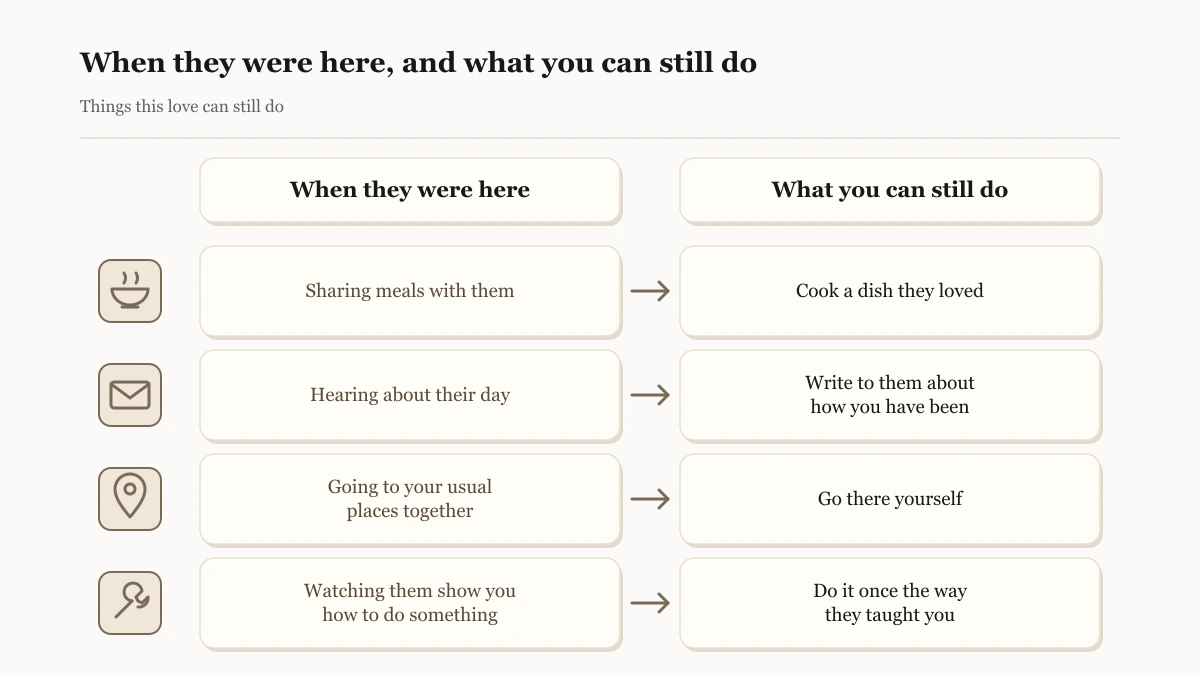
You have carried this love a long way already. None of the things below is big. Pick one you can manage right now.
Do something they taught you
Maybe they taught you how to make a certain dish, or how to fix things, or a small habit they kept every day. Maybe it was a phrase they always used to remind you of something when things got hard. Pick one and set aside a time this week to do it. While you do it, you will be using their method and following their order, and sometimes even their catchphrase will slip out. I think of these as things they left you that you can still use today.
Go to a place they often went
It might be the noodle shop they always went to, the road where they liked to walk, or the stretch of sea they had to visit once a year. You can go alone, or bring someone who also knew them. Once you are there, you do not need to do anything in particular. Sit for a while, order the noodles they would have ordered, and look at the view they used to look at. If the place is far away, you can find it on a map first and see what it looks like now.
Write them a letter
The things you say to them in your head can go on paper. They will never read this letter. It is for you, a place to finish saying those things, so there is no need to send it, and it does not have to be long.
I would suggest this order. First, write about something that happened to you lately, the way you used to chat with them. Next, write about something that reminded you of them recently. Last, write one thing you have always wanted to tell them and never got to say. When you are done, you can keep it in a drawer. On their birthday, or on a day you miss them especially, take it out and write the next one.

Keep a few of their things
There is no rush to sort through their belongings. When to do it, and what to keep, can wait until you are ready. In the meantime, you can choose one or two things and put them where you will see them every day, such as the watch they always wore, a note in their handwriting, or their favorite jacket. You can also keep your chats and photos with them on your phone, and open them whenever you miss them.
Tell someone about them
Find someone you trust, ideally someone who also knew them, and share one thing about them: something funny they did, or a phrase they were always saying. You do not need to start with the grief. Afterward, you can add: “You can talk to me about them. I want to hear it.” I think that sentence lets the people around you know that whenever the one you lost comes to mind, it is fine to bring it up with you.
Four more things you might be wondering
I still open our chat a lot, and sometimes I even send them messages. Is that okay?
Yes. That chat is where the two of you talked the longest, and leaving a message there is one way of saying out loud what you want to tell them. If you ever notice that you are spending a lot of time in it every day, even time you should be sleeping, my suggestion is to switch to writing in a notebook, or to promise yourself you will only open it when you miss them most.
My family does not want to talk about them, and whenever I bring them up, someone gets upset. What should I do?
Go along with what your family can handle right now; many of the ways you miss them do not require your family to join in. Everyone misses someone in their own way. Some people need to talk, and some need not to talk for a while. At an ordinary moment, you can ask: “Sometimes I really want to talk about them. Whenever you feel like talking, just let me know.”
How do I get through their birthday and the day they died?
Decide ahead of time how you will spend the day, rather than facing it on the spot. A few days before, think it through. Which one thing connected to them will you do that day? Do you want to be alone, or have someone with you? Can you lighten your workload? These days are hard to begin with. If you plan them in advance, you will not have to make every decision on the spot while you are grieving.
I have started a new chapter, and there are new people in my life. Is it fair to them that I still think of the person I lost so often?
Yes, it is fair. As I see it, the people around you now know the person you are today, and part of who you are today only exists because you walked through those days with the one you lost. Thinking about them and talking about them also helps the people around you know you better.
If you are worried someone might mind, you can ask once, directly: “Sometimes I talk about them. Does that make you uncomfortable?” Listen to the answer, and then work out together a way that feels comfortable for both of you.
Your love for them is still here
Here is how I see it. You still miss them this much after so long because you love them very much. But if that love never finds anything to do, it can only turn into one wave of missing after another, weighing on your heart alone.
Wanting to keep loving someone who is gone is not strange at all. When someone has died and the people who love them still want to remember them in their own way, I do not think that needs any reason, and it does not need to stop by any particular day.
From here on, when you cook that dish, walk that road, or write that letter, there will be times when the tears come and times when you laugh out loud. I believe both are good, because each time, in your own way, you have truly thought of them once more.
They are gone, but the things you remember about them are still here. When you think of them from now on, it is okay to be sad for a while, and then slowly come back to your own days.
Sources
Research and sources this essay draws on.
- Continuing Bonds: New Understandings of GriefTaylor & Francis
- A new model of grief: Bereavement and biographyMortality, 1(1), 7–25
- The dual process model of coping with bereavement: Rationale and descriptionDeath Studies, 23(3), 197–224