My Parents Are Getting Old. When Did I Become the One Who Decides?

You were at your parents’ place, and you opened the pill organiser on the kitchen table.
One compartment per day. You had sorted it yourself the last time you visited, neat and even. Now a few of the middle ones were still full.
You did not say anything right away. You tipped those pills out, sorted them again, and asked as lightly as you could manage: “You’ve been taking these, right?”
He said yes. Every day.
You made a small sound of agreement and closed the lid. The rest of the afternoon you talked about the weather, the neighbours, the new plant on his balcony. You drove home, showered, got into bed. Only after the light was off did the sentence surface.
When did I become the person who checks whether he took his pills?
Wanting to hang up does not mean you love him less
Phone calls with your parents are not what they were a few years ago.
Back then, nothing happened on those calls. He asked if you had eaten. You said yes. He told you not to work too hard. You said okay, and you hung up. Nothing happened — and that was exactly the point.
Now every call has something buried in it. A follow-up appointment. A lost health insurance card. A neighbour with an investment opportunity. A loose stair rail. A story he already told you last week. And while you listen, half of your mind is running a second track: How serious is this? Do I need to handle it? Can I fit it in this week?
So you want the call to end. Not because you do not want to hear his voice, but because every call now asks you to make an assessment on the spot, and you have already worked a full day.
This is not about how much you love him. It is about load. When something arrives every single time attached to “you need to decide,” people start avoiding it. You have patience for your friends and your colleagues and somehow none for your parents — not because you care about them less, but because theirs is the one relationship where every conversation now asks you to decide something on the spot.
If you have noticed that you get sharp with your parents faster than with anyone else, that is a separate thing, and I wrote about it here: Why Do We Hurt the Family We Love Most With Our Words?
Not everyone goes home with good memories
I want to be clear about one thing first, because the rest of this piece rests on it: I am not going to assume your relationship with your parents has been a good one.
Some people go home to a place they spent their whole childhood trying to leave. A parent getting older is not only sad for them. It comes mixed with something harder to say out loud — you once wanted them further away, they have actually become weaker, and you still have to go back, and there is no clean feeling in there to stand on.
If that is where you are, I would read this one first: Not Every Family Feels Safe: How Much Distance Is Right for You? That piece is about adjusting distance. This one is about how care actually gets done. Both can be true at once. You are allowed to keep your distance and decide how much you do.
I am also not going to use “they raised you, now you raise them” to talk you into anything. That line is useless to someone already doing the work, and unfair to someone who cannot.
He is still here, and you already miss him
There is a feeling you may not have said out loud to anyone: he is sitting right across from you, and you already miss him.
You miss the man who walked fast enough that you had to jog to keep up. You miss the one who knew everything, the one you called when you needed an answer. He is right there in front of you, and that man is already gone. That is what you are sad about — not that something went wrong today, but that he is turning, a little at a time, into someone else.
The feeling has a name. In the literature on families caring for someone with dementia, it is called anticipatory grief — the person is still here, and the loss has already started.
Let me be precise about the range of that: the term has been described most carefully in dementia caregiving, and your parents may not be anywhere near that. But you watch him while he sleeps. Your throat tightens when he asks the same question again. You do not have to push that down. Missing someone early does not make the day arrive any sooner. What I would suggest is doing one very small thing in that moment: look up at him, or ask him something. The person you are missing is sitting right across from you.
What reverses is the direction of protection, not who you are to each other
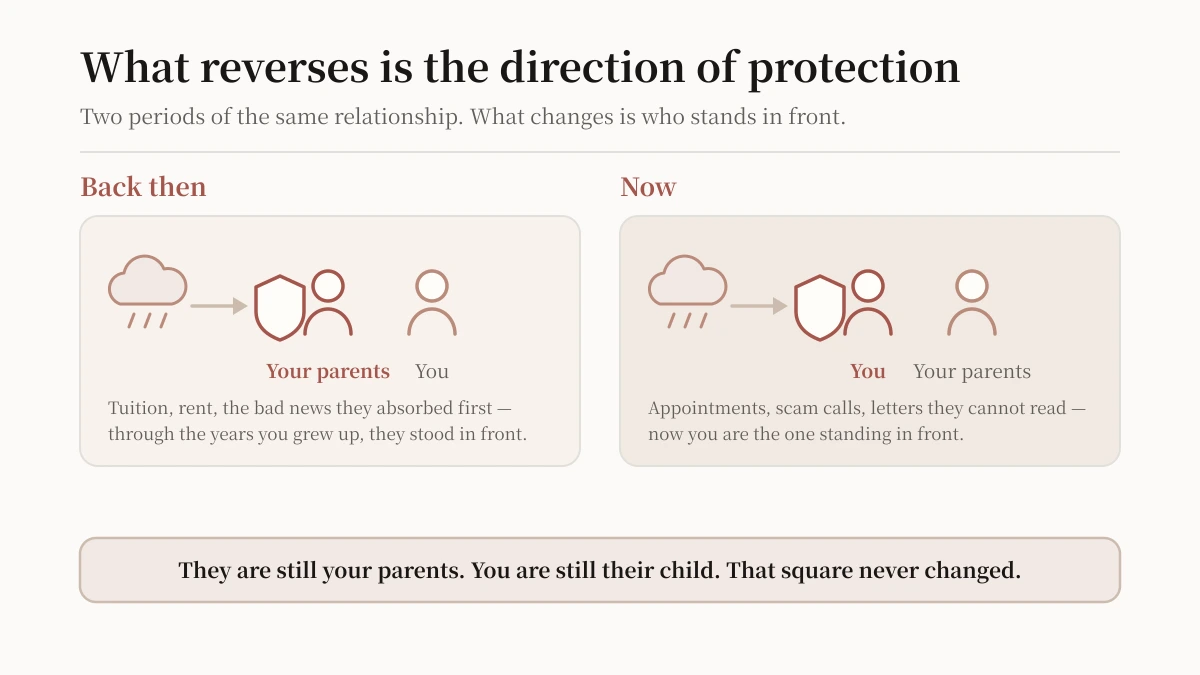
First, a sentence has to go. You have probably heard it, maybe said it: “When your parents get old, they become your children.”
I do not think anyone means harm by it. It is trying to describe the feeling of now it is my turn to look after him. But it leads somewhere harder, for three reasons.
One: the direction is opposite. A child gains a little every day. Teach him to tie his shoes today, and tomorrow he does it himself. An ageing parent loses a little every day. Tie them today, and tomorrow he is more likely to wait for you. The same act is an investment in a child and a replacement in him.
Two: you start deciding for him. The most immediate consequence of seeing someone as a child is that you stop asking what they want. And for someone who has lived an entire life, the frightening part is usually not being old, and not being ill. It is that nobody asks his opinion any more.
Three: you lose him once ahead of schedule. Picturing your father as a child means you have already set that father down somewhere in your mind. He has not gone anywhere, and you have held a small private goodbye. That is not fair to you.
So what is the more accurate way to say it?
They are still your parents and you are still their child. What changes is not who you are to each other — it is that he used to stand between you and things, and now you stand between him and things.
This is not word games. It changes what you do tomorrow. Because the next step after “he is a child now” is deciding for him — and the next step after “now I am the one shielding him” is deciding with him.
Deciding for him, or deciding with him
Before the how, one thing worth saying: you will want to take over. You watch him work at a button for a long time, watch him stop halfway through sorting his pills — and most of the time you do not ask first, your hand is already there. Taking over is the default; not taking over is what you have to do on purpose. So of the two approaches below, the first needs no learning at all. The second is the one you practise.
Take the same problem, and these two approaches grow into completely different shapes.
The pills. Deciding for him: you buy a new organiser, sort the whole month yourself, and tell him you will come do this every month from now on. Deciding with him: “Some of the compartments I filled last time haven’t been touched. Is it hard to open, or is it that you forget?” Find out which one first, then pick the fix together. Hard to open, get an easier one. Forgetting, try an alarm, or a standing morning phone call between the two of you.
He refuses the walking frame. Deciding for him: buy it, put it in the living room, tell him the doctor says he has to. Deciding with him: “What don’t you like about it? Does it look too old, or does it handle badly?” A lot of people are not refusing the frame. They are refusing the announcement that they now need one. The first thing can be discussed. “The doctor says” cannot.
Money. Deciding for him: take the bank card away. Deciding with him: “I keep seeing scams that target older people and it worries me. Could we agree that for anything above a certain amount, you call me first and we look at it together?” An agreement he can say yes to, instead of an authority quietly removed.
Where is the difference? Deciding for him is faster, and honestly, usually more efficient. I am not going to pretend the other way is easier. It takes longer, and he may not choose what you wanted.
But every time you decide for him, he loses one more piece of evidence that he can still do things himself. That evidence matters to him far more than you would guess.
One sentence you can actually say
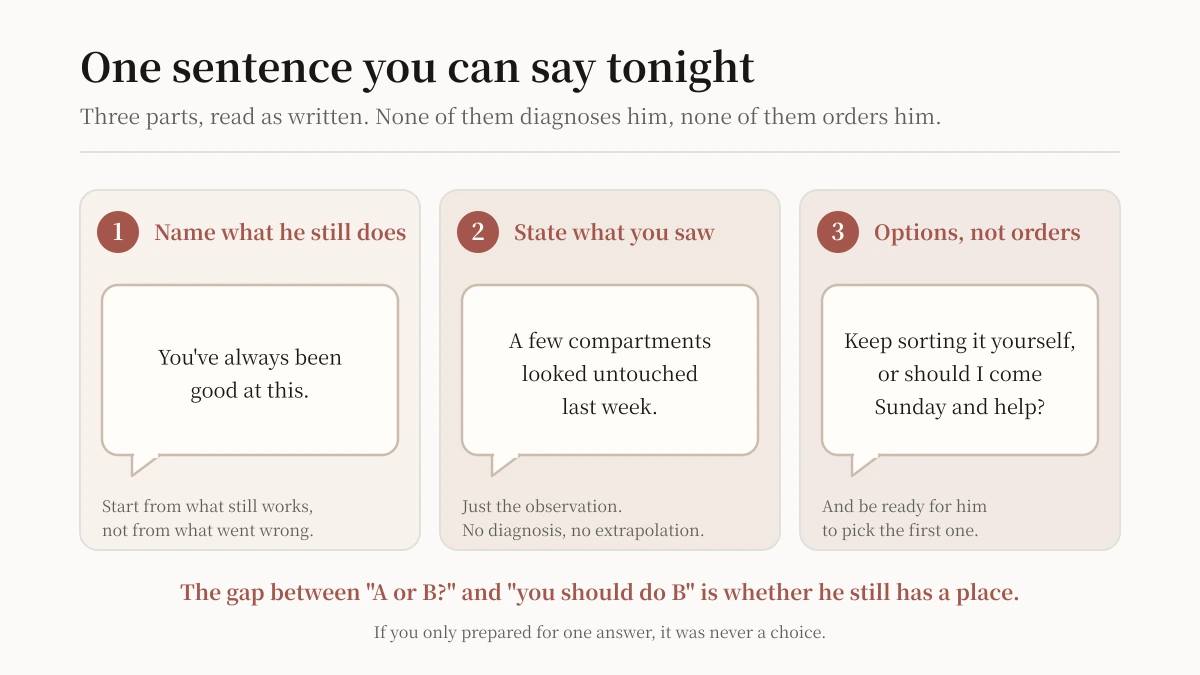
So how do you open your mouth?
I break it into three parts. Read them as written or put them in your own words, but keep all three.
- Name what he still does well: “You’ve always been good at this.”
- State the specific thing you saw — no diagnosis, no extrapolation: “A few of the compartments looked untouched last week.”
- Offer options, not instructions: “Do you want to keep sorting it yourself, or should I come Sunday and help you sort it?”
The third line is the whole point. The difference between “do you want A or B” and “you should do B” is whether he still has a place in this.
And you have to be ready for him to pick A. If you only prepared for one answer, it was never a choice — it was an instruction in nicer packaging. He will hear it, and he will remember.
There is also something you can do today that requires nobody’s cooperation:
Take a piece of paper and write down what he can still do. Shower himself. Take his own medication. Go out for groceries. Remember whose birthday it is. Decide what he wants for dinner. The more specific, the better.
Then treat that list as untouchable. Slow is fine. Not quite as well as you would do it is fine. Slow is not the same as unable, but every time you take something over, the list gets one item shorter.
The paper is not for him. It is for you. On the day you are exhausted, taking over will be the cheapest option available, and you will want something in your pocket that tells you what you nearly took away.
The four questions you are actually going to ask next
“I get impatient with him. Sometimes I even want this to be over. Am I a terrible person?”
That thought is far more common than you think. It just never gets said in the family group chat.
I am not going to grade it. I want to tell you where it comes from: it is usually not I want him gone. It is I want this feeling of constantly holding something up to stop. Those two arrive in your head wearing the same words, and they are not the same thing.
Having that thought means you have been in this position a long time and nobody has come to take a shift. It is a reading on the load, not a reading on your character.
“He won’t see a doctor, won’t use the frame, won’t move closer. Do I force it?”
I am not going to decide for you, but here is the sorting rule I use myself: first work out whether this is risk or preference.
Preference is how he wants to live. What is for dinner. Whether to replace that ancient phone. Whether to dye his hair. Say your piece once, then let it go.
Risk is what could kill him or cause irreversible harm. Driving that has started to go wrong. Gas left on. Stairs he can no longer manage. Medication taken incorrectly. Those you keep raising, and you can keep raising them past the point where it is comfortable for either of you.
Most fights are actually preference being argued as if it were risk. Once you separate them, you will find fewer things genuinely need you to push — and more strength available for the ones that do.
If it does turn out to be risk and he still refuses, here is what I would suggest: do not go head-to-head alone. Find someone he listens to. His doctor. His sibling. The neighbour he trusts. You saying it many times is worth less than his old friend saying it once, and that is not your failure. That is a fact about positions in a relationship.
“I’m the only one doing any of this. What am I supposed to do?”
I am not going to tell you that talking it through with your siblings will fix it. In some families it does. In others it does not, and you have probably already tried.
Two things I think are more useful.
First, write down what you actually do. Not to build a case. Because while it all lives in your head, even you will underestimate it. On paper you will see that this is not “helping out a bit.” It is a job.
Second, break “help” into pieces someone can claim. “Be more attentive to Dad” is uncatchable. “Can you take the monthly hospital appointment?” is catchable. And if you break it down as far as it goes and still nobody takes a piece, at least you have your answer, instead of waiting in your head for someone who is not coming.
If you have no siblings, this section may land as a different kind of hard — nobody to blame, nobody to wait for. Then I would say: write that same list, and look for the parts that money or a public service can take off it. That is not surrender. That is keeping your strength for the parts only you can do.
“If I hire a carer or move him into a home, does that make me a bad child?”
My judgement is that this is the wrong question.
The question is not am I handing him over. It is where does he live better, and where can I last longer.
Someone who pushes until their own health breaks, their job goes, and their marriage cracks does not end up providing more care. You are not an instrument of care. You are the other person in this. If you go down, nobody is doing any of it.
And “caring for him personally” is not the same as “caring for him well.” Some care takes training you do not have, and loving him more will not close that gap. Hand that part over, and spend what you save on the parts only you can do: talking with him, remembering what he likes, being there when he is frightened. Nobody can stand in for you on those.
One thing you can do tonight
I am not going to promise you he will get better. He will not, and I would rather not lie to you.
But one thing does change, and this one is yours to decide: what you are like while you walk him through it.
These years are very likely the most the two of you will ever talk. There was a stretch when you were busy and he did not want to intrude, and a call was over in a few sentences. That has changed — whether you live next door or a time zone away, you know how his week has been, which day he sounded quieter than usual. It is exhausting, and it is also something you never had before — you are getting to know a person you assumed you already knew.
One day, looking back, what you remember will mostly not be the things you got done. Not the appointments, not the forms, not the argument about whether he should still be driving. It will be the parts where nothing was being handled: he loses the thread halfway through a sentence, the two of you complaining down the phone about a terrible drama series, he suddenly starts telling you something about his life you never knew.
You do not have to solve the pill organiser tonight. What you can do tonight is make a phone call — no appointments, no test results, nothing that needs deciding. Just ask him one thing: “Did that plant make it?”
Then listen. He will talk for a while. He may repeat himself. He may wander off into a neighbour you have never met.
For those few minutes you decided nothing on his behalf, and he was still the father talking to you.
You do not have to get all of it right. You are already doing more than you think, and there is more time left to do it in than you think. That place is still there — it just needs you, now and then, to put down the one who decides and go back to being his kid for a bit.