Not Every Family Feels Safe: How Much Distance Is Right for You?

Your phone lights up with a message from home: “You’re coming this weekend, right?” You have not opened it, but your shoulders are already tense. If you say no, you expect a chain of questions. If you say yes, you know you will spend dinner steering around your job, your relationship, your income, and the choices you have repeatedly asked them not to evaluate.
You do not feel nothing. You remember the bowl of soup left warm for you. You remember who sat beside your bed when you were ill. The good memories are part of what makes the decision so hard. You are not choosing between a family that was entirely loving and one that was entirely painful. You are trying to answer a quieter question: how much distance would let me stay in contact with my own life?
You do not have to decide whether to end contact before you are allowed to protect yourself. Begin with the part of contact that exhausts you most: the nightly call you feel forced to answer, repeated questions about your income, or visits you are not allowed to end. Shorten one call, keep one topic private, or give one visit a clear ending. Distance is not a verdict on whether your family is good or bad. It gives you room to notice whether you can sleep and function again—and whether you actually want to move closer, or are only afraid of disappointing them.
Wanting closeness and wanting space can both be true
Some people need hours to feel like themselves after a call with family. They replay the conversation and ask whether they overreacted. Maybe the question was meant as concern. Maybe the joke was meant to lighten the mood. And yet they also remember that they clearly asked not to discuss that subject, and the questioning continued.
Caring about a relative does not cancel the effect of a repeated interaction. You can appreciate what someone once gave you and name what contact costs you now. You can hope that the relationship becomes warmer and stop attending gatherings that leave you unable to sleep. You can miss a person without giving them immediate access to every part of your day.
I would begin with a smaller question than “Do they truly love me?” That question carries an entire history, and it may never produce an answer that settles your body. Ask instead: After contact, how long does it take me to return to my ordinary life?
A call that leaves you able to eat, work, and sleep is different from one that leaves you shaking, blaming yourself, or unable to focus the next day. This is not a verdict on whether your relative is a good or bad person. It is information about what a particular form of contact does to you.
The right distance has more than one setting
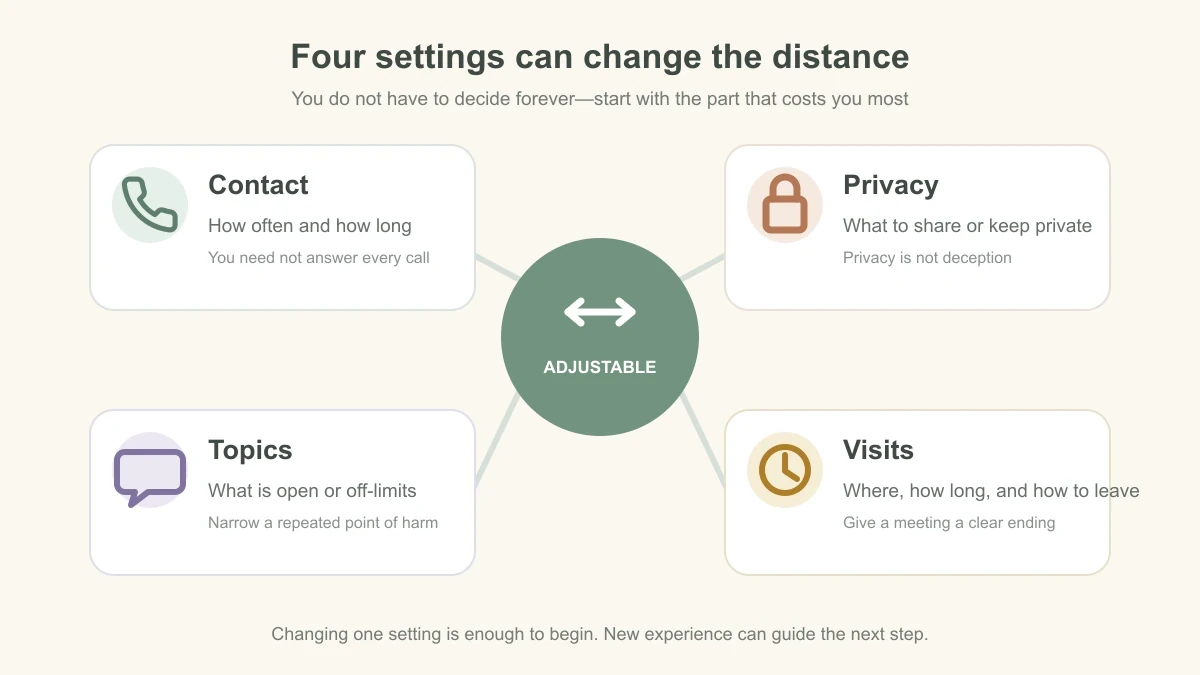
You do not have to begin with a dramatic announcement. Break distance into parts and look for the one part that most needs to change.
Frequency and duration. You do not have to answer every call immediately or stay on the phone until the other person feels finished. You can choose one regular time to respond, ask by text before a call, or end while you still have enough energy for the rest of your evening.
Privacy. A relative may know where you live without receiving every detail about your salary, health care, dating life, or future plans. Privacy is not deception. It is your decision about what this relationship is currently able to hold with care.
Topics. A subject does not have to be banned forever to be unavailable today. If every conversation about work becomes comparison, every conversation about a partner becomes interrogation, or every health update becomes pressure, you can remove that subject from contact for now.
Conditions for meeting. You can meet in public, arrange your own transportation, bring someone you trust, stay for one meal rather than a weekend, or sleep elsewhere. Knowing that you can leave changes a visit from an open-ended surrender of time into a choice with a beginning and an end.
These settings do not have to move together. You may keep a weekly call but stop discussing your relationship. You may attend a holiday meal without staying overnight. You may need a quiet month and then decide what the next month should look like. Distance is not a score you give your family. It is an amount of access your life can presently sustain.
Before choosing a label, keep an after-contact record
If you do not know how much distance you need, do not force yourself to answer tonight. Take a page and recall your last few interactions. For each one, write only three things:
- what happened, without guessing the other person’s motive;
- what happened in your body and daily life afterward, and how long it lasted;
- one change that would make the next interaction less costly.
Instead of “She wanted to ruin my evening,” write: “After I said I would not discuss my salary, she asked again three times. I replayed the conversation for the rest of the night. Next time the question returns, I will end that topic.”
The record is not a case you are building against anyone. It helps you identify what you need. You may discover that you do not need a permanent exit. You may need a reliable stopping point. You may also discover that the pattern is more serious than you have allowed yourself to name. Both are useful pieces of truth.
A boundary describes your action, not their transformation
“Stop controlling me” names real distress, but it leaves the next moment unclear. A boundary becomes more usable when it connects a specific event to a specific action you control.
You might say:
I know you care about my work, but I’m not discussing my income today. If the questions continue, I will end the call and contact you next week.
Or:
I’m coming for dinner, and I will leave at eight. I have arranged my own ride, and I won’t be staying overnight.
If you do not have energy for an explanation, make it shorter:
I can’t discuss this tonight. I will respond tomorrow afternoon.
None of these sentences guarantees understanding; their purpose is to tell you what you will do next. If the questions continue, you do not have to produce a more persuasive explanation and enter an endless trial about whether your need is legitimate. You can repeat the sentence once, then end the call, change the topic, or leave as you said you would.
Does setting a boundary make you an ungrateful son or daughter?
Often the frightening part is not missing one call. It is the meaning attached to it: “After everything we did for you, you won’t even come home?” “Family cannot say anything to you anymore?” These statements tie care to obedience and love to unlimited access. Any step backward is then treated as a rejection of the entire past.
Remembering what your family gave you does not require giving up all authority over your time, information, and body. Gratitude can be real, and hurt can be real. Even when you remember genuine care, you can reduce forms of contact that repeatedly leave you sleepless, ashamed, or unable to function. Acknowledging that love existed does not require you to keep accepting the same harm.
I think a more useful question is: Does this arrangement preserve basic respect while protecting enough space for me to live normally? Respect can mean no retaliation, humiliation, or deliberate panic. It does not mean answering every call, disclosing every decision, or accepting every invitation.
If you want to leave room for the relationship to change, you can make the next decision time-limited: “I’m not visiting this month. At the end of the month, I will tell you what I can do in September.” That is not a promise to restore the previous level of contact. It keeps your decision inside the period you can honestly see.
If your family rejects the boundary, you do not have to explain it until you collapse
A relative may be disappointed the first time you change a familiar pattern. They may ask questions or say that you have changed. Their disappointment does not, by itself, prove that the boundary is harmful. The important information is what happens after you calmly repeat it. Can they gradually make room for the change, or does every explanation become a new opening for argument?
You can say:
I understand that you dislike this plan. I am still leaving at eight tonight.
Then return your attention to action. If you said you would end a call when insults begin, end it. If you said you would not discuss your partner, stop answering questions that pull you back there. A boundary does not become real because you found flawless words. It becomes real when you care for yourself at the point you named.
If the other person later changes, you can change the distance too. That is not inconsistency. It is a response to new experience. You do not have to stay far away forever to prove that an earlier decision was justified, and you do not have to move closer because one conversation went well. You are allowed to use more than one interaction as evidence.
Should you go no contact?
I cannot make that decision from inside an article. For some people, stopping contact is necessary for safety. For others, it may be more distance than they need or want. The useful choice depends on whether you are facing ordinary friction, a repeated disregard for boundaries, or danger and control.
Consider three questions.
First, how deep is the impact, and how often does it happen? Are you briefly uncomfortable, or does nearly every interaction interfere with sleep, work, health, parenting, or your ability to make decisions?
Second, what happens after you state a specific boundary? Perfection is not required. Look for curiosity about the impact, a willingness to stop, and a visible difference the next time. Repeated promises without changed behavior are information too.
Third, is anyone threatening your safety? Violence, stalking, digital monitoring, withholding money or documents, threats, or using other relatives to locate and pressure you are not problems that better wording can solve.
You may begin with the smallest change that gives you useful information. You may also move directly toward safety when the risk is high. Do not begin by asking whether your choice qualifies as low contact or no contact. Begin with severity: if particular topics are the problem, limit those topics or shorten visits; if a relative repeatedly disregards stated boundaries, reduce access more substantially; if there is violence, stalking, or threats, make a safety plan and seek outside help first.
When there is violence or a credible threat, plan for safety before announcing distance
In an ordinary conflict, clearly stating a boundary may help. When someone escalates as they lose control over you, announcing that you are leaving or ending contact can increase danger. Official domestic-abuse guidance includes abuse by parents, siblings, adult children, and extended family; it also recognizes violent or threatening behavior, coercive control, economic abuse, and psychological harm. Its central principle is that the safety, needs, and wishes of the person facing abuse should guide the response.
If you are worried about your physical safety, I recommend telling someone trustworthy, keeping important documents and essential contacts accessible, identifying a safe place, and contacting local domestic-violence, social-service, health-care, or emergency support. If your devices may be monitored, consider digital safety when searching for help. You do not need to persuade the threatening person in person before you are allowed to seek support.
This is different from a difficult family conversation. If you are in immediate danger, contact the emergency service where you live. Whether the relationship can be repaired is a question for after safety.
Distance can interrupt harm without erasing care
Families often treat closeness as the only visible proof of love. The faster you answer, the more you disclose, and the longer you stay, the more loyal you appear. But when every approach repeats the same criticism, pressure, and defense, keeping the old distance may not be protecting love. It may only be preserving the conditions in which everyone gets hurt again.
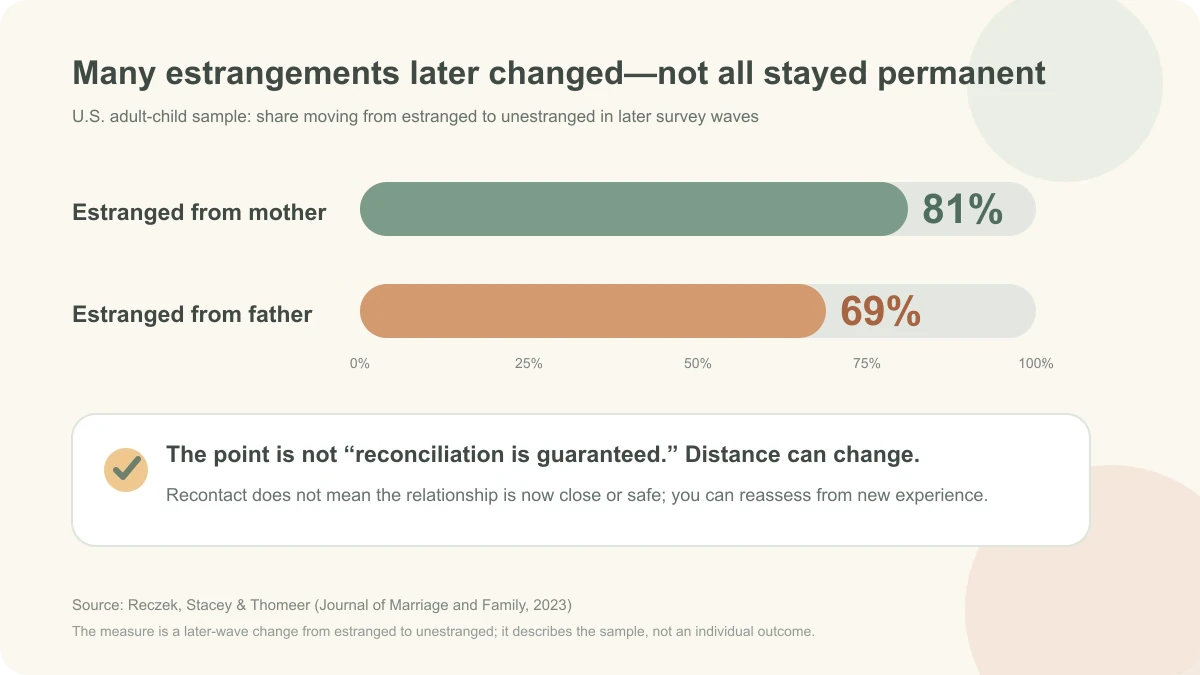
Distance cannot transform another person. It can help you hear yourself. When contact no longer enters your day without warning, you may be better able to distinguish missing someone from fearing their reaction or trying to relieve guilt. When a visit has an end time, you can observe whether they respect one small difference. That observation gives you more than another argument about intentions.
If you want help interrupting ordinary conflict without abandoning your needs, read Why Do We Hurt the Family We Love Most With Our Words?. If you have been carrying the repair alone for a long time, Leaving a Draining Relationship Is How You Make Room to Grow may help you identify changes that do not require the other person’s permission.
You do not have to decide forever tonight
You may eventually return to more contact. You may keep a smaller relationship. You may learn that you need a longer quiet period than you first expected. None of those outcomes has to be settled tonight.
For now, do one thing. Put down the message that made your chest tighten and choose a time to look at it again. Not never. Simply: “I will read this tomorrow afternoon.” Before then, finish a meal. Take a shower. Step outside. Let your body receive the information that you are no longer inside that conversation.
You do not have to prove that you care by remaining continuously available for pain. The right distance does not erase your family from your life. It puts your life back into the relationship too. With room to breathe, the next step closer can become a choice instead of a return to the place you were assigned.