You Do Everything for Them and Still Feel Like You Owe Them

It is Sunday night. You have just parked, your keys are still in your hand, and your phone buzzes. It is your mother: “You got back that fast?”
You look at the message with your thumb hovering, and you have no idea what to type.
You spent six hours at their house today. You changed the kitchen light that kept flickering, drove them to the supermarket, cleared the expired things out of the fridge when you got back, then sat on the sofa and listened to your father tell the story about the business he started with a friend when he was young, for the third time, and you laughed in the same place you always laugh.
Nobody argued. Nothing happened. But you get home, you shower, you turn off the light, and the thought arrives anyway.
How much do I have to do before I stop feeling like I owe them?
If that is the sentence that brought you here, I am not going to tell you that caring about your parents is a trap, and I am not going to tell you to walk away from them. That is not what you came for. You came for something you can actually put down tonight.
The tiring part is not the amount, it is that none of it counts
Here is the first thing worth saying: what is wearing you out is usually not how much you do, it is that none of it ever seems to count.
A task you finish can be crossed off, and finished tasks do not wear people down. What wears you down is that the task gets done and the “still not enough” is sitting exactly where it was, so there is nowhere to set anything down.
You might be the one who does a lot. The money goes out every month, you take them to appointments, you are always there for the holidays, and you are the first name to appear in the family group chat whenever something needs handling. The thought still shows up every week.
You might also be the one who does less. You moved to a city far away, you pick up the phone once a week, and at the holidays you told them you had to work, when in fact you could have swapped that shift. You just did not want to sit at that table being asked about your life all evening.
None of that made it any lighter. You did not go back, but you spent that whole afternoon wondering what they were doing, whether anyone had turned up, who ended up cooking. None of that shows anywhere, not even to them, so nobody ever gets to tell you that you had your reasons.
You might also be someone who never has to “go back” at all, because you live together. Then it has no start and no finish, and even closing your own bedroom door takes a second of thought. You might have only one parent left to look after, or no spare money to give and only time.
All of those people are lying awake thinking the same sentence.
The same act can be two different things
There is research showing that being a good son or daughter is not one thing underneath. It is two.
One is that you want to be good to them. There is real affection between you, you remember what they did for you, and you want to give something back and keep them from worrying.
The other is that you cannot not do it. You are their child, this is what people do, and if you do not, someone will have something to say.
The awkward part is that these two produce identical days. The same phone call, the same money, the same drive over. From the outside there is nothing to tell them apart, and on any given Sunday you might not be able to tell them apart either.
So how do you tell? I use one small test: listen for the sentence in your head once the thing is done. It might be the moment you walk out of their door, or, if you live together, the moment you get back to your room and close it behind you.
If it is “glad I did it,” that is the wanted-to kind. You did it, and you wanted to do it.
If it is “glad that is done,” that is the had-to kind. What you are relieved about is that the task is finished, not about the person you were just sitting with.
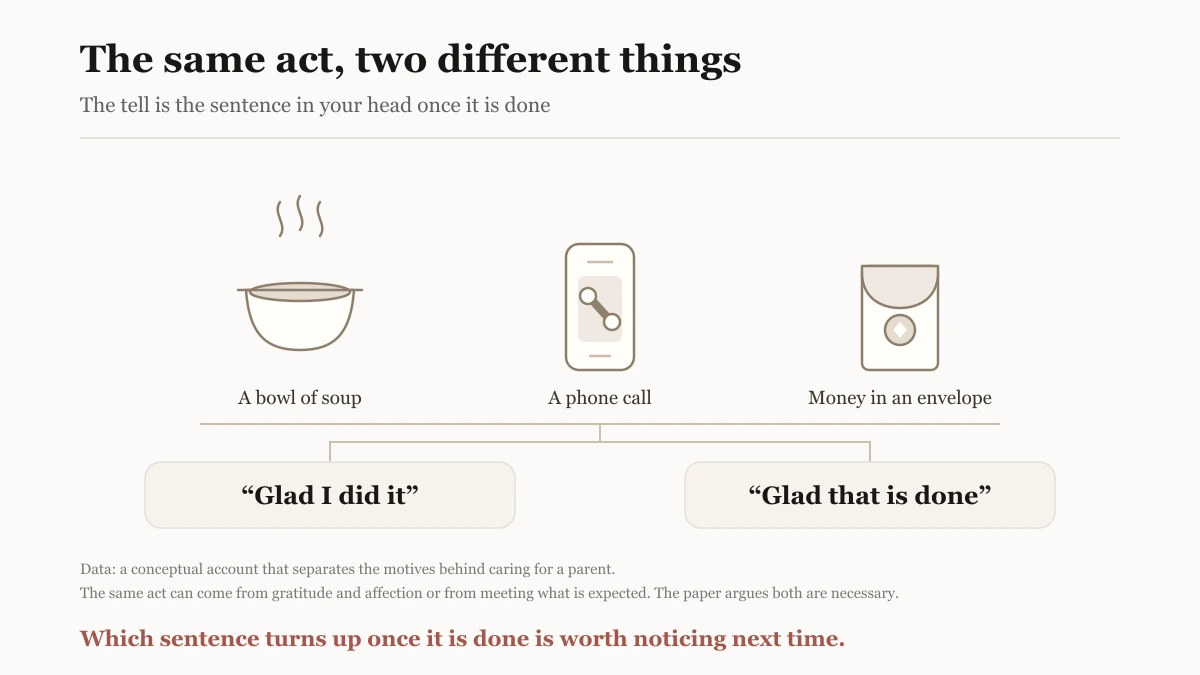
Let me be clear about something before it gets misread. “Glad that is done” is not the bad one. Nobody runs their life on wanting alone, and plenty of necessary things only get done because somebody felt they should. Both are needed, and I am not asking you to get rid of either.
I want you to be able to tell them apart for one reason only. If the sentence has been “glad that is done” the last several times, then the thing to look at is not whether you are doing enough. It is that it has been a long time since any of it was something you wanted to do.
Doing it one more time will not fix that, because what is missing is not frequency. It is that none of it was chosen by you. Next time, pick one thing: take something he likes to eat, go with him to the shop he keeps mentioning, dig out an old photo of him and ask what was happening that day. Leave everything else exactly as it is. I am not going to promise you that the one thing makes it lighter, but the sentence in your head afterwards is worth listening to again.
One kind of guilt is gone once you do it, one kind is still there
Your guilt splits along the same line.
One kind is there because you genuinely have something undone. You have not called in three months. You forgot his birthday. He mentioned his knee was bothering him and you made a noise and moved on. This kind is easy to spot because it can point at something. In my own experience, the call gets made, you talk for twenty minutes, and by the time you hang up the heavy feeling has thinned out, because all it was ever doing was reminding me of an item I had not got to.
The other kind is still there after you have done it. You go back every single week and you are still short on the drive home. You already sent money and you still feel you should send more. You arranged for someone to help and you still feel you should be doing it yourself.
What is the difference? The one pointing at a task tells you what to do. The one pointing at all of you does not. Try it right now: ask it “what exactly would count as enough,” then see whether you can answer. Not being able to is not your failing, it is because it has never named a single task. It is not pointing at one thing you left undone, it is pointing at the whole of you.
The one pointing at a task can be finished. The one pointing at the whole of you cannot, because it never handed you anything finishable in the first place.
Do not guess, just remember last time
You can sort this out tonight. It takes no conversation and nobody has to admit anything first.
Take the three most recent things you feel you owe them for, and go through them one at a time: last time you actually did this, did the feeling genuinely ease afterwards?
Do not predict it, remember it. You have done all of these before. The answers are already in you.
- If it genuinely eased, that one works. Next time it turns up, go and do it and do not think about it too hard.
- If doing it changed nothing, stop adding to it. It will not shrink because you did it one more time this month, and that extra round only raises the bar for next time.
- If you cannot remember, run the small version this week. Make a five minute phone call rather than blocking out a whole weekend, and pay attention to how you feel that same evening.
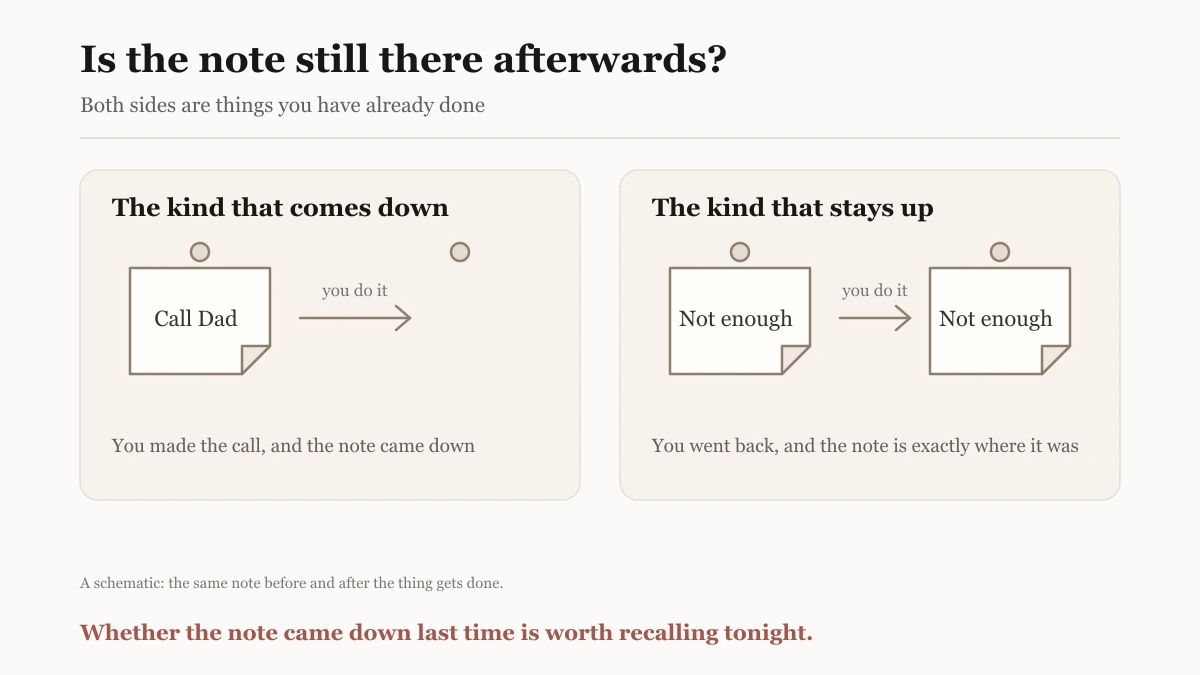
The ones that changed nothing are not there to be solved, they are there to be recognised. Recognising it will not stop it hurting that night, but you will stop pouring effort into something that cannot be filled, and that effort has other places to go, including the few things that would actually make both of you feel better.
Three places that quietly double it
The relative who says you hardly ever come back
Someone always says it at the holiday table, usually in a light tone. The group chat produces a photo of somebody else taking their parents abroad, captioned “while they can still travel.”
Those things are counting the visible part, not the part you did. Nobody photographed you driving him to the emergency room in the middle of the night last month, and the transfer that leaves your account every month, or the overtime you turned down to free up the time, never shows up in a group chat.
If you live together, the line comes in a different version, something like you never sit and talk with him, and whoever says it can see just as little of what your days are actually like.
I am not suggesting you go and correct anyone, that rarely helps. What is worth knowing is that your own verdict of “I am not doing enough” was partly reached by people who only ever saw a small piece of it.
The request that never gets made out loud
Some parents do not ask. They sigh on the phone, or they say “it is fine, you are busy, do not worry about it.”
The difficulty is structural: an expectation that never gets said out loud cannot be agreed to and cannot be declined. All you can do is carry it and keep guessing what he actually wants, and every wrong guess costs you another round of doing more.
This is not somebody engineering you. Plenty of parents genuinely cannot name what they want, and that generation did not get much practice at saying it. What you can do is swap the guessing for asking. You do not have to work out on your own whether he means a whole weekend or one phone call, let him say it. I would say the version he says out loud tends to be smaller than the one in your head.
The thing you are quietly making up for
There is a quieter version. What you actually feel you owe them for has nothing to do with anything they mentioned today. You moved far away. You did not have children. You took the path they argued against. There was a time when you embarrassed them badly.
That has nowhere to go, so you keep topping up somewhere else instead. A bit more money, a few more calls, yes to everything. What you are adding is usually not what they wanted, and it does not make you feel better either, because the hole you are filling was never in that spot.
Three things you are probably about to ask
“What if I really am not doing enough?”
That question has an answer, and it fits on one sheet of paper.
Take a sheet of paper and write down the things you feel you owe them for. One rule: every line has to name a time and an action. “Call the clinic tomorrow afternoon and book him in” qualifies. “Find a day this month to take him to his appointment” qualifies.
Some people get three or four lines out. Then you do have things undone, you now know exactly which ones, and you can go and do them. The paper empties out.
Some people sit there and what comes out is “should care about him more,” “should be more patient,” “should be better to him.” Nobody can follow those, because nobody can say how much caring counts as more, so you will keep writing them and keep feeling behind.
If everything on your sheet looks like that, what you are short of is not a task. It is hearing someone say it: “what you do is enough.”
That sentence mostly does not come. Your parents will not say it, and I do not know why, maybe it has never occurred to them to. Relatives will not say it, because they only ever saw a small piece of it. And you will not say it to yourself, because it sounds too much like letting yourself off.
So you are the one who has to say it. Turn the sheet over and write down what you actually did this month: where you drove him, the payments you made, the calls you picked up at bad moments, the evening you went the long way round after work. Read it back, then say it out loud once: this is what I did this month, and this is what I am able to do.
It will feel strange, possibly a bit embarrassing. But nobody else is going to say that sentence for you, and if you do not, it stays unsaid.
“If I let go of the guilt, does that make me someone who does not care?”
I would say the guilt has not been helping you take care of them. It has only been making the care hurt more.
When you do those things in that state you are braced the whole time. You rush to get them finished, you get impatient when he is slow, and part of you keeps wondering whether it is still not enough. I do not know whether he can feel it. You know that you were gritting your teeth through it.
I am not going to promise you it gets easy once you put it down. What I will say is that you still do all of those things, and without part of you wondering the whole time whether it is enough, you have enough left in you to sit through the same story a third time.
“Will my parents think I am a bad son or daughter?”
I am not going to lie to you. They might, and that is not something you can fix.
For some people, going along with what a parent wants is the whole of what being a good child means, and every time you do not, they feel a piece has gone missing. You can explain, you can keep showing it in what you do, but you cannot swap out the ruler they are measuring with.
That does not make them wrong. That ruler was handed to them by their own generation, they have been measuring themselves with it their whole life, and it was probably not comfortable for them either. You can understand where it came from and still decline to use it on yourself.
The one thing you get to decide is whose definition you use when you judge yourself.
If what you are really asking is whether to go back less often and how to say any of this out loud, that is a different problem, and I wrote about it separately in Not Every Family Feels Safe: How Much Distance Is Right for You?.
That message is lighter than it looks
So why does any of this leave you short of breath?
Not because you do too little, and not because you give too much. It is because the feeling that will not leave has never told you what it wants, and the only move you can think of is more of the same: do it one more time, give a bit more, pick up a few more calls. You do it, and the next day it is back.
So the thing to change is not the amount. It is sorting the few things in front of you into the ones that genuinely leave you lighter afterwards and the ones that change nothing. Do the first. Stop adding to the second, because the extra round will not shrink it.
The last thing I want to say is this: you do not have to feel indebted in order to be good to them. Here is how I see the things you already do: take away the half that was pushing you, and what is left will not be nothing. How much is left is something only you can count, but that part you actually wanted to do.
Next time that message turns up, “you got back that fast,” you may still freeze for a second. Here is how I read it: that line is not asking you for anything, that is somebody who wanted a bit longer with you. I do not know what is actually going through her mind, and neither will you. But those are two ways of reading the same line, and you have spent years picking the heavier one.